
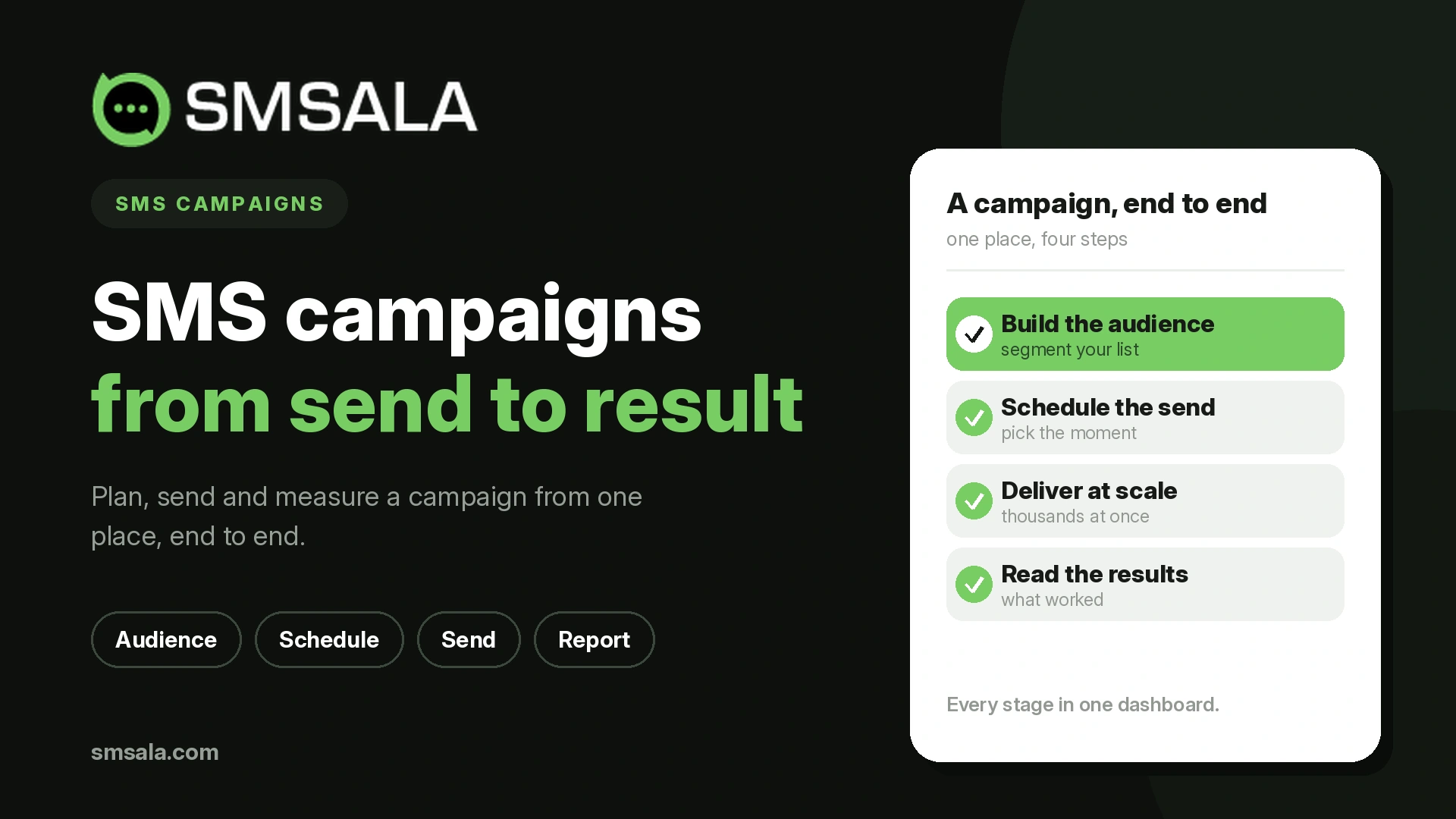
Running an SMS campaign is easy. Running one that makes money, without burning your list or breaking a rule, is a process. Most guides on this topic hand you a list of tips and leave you to assemble them. This one walks the campaign from start to finish as an actual workflow: decide the goal, build the audience, write the message, time the send, confirm it will arrive, measure what happened, and improve the next one.
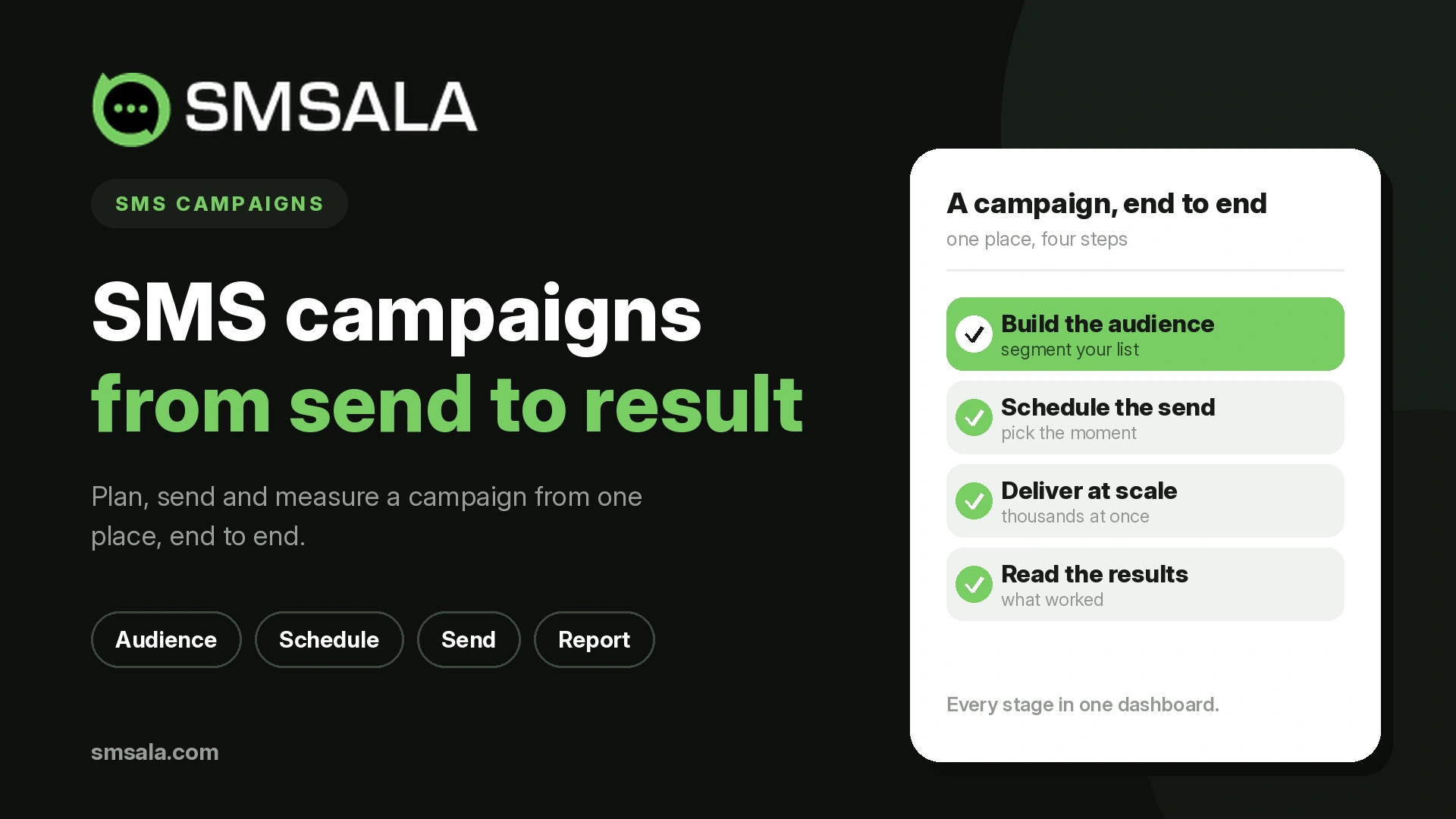
It also covers the two stages almost everyone gets wrong, handling opt-outs and using delivery data, and shows where automation replaces the manual work entirely.
What counts as an SMS campaign
An SMS campaign is a coordinated set of text messages sent to a defined audience to achieve one measurable goal, whether a sale, a booking, a renewal, or a reply. The word "coordinated" is what separates a campaign from a random blast. A campaign has an objective, a target segment, a message built for that segment, a planned send time, and a way to measure the outcome.
Campaigns come in three shapes, and knowing which you are running changes everything downstream.
One-time broadcasts go out once to a segment: a flash sale, an announcement, an event invitation. They are planned and sent by hand.
Triggered campaigns fire automatically when a customer does something: abandons a cart, makes a purchase, books an appointment. They are built once and run on their own.
Recurring campaigns repeat on a schedule: a weekly offer, a monthly statement, a seasonal push. They combine planning with automation.
Most mature programs run all three at once. The stages below apply to each, with automation doing the sending for the last two.
Stage 1: Set one objective and pick the campaign type
Every strong campaign starts with a single, measurable goal, not "raise awareness" but "recover 10% of abandoned carts this month" or "fill 50 open appointment slots this week." One goal keeps the message focused and makes success unambiguous.
The goal points directly to the campaign type. Match them before you write a word.
Goal | Campaign type | Shape |
Drive an immediate purchase | Flash sale / limited offer | One-time broadcast to a relevant segment |
Recover lost sales | Abandoned-cart reminder | Triggered, minutes to hours after the cart is left |
Onboard new subscribers | Welcome series | Triggered on opt-in |
Bring back lapsed customers | Win-back | One-time or triggered, to a quiet segment |
Fill capacity | Appointment or booking reminder | Triggered, with reply-to-reschedule |
Reward loyalty | VIP offer with coupon codes | Recurring, to a high-value segment |
A campaign that tries to do two of these at once usually achieves neither. Pick one, and let the rest wait for their own campaign.
Stage 2: Build and segment the audience
A campaign is only as good as the list it reaches, and the list has two properties that matter: consent and relevance.
Consent is non-negotiable. Every recipient of a marketing message must have opted in clearly, knowing they were subscribing to texts, from whom, and roughly how often. A campaign sent to people who did not agree is not a campaign, it is a complaint generator and, in most markets, a legal risk. Consent should be documented, and it should be genuine, not buried in a pre-ticked box.
Relevance comes from segmentation. Sending one message to your entire list is the fastest way to waste money and drive opt-outs, because most of the list is not interested in most offers. Segment by what you actually know:
Behavior, such as recent purchases, browsing, or cart activity, which is usually the strongest predictor of response.
Purchase history and value, separating first-time buyers, repeat customers, and VIPs.
Location, for store-specific or region-specific offers.
Lifecycle stage, from new subscriber to loyal customer to lapsed.
The point of segmentation is not tidiness. It is that a smaller, well-matched send almost always beats a larger, generic one on revenue per message, while generating far fewer opt-outs. Before a large send, cleaning the list also pays off: an HLR lookup removes dead and invalid numbers so you stop paying to message phones that no longer exist.
Stage 3: Write the message
An SMS gives you a few seconds and a small window of text. The structure that works is consistent.
Lead with your identity. The first words must say who is texting, because an unrecognized sender reads as spam and gets ignored.
Say one thing. A single, clear offer or instruction. A message with two asks gets neither done.
Be concrete. "20% off boots, today only" beats "great savings inside." Specificity and a real deadline are what move people.
Include a trackable link. Send recipients to purpose-built SMS landing pages rather than a generic homepage, and use a link you can measure so the send connects to the outcome.
End with the exit. A clear opt-out is legally required in most markets and, done well, builds trust rather than losing subscribers.
One technical detail quietly controls cost. A standard SMS segment holds 160 characters in the GSM-7 alphabet. Add an emoji, a curly quote, or a non-Latin character and the message switches to Unicode encoding, which drops the segment to 70 characters. A message you thought was one text can become two or three, multiplying the bill across a large send. Write tight, and check your encoding before sending.
Stage 4: Time and schedule the send
When a message arrives affects results almost as much as what it says. Three rules hold across almost every program.
Send in the recipient's time zone, not yours. A batch that goes out at 10 a.m. on your server can land at 3 a.m. across an international list. Time-zone-aware sending is essential, not optional.
Respect local hours. A marketing text early in the morning or late at night reads as an intrusion, and many markets legally restrict promotional messaging outside daytime windows.
Control frequency. Every promotional message spends a little of the goodwill that earned the opt-in. Most consumer programs settle between four and eight promotional messages a month, treating transactional and service messages separately because they are expected. Watch the opt-out rate as your real ceiling.
For anything beyond a single manual send, scheduling and automation handle timing far more reliably than a person watching a clock, especially across time zones and recurring sends.
Stage 5: Confirm the message will actually arrive
This is the stage competitors skip, and it decides more campaigns than copy ever will. A brilliant message on a broken route has a delivery rate of zero.
Before a campaign of any size, confirm the plumbing.
Routes. Your provider should send over direct carrier routes, not grey routes that disguise international traffic to cut cost and get blocked without warning. Route quality determines both delivery and whether your reporting is trustworthy.
Sender identity. The right Sender ID for each destination country, registered where required, so the message displays correctly and is not filtered.
Registration. In regulated markets, register before sending. India's DLT registration requires registering your entity, headers, and templates; the United States requires A2P registration for standard numbers. Unregistered traffic gets filtered or blocked.
A test send. Always send to a small internal group first to confirm rendering, links, sender display, and encoding before the full campaign goes out.
Treat this stage as a pre-flight checklist. Skipping it is how a campaign looks fine in the dashboard and never reaches customers.
Stage 6: Measure what actually happened
Open rate is close to useless for SMS, because nearly every text is opened. The metrics that describe a campaign's health sit on either side of the open.
Delivery rate is the share of sent messages confirmed delivered to a handset. A low delivery rate on a clean route points to list or routing problems, not creative ones.
Click-through rate shows whether the message earned the next step, and is the truest read of offer and copy quality.
Conversion rate shows whether the click became the outcome you wanted, which is why trackable links and dedicated landing pages matter.
Opt-out rate is your early warning. A spike after a send means the message was too frequent, too irrelevant, or too promotional.
Revenue per message ends arguments. Total attributed revenue divided by messages sent tells you whether the campaign paid for itself.
The raw material for much of this is the delivery receipt, or DLR, returned by carriers. Reading delivery reports tells you not just how many messages arrived but often where and why others failed, which turns measurement into something you can act on rather than just observe.
Stage 7: Improve the next campaign
A single campaign is a data point. A program improves because each campaign informs the next, and the engine of that improvement is testing.
A/B test one variable at a time. Split a segment and change a single element, the offer, the send time, the opening line, or the call to action, so you can attribute any difference to that one change. Testing two things at once tells you nothing clean.
Read the delivery data, not just the sales. If a campaign underperformed, delivery reports often show why: a chunk failed on a bad route, a segment was full of dead numbers, or a country blocked an unregistered sender. Fixing the plumbing frequently beats rewriting the message.
Prune on a schedule. Subscribers who have not engaged in months drag down your metrics and, on some carriers, your sender reputation. A maintained list delivers better and costs less.
Over a few cycles, this loop of test, measure, and prune compounds into a program that quietly outperforms one that sends the same blast every week.
Handling opt-outs the right way
Opt-outs feel like losses, so many businesses treat them carelessly. That is a mistake on both compliance and performance grounds.
Every promotional message must carry a clear, working opt-out, usually a reply keyword such as STOP, and the request must be honored immediately and permanently. Continuing to message someone who opted out is a direct violation of consent rules in nearly every market and a fast route to carrier complaints and penalties.
Beyond compliance, a frictionless unsubscribe is good for the health of your program. People engage more freely with a list they know they can leave. Forcing them to stay, or hiding the exit, drives them to report the message as spam instead, which damages your sender reputation far more than a clean opt-out ever would. The right response to a rising opt-out rate is not to make leaving harder. It is to send fewer, more relevant messages so people have less reason to go.
Treat your opt-out data as feedback. A campaign that spikes unsubscribes is telling you something specific about frequency or relevance, and the next campaign should answer it.
Automating campaigns so they run themselves
The stages above describe a manual campaign. The highest-return SMS work is the campaigns you build once and let run.
Triggered campaigns fire from customer behavior: a welcome series on opt-in, a cart reminder when a purchase is abandoned, a reminder before an appointment, a win-back when a customer goes quiet. Built well, a sequence of these, often called a drip, delivers the right message at the right moment without anyone sending it. This is where SMS becomes efficient rather than labor-intensive, because the campaign works while your team does other things.
Automation gets stronger when the messages can react to replies. Adding two-way messaging lets recipients confirm, reschedule, or ask a question, and connecting the whole flow to a CRM means every message is triggered by a real event and logged automatically. The result is a set of campaigns that plan, send, and record themselves, leaving manual effort for the one-time broadcasts that genuinely need a human touch.
A campaign management workflow
Pulling the stages together, a repeatable campaign runs like this.
Define one measurable goal and pick the matching campaign type.
Select and segment the audience, confirming consent and cleaning the list.
Write the message for that segment, with one action, a trackable link, and a clear opt-out.
Set timing by recipient time zone, within legal hours, at a defensible frequency.
Confirm deliverability: routes, sender ID, registration, and a test send.
Send, then monitor delivery in real time.
Measure delivery, clicks, conversions, opt-outs, and revenue per message.
Review and test one variable, read the delivery data, and feed the lesson into the next campaign.
Run this loop consistently and campaign quality climbs on its own. Skip stages, especially deliverability and measurement, and you are guessing.
A regional note
Campaign rules are stubbornly local. Sender registration, consent standards, do-not-disturb registries, and permitted sending hours vary country by country, and a campaign that is compliant at home can be blocked or illegal abroad. In the Gulf, for example, running effective SMS campaigns in Dubai and across the UAE means using registered sender IDs and respecting local promotional windows, which rewards businesses that set up properly and penalizes shortcuts. When you send across borders, treat each destination as its own small project with its own rules and routing, and lean on a provider that supports registration in the markets you care about. The reach behind large campaigns still depends on the same disciplined bulk SMS foundation wherever you operate.
Common campaign mistakes
A few errors account for most disappointing campaigns, and each is avoidable. Blasting the whole list with one offer instead of segmenting. Chasing volume until opt-outs climb. Skipping the test send and discovering a broken link after 50,000 messages. Treating "sent" as "delivered" and never checking receipts. Sending on server time and reaching people in the middle of the night. Hiding the opt-out and earning spam reports instead. And judging a campaign on a vague sales bump rather than measured revenue per message. Fixing the process, not just the copy, prevents nearly all of them.
Frequently asked questions
What makes an SMS campaign different from a single text blast?
A campaign has one measurable goal, a defined segment, a message built for that segment, a planned send time, and a way to measure the result. A blast is just volume. The structure is what produces a return.
How do I measure whether a campaign worked?
Look past the open rate, which is near-universal for SMS. Track delivery rate, click-through rate, conversion rate, opt-out rate, and revenue per message. Together these tell you whether the message arrived, earned action, and paid for itself.
How often should I send campaigns?
Most consumer programs send four to eight promotional messages a month, with transactional and service messages counted separately. The real limit is your opt-out rate: if it rises after a send, you are sending too often or too broadly.
What should I do when someone opts out?
Honor it immediately and permanently, and make opting out easy in the first place. A clean opt-out protects your compliance and your sender reputation, both of which suffer far more when people report messages as spam instead.
Why did my campaign have a low delivery rate?
Usually routing or list quality. Grey routes get blocked, unregistered senders get filtered in regulated markets, and stale lists are full of dead numbers. Delivery reports and a clean, direct route are how you find and fix the cause.
Can SMS campaigns run automatically?
Yes. Triggered and recurring campaigns, such as welcome series, cart reminders, and appointment reminders, are built once and fire on customer behavior or a schedule, which is where SMS becomes most efficient.
conclusion
A good SMS campaign is not a lucky message. It is a process run well: one clear goal, a relevant segment, a tight message, correct timing, confirmed delivery, honest measurement, and a lesson carried into the next send. Get the process right and individual campaigns stop being hit-or-miss.
If you want the deliverability, registration, and automation layer set up so your campaigns arrive, comply, and largely run themselves, that groundwork is where an experienced messaging partner earns its place, leaving your team to focus on the offer and the audience.