
Businesses pour effort into the perfect SMS. They agonize over the 160 characters, test the offer, time the send, and then, at the decisive moment, they attach a link to their generic homepage and watch the click die there. The customer taps, lands on a cluttered desktop-oriented page that says nothing about the offer that brought them, cannot find what they were promised, and leaves. All the work that went into the message is wasted in the two seconds after the tap.
This is the most common and most expensive mistake in SMS marketing, and it comes from a simple misunderstanding: the belief that the text is the campaign. It is not. The text gets the click; the landing page gets the conversion. The message's only job is to earn a tap, and everything that determines whether that tap becomes a sale, a signup, or a booking happens on the page it leads to. Yet businesses build elaborate messages and neglect the page entirely, which is like writing a brilliant sales pitch and then hanging up before the close.
This guide is about that neglected half. Why SMS needs a dedicated landing page more than almost any other channel, what makes an SMS landing page different from an ordinary one, the link that carries the customer across, and how to measure the whole journey from tap to conversion.
Why SMS needs a landing page more than other channels
The case for SMS landing pages starts with SMS's biggest limitation. A text message is tiny and plain: around 160 characters, no images, no video, no forms, no formatting, no detail. That constraint is fine for the message's job, which is to spark interest and earn a tap, but it means the message physically cannot carry what actually converts someone. There is no room for the product photos, the full offer terms, the sign-up form, the social proof, or the detailed pitch.
So the landing page is not an optional extra for SMS, it is where all the content the message could not hold has to live. Every other channel carries more of this itself: an email can hold the images and the form, a rich message can show a card. SMS holds almost nothing, which paradoxically makes its landing page the most important of any channel's, because the page is doing nearly all the work of conversion. The more constrained the message, the more the page matters, and no message is more constrained than an SMS. This is why serious bulk SMS marketing treats the landing page as half the campaign, not an afterthought.
What makes an SMS landing page different
An SMS landing page is not just a landing page you happen to link from a text. The context it operates in is specific, and it imposes requirements a generic landing page can ignore.
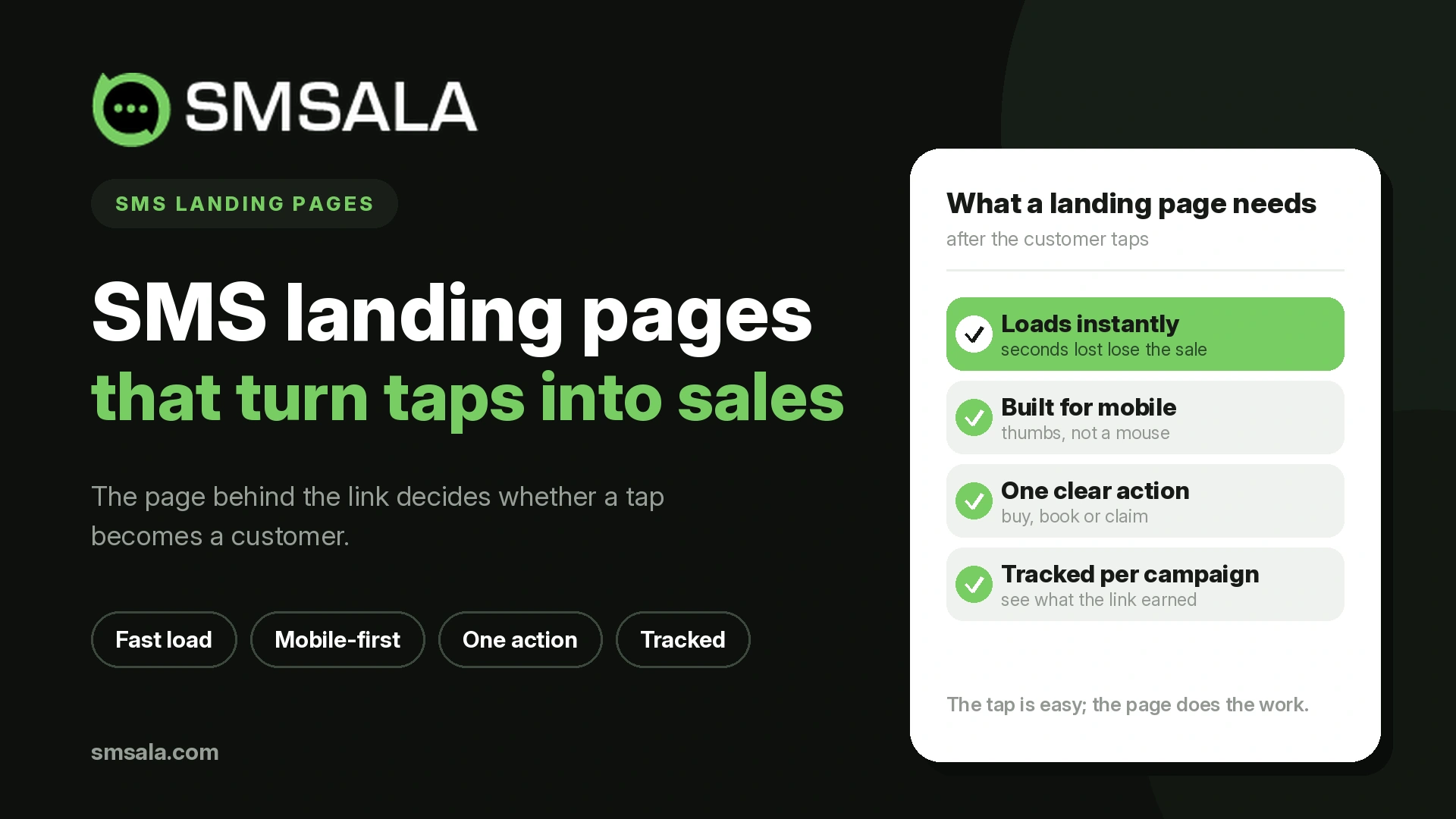
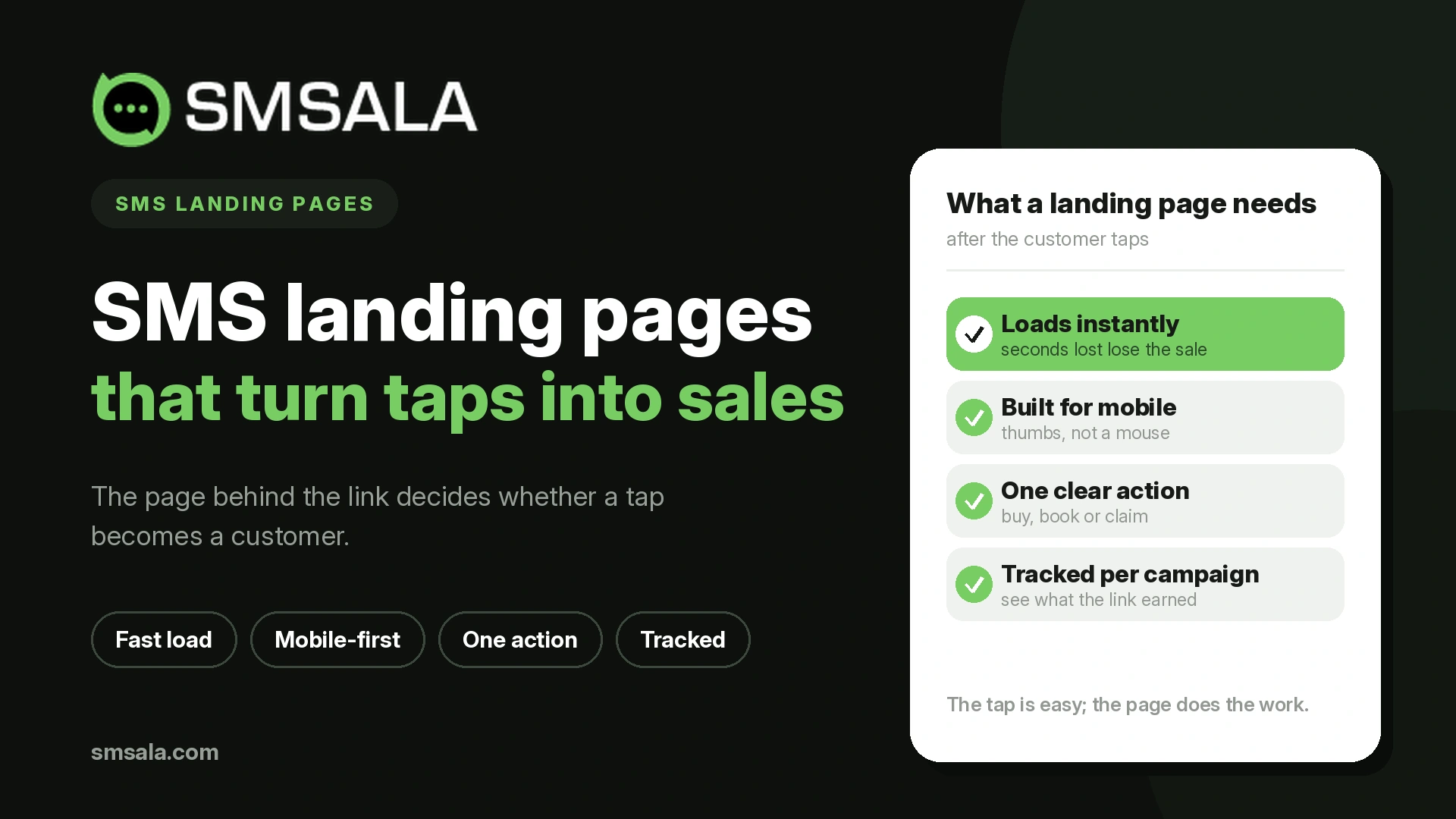
It is opened on a phone, every single time. SMS is a mobile channel with no exceptions, so the page is viewed on a small screen held in a hand, usually one-thumbed. It must be genuinely mobile-first, not a desktop page that technically resizes: large tap targets, readable text without zooming, no tiny forms or hover-dependent elements. A page that is merely "mobile-friendly" rather than mobile-first loses people on the device they are all using.
It has to load fast. The person tapped an impulse from a text, often on mobile data, and their patience is measured in a couple of seconds. A slow page loses them before it renders. Speed is not a nice-to-have for SMS landing pages, it is a conversion factor, because the audience arrived on a whim and will leave on one.
It must match the message. This is the continuity that homepage-dumping destroys. If the text promised "25% off running shoes," the page must open on 25% off running shoes, not a generic storefront. This message match reassures the visitor they are in the right place and continues the momentum the text created. A mismatch, landing on the homepage after clicking a specific offer, breaks that momentum and the visitor leaves confused.
It should ask for one thing. The message drove one action, so the page should focus on that one action and remove everything else. A single, obvious call to action converts far better than a page offering five competing options to someone who came for one. The narrower the page, the better it converts from SMS.
It can often be pre-filled. Because the visitor arrived from a text you sent, you may already know who they are, which lets you remove friction. A coupon redemption page can arrive with the discount already applied, a form can be pre-populated with details you hold in your CRM, a booking page can know which customer it is. Every field the visitor does not have to fill is friction removed, and SMS's known-recipient context makes this pre-fill uniquely achievable.
The link that carries them across
The bridge between the message and the page is the link, and it is more than a technical detail. Two things about it matter.
First, trust. A raw, long, random-looking URL in a text reads like the phishing that plagues SMS, and a wary recipient will not tap it. A short, branded link that clearly relates to your business signals that the message is genuine and safe to tap. In a channel where scam links are common, the link's appearance directly affects click-through.
Second, measurement. The link is how you attribute conversions to the SMS campaign. A trackable link tells you who tapped, ties the landing-page conversion back to the specific send, and lets you measure the campaign's real result rather than guessing. Without a proper trackable link, the SMS and the conversion live in separate worlds and you cannot connect them, which is why the link is the backbone of SMS tracking and analytics. Branded and trackable, the link builds trust and enables measurement at once.
What SMS landing pages are used for
The pages follow the campaigns. The most common and effective SMS landing pages carry the conversions SMS drives: coupon redemption pages with the code pre-applied, product and offer pages for a promotion, event and appointment registration or booking pages, lead-capture forms for a campaign, app-download pages, and survey or feedback pages. For online sellers, these pages are the conversion point of e-commerce SMS, where a cart-recovery text or an offer lands the shopper directly on a checkout-ready page. In every case, the page exists to complete the single action the message set up, which is why the focused, matched, fast, mobile-first page converts and the generic homepage does not.
Measuring the whole journey, not half of it
Because the conversion happens on the page, measuring only the message is measuring half the funnel. The SMS-to-page journey has two stages, and you need both: the click-through rate from the message to the page (did the text earn the tap) and the conversion rate on the page (did the page close the action). A campaign with a high click-through but low page conversion has a landing-page problem, not a message problem, and one with low click-through has the reverse. Only by watching both can you tell where a campaign is leaking. Then tie it to the outcome that matters, the completed conversions and their value, treating the landing page as the part of campaign management where the result is actually won or lost. Measuring the send alone tells you people tapped; measuring the page tells you whether it worked.
Common mistakes
The failures cluster around neglecting the page. Dumping the click on a generic homepage instead of a matched landing page, the single most common and costly error. Linking to a page that is not genuinely mobile-first, on a channel that is entirely mobile. Slow-loading pages that lose impatient tappers. Message mismatch, where the page does not deliver what the text promised. Cluttered pages offering many options to someone who came for one. Raw, untrusted-looking links that people will not tap. And measuring only the message, blind to where the conversion actually succeeds or fails. Each comes back to treating the text as the whole campaign and the page as an afterthought.
Building SMS landing pages well
The practices follow directly from the requirements. Build the page mobile-first, designed for a thumb on a small screen, and test it on an actual phone before sending. Make it load fast, stripping anything heavy. Match its opening to exactly what the message promised. Focus it on the single action the message drove, removing competing distractions. Pre-fill whatever you already know to cut friction, especially applied codes and known details. Use a short, branded, trackable link so people trust it and you can measure it. And feed the results back, watching both the click-through and the page conversion so you improve the half of the campaign that actually converts. Pages built into automated flows like drip campaigns should carry the same discipline, since a triggered message is only as good as the page it lands on.
SMS landing page checklist
Send the click to a dedicated, matched landing page, never a generic homepage.
Build mobile-first and test on a real phone, since every visitor is on mobile.
Make the page load fast to hold impatient, impulse-driven tappers.
Match the page's opening to exactly what the message promised.
Focus on one clear call to action, removing competing options.
Pre-fill known details and apply codes automatically to reduce friction.
Use a short, branded, trackable link for trust and attribution.
Measure both click-through and page conversion, not just the send.
The bottom line
The importance of SMS landing pages comes down to a simple division of labor: the text earns the click, and the landing page earns the conversion. Because an SMS can carry so little, its landing page does more of the work than any other channel's, which makes neglecting it the most expensive mistake in SMS marketing. Build a fast, mobile-first, message-matched, single-action page with known details pre-filled, reached by a trusted branded link, and the clicks your message earns actually turn into results. Send those same clicks to a generic homepage, and you will have paid to generate taps that die on arrival. The message is only ever half the campaign; the page is where it pays off.
SMSala supports the branded, trackable links and the reliable delivery that SMS landing-page campaigns depend on, but the conversion comes from building the page as carefully as the message, because that is where the click becomes a customer.
Frequently asked questions
What is an SMS landing page?
It is a mobile-optimized web page that the link in a text message leads to, designed to complete the action the message set up, such as redeeming an offer, filling a form, or booking. Because an SMS itself is tiny and text-only, the landing page carries all the content, detail, and conversion mechanics the message cannot, making it where the campaign actually converts.
Why can't I just link my SMS to my website homepage?
Because a generic homepage does not deliver what the text promised, forcing the visitor to hunt for it, and most leave. It is usually not truly mobile-first, may load slowly, and offers many competing options to someone who came for one specific thing. A dedicated landing page that matches the message and focuses on a single action converts far better than dumping the click on your homepage.
What makes an SMS landing page different from a normal landing page?
Its context. It is opened on a phone every single time, so it must be genuinely mobile-first and load fast for an impatient, impulse-driven visitor. It must match the exact promise of the message, focus on one action, and can often be pre-filled because you know who you sent the message to. These constraints are sharper than for a general landing page.
Why does the link in an SMS matter so much?
For two reasons: trust and tracking. A raw, random-looking URL reads like a scam and people will not tap it, while a short branded link signals the message is genuine. The link is also how you attribute conversions to the campaign, connecting the tap to the result. Branded and trackable, it drives both click-through and measurement.
How do I measure whether my SMS landing page is working?
Measure both stages of the funnel: the click-through rate from message to page, and the conversion rate on the page itself. High click-through but low page conversion points to a landing-page problem; low click-through points to a message problem. Then tie it to completed conversions and their value, so you can see and fix where the campaign leaks.