
A company checks its SMS dashboard after a campaign and sees 99% delivered. Reassuring — until the sales don't match, the OTP support tickets pile up, and a few staff testing their own numbers notice the messages never arrived. The dashboard says one thing; reality says another. The number was never real, because the provider fabricated it. And here's the uncomfortable implication: this company has been "improving" its deliverability against a figure that was fiction all along, tuning a dial that wasn't connected to anything.
That's the problem with treating SMS deliverability rate as a single number to push upward. It's not one dial — it's the net result of a chain of independent points where a message can fail, and the reported rate is only useful if it's honestly measured in the first place. Raising deliverability, done properly, means two things most advice skips: first making sure you can see the truth about what's arriving, then diagnosing which specific link in the chain is dropping your messages and fixing that one. Send blindly against a fabricated number and you'll optimise forever without improving anything. This covers both — honest measurement first, then the chain of gates every message must clear, and how to find the one that's failing you.
What SMS deliverability rate actually is
SMS deliverability rate is the percentage of the messages you send that actually reach recipients' handsets, confirmed by the mobile carrier. A rate of 95% means 95 of every 100 messages genuinely landed on a phone; the other 5 failed somewhere between your system and the device.
The critical distinction the term hides — and one that most explanations blur — is between the stages a message passes through, because "sent" is not "delivered":
Submitted — your system handed the message to the provider. This tells you nothing about delivery.
Accepted — the provider accepted it for sending. Still not delivered.
Delivered — the carrier confirms it reached the handset. This is what deliverability measures.
Failed — it didn't reach the handset (expired, rejected, undeliverable, or blocked).
Deliverability is specifically the delivered-to-submitted ratio, confirmed by genuine carrier receipts (the delivery report, or DLR). The whole point is that confirmation — because without a truthful DLR, "delivered" is just a claim. Which is exactly where the real work starts, and where most businesses go wrong before they've even begun.
First problem: can you trust your deliverability number?
Before improving deliverability, confront the question almost no guide asks: is the number you're looking at real? Because if your provider fabricates delivery statuses, everything you do to "improve" is guesswork against fiction.
Here's why this happens. A message's true delivered status comes from a genuine carrier receipt — the network confirming the handset received it. Providers running legitimate, direct routes pass that real carrier DLR back to you, so your rate reflects reality. But providers running cheap grey routes often can't get genuine carrier confirmations (the routes are unauthorised), so some fabricate them — marking messages "delivered" that the carrier actually dropped. The result is a dashboard showing a healthy rate for a campaign that reached far fewer phones than it claims. You're not measuring deliverability; you're reading a comforting number a provider made up.
So step one of enhancing deliverability is ensuring you can measure it truthfully. That means a provider whose delivery reports are genuine carrier receipts, not invented statuses — the difference between real and fabricated reporting is the difference between the direct and grey routes a message can travel. The practical test: send a batch to phones you physically control and compare what actually arrived against what the dashboard reports. If the report says 100% and only 85% of the phones buzzed, your reporting is fabricated, and no amount of list-cleaning or content-tuning will help until you're on a provider that tells you the truth. Being able to genuinely measure SMS delivery is the foundation everything else stands on — you cannot improve what you cannot honestly see.
Once you trust your number, you can start diagnosing why it's lower than it should be — and that means understanding deliverability as a chain.
Deliverability is a chain, not a dial
A message doesn't simply "deliver" or "fail" — it passes through a series of gates on the way to the handset, and it can be stopped at any one of them. Your deliverability rate is the product of all these gates: the message has to clear routing, sender identity, the recipient's number being valid, content filtering, and carrier reputation to arrive. Fail any single gate and the message dies, regardless of how well it cleared the others.
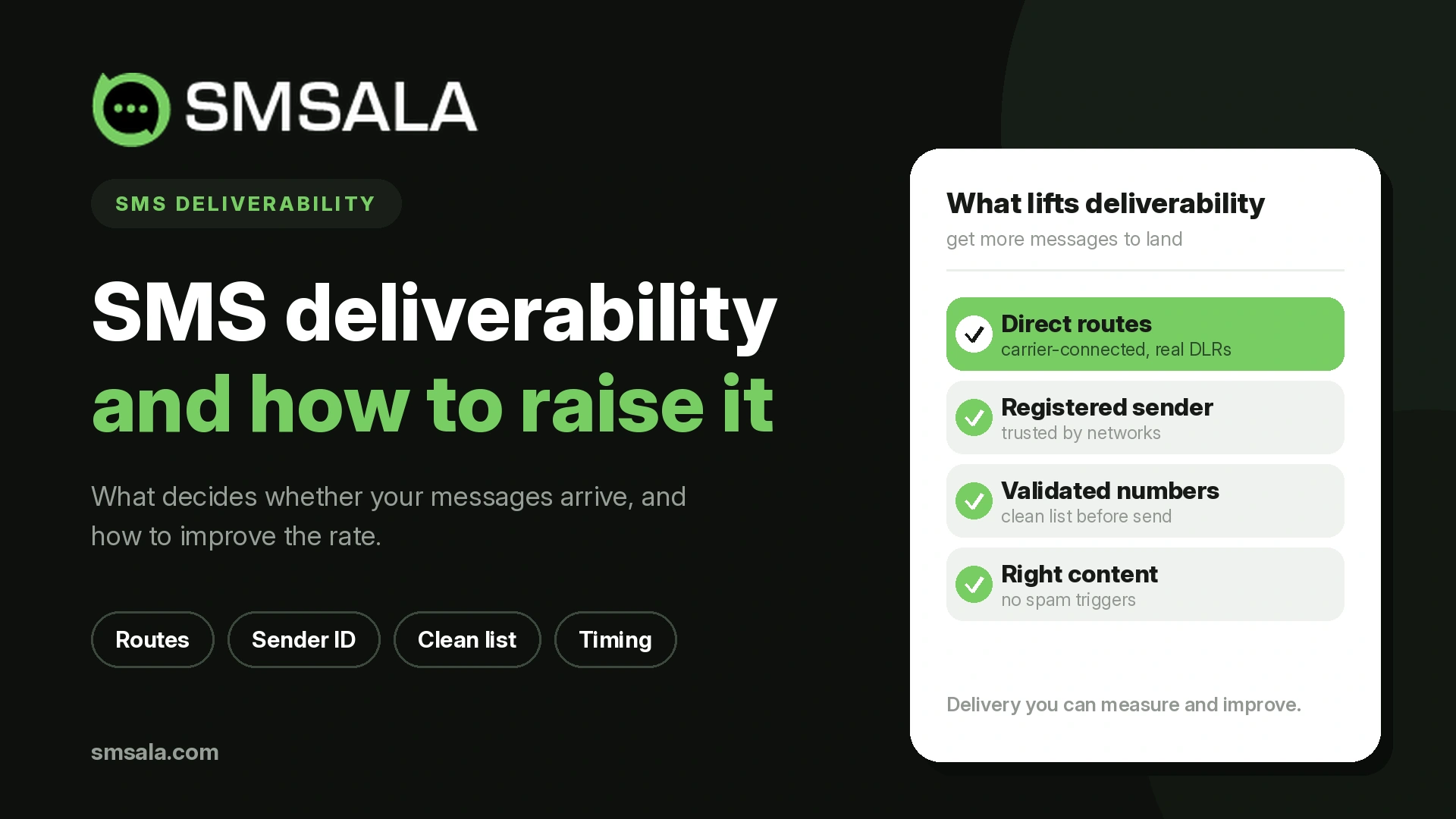
This reframes "how do I improve deliverability" into a far more useful question: which gate is failing? A message perfectly routed, from a registered sender, with clean content, still fails if the number is dead. A message to a valid number with great content still fails if it's grey-routed. Improving deliverability isn't turning up a single dial; it's diagnosing which link in the chain is dropping your traffic and fixing that specific one. The gates, in the order they matter, are routing, sender ID and registration, list quality, content and consent, and carrier reputation over time. Here's each.
Gate 1: routing quality
The first and most decisive gate is how your messages are routed to carriers. Every message reaches a recipient's network by either a direct route (a legitimate, carrier-approved connection) or a grey route (an unauthorised path that dodges carrier fees). Direct routes deliver reliably and report honestly; grey routes get detected and blocked by carriers intermittently, lose a chunk of traffic, and — as covered above — often fabricate the delivery statuses that hide the loss.
Routing is the decisive gate because it's invisible and it undermines everything downstream: you can have a pristine list and perfect content, and a grey route will still silently drop your messages while telling you they delivered. It's also the gate most tied to price — suspiciously cheap SMS usually means grey routing, so the "saving" is paid back in lost delivery. If your honestly-measured deliverability is poor, routing is the first place to look, because it caps the ceiling on everything else. A provider on direct routes is the precondition for a high deliverability rate; without it, the other gates barely matter.
Gate 2: sender ID and registration
The second gate is your sender identity and its registration status — and in regulated markets, this gate blocks more legitimate traffic than businesses realise. Many markets now require your sender ID and A2P traffic to be pre-registered with carriers before you're allowed to send: 10DLC in the US, DLT registration in India, sender-ID registration across the Gulf, Europe, and elsewhere. An unregistered or non-compliant sender ID gets filtered at the network — blocked before it reaches anyone — frequently while your dashboard still shows it as accepted.
This is why a business new to a market sometimes sees deliverability collapse for no obvious reason: the sender ID wasn't registered, so the carrier dropped everything. Proper sender ID registration is a hard prerequisite for delivery in these markets, not an optional nicety — and it's a gate that content and list quality can't compensate for. If you send into regulated markets, confirm your sender IDs are registered and your A2P traffic is compliant; where India is a destination, DLT registration is the specific gate through which all legitimate traffic must pass. Skip it and the message never gets the chance to be delivered.
Gate 3: list quality
The third gate is whether the number can receive your message at all. This is the source's main focus, and it's real: a chunk of any aging list is dead weight — numbers that have been disconnected, reassigned, changed, entered wrong, or that were never mobile numbers (a landline can't receive SMS). Every message to one of these fails, dragging your rate down and wasting money on sends that never had a chance.
Cleaning the list is the most controllable deliverability fix. Remove numbers that consistently fail, correct or drop obviously invalid entries, and periodically validate the list. For large or old lists, an HLR lookup checks whether numbers are live and reachable before you send, so you're not paying to message the disconnected. And on an ongoing basis, watch which numbers repeatedly return failed statuses and retire them. List quality is the gate you own most directly — no provider or carrier controls it, you do — so it's often the quickest deliverability win once routing and registration are sound. A clean list of valid, reachable numbers removes a whole category of failure.
Gate 4: content and consent
The fourth gate is carrier spam filtering, which screens message content and sending patterns to weed out what looks like spam. Messages that trip the filters get blocked, and several things trip them: no opt-out mechanism, content that looks promotional-spammy (certain trigger words, misleading claims, excessive links or shortened URLs from bad domains), and sending patterns that look like spam (identical messages blasted to huge lists from a fresh, unregistered identity).
Clearing this gate means sending like a legitimate business, not a spammer. Include a clear opt-out in promotional messages (both a compliance requirement and a spam-filter signal that you're legitimate), keep content honest and non-deceptive, avoid the patterns filters associate with spam, and — underpinning all of it — send only to recipients who consented. Consent matters for deliverability beyond the legal reason: messaging people who didn't opt in generates spam complaints, and complaints damage your standing with carriers, which feeds directly into the next gate. Understanding what commonly hinders text message delivery at the content level helps you write and send in ways that clear the filters rather than trip them.
Gate 5: carrier reputation over time
The fifth gate is subtler and cumulative: carriers build a reputation profile of your sending over time, and a poor reputation degrades your deliverability even when everything else is right. Consistently high spam complaints, high failure rates (from dirty lists), and spammy patterns lower your reputation; carriers then filter your traffic more aggressively, so your deliverability quietly erodes.
This is where a claim you'll often see — that "two-way messaging improves deliverability" — needs correcting. Enabling replies doesn't directly make a message more likely to be delivered. What actually helps is engagement and good sending behaviour building carrier reputation over time: recipients who want your messages, low complaint rates, clean lists, and legitimate patterns signal to carriers that you're a trustworthy sender, and that reputation improves how your future traffic is treated. Two-way interaction contributes only insofar as it's part of a healthy, consented, engaged relationship — it's the engagement and low complaints that matter, not the reply channel itself. So protect your reputation by sending wanted messages to consented recipients, keeping complaints and failures low, and being consistent. Reputation is earned slowly and lost quickly, and it silently sets the ceiling on your deliverability once the other gates are clear.
How to diagnose which gate is failing
Because deliverability is a chain, improving it is a diagnosis, not a blanket effort. Work through the gates in order:
Verify your measurement is honest. Send a test batch to phones you control and compare real arrivals to the dashboard. If they don't match, fix your provider/routing before anything else — you're flying blind until they do.
Check routing. Confirm direct routes, not grey. Poor honest deliverability with everything else clean points here first.
Check sender ID and registration. Especially if delivery is poor in a specific market — confirm the sender ID is registered and A2P-compliant there.
Check list quality. Look at your failure statuses: a high rate of undeliverable/expired failures points to dead or wrong numbers. Validate and clean.
Check content and consent. If specific message types or campaigns fail more, examine content for spam signals and confirm consent and opt-out are in place.
Check reputation trends. If deliverability is slowly declining over time despite clean inputs, your carrier reputation may be eroding from complaints or failures — address the root behaviour.
Reading your DLR reports closely is what makes this diagnosis possible: the specific failure codes (expired, rejected, undeliverable, blocked) point to different gates, so genuine, granular delivery data tells you where in the chain messages are dying rather than just that they are. Diagnose the failing gate, fix that one, and your rate rises — far more effective than generic "improve deliverability" effort scattered across gates that were already fine.
What's a good SMS deliverability rate?
A fair benchmark question. On direct routes with a clean, consented list and proper registration, deliverability should be high — commonly in the mid-to-high 90s percent — because most messages should reach most valid, reachable numbers. The exact figure varies by destination country (some networks are harder to reach than others), so a global average hides country-level variation worth watching separately. What matters more than hitting a specific number is that the rate is honestly measured and diagnosable: a genuine 92% you can trust and improve beats a fabricated 99% you can't. If your honest rate sits well below the 90s, one of the gates above is failing and the diagnosis process will find it. And always read the rate per destination, not just as an aggregate, because a strong average can hide a specific market where an unregistered sender ID or bad routing is dropping everything.
Mistakes that quietly wreck deliverability
Trusting a fabricated number — optimising against a provider's invented "delivered" statuses instead of verifying real delivery, so you never see the actual problem.
Treating deliverability as one dial — making blanket "improvements" instead of diagnosing which specific gate is failing.
Choosing a provider on price — buying grey-route delivery that caps your rate and hides the loss, the single biggest self-inflicted deliverability wound.
Skipping sender-ID registration — having traffic blocked wholesale in regulated markets while the dashboard shows it as accepted.
Letting the list rot — paying to send to dead and wrong numbers and dragging the rate down with avoidable failures.
Sending to non-consented recipients — generating the spam complaints that erode carrier reputation and degrade future deliverability.
Reading only the aggregate — missing a specific country where delivery has collapsed because the global average looks fine.
If you're working to enhance your SMS deliverability rate, the first move is making sure you can see the truth about what's arriving — genuine carrier delivery data, not a fabricated number — and then fixing the specific gate that's failing. SMSala runs on direct carrier routes with honest, granular reporting, which you can see within a full bulk SMS gateway — the layer that determines whether your messages actually reach phones and whether the delivery rate you're looking at is real.
FAQ
What is SMS deliverability rate?
It's the percentage of messages you send that actually reach recipients' handsets, confirmed by the mobile carrier. A 95% rate means 95 of every 100 messages genuinely landed on a phone. Crucially, it measures delivered (carrier-confirmed) messages, not merely sent or accepted ones — which is why honest carrier delivery reports matter so much.
How can I improve my SMS deliverability rate?
Treat it as a chain, not a single dial: first make sure your delivery number is honestly measured (not fabricated by a grey-route provider), then diagnose which gate is failing — routing quality, sender-ID registration, list quality, content and consent, or carrier reputation — and fix that specific one. Most improvement comes from using direct routes, registering sender IDs, and cleaning the list.
Why can't I trust the "delivered" number on my dashboard?
Because grey-route providers often fabricate delivery statuses — marking messages "delivered" that the carrier actually dropped, since unauthorised routes can't get genuine carrier confirmations. This shows a healthy rate for a campaign that reached far fewer phones than claimed. Test by sending to phones you control and comparing real arrivals against the dashboard; a gap reveals fabricated reporting.
Why are my SMS messages not being delivered?
A message can fail at any gate in the delivery chain: grey-route routing that carriers block, an unregistered sender ID filtered in regulated markets, a dead or invalid recipient number, content that trips spam filters, or a poor carrier reputation from complaints. Reading the specific failure codes in your delivery reports tells you which gate is dropping your messages.
What is a good SMS deliverability rate?
On direct routes with a clean, consented list and proper sender-ID registration, deliverability is typically in the mid-to-high 90s percent, though it varies by destination country since some networks are harder to reach. More important than a specific number is that the rate is honestly measured and diagnosable — a trustworthy 92% beats a fabricated 99%.
How does grey routing affect SMS deliverability?
Grey routes — unauthorised paths that dodge carrier fees — get detected and blocked by carriers intermittently, losing a portion of traffic, and often fabricate "delivered" statuses that hide the loss. They cap your real deliverability while making the dashboard look fine. This is why suspiciously cheap SMS usually means lower actual delivery, paid back in lost messages.