
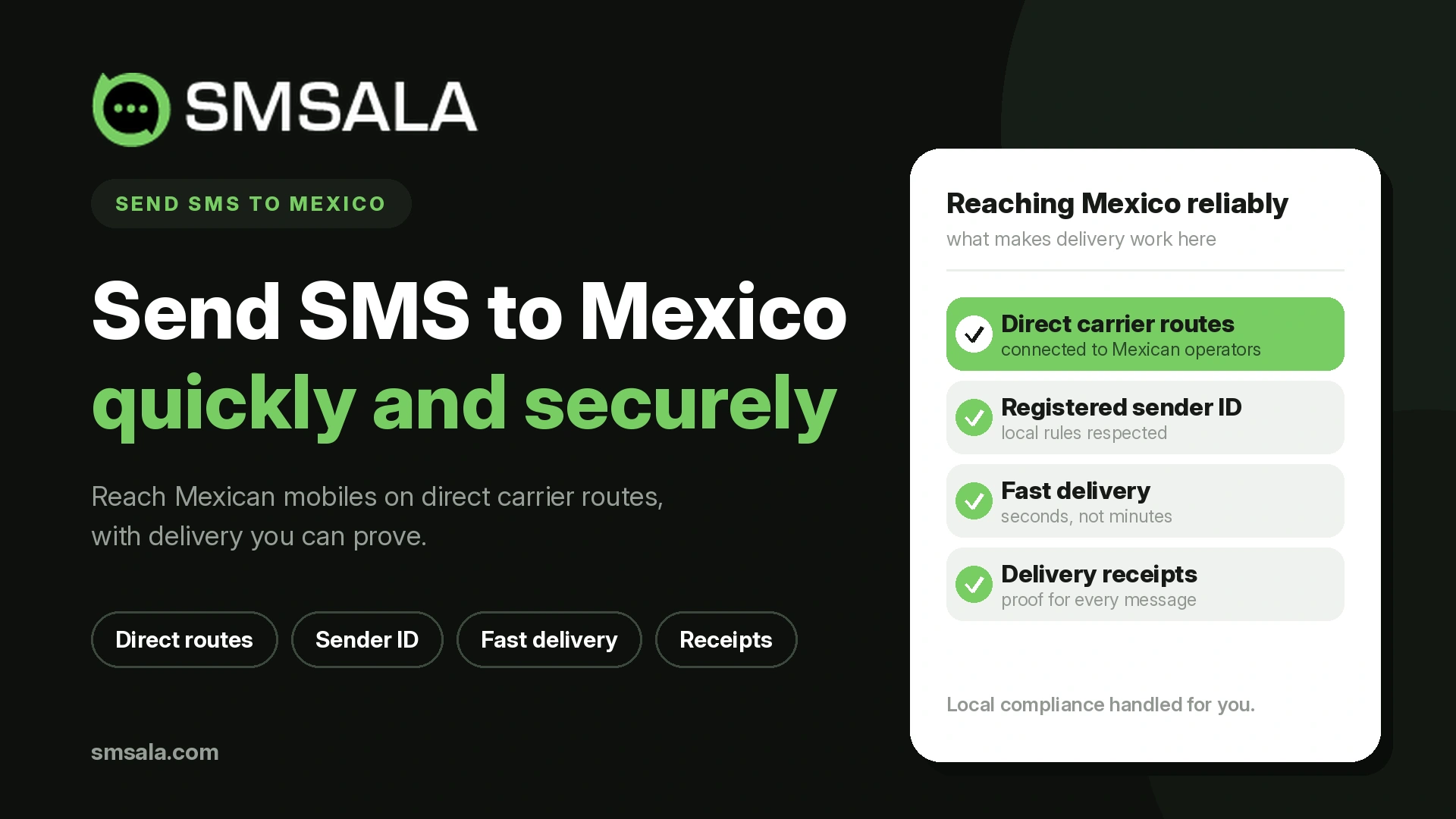
Mexico is one of the most active mobile markets in Latin America, with well over 100 million mobile connections and customers who read text messages within minutes. That makes SMS a direct line to Mexican consumers for verification codes, order updates, appointment reminders, and promotions. Sending well, though, means understanding the local carriers, the current regulator, how sender IDs behave, and the quirks of writing for Spanish.
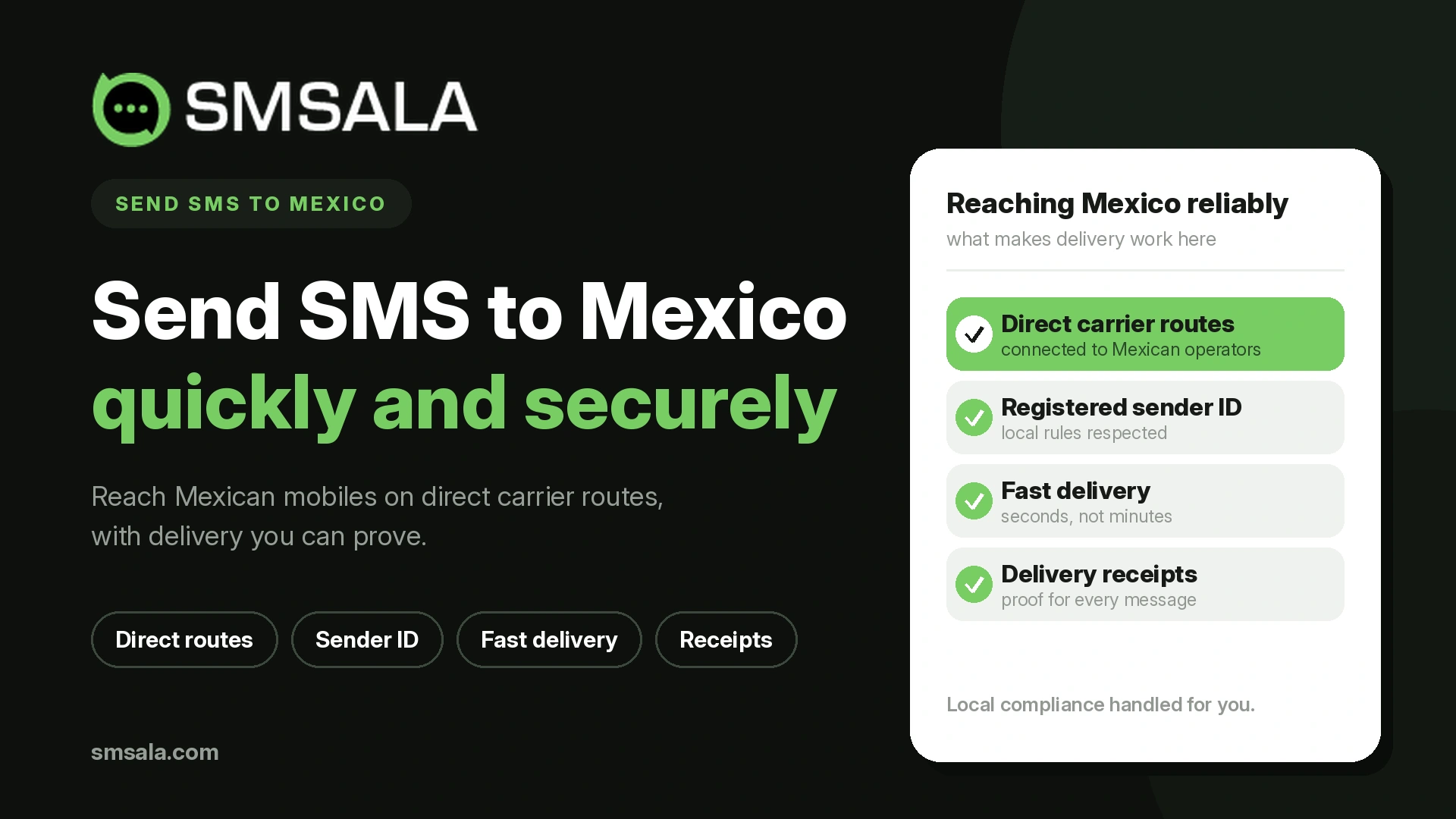
This guide covers what actually affects delivery when you send SMS to Mexico, and how to do it reliably at scale.
Why Mexico is a strong market for SMS
Mobile reach in Mexico is broad and cuts across every income level and region. A text message arrives on any handset without an app or a data connection, which is why businesses use it to reach customers that email and app notifications miss. Engagement is high, and for time-sensitive messages like one-time passwords or delivery alerts, SMS remains the fastest dependable channel.
The commercial uses are wide. Retailers and e-commerce brands run promotions and abandoned-cart reminders, banks and fintechs send authentication codes, logistics companies share tracking updates, and clinics send appointment reminders. For teams focused on the retail and promotional side, the mechanics of SMS marketing in Mexico build directly on the delivery fundamentals below.
Mexico's mobile networks: who carries your messages
Three mobile network operators carry most SMS traffic in Mexico. Telcel, part of América Móvil, is the largest by a wide margin and reaches the most subscribers nationwide. AT&T Mexico is the second major network, and Movistar operates as the third brand. A growing set of mobile virtual network operators (MVNOs) ride on these networks, which means your messages ultimately traverse one of the main carriers regardless of the customer's brand.
For a sender, the practical takeaway is coverage across all of them. A route that performs well on Telcel but struggles on AT&T will leave a share of your audience unreached. This is where routing quality matters: direct carrier connections deliver consistently, while cheaper grey routes are unstable and prone to filtering. The difference between direct and grey-route messaging shows up plainly in delivery receipts, especially at volume.
The rules: Mexico's telecom regulator and consent
Mexico's regulatory landscape changed recently, and it is worth getting current. The former Instituto Federal de Telecomunicaciones (IFT) has been replaced by the Comisión Reguladora de Telecomunicaciones (CRT). The IFT's website now operates only as a historical archive and directs businesses to the CRT for current procedures, so any guidance that still points to the IFT as the live authority is out of date.
Consent is the other pillar. Mexico's federal data protection law requires a lawful basis, typically consent, to process the personal data you use for messaging, and consumers can register with the Registro Público para Evitar Publicidad (REPEP), run by the consumer protection authority PROFECO, to opt out of advertising communications. In practice that means you should message people who have agreed to hear from you, honor opt-outs promptly, and give every promotional message a clear and easy way to unsubscribe. Transactional messages such as OTPs and order updates are a different category from marketing, but consent-based, permission-first sending is the safe baseline for all commercial SMS.
Sender IDs and how your messages appear
How your message is labeled on the recipient's phone depends on the sender ID, and Mexico handles these differently from some other markets. Support for alphanumeric sender IDs (a brand name instead of a number) is limited and varies by carrier, so a brand header that displays cleanly in one country may be overwritten or replaced with a numeric long code in Mexico. Long codes and short codes are the common alternatives, with short codes suited to high-volume or two-way programs.
Because presentation is not guaranteed, do not rely on the sender ID alone to identify your brand. Confirm what is supported for your traffic before launch, and reinforce identity inside the message body. Understanding how SMS sender IDs work across markets helps set the right expectation for what Mexican recipients will actually see.
Writing for Spanish: language and encoding
Messages to Mexico should be in Spanish. Beyond translation quality, there is a technical detail that affects both cost and readability: character encoding. A standard SMS using the GSM-7 alphabet fits 160 characters in a single segment, but characters outside that set switch the whole message to Unicode (UCS-2), which cuts the limit to 70 characters per segment. Some Spanish accented vowels fall outside the GSM-7 default set and can trigger this switch, so a short-looking message may quietly split into multiple billable parts.
The fix is not to strip accents, which harms clarity and professionalism, but to be aware of the trade-off and check segment counts before sending. A platform with proper Unicode SMS support and a clear segment preview lets you write correct Spanish while keeping an eye on length and cost.
Common use cases for SMS in Mexico
Authentication (OTP and 2FA): Login and payment verification codes that need to arrive in seconds.
Transactional alerts: Order confirmations, shipping and delivery updates, payment receipts, and appointment reminders.
Marketing and promotions: Sales, offers, and re-engagement messages sent to opted-in audiences.
Customer service: Two-way messaging for support, confirmations, and simple queries.
Each has a different tolerance for delay and a different compliance profile, which is why routing and categorisation matter as much as the copy.
A2P SMS and sending at scale
Business messaging to consumers is application-to-person (A2P) traffic, sent from software rather than a personal handset. Sending A2P at any real volume means using a proper platform and, for automated flows, an API. If your application needs to trigger a verification code the instant a user requests it, that has to happen programmatically.
Look for an A2P SMS setup with a well-documented REST API, support for high throughput, and delivery webhooks. The ability to send SMS at scale through a bulk SMS REST API is what lets you connect your website, app, or CRM and automate OTPs, alerts, and campaigns without manual steps.
Delivering reliably: routes, receipts, and deliverability
Reliable delivery in Mexico comes down to a few controllable factors. Use direct routes into the main carriers rather than grey routes that get filtered. Track delivery receipts (DLRs) in real time so you can see per-carrier performance and catch a failing route quickly. And watch your SMS deliverability rate as a trend across carriers, not as a single headline number, because a drop on one network is easy to miss in an overall average.
Timing helps too. Mexico spans multiple time zones, so schedule around local business hours to improve both delivery experience and response rates, and avoid sending promotional messages late at night.
What it costs to send SMS to Mexico
SMS to Mexico is priced per message, and a few factors drive the rate. Message category matters, volume brings negotiated tiers, and route quality is decisive: a low headline price often signals grey routing that fails and forces resends, making it more expensive in practice. Encoding plays a role as well, since Unicode messages split into more segments and each segment is billed.
Rather than anchoring on a single figure, which shifts with the market and carrier agreements, ask any provider for a current written quote for your specific volume and message type, and confirm that the routes into Telcel, AT&T, and Movistar are direct.
Choosing a provider to send SMS to Mexico
The right provider makes most of the issues above invisible. Prioritise direct connectivity to the Mexican carriers, clear sender ID guidance for the market, real-time delivery reporting, proper Unicode handling for Spanish, and an API that fits your stack. SMSALA's bulk SMS service covers Mexico as part of its international network, with carrier-grade routing, delivery tracking, Unicode support, and REST and SMPP integration, so a single setup handles both automated transactional traffic and bulk campaigns.
Best practices for SMS campaigns in Mexico
Message only opted-in recipients and honor unsubscribe requests immediately.
Write in clear Spanish and check the encoding and segment count before sending.
Identify your brand in the message body, since the sender ID may not display as expected.
Use direct carrier routes and confirm coverage across Telcel, AT&T, and Movistar.
Send transactional and promotional traffic appropriately, keeping OTPs fast and campaigns permission-based.
Monitor delivery receipts by carrier and treat a rising failure rate as an incident.
Respect local timing across Mexico's time zones and avoid off-hours promotions.
Test before you scale with a small live send across all three networks.
Frequently asked questions
Who regulates SMS and telecom in Mexico now?
The Comisión Reguladora de Telecomunicaciones (CRT). It has taken over from the former IFT, whose website is now only a historical archive that points businesses to the CRT.
Which carriers do I need to reach in Mexico?
Primarily Telcel, AT&T Mexico, and Movistar, plus the MVNOs that run on their networks. Aim for direct routing that covers all of them.
Can I use a branded (alphanumeric) sender ID in Mexico?
Support is limited and varies by carrier, so a brand name may be replaced with a numeric long code. Confirm what is supported for your traffic and reinforce your brand in the message text.
Do accented Spanish characters affect my SMS?
Yes. Some Spanish accented characters fall outside the standard GSM-7 set and switch the message to Unicode, which reduces the per-segment limit from 160 to 70 characters and can increase cost. Check segment counts before sending.
Do I need consent to send marketing SMS to Mexico?
For promotional messages, yes. Message opted-in recipients, honor the REPEP advertising opt-out registry, and include an easy way to unsubscribe. Transactional messages like OTPs are treated separately, but permission-first sending is the safe standard.
Conclusion
Sending SMS to Mexico reliably is a matter of getting the fundamentals right: reach all three major carriers over direct routes, follow the current rules under the CRT and Mexico's consent framework, write proper Spanish while watching encoding, and set realistic expectations for how sender IDs display. Pair those with real-time delivery monitoring and a solid API, and SMS becomes one of the most dependable ways to reach customers across Mexico, whether you are confirming a login or announcing a sale.