
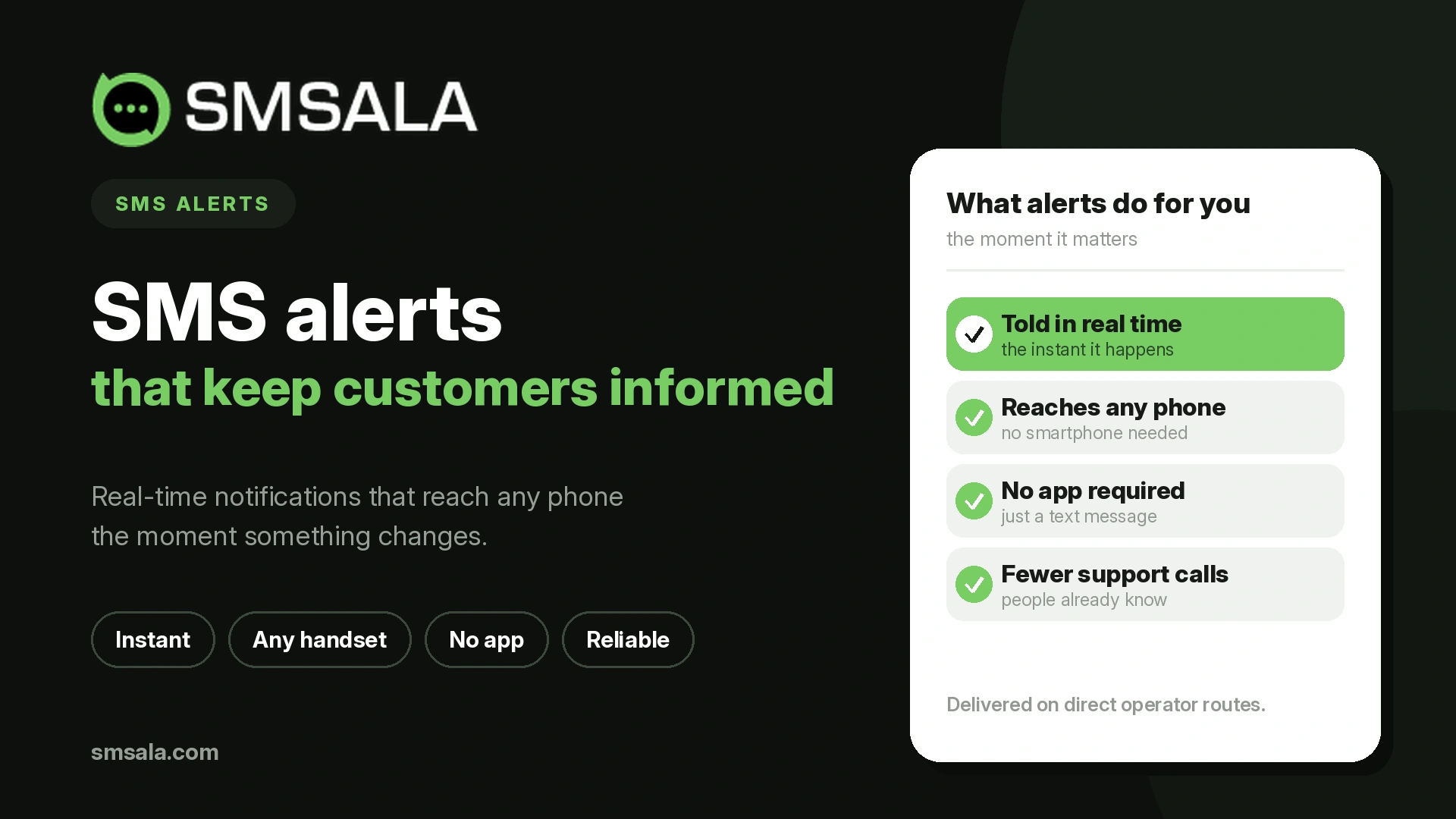
An SMS alert is an automatic text message that tells someone about something important the moment it happens: a payment taken, a delivery arriving, a flight delayed, a storm approaching, a login from a new device. Unlike a marketing text, an alert is not trying to sell anything. Its entire job is to deliver time-sensitive information fast enough to matter, to a person who needs to know now. That single purpose, getting critical information to someone the instant it becomes relevant, is why SMS alerts have become infrastructure for banks, hospitals, airlines, utilities, and governments alike.
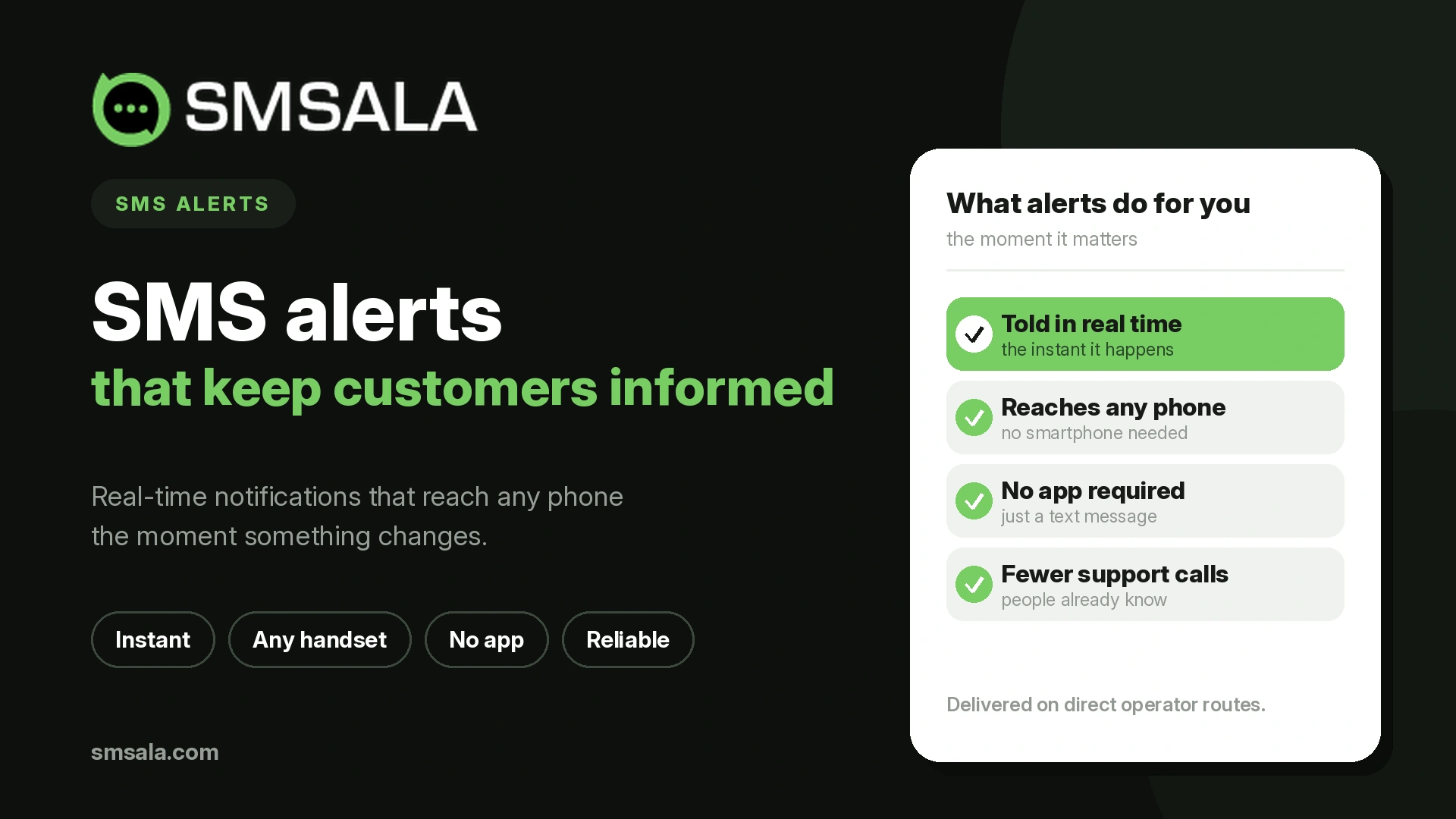
Alerts are also where the reliability of a messaging channel is tested hardest. A marketing message that arrives late is a missed opportunity. A fraud alert, an outage notice, or an evacuation warning that arrives late, or not at all, is a real problem. That raises the stakes on everything from channel choice to routing, and it is why the businesses that depend on alerts think carefully about how they send them rather than treating it as an afterthought.
What an SMS alert is
An SMS alert is a short, automated notification sent to a phone to communicate a specific, time-sensitive event. It is triggered by something happening in a system, a transaction clearing, an order shipping, a threshold being crossed, and it fires without a human composing it each time. The defining traits are that it is automatic, timely, and informational rather than promotional.
That last point matters more than it seems. Because alerts inform rather than market, and because the recipient generally wants them, they sit in a different regulatory category from promotional messages. Transactional and service alerts face lighter consent rules and are usually permitted at any hour, unlike marketing. This is the same distinction that runs through all A2P messaging, and it is what lets a bank text a fraud warning at 2 a.m. when it could not send a promotion at that time.
Why SMS is the channel for alerts
Several channels can carry a notification, but SMS has a specific set of properties that make it the default for anything critical.
It reaches almost any phone, with no app to install and no account to create, so it works for an entire customer base rather than only the subset who downloaded an app and left notifications on. It is read within minutes, which is the whole point of an alert. And critically, it works when other channels do not: SMS travels over cellular signaling that functions on a basic connection, so it can get through when data networks are congested or down, which is exactly the situation many emergencies create. When email sits unread for hours and a push notification never arrives because the app was uninstalled, a text still lands.
This resilience is why SMS remains the backbone for critical alerts even as richer channels grow. A notification is only useful if it arrives, and SMS arrives more reliably, to more people, in more conditions, than any alternative. Richer channels such as RCS and WhatsApp Business can add branding and interactivity for recipients who support them, but SMS is the universal floor that catches everyone else.
The types of SMS alerts
Alerts span a wide range, and organizing them by type clarifies what each is for and how it should be handled.
Alert type | What it communicates | Example |
Transactional | A completed action | Payment received, order confirmed, funds transferred |
Account and security | Access and safety events | New-device login, password change, fraud warning, verification codes |
Operational and service | Status of a service in progress | Delivery en route, appointment reminder, booking change |
Emergency and critical | Urgent safety information | Evacuation notice, outage, recall, incident alert |
Weather and environmental | Conditions requiring action | Storm, flood, or heat warnings and their all-clears |
Threshold and monitoring | A metric crossing a set point | Low balance, stock level, server or sensor alarm |
Security alerts are worth a particular note, because they overlap with authentication. The same infrastructure that delivers a fraud warning also delivers the verification codes that protect accounts, and both are among the highest-priority, most time-critical messages any business sends. A delayed security alert is not just an inconvenience; it can be the difference between catching fraud and not.
Alerts across industries
Almost every sector that serves customers at scale relies on SMS alerts, and the pattern of use reflects each industry's stakes.
Banks and financial services send transaction confirmations, fraud warnings, and payment reminders, where speed protects both the customer and the institution. Retail and e-commerce send order and delivery updates that have become a baseline customer expectation. Healthcare sends appointment reminders and results-ready notices that reduce missed care. Airlines and logistics send delay, gate-change, and dispatch alerts where a timely message prevents a wasted trip. Utilities send outage and restoration notices. And governments and public agencies send emergency and weather warnings to entire populations. The common thread is that in each case, a missed message carries a real cost, which is exactly the situation SMS alerts exist to prevent. For a fuller view of how sectors deploy messaging, the same logic extends across industries well beyond alerts alone.
Weather and emergency alerts: a closer look
Weather and emergency alerts deserve separate attention, because they represent the most demanding use of the channel and the one where SMS's advantages matter most.
When severe weather, a public-safety incident, or an infrastructure failure strikes, the situations that make alerts most necessary are often the ones that degrade other channels. Power and internet may be down, data networks may be overwhelmed by everyone reaching for their phones at once, and people may be away from their computers. SMS is built to survive these conditions, delivering over cellular signaling that holds up when data does not, which is why public authorities and organizations running weather-alert systems rely on it.
Building an effective weather or emergency alert program has specific requirements. Messages must be unmistakably clear and immediately actionable, telling people not just what is happening but what to do. They must reach the right geography, so alerts target the affected area rather than everyone. They should be sent through infrastructure that can dispatch to large populations at once without slowing, since an emergency alert delayed by a slow queue has failed. And they must be reserved for genuine urgency, because an audience trained to ignore over-frequent alerts will ignore the one that matters. Reaching a whole population instantly is a form of mass communication where reliability is not a feature but the entire requirement.
Why alert delivery cannot be left to chance
For alerts more than any other message type, delivery is everything, and this is where the choice of how to send them shows its consequences. A promotional message that fails to deliver costs a possible sale. An alert that fails to deliver can cost far more, and the recipient often has no idea it was ever sent.
That zero-tolerance requirement raises the bar on infrastructure. Alerts must travel over direct carrier routes, not cheap grey routes that can be blocked without warning, because an alert system that works most of the time is not good enough for messages that matter most when they matter. The provider needs redundancy and failover, so that if one route degrades, traffic reroutes rather than stalling. Speed under load matters, since alerts often need to reach many people at the same moment, and a system that queues slowly turns a timely warning into a late one. Real-time monitoring of the delivery rate lets problems surface immediately rather than after the fact, and cleaning recipient lists with an HLR lookup removes dead numbers so effort is not wasted. A registered Sender ID also matters here, because an alert from a recognized name is trusted and acted on, while one from an unknown number may be dismissed as spam at the worst possible moment.
The lesson is that alert delivery is an engineering decision, not a pricing one. The cheapest route is a false economy when the message is one a business cannot afford to lose.
Setting up an SMS alert system
Building an alert program follows a clear path, and the order reflects that reliability and integration come before content.
Identify the trigger events. Decide precisely which system events should fire an alert, such as a transaction, a status change, or a threshold breach.
Integrate through an API. Connect your systems to a messaging provider through an SMS API so alerts fire automatically the instant an event occurs, with no manual step.
Confirm consent and preferences. Even for alerts, capture the consent the message type requires and let recipients manage which alerts they receive, honoring opt-outs on anything non-essential.
Design clear templates. Write each alert to be understood in a glance and, where relevant, to say what action to take. Include a way to reply to an alert where a response is useful, such as confirming or rescheduling.
Choose reliable, direct routing. Select a provider and routes built for guaranteed delivery, with failover, sitting behind a dependable SMS gateway.
Automate scheduling where needed. Use scheduling and automation for time-based alerts and reminders so they send at the right moment without manual effort.
Test and monitor. Confirm alerts fire correctly and arrive quickly, and watch delivery continuously so failures are caught early.
The steps most often underestimated are integration and routing. An alert system that depends on someone remembering to send it is not an alert system, and one built on unreliable routes fails at the worst time.
Best practices for alerts
A few principles separate an alert program people trust from one they mute.
Keep every alert clear and actionable, saying what happened and, where relevant, what to do. Send only what is genuinely worth interrupting someone for, because the fastest way to make people ignore your alerts is to over-send, and an audience that tunes out routine noise will miss the critical message too. Respect consent and give control over non-essential alerts, even though transactional messages face lighter rules, since trust is easy to lose. Identify yourself with a recognized sender so the alert is believed. And reserve the highest-urgency treatment for genuine emergencies, because credibility is the currency an alert system spends. This restraint is the opposite instinct from SMS marketing, and it is exactly what keeps alerts effective.
Common mistakes
A few errors undermine otherwise sound alert programs. Sending alerts over cheap routes that fail when it matters most. Over-alerting until recipients mute or ignore everything, including the urgent ones. Writing vague messages that inform without telling people what to do. Sending from an unrecognized number that reads as spam. Skipping integration so alerts depend on manual sending. And ignoring delivery monitoring, so failures go unnoticed until a customer complains. Each is avoidable, and each defeats the purpose of an alert, which is to be received and acted on.
Frequently asked questions
What is an SMS alert?
It is an automatic, time-sensitive text notification about a specific event, such as a transaction, a delivery, a security event, or an emergency. Unlike marketing messages, alerts inform rather than promote and are usually welcomed by the recipient.
How are SMS alerts different from SMS marketing?
Alerts deliver time-critical information the recipient wants and face lighter consent and timing rules, so they can be sent at any hour. Marketing messages promote and carry stricter consent and sending-window rules. The infrastructure overlaps, but the purpose and rules differ.
Why use SMS for alerts instead of email or push?
SMS reaches almost any phone with no app or data connection, is read within minutes, and works when data networks are congested or down, which is common in emergencies. That reliability makes it the default for anything critical, with email and push as supplements rather than replacements.
Do SMS alerts require consent?
Purely transactional and safety alerts the recipient set in motion face lighter rules, but capturing appropriate consent and honoring opt-outs on non-essential alerts is the safe standard and builds trust. Rules vary by market, so the strictest applicable standard is the safest.
How do businesses set up SMS alerts?
By identifying the trigger events, integrating their systems with a messaging provider through an API so alerts fire automatically, designing clear templates, choosing reliable direct routing, and monitoring delivery. Automation and integration are what make alerts timely and consistent.
Can SMS alerts be used for weather and emergencies?
Yes, and it is one of the strongest uses, because SMS delivers over cellular signaling that survives when data networks fail. Effective emergency alerts are clear, actionable, geographically targeted, sent through infrastructure that can reach large populations instantly, and reserved for genuine urgency.
Conclusion
SMS alerts are the messages a business cannot afford to get wrong, and their value rests entirely on arriving fast, to the right people, every time. That makes them less a marketing decision than an infrastructure one: clear content, genuine restraint, and above all reliable, direct delivery that holds up under load and in the conditions where alerts matter most.
For organizations that depend on alerts reaching people without fail, from transaction warnings to emergency notices, that reliability is where an experienced messaging partner earns its place, with the direct routing, failover, and monitoring that critical notifications demand backing every message built on dependable bulk SMS infrastructure.