
An OTP is the only message where arriving thirty seconds late is the same as never arriving. The user is sitting on a login or checkout screen, staring at an empty code field, watching a countdown. If the code doesn't appear in the first few seconds, they retry, they get frustrated, and a meaningful share of them abandon the signup, the purchase, or the login entirely. A delivery report that says "delivered" two minutes later is cold comfort by then the customer is gone.
This is what makes OTP delivery unlike any other messaging job. It's not enough for the code to arrive; it has to arrive almost instantly, every time, to the right person, without being intercepted or exploited along the way. "Secure OTP delivery" is really three demands at once speed, reliability, and security and most discussions of it focus on the least interesting one while treating the code itself as the whole story.
This guide is about the delivery. Why speed is the metric that matters, what quietly delays or drops codes, how fallback channels turn one unreliable path into a dependable system, and what "secure" actually means when the risk is the delivery channel itself. (What OTP does and doesn't protect against as a fraud control is a separate question, covered in depth in the companion guide to OTP as a fraud control this one assumes you've decided to use OTP and need to deliver it well.)
Speed is the metric, not just delivery
Most teams measure OTP delivery by delivery rate: what percentage of codes were delivered. That's necessary but incomplete, because it ignores the dimension that actually determines success how fast.
For an OTP, delivery time is a conversion metric. Every extra second between the user requesting a code and the code appearing loses some users. A system with a 99% delivery rate where codes take a minute to arrive performs worse, in real business terms, than one with a slightly lower rate that delivers in seconds, because users abandon on time, not on eventual delivery. The right way to think about OTP delivery is therefore twofold: did the code arrive, and did it arrive fast enough to be used?
This reframes what you're optimising. You're not just chasing a high delivery percentage you're chasing fast, reliable delivery, and measuring the conversion rate (codes actually entered) that reflects both. A code that arrives after the user has given up counts as delivered by the network and failed by the business.
What quietly delays or drops an OTP
If speed is the game, the enemy is anything that adds latency or loses the message. Several culprits do exactly that, and they're the same ones that make the difference between an OTP system that feels instant and one that feels broken.
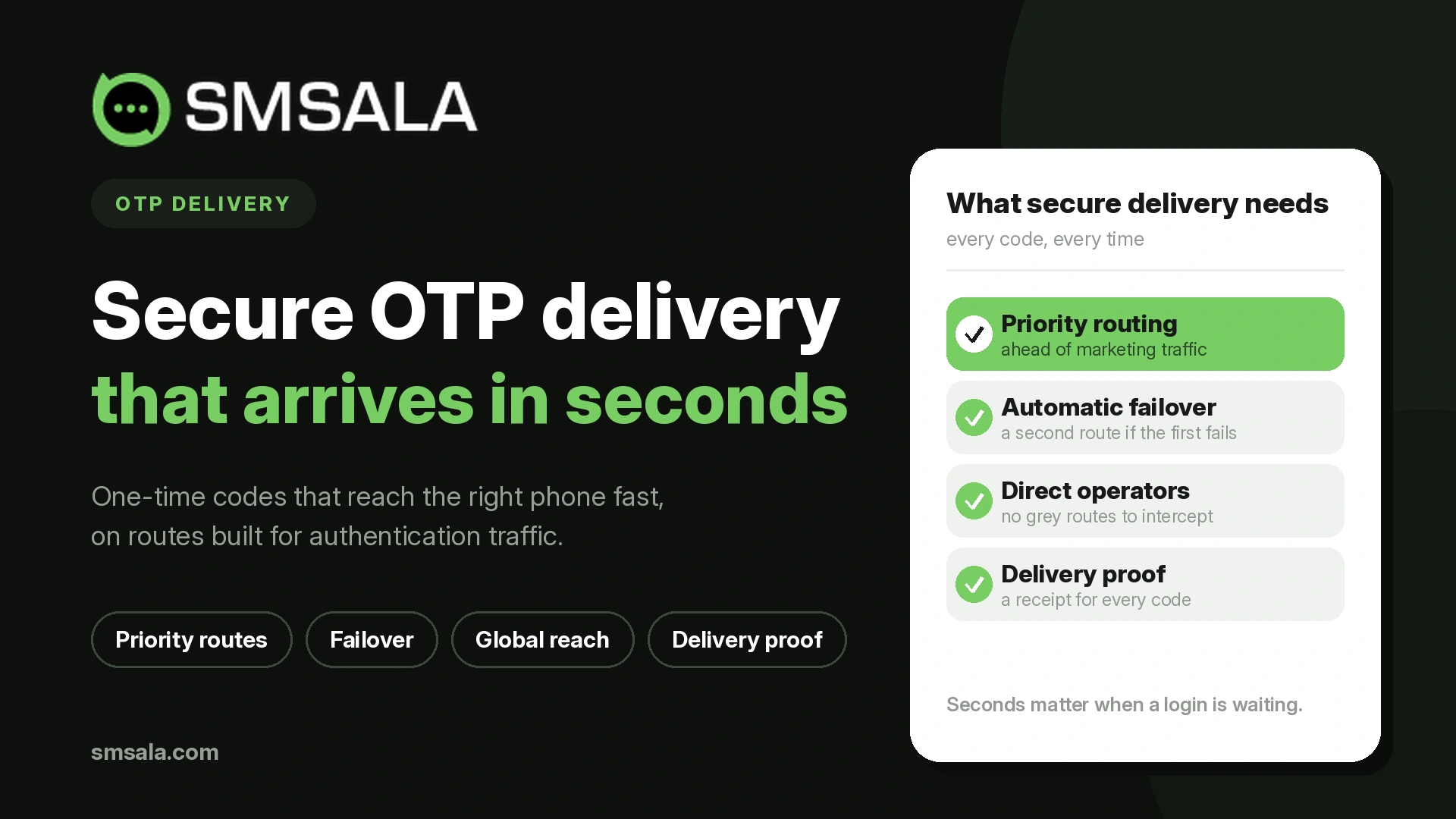
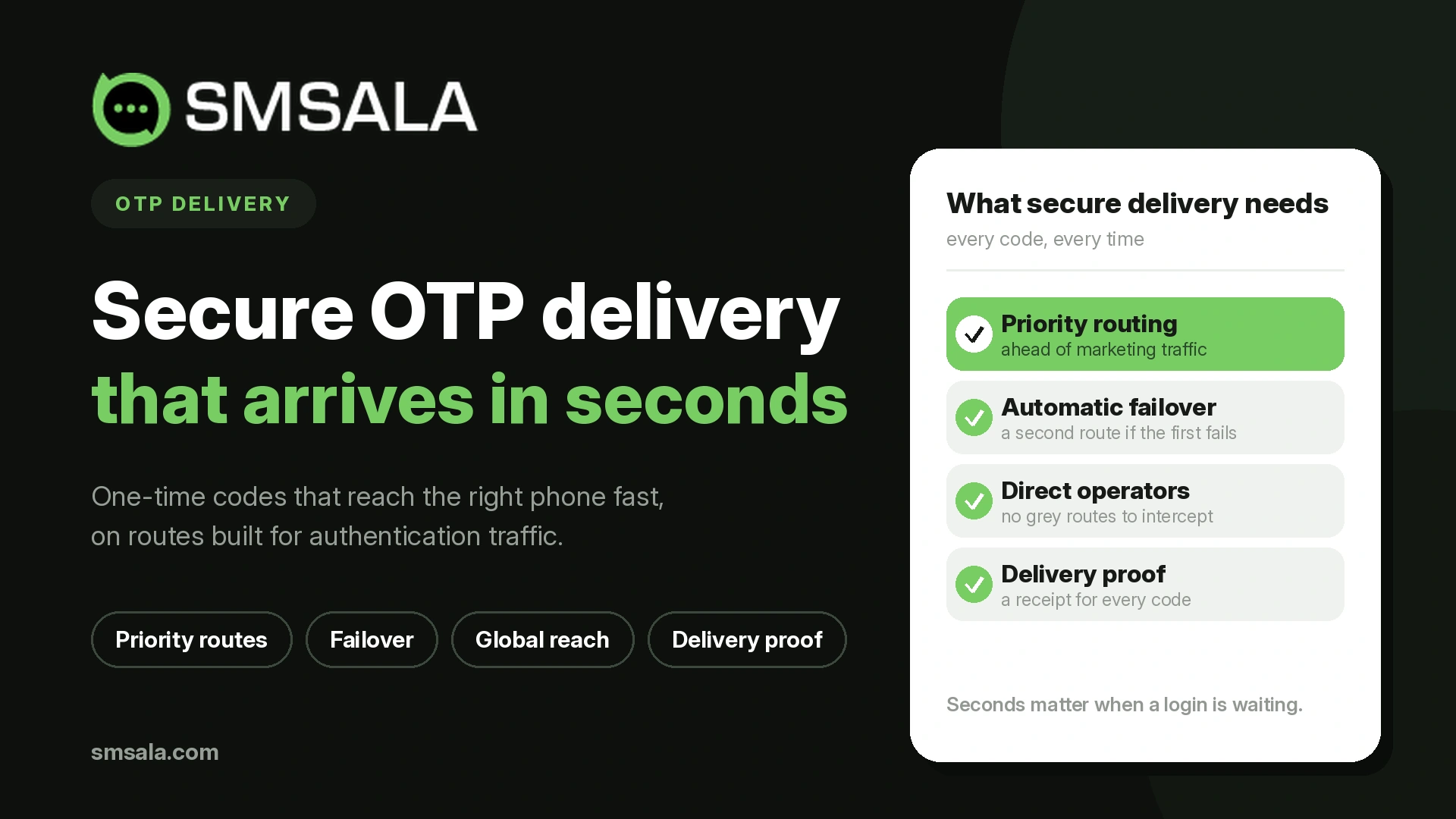
The route is the biggest factor. OTP traffic must travel on direct, premium carrier routes. Cheap grey routes the ones that make bulk messaging look cheap introduce exactly the delays and failures OTP can't tolerate, and they can stop delivering mid-day when a carrier shuts them down. For OTP, the lowest-cost route is never the right choice; the priority is delivery in seconds, and that requires direct routing.
Carrier filtering can delay or block codes if your sender isn't recognised or your traffic looks suspicious, so clean, registered sending matters as much for speed as for compliance.
Dead and invalid numbers waste the attempt entirely a code sent to a number that no longer exists is a guaranteed failure and a frustrated user who never gets in. Validating numbers before sending, where appropriate, removes that failure before it happens.
Congestion and queuing hurt when OTP traffic isn't prioritised. If your verification codes sit in the same queue as a marketing blast, they wait behind it which is why OTP needs priority handling, never to be batched with promotional traffic.
The theme: OTP delivery rewards infrastructure built for speed and reliability, and punishes the cost-cutting that's tolerable for less urgent messages.
Reliability through fallback: one channel is a single point of failure
Here's the shift that separates a fragile OTP system from a dependable one: no single channel delivers to everyone, every time, so the reliable systems don't rely on one.
SMS is the right primary channel for OTP because of its universal reach it works on any phone without an app. But SMS isn't infallible: a message can fail, a carrier can filter it, a user can be roaming or in a dead zone, or a number can be a landline that can't receive texts. When that happens, a single-channel system just fails, and the user is locked out.
Fallback logic fixes this. If the SMS doesn't deliver or the code isn't entered within a set window, the system automatically retries through another channel a voice call that reads the code aloud, a message via the WhatsApp Business API, or email as a last resort. Voice fallback is especially valuable because it reaches landlines and users who can't receive SMS at all, and because a ringing phone gets attention. The result is a system whose overall reliability far exceeds any single channel's, because a failure in one path is caught by the next.
The design principle is to lead with the fastest, most universal channel and have automatic, time-boxed fallback behind it not to make the user request a new code through a different method, but to escalate silently so the code arrives one way or another.
The "secure" half: protecting the delivery itself
Speed and reliability get a code to the user. Security makes sure the code delivery can't be exploited or spoofed along the way. Several practices matter, and they're distinct from the question of whether OTP stops fraud in the first place.
Send from a recognisable, registered sender. A consistent sender ID that users learn to associate with you does double duty: it improves deliverability and it's an anti-phishing measure, because users who know what a real code message looks like are harder to fool with a fake one. Registration also keeps the sender from being overridden or filtered.
Expire codes quickly. A short validity window a few minutes limits the time an intercepted or leaked code is useful. Long-lived codes are a standing risk.
Rate-limit the request endpoint. The system that sends codes on demand can be abused: attackers trigger mass OTP requests to run up your bill (SMS pumping) or to harass a target. Limiting requests per number and per source, backed by carrier-side SMS firewalls, protects both your costs and your users.
Expose the minimum. The message should carry the code and little else not account details, balances, or anything sensitive that turns an intercepted message into a bigger breach. "Your code is 4827" is safer than a message restating who you are and what account it's for.
Encrypt in transit. Traffic between your systems and the provider should be encrypted, so codes aren't exposed on the way to being sent.
Together these make the delivery itself secure hard to spoof, quick to expire, expensive to abuse, and minimal in what it reveals.
Delivering OTPs globally
OTP delivery gets harder across borders, and a system that works flawlessly at home can stumble abroad. Routing quality varies by country, sender ID rules differ (some markets require registered senders, some don't permit alphanumeric IDs at all), and some countries have specific regulations around verification traffic. A provider with strong direct routes and local sender registration in your target markets is what keeps delivery fast and reliable internationally, rather than degrading to slow, unreliable paths the further from home you send. This is where per-country delivery rates diverge sharply, and where testing real delivery in each market you serve matters most.
Delivering OTPs at scale
At high volume a large consumer app sending codes constantly OTP delivery becomes an infrastructure question. Three things matter most. Throughput must absorb spikes without queuing, because verification demand is bursty and a code delayed by a traffic surge is a code that failed. Priority handling ensures OTP traffic is treated as the high-priority, time-critical class it is, never batched behind bulk sends. And redundancy across routes and channels keeps delivery steady when any single path degrades. The scale question isn't just "can it send a lot" it's "can it send a lot, fast, with every code still arriving in seconds."
Measuring OTP delivery properly
Because OTP delivery is judged on speed and reliability together, measure both and don't stop at the numbers your provider reports.
Track delivery rate, yes, but also delivery time: how long from request to arrival, because that's what conversion hinges on. Track the conversion rate codes actually entered successfully as the truest measure of whether delivery worked in practice. Break failures down by country and carrier, because problems cluster there and a global average hides them. And treat the delivery reports with appropriate skepticism: on poor routes, "delivered" statuses can be inaccurate, so for OTP where a false "delivered" means a locked-out user independent verification that codes genuinely arrive is worth the effort. A dashboard showing high delivery while users complain they never got their code is a sign of exactly this.
Best-practice checklist for secure OTP delivery
Route OTP traffic on direct, premium paths never grey routes for speed and reliability.
Prioritise OTP traffic so it never queues behind marketing or bulk sends.
Build automatic, time-boxed fallback to voice or another channel when SMS doesn't deliver.
Send from a consistent, registered sender ID for deliverability and anti-phishing.
Expire codes within a few minutes and expose nothing beyond the code.
Rate-limit the request endpoint to prevent abuse and pumping.
Validate numbers and handle country-by-country routing and sender rules.
Measure delivery time and conversion, not just delivery rate, and verify real arrival on critical routes.
The bottom line
Secure OTP delivery is a speed problem, a reliability problem, and a security problem at once, and doing it well means treating it as all three. The code has to arrive in seconds, because a late code is a failed one; it has to arrive reliably, which means direct routing and automatic fallback rather than a single fragile channel; and it has to arrive safely, from a recognised sender, quick to expire and protected against abuse. Build for those together fast routes, prioritised traffic, multi-channel fallback, and delivery-channel security and OTP becomes the seamless, trusted step it's meant to be. Build for delivery rate alone, and you'll ship a system that looks fine on a dashboard while quietly locking customers out.
SMSala delivers OTP traffic on direct, prioritised routes with multi-channel fallback, sender registration, and the verification-grade reliability that time-critical codes demand including for high-stakes sectors like banking where a failed code is a failed transaction but wherever you deliver from, the goal is the same: the right code, to the right person, in seconds, safely.
Frequently asked questions
Why does OTP delivery speed matter so much?
Because the user is waiting on a screen for the code, and every second lost causes some to abandon the login or purchase. A code that arrives a minute late has effectively failed, even though the network reports it delivered. For OTP, delivery time is a conversion metric, so speed matters as much as whether the code arrives at all.
Why shouldn't I use the cheapest route for OTP?
Because the cheapest routes grey routes introduce delays and failures OTP can't tolerate, and they can stop delivering without warning when carriers shut them down. OTP demands direct, premium routing that delivers in seconds. For most messaging, cost matters; for OTP, speed and reliability come first, because a slow or dropped code is a locked-out customer.
What is OTP fallback and why do I need it?
Fallback is automatically retrying delivery through another channel typically a voice call reading the code aloud, or WhatsApp when SMS doesn't deliver or the code isn't entered in time. No single channel reaches everyone every time, so fallback turns a fragile single-channel system into a reliable one, catching failures that would otherwise lock users out.
What makes OTP delivery "secure" beyond just sending the code?
Sending from a recognised, registered sender (which resists phishing and improves deliverability), expiring codes quickly, rate-limiting the request endpoint to prevent abuse and inflated-traffic fraud, exposing nothing beyond the code itself, and encrypting traffic in transit. These protect the delivery channel, which is distinct from whether OTP as a method stops a given type of fraud.
How should I measure whether my OTP delivery is working?
Track delivery rate and delivery time together, and the conversion rate of codes actually entered, which reflects both. Break failures down by country and carrier, since problems cluster there, and verify real arrival independently on important routes because on poor routes a "delivered" status can be inaccurate, and for OTP that means a customer who's locked out.