
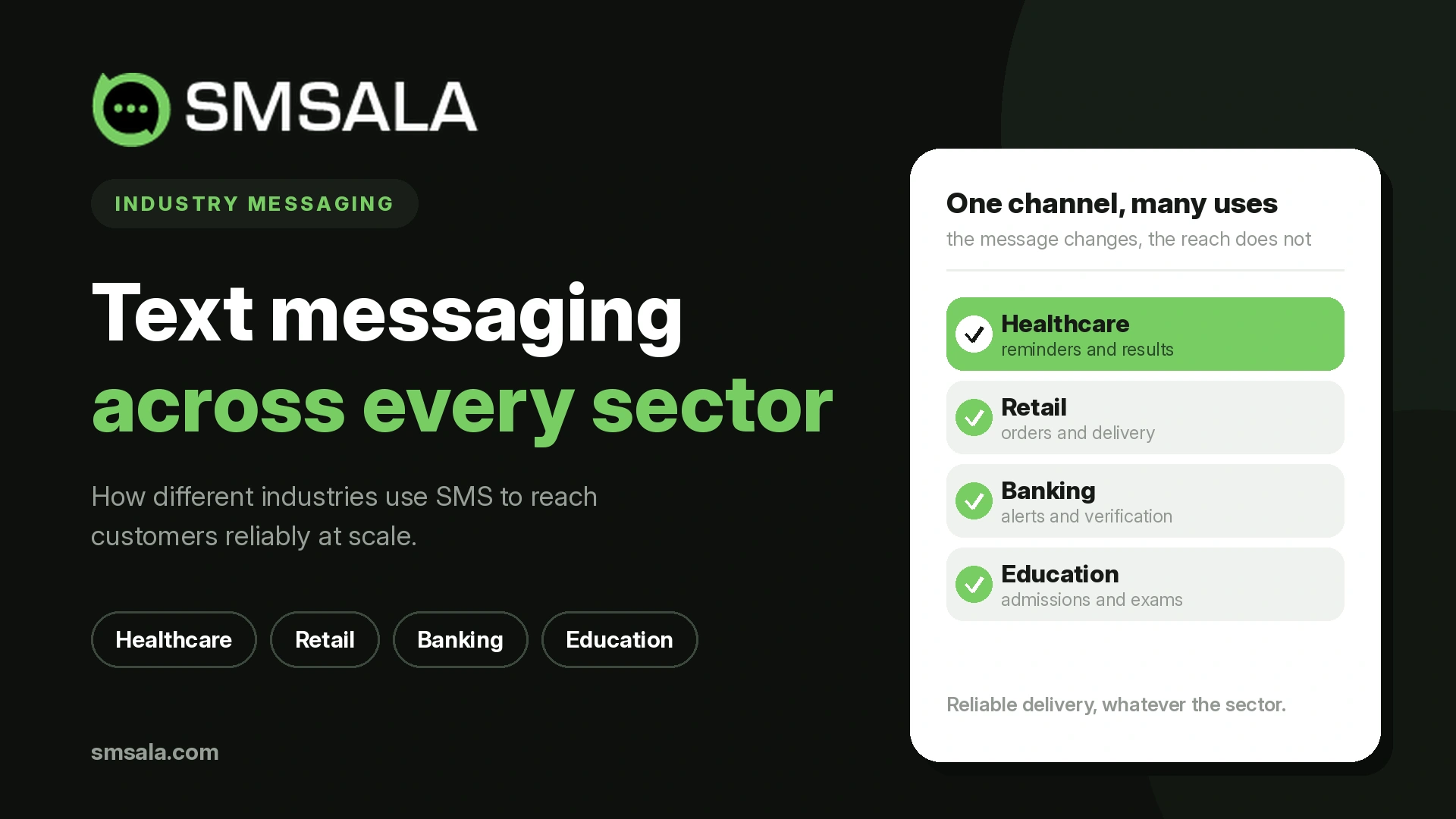
Text messaging is one of the few tools that works almost identically for a hospital, a law firm, a hair salon, and a shipping company, and yet each of them uses it to solve a completely different problem. That is what makes it worth understanding sector by sector rather than in the abstract. The hospital sends a reminder that prevents a missed appointment. The law firm sends an update that keeps a client informed without a phone call. The salon fills a cancelled slot. The courier tells someone their parcel is arriving. Same channel, same ninety-second read, entirely different value.
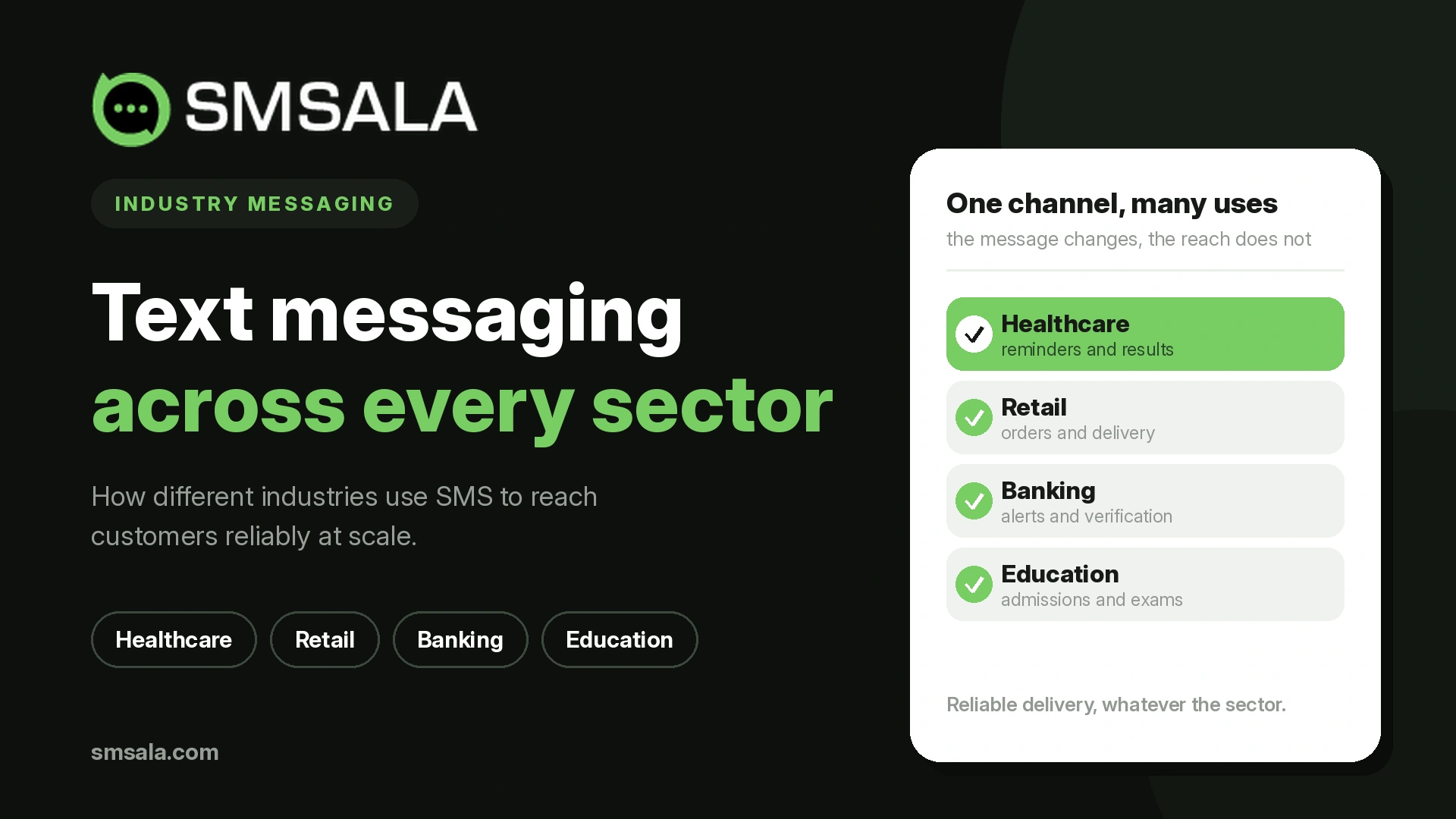
This guide maps how text messaging is actually used across industries, then covers the practical craft that applies everywhere: how QR codes bring people onto your list, when emojis and abbreviations help or hurt, why some messages get flagged as spam, and what quietly stops texts from being delivered. It is a working reference for anyone deciding how their own sector should use SMS.
Why text messaging works in almost every sector
Before the sector detail, it helps to see why one tool fits so many industries. Text messaging shares a small set of properties that happen to be valuable almost everywhere.
It reaches nearly everyone, on any phone, without an app or a data connection. It is read within minutes, which suits anything time-sensitive. It is short, which forces clarity. It is cheap enough that even routine messages pay for themselves. And it is measurable, so the value can be proven rather than assumed. Any business whose success depends on a customer showing up, paying on time, staying informed, or acting quickly has a use for a channel with those properties, which is most businesses.
The two jobs text messaging does everywhere
Across every sector, business texting does one of two jobs, and separating them is the key to using it well.
The first is operational: messages that keep things running, such as reminders, confirmations, alerts, verification codes, and status updates. These are welcomed because the recipient is expecting them, and they often deliver the highest value because a single reminder can save a missed appointment or a late payment.
The second is outreach: messages that promote, such as offers, launches, and re-engagement. These carry stricter consent and timing rules because they interrupt, and they work best sparingly and with genuine relevance.
Most sectors use both, but the balance shifts. A hospital is almost entirely operational; a retailer leans on outreach; a salon sits in between. Knowing which job a message is doing tells you which rules apply and how often you can send. The distinction between these and promotional messages governs everything from compliance to frequency.
How individual sectors use text messaging
The table below is a quick map. The sections that follow go deeper on the sectors where the detail matters most.
Sector | Operational uses | Outreach uses |
Retail and e-commerce | Order, shipping, delivery updates | Sales, restock alerts, cart recovery |
Healthcare and clinics | Appointment reminders, results-ready alerts | Health-program enrollment, checkup nudges |
Banking and finance | Transaction alerts, verification codes, payment reminders | Product offers to opted-in customers |
Education | Admissions, fees, exam and closure alerts | Course and event promotion |
Legal and professional services | Case updates, appointment and deadline reminders | Consultation and review requests |
Salons and personal care | Booking confirmations and reminders | Offers, loyalty rewards, slot-filling |
Hospitality and events | Bookings, check-in, itinerary changes | Promotions, event reminders, invitations |
Real estate | Viewing reminders, new-listing alerts | Project launches, buyer follow-ups |
Logistics and delivery | Dispatch, arrival, and failed-delivery notices | Service upgrades, feedback requests |
Internal and HR | Shift, safety, and emergency alerts to staff | Engagement and program announcements |
Retail and e-commerce
Retail is the most obvious fit and the most measurable. The operational side, order and shipping updates, is now expected by customers and quietly builds trust. The outreach side, flash sales, back-in-stock alerts, and cart recovery, is where the direct revenue sits, especially when tied to automation so a reminder fires the moment a cart is abandoned. This is the sector where bulk SMS marketing most clearly pays for itself.
Healthcare and clinics
Healthcare runs almost entirely on operational messaging, and the value is unusually concrete: a no-show is unrecoverable time, and a single reminder converts a likely miss into a kept appointment or a slot someone else can fill. Results-ready alerts, prescription and follow-up reminders, and preparation instructions round out the mix. Because health data is sensitive, consent and secure handling carry extra weight here, and messages stay strictly informational rather than promotional.
Banking, finance, and insurance
Finance uses text messaging for trust and time-critical alerts more than promotion. Transaction and fraud alerts, balance notices, payment and renewal reminders, and above all verification codes are the core. Delivering a reliable OTP for banking is often the first reason a financial business adopts SMS at all, and dependable one-time passcodes remain among the highest-volume, highest-stakes messages any sector sends. The promotional layer is light and tightly regulated.
Education and universities
Schools, colleges, and universities use text messaging to cut through where email quietly fails with a young, mobile-first audience. Admissions updates, fee and deadline reminders, exam and result notifications, timetable changes, and emergency or closure alerts all suit a channel that is read in minutes. Universities in particular manage large, distributed populations of students, parents, and staff, and a well-segmented SMS program reaches each group with the right message, from application status to campus safety alerts.
Legal and professional services
Law firms and other professional-service providers use text messaging to stay in contact without the friction of phone tag. Case and matter updates, appointment and court-date reminders, document-ready notifications, and consultation confirmations keep clients informed and reduce missed meetings. The tone stays professional and the content operational, with outreach limited to consultation offers or review requests to existing, consenting clients. Confidentiality and clear consent matter more here than in most sectors, so messages avoid sensitive detail and point to secure channels for anything private.
Salons, spas, and personal care
Appointment-based personal-care businesses live and die by their calendar, which makes SMS a natural fit. Booking confirmations and reminders cut no-shows, and the same channel fills last-minute cancellations by texting a waitlist or a nearby offer. On the outreach side, loyalty rewards, birthday offers, and quiet-day promotions bring regulars back. For a small salon, a simple reminder-plus-offer program is often the single highest-return marketing it runs.
Hospitality, events, and weddings
Hospitality uses text messaging across the whole guest journey, from booking confirmation to check-in details to real-time updates about a delay or a change. Events extend this to invitations, reminders, and last-minute logistics, where a text the day before reliably lifts attendance in a way email misses. Even personal events such as weddings increasingly use SMS for invitations, RSVPs, and day-of coordination, because a message in the pocket reaches guests who never open their email. The common thread is time-sensitive coordination, exactly what SMS handles best.
Real estate
Property is a fast-moving, high-value market where the worth of a message decays by the hour. A new-listing alert that matches a buyer's criteria, a price change, or a viewing reminder all reach the buyer while the opportunity is live. Agents use SMS as a lead-response tool as much as a marketing one, and enabling replies turns an alert into a conversation and a conversation into a viewing.
Logistics and delivery
Logistics is pure operational messaging, and customers now expect it. Dispatch, out-for-delivery, arrival-window, and failed-delivery notices reduce support calls and missed handovers, and a reply option lets recipients reschedule or redirect. In a sector where a missed delivery is a real cost, a timely text is cheaper than a second attempt.
Internal and employee communication
Text messaging is not only outward-facing. Organizations use it to reach their own people, especially deskless and shift-based workers who do not sit at email all day. Shift schedules and changes, safety and emergency alerts, and urgent operational notices reach staff instantly on the device they always carry. For a distributed or frontline workforce, SMS is often the only channel that reliably gets an urgent message read, which is why it underpins a lot of internal mass communication.
The practical craft that applies to every sector
Whatever the industry, a few cross-cutting techniques decide whether a program works. These are the details that separate a text people act on from one they ignore or report.
QR codes as an entry point
A QR code is one of the simplest ways to grow a consented list, because it bridges the physical and digital worlds. A code on a receipt, poster, table tent, or product can open a pre-filled text or a sign-up page, letting someone opt in with a scan instead of typing. It suits exactly the sectors with physical touchpoints, such as retail, hospitality, salons, and events, and it captures intent at the moment interest is highest. Pointing the scan at a purpose-built sign-up or offer on dedicated landing pages turns a glance into a subscriber.
Emojis and abbreviations
Emojis and shorthand can make a message feel human, but both carry costs that many senders miss. A single emoji switches the message from the standard GSM-7 alphabet to Unicode encoding, which cuts the segment limit from 160 characters to 70 and can quietly turn one text into three, multiplying the cost of a large send. Abbreviations save characters but risk clarity, and heavy text-speak can read as unprofessional in sectors such as legal or finance where trust matters. The rule of thumb: use them sparingly, match them to your audience and sector, and never at the expense of a message being instantly understood.
Why messages get flagged as spam, and how to avoid it
Recipients and carriers both judge messages fast, and looking like spam is fatal. People identify spam by the tells: an unknown sender, no clear identity, a suspicious link, pressure tactics, and content they never agreed to receive. Carriers apply the same logic at scale through carrier spam filters that silently drop traffic matching those patterns. Avoiding the spam label is mostly about doing the honest things: send only to people who opted in, identify yourself clearly in the first words, use a registered sender ID so your name displays instead of an anonymous number, keep links clean and branded, and never use false urgency. A message that looks trustworthy to a person usually looks trustworthy to a filter too.
What actually hinders delivery
A message can be perfect and still never arrive, and the causes are worth knowing because they sit outside the copy. The usual culprits are poor routing, where cheap grey routes get blocked without warning; unregistered senders in markets that require registration, which are filtered on sight; invalid or inactive numbers on a stale list; carrier filtering triggered by spam-like content; and recipients with no signal at the moment of sending. The defenses are equally concrete: send over direct routes, complete any required registration, clean the list with an HLR lookup before large sends, and watch your delivery rate so a drop is caught early rather than discovered in a quarter of lost results. Delivery is the first thing every sector should protect, because nothing else matters if the message does not land.
Choosing how to send across sectors
The right sending method depends on the job. Operational messages that must fire from another system, such as an appointment reminder or a verification code, belong on an automated connection or a triggered flow. Periodic outreach can run from a dashboard. High-volume, time-critical alerts need the reach of bulk SMS on clean routes. And two-way needs, from confirming an appointment to answering a query, call for two-way messaging or a chatbot that can handle routine replies. Many organizations combine several, and increasingly coordinate SMS with richer channels such as WhatsApp Business and RCS so each message travels the way it works best.
Common mistakes across sectors
A few errors recur regardless of industry. Treating operational and outreach messages the same, and applying promotional rules loosely to consent-sensitive sectors like healthcare or finance. Sending without proper consent and getting flagged as spam. Ignoring the encoding cost of emojis on large sends. Choosing a cheap provider on grey routes and losing messages silently. Blasting outreach to a whole list instead of segmenting by need. And failing to watch delivery, so problems hide until results suffer. Each is avoidable, and each undermines an otherwise sound program.
Frequently asked questions
Which industries benefit most from text messaging?
Almost any sector that depends on customers showing up, paying on time, staying informed, or acting quickly. Retail, healthcare, finance, education, hospitality, real estate, logistics, and personal-care services all see strong results, though the balance of operational versus promotional use differs by sector.
What is the difference between operational and promotional business texts?
Operational messages keep things running, such as reminders, confirmations, alerts, and verification codes, and are expected by the recipient. Promotional messages market something and carry stricter consent and timing rules. Most sectors use both, weighted toward one or the other.
Do emojis cost more in a text message?
They can. A single emoji switches a message to Unicode encoding, which reduces the per-segment limit from 160 to 70 characters, so a message can span more segments and cost more across a large send. Use emojis deliberately, not by habit.
Why do some business texts get marked as spam?
Because they show the tells recipients and carriers watch for: an unknown or unregistered sender, no clear identity, suspicious links, false urgency, or content the person never opted into. Sending only to consented contacts from a registered sender ID, with honest content, avoids the label.
How can QR codes help a text-messaging program?
A QR code lets someone opt in with a scan instead of typing, capturing consent at a physical touchpoint such as a receipt, poster, or product. It suits sectors with in-person interactions and grows a clean, permission-based list.
What stops a text message from being delivered?
Common causes include poor or grey routing, unregistered senders in regulated markets, invalid numbers, carrier spam filtering, and recipients with no signal. Direct routes, proper registration, list cleaning, and delivery monitoring address most of them.
Conclusion
Text messaging earns its place across industries because the same simple properties, reach, speed, brevity, and measurability, solve very different problems depending on the sector. The organizations that get the most from it are the ones that know which job each message is doing, respect the rules that job carries, and protect delivery so the message actually lands.
If you want text messaging set up correctly for your sector, with the routing, registration, automation, and two-way capability matched to how your industry actually uses it, that groundwork is where an experienced messaging partner earns its place, so your reminders, alerts, and offers arrive and do their job.