
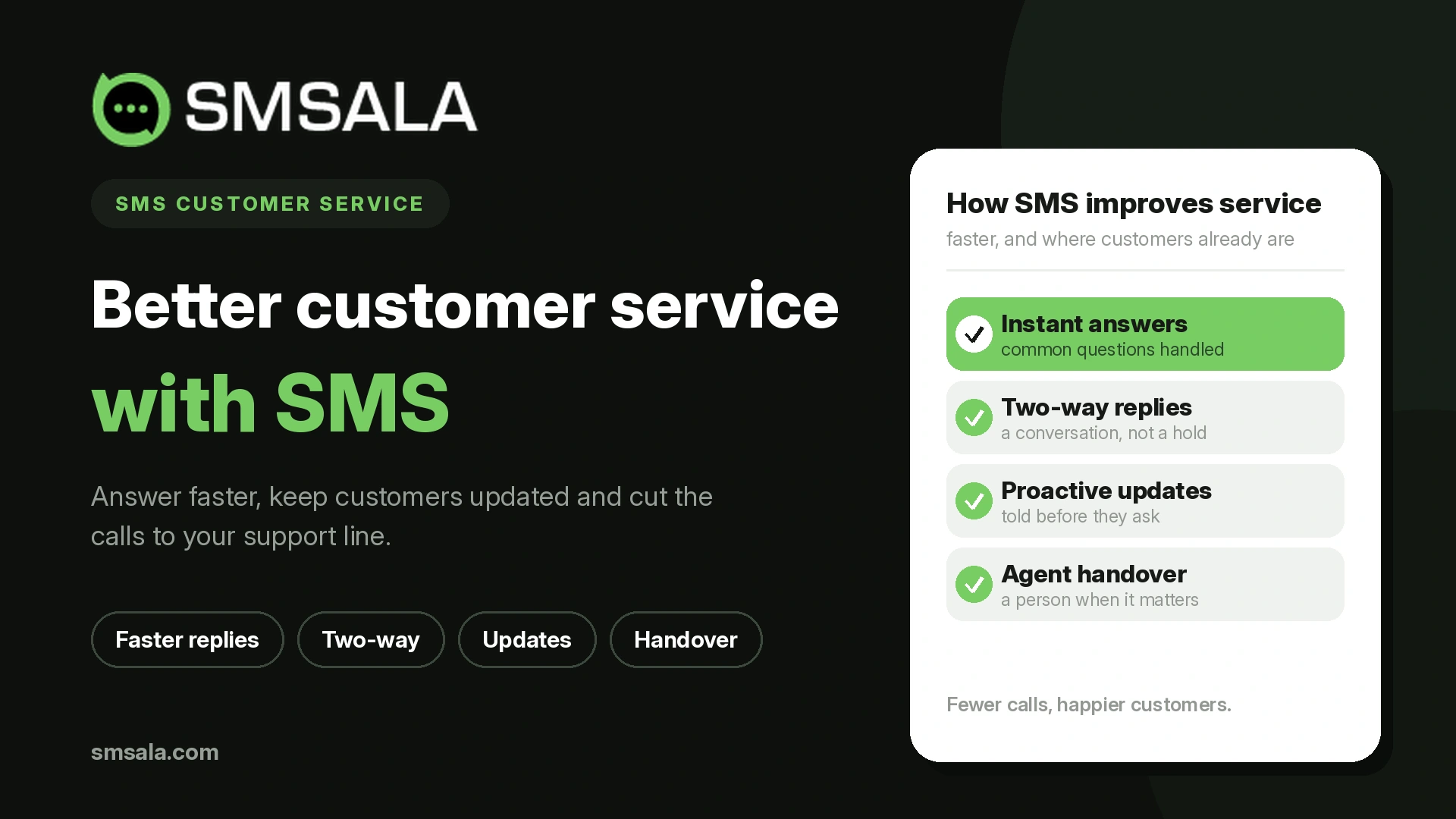
Most articles about using SMS for customer service treat it as one more channel to push things through — send reminders, blast discount codes, deliver receipts. All useful, none of it actually customer service, because service isn't about what you send to customers. It's about how well you respond when they need something. And that reframing is the whole point: SMS improves customer service not primarily by giving you a faster way to broadcast, but by giving customers a low-friction way to reach you — and giving you a fast, trackable way to answer.
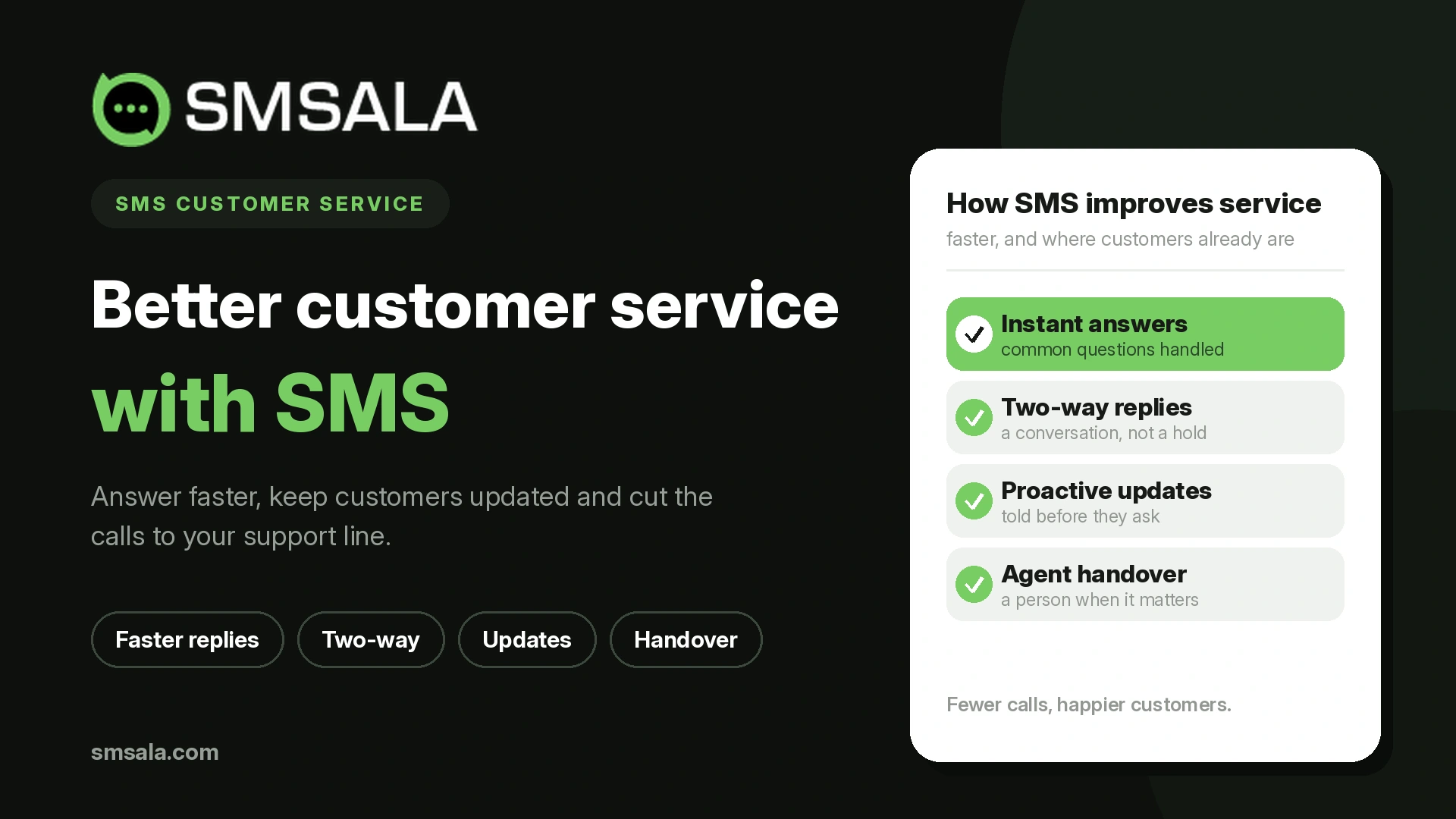
The difference matters because it changes which direction the channel points. Marketing SMS points outward: business to customer. Customer service SMS is fundamentally inbound-first: it works when the customer can start the conversation, ask their question, raise their problem, and get a real answer without the friction that makes them dread contacting support in the first place. The businesses that improve service with SMS are the ones that grasp this — they don't just add SMS to the outbound stack, they open a two-way line and staff the answering side of it. So this unpacks what SMS actually changes about the support relationship, layer by layer, rather than listing messages you can send.
The core shift: removing the friction of contacting support
Start with why customers dread contacting support at all, because SMS's biggest service improvement is dissolving exactly that friction. The traditional options are all high-effort. A phone call means navigating a menu, waiting on hold, and being available to talk in real time. Email means composing a formal message and waiting hours or days for a reply. A web form means finding it, filling it, and hoping it goes somewhere. Each carries enough effort that many customers simply don't bother — they stay quietly dissatisfied, or they leave.
SMS collapses that friction. Texting a question takes seconds, requires no waiting on hold, no real-time availability, no formal composition — it's the same effortless action people use with friends all day. The mechanism that improves service is that lowering the cost of contact raises the rate at which customers actually raise issues — and a customer who tells you about a problem is one you can fix and keep, whereas one who silently leaves is gone with no chance to recover them. This is the foundational value: two-way messaging turns support from something customers avoid into something they'll actually use, which surfaces problems you'd otherwise never hear about until the customer had already churned.
And most people genuinely prefer it. Given the choice between resolving an issue by phone call or by text, a large share choose text — it's asynchronous, it doesn't demand their full attention, and it leaves a written record they can refer back to. Meeting customers on the channel they'd rather use is itself a service improvement before a single problem is solved.
Why the inbound direction is what changes everything
To use SMS for service well, you have to understand the distinction between outbound and inbound messaging, because service lives mostly on the inbound side and most businesses only set up the outbound.
Outbound SMS is what marketing uses — the business initiates, the customer receives. Inbound SMS is the reverse — the customer initiates, and the message arrives at the business. Real customer service requires both directions working together: the customer texts in (inbound), a person or system responds (outbound), the customer replies (inbound), and so on until the issue is resolved. A business that only configures outbound has a broadcast channel, not a service channel. Understanding inbound and outbound SMS as two halves of one conversation is what separates a service deployment from a marketing one.
The practical requirement this creates: replies must reach someone who answers. An inbound message that lands in a void teaches the customer the channel is fake, which is worse than not offering it — you've invited them to reach out and then ignored them. So opening an SMS service line is a commitment to staff or automate the answering side, not just a feature to switch on.
Where automation genuinely helps — and where it doesn't
Once the two-way line is open, the question becomes how to answer at volume without a human typing every reply. This is where automation fits, and knowing its boundary is what keeps automated service from becoming worse than no service.
Automation handles the predictable well. An SMS autoresponder can instantly answer the common, structured questions — opening hours, order status, appointment details, "text BALANCE for your balance" — that make up a large share of inbound volume. For more, an SMS chatbot can handle multi-step interactions, triage incoming queries, and resolve routine issues end to end, escalating to a human only when it hits something it can't handle. The service improvement is speed: the customer gets an instant answer to a common question at any hour, instead of waiting for business hours and a human.
The boundary that matters: automation should resolve the routine and route the rest, never trap a customer in a loop. The failure mode is a bot that can't answer the actual question and won't hand off to a person — which is more frustrating than no automation at all, because it wastes the customer's time and then abandons them. The rule is that a customer must always be able to reach a human when the automation can't help. Used within that boundary — fast on the routine, clean handoff on the complex — automation improves service; used as a wall between the customer and a real answer, it destroys it.
The service uses that actually matter
With the two-way, appropriately-automated line in place, here are the specific ways SMS improves service — organised by what each does for the customer, not just what it sends:
Resolving issues conversationally. The central use: a customer texts a problem and gets it solved through a short exchange, faster and with less effort than any call or email. This is service SMS at its core.
Proactive updates that pre-empt the question. Order status, delivery windows, appointment confirmations, and reminders sent before the customer wonders — each removes a reason the customer would have had to contact you, which improves service by eliminating the need for it. A customer who's told "your order ships tomorrow" doesn't need to ask.
Gathering feedback that closes the loop. A quick post-interaction SMS poll — "How did we do? Reply 1–5" — gets far higher response than email because replying is effortless, and a low score is an early warning you can act on privately before it becomes a public complaint. This is service improving itself: the feedback tells you where service is failing.
Digital receipts and records. Sending receipts, confirmations, and reference numbers by text gives the customer a durable, searchable record on the device they always have — no paper to lose, no inbox to dig through.
Delivering account-specific information on request. Letting a customer text to check a balance, an order, or a booking gives them self-service answers instantly, which serves them and reduces load on your team at once.
Notice the pattern: each use either lets the customer resolve something with less friction, or removes a reason they'd have needed to contact you. That's what "improving customer service" concretely means — not more messages, but less effort and less waiting for the customer.
The infrastructure that makes it work at scale: CRM integration
For SMS service to work beyond a handful of conversations, it has to connect to what you already know about the customer — otherwise every interaction starts from zero, which is itself poor service.
The mechanism is context. When SMS is integrated with your CRM, the person or system answering a customer's text can see who they are, what they've bought, their history, and any open issues — so the customer doesn't have to re-explain themselves, and the response is informed rather than generic. A customer who texts "where's my order?" gets an answer that already knows which order, because the CRM supplied it. This is the difference between a service interaction that feels personal and competent and one that feels like starting a fresh support ticket every time. Integration is also what lets you route the right conversation to the right person, track resolution, and maintain a coherent history across a customer's interactions. Without it, SMS service is a series of disconnected texts; with it, it's a coherent support channel that remembers.
The internal dimension: serving customers starts with reaching staff
An easily-missed part of SMS improving customer service is that good external service often depends on good internal communication, and SMS serves that too.
The connection is direct: staff who get timely information serve customers better. Reaching employees by SMS — shift changes, urgent operational updates, a heads-up about a service outage before customers start asking, emergency notifications — means the frontline knows what's happening and can respond to customers accurately instead of being caught unaware. A support team texted "the payment system is down, here's the holding message" serves customers far better than one blindsided by complaints. Using SMS to communicate with employees is a quiet enabler of customer service, because the quality of what your staff can tell customers depends on what they've been told themselves.
The relationship payoff: service as retention
Step back and the reason all this matters commercially is that good service is retention, and SMS improves the service that keeps customers.
The logic is that customers leave over friction and feeling unheard far more than over price. A customer whose problem was solved quickly by text, who got proactive updates instead of anxious silence, and who felt able to reach a real person when they needed one, has little reason to leave and every reason to trust the business again. Each well-handled service interaction is a deposit in the relationship. This is where customer service and customer relationships merge — the responsiveness that resolves a problem today is the same thing that earns the renewal, the repeat purchase, and the recommendation tomorrow. SMS improves service, and improved service is one of the most durable drivers of retention a business has.
The bottom line
SMS improves customer service by inverting the usual direction of the channel — from broadcasting at customers to answering them. Its core value is removing the friction that makes people dread contacting support: texting a question takes seconds and needs no hold music, real-time availability, or formal composition, so customers actually raise issues instead of silently leaving. Realising that value means treating SMS as inbound-first, staffing or sensibly automating the answering side, connecting it to your CRM so responses are informed rather than generic, and keeping automation on the right side of the line where it resolves the routine and always lets customers reach a human. Layer in proactive updates that pre-empt questions, effortless feedback that reveals where service fails, and reliable internal communication so staff can serve well, and SMS becomes a genuine service channel rather than another outbound pipe. And because good service is what retains customers, improving it this way is among the most commercially valuable things SMS can do.
If you're building SMS into customer service, SMSala's two-way messaging with autoresponder and chatbot support, CRM integration, and inbound handling provides the answering infrastructure real service depends on — so a customer's text reaches someone who can actually help, informed by who they are.
FAQ
How does SMS improve customer service?
By removing the friction of contacting support. Texting a question takes seconds and needs no hold music, real-time availability, or formal writing, so customers actually raise issues instead of silently leaving. It also lets businesses answer quickly, send proactive updates that pre-empt questions, and gather feedback effortlessly — all of which resolve problems with less effort for the customer.
Is SMS better than phone calls for customer service?
For many customers, yes. Given the choice, a large share prefer texting because it's asynchronous, doesn't demand their full attention, avoids waiting on hold, and leaves a written record they can refer back to. Phone still suits complex or emotional issues, but for routine queries, SMS is faster and lower-effort for both sides.
What is the difference between inbound and outbound SMS in customer service?
Outbound is business-to-customer — updates, reminders, confirmations the business initiates. Inbound is customer-to-business — the customer texting a question or problem. Real customer service needs both working together as a conversation, and businesses that only set up outbound have a broadcast channel rather than a service channel.
Should customer service SMS be automated?
Partly. Automation via autoresponders and chatbots should handle routine, predictable questions instantly — hours, order status, balances — and route complex issues to a human. The critical rule is that customers must always be able to reach a person when automation can't help; a bot that traps customers without a human handoff is worse than no automation.
Why does SMS customer service need CRM integration?
So responses are informed by context. When SMS connects to the CRM, whoever answers can see the customer's identity, history, and open issues, so the customer doesn't have to re-explain themselves and the reply is relevant. Without integration, every interaction starts from zero, which feels like opening a fresh support ticket each time.
Can SMS customer service improve customer retention?
Yes. Customers churn over friction and feeling unheard more than over price. Fast, low-effort problem resolution, proactive updates that prevent anxious silence, and the ability to reach a real person all build trust. Each well-handled service interaction strengthens the relationship, making good SMS service one of the most durable drivers of retention.