
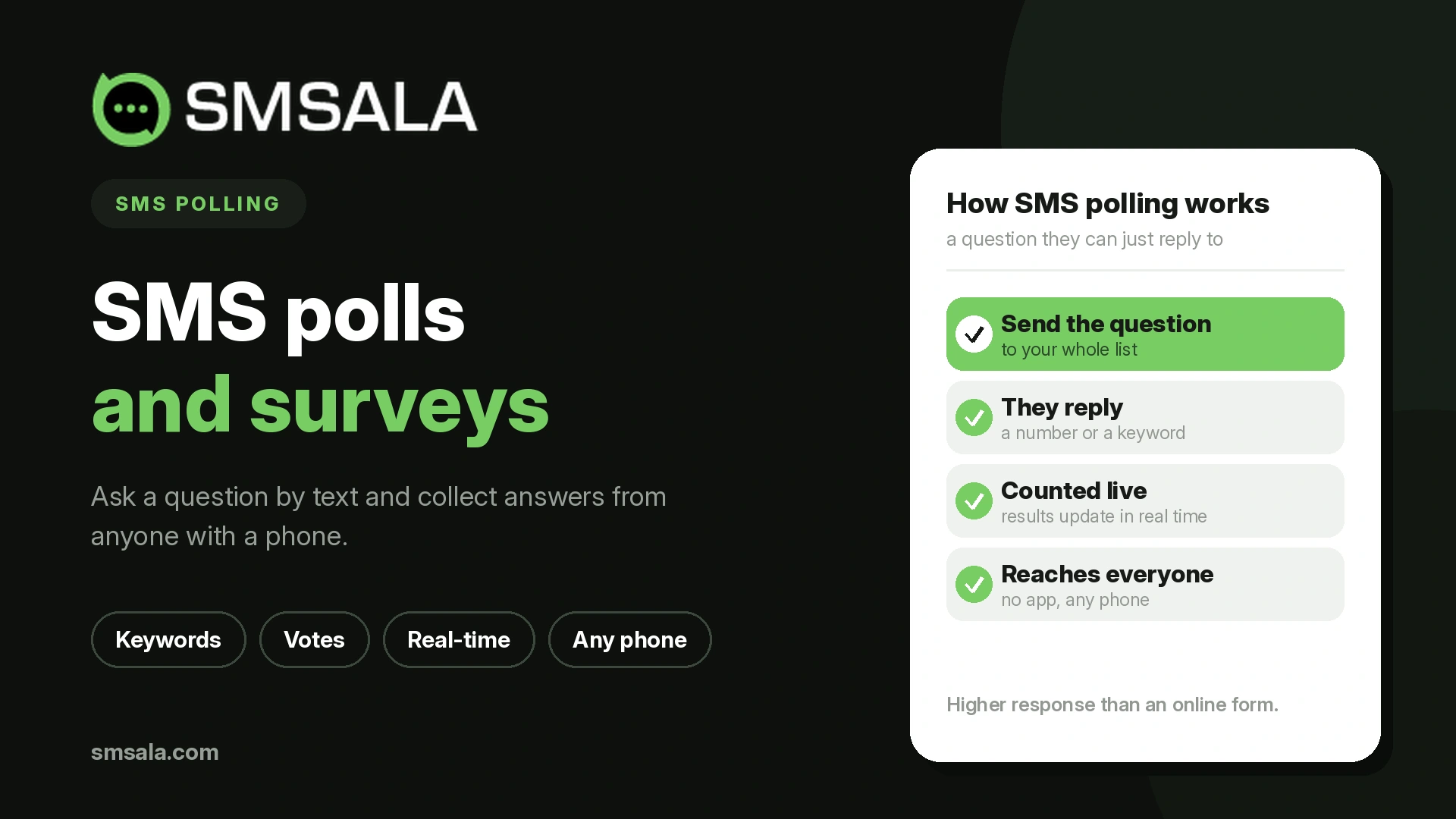
An SMS poll asks a question by text and collects the answers as replies. People open texts, respond in seconds, and need no app to take part, which is why a well-run poll can gather more responses, faster, than almost any other channel. Whether those responses are actually useful is a different question, and it comes down to two decisions: choosing the right way to run the poll, and designing it so the answers are clean enough to act on.
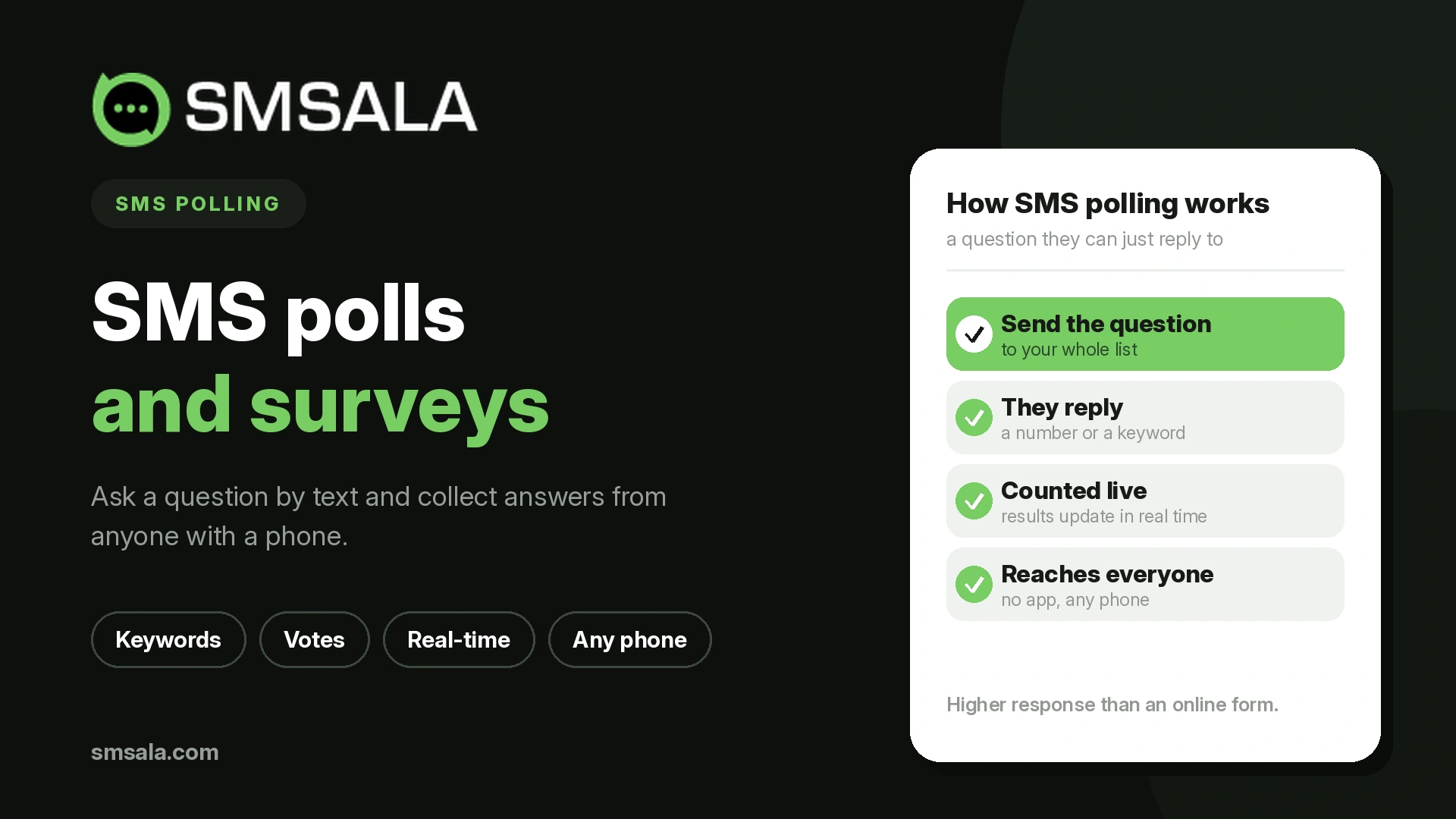
Get those right and SMS polling is one of the most efficient feedback tools available. Get them wrong and you collect a pile of replies you cannot interpret.
The two ways to run an SMS poll
"SMS polling" describes two different mechanics, and picking the wrong one for your goal is the most common mistake.
Mechanism | How it works | Best for | What you need |
Inbound keyword poll | The audience texts a keyword or option to your number to vote | Live audiences, events, contests, broadcast | A reply-capable number or short code with keyword handling |
Outbound reply poll | You send a question to your list; they reply with an answer | Customer feedback, satisfaction, quick pulse checks | An opted-in contact list |
Outbound link survey | You text a link to a web survey with several questions | Deeper research needing more than one question | A survey tool and a mobile-friendly page |
The direction is the key distinction. In an inbound poll the audience comes to you, having seen a prompt like "Text YES to 12345." In an outbound poll you go to your existing contacts. They solve different problems, and the rest of your design follows from which one you are running.
Inbound keyword polls: letting an audience vote
Inbound polling suits any moment where a crowd wants to weigh in at once. A live event asks the room to vote on a topic, a radio show invites listeners to pick a song, a contest lets fans choose a winner, a conference gauges opinion in real time. The audience texts a keyword to a published number, the system tallies replies as they arrive, and results update live.
What makes this work is the inbound number. Because a branded Sender ID cannot receive messages, an inbound poll needs a short code or a reply-capable long number set up to route incoming keywords, which is simply inbound and outbound SMS working together. Assign a distinct keyword to each option, keep the instructions on screen or on air simple, and the tally takes care of itself.
Outbound polls: asking the people you already know
Outbound polling reverses the flow. You send a question to your contacts and collect their answers, and it is the natural fit for customer feedback: a satisfaction check after a purchase, a quick preference question, a rating request after a support call. Here you choose between two formats, and the choice is a genuine trade-off.
A reply-based poll asks a single question and invites a direct answer, such as "How was your visit? Reply 1 to 5." It gets the highest response because answering is one tap, but free-form replies can be messy to interpret. A link-based survey texts a short message with a link to a web form, which lets you ask several questions and collect cleaner, structured data, at the cost of lower completion because each extra step loses people. Pointing to a fast, mobile-friendly landing page narrows that gap, but the rule holds: the more you ask, the fewer finish. Ask for one thing by reply when response rate matters most, and use a link only when the extra questions are worth the drop-off.
Designing a poll that gives usable answers
The wording of the question decides the quality of the data more than any platform feature.
Ask one thing. A poll that asks two questions at once produces answers you cannot cleanly separate. Make the response format unambiguous, because "Reply A or B" and "Rate 1 to 5" collect tidy data, while an open "What do you think?" collects sentences you must read one by one. Expect messy replies regardless, since people will answer "yes please" instead of "1," so decide in advance how you will interpret or re-prompt them. Keep the whole interaction to a single tap where you can, and mind the timing, sending right after the experience you are asking about while it is fresh. A poll designed this way practically analyzes itself; one that is vague creates work and doubt.
The honest part: fast responses are not representative ones
This is where SMS polling is most often misused. A high response rate feels like strong data, but the people who reply to an SMS poll are the ones who chose to, which is not the same as a representative sample of your customers, your audience, or the public. They tend to be your more engaged, more opinionated contacts.
That self-selection is fine, even ideal, for what SMS polling is actually good at: gauging engagement, collecting feedback from willing customers, running a fun contest, taking a quick pulse. It is a problem the moment you treat the results as representative research and generalize them to everyone. An event poll tells you what the people in the room who bothered to text think, not what all attendees think, and certainly not what the wider population thinks. Use SMS polls to hear from your audience, not to speak for a population you did not sample. Keeping that distinction clear is the difference between a useful signal and a misleading one.
Voting in is not opting in
Consent trips up SMS polling in a specific way. When someone texts a keyword to vote, they have initiated that single interaction, but they have not agreed to receive your marketing. Adding those numbers to a promotional list and texting them later is a compliance violation, however tempting the freshly collected contacts look. If you want to keep messaging poll participants, you need a separate, explicit opt-in, usually offered in your reply to their vote.
Outbound polls carry the opposite requirement: you can only poll contacts who already opted in to hear from you. Either way, every message needs working HELP and STOP handling, and the traffic runs under the usual rules, meaning 10DLC registration in the US and equivalent regimes elsewhere. Treat a vote as permission for that vote, nothing more, unless the person clearly agrees otherwise.
Closing the loop
Collecting responses is only half the value; acting on them is the rest. Route the signal somewhere useful, so a low satisfaction score triggers a follow-up rather than sitting in a report, and connect results to customer records in your CRM so a response informs the next interaction. Because polls run over a reply channel, make sure your two-way messaging can receive and process answers reliably, and review the outcomes through proper analytics and reporting rather than eyeballing a stream of texts. A poll that changes what you do next is worth running; one whose results are never used is just noise you paid to send.
SMS polls versus other survey channels
SMS is not always the right survey tool. Its strengths are immediacy, reach, and completion on short questions, which makes it excellent for a one-tap rating or a live vote. Its weakness is depth: a long, multi-part questionnaire belongs on the web or in email, where respondents expect to spend a few minutes. The reliable pattern is to use SMS for the quick, timely question and to escalate to a fuller survey only when you genuinely need the detail, accepting that fewer people will finish it. Matching the channel to the length of what you are asking is most of the battle.
Frequently asked questions
How does an SMS poll actually work?
Either the audience texts a keyword to your number to vote, which is an inbound poll, or you send a question to your contacts and collect their replies, which is an outbound poll. Inbound needs a reply-capable number or short code; outbound needs an opted-in list.
Are SMS poll results reliable?
They reliably tell you what your responders think, but responders are self-selected, so the results are not a representative sample of a broader population. Use SMS polling for engagement and feedback, not for research you intend to generalize to everyone.
Can I market to people after they vote in my poll?
Not automatically. Texting a keyword to vote is not consent to receive marketing. To message poll participants later, get a separate, explicit opt-in, typically offered in your reply to their vote.
Should I use a reply-based poll or a link to a survey?
Use a reply-based poll when response rate matters most and one question will do, since answering is a single tap. Use a link to a web survey only when you need several questions, accepting that each extra step lowers completion.
When is SMS better than email for a survey?
SMS wins for short, timely questions where you want a fast, high response, such as a rating right after an interaction. Email or web is better for longer, detailed questionnaires that need more of the respondent's time.
The takeaway
SMS polling earns its reputation for speed and response, but the value is decided before a single reply arrives. Choose the mechanism that fits your goal, inbound keyword voting for an audience or outbound questions for your own contacts, design the question so the answers come back clean, and stay honest that willing responders are not a representative sample. Handle consent as narrowly as the interaction allows, and make sure the results actually change something. Run this way on a reliable, compliant platform such as SMSala, and an SMS poll becomes a genuine feedback loop rather than a stream of texts nobody acts on.