
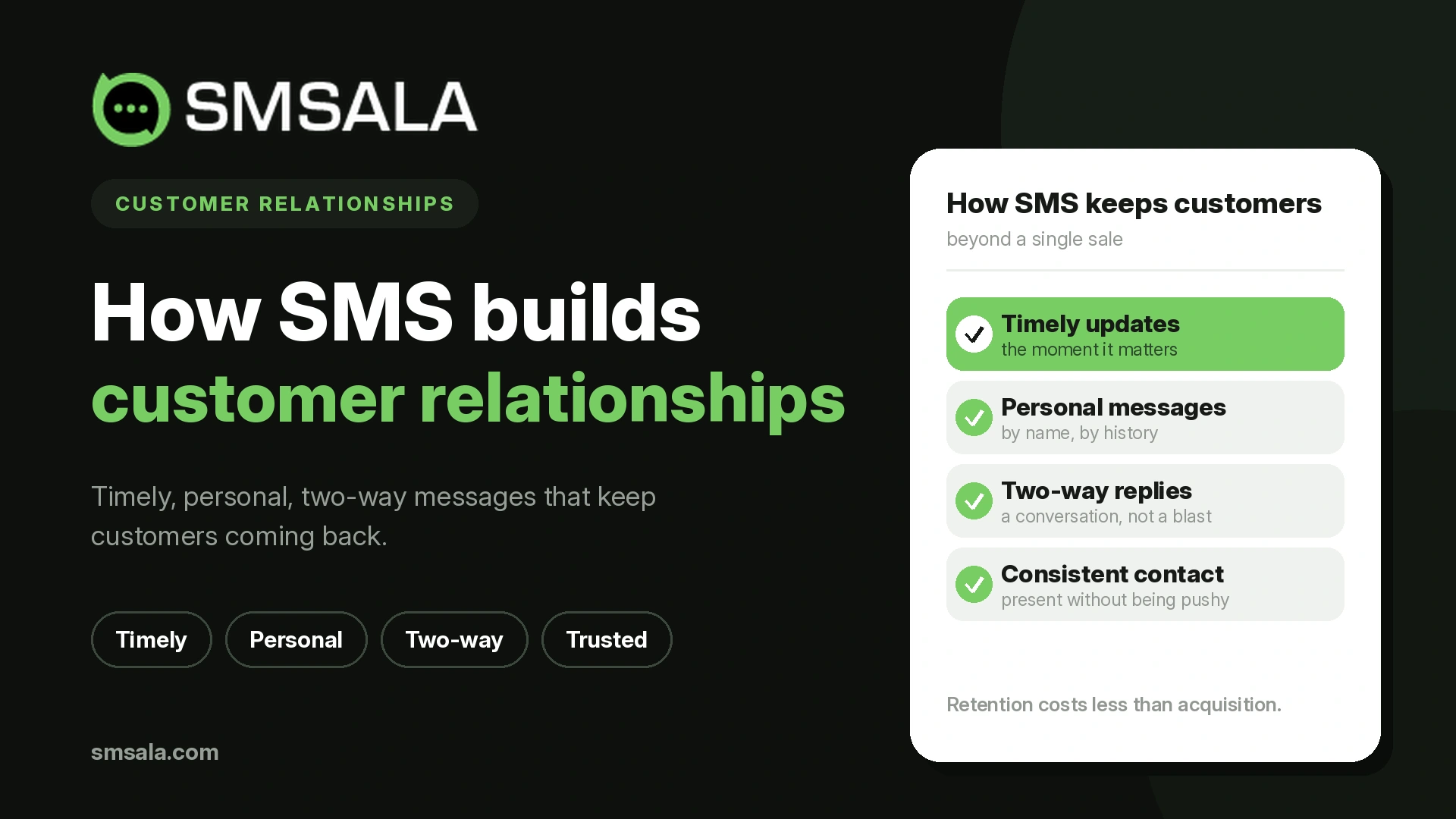
A business sends its customer list a promotional text every week — an offer, a sale, a new product. Ask them what they're doing and they'll say "building our customer relationship." But they're not. They're advertising to people who happen to have given their phone number. A relationship isn't a stream of promotions flowing one direction; it's something the word itself implies and the weekly blast entirely lacks — mutual, two-sided, and remembered over time. Confusing the two is why so much "SMS relationship marketing" builds no relationship at all.
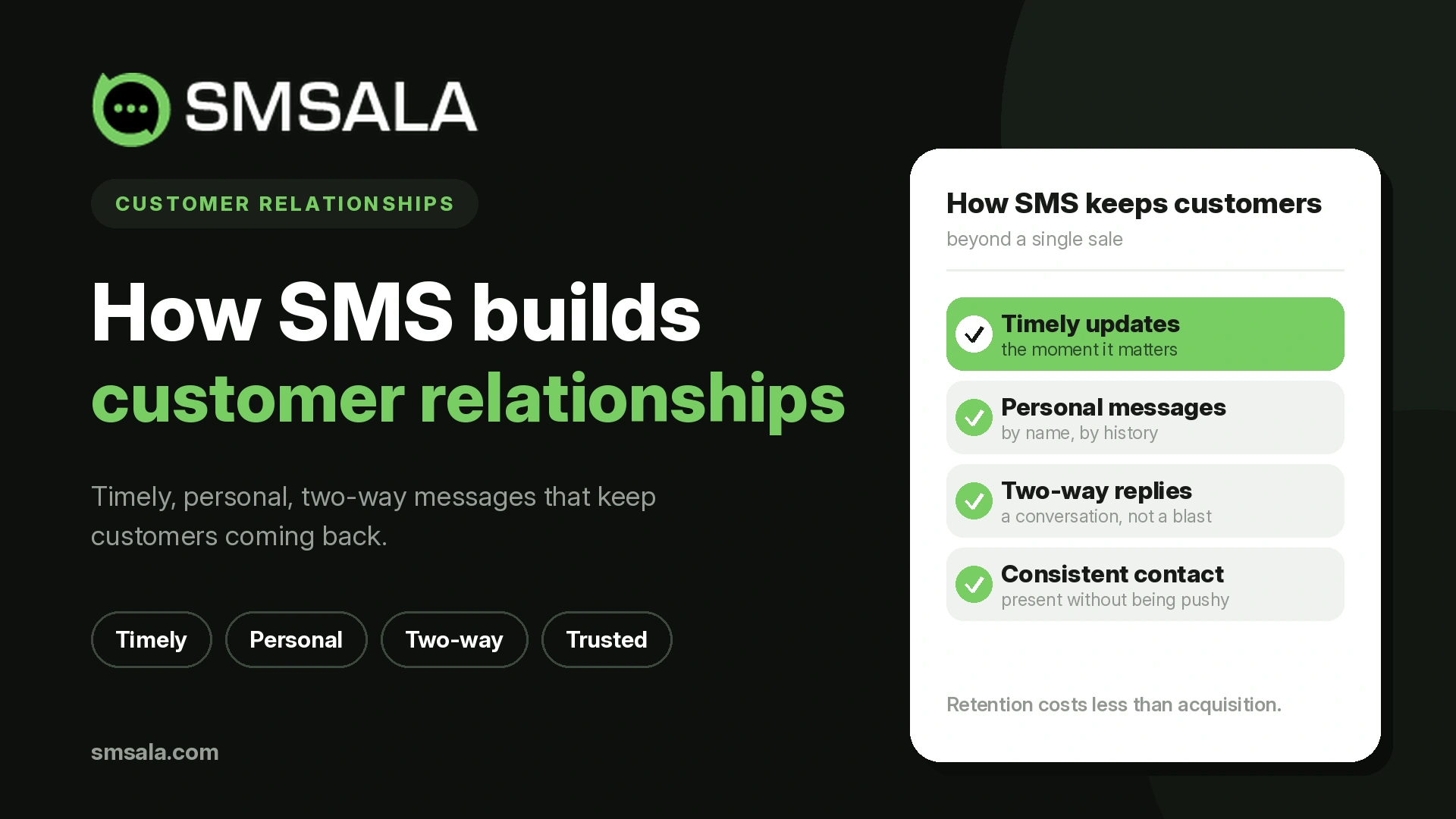
This matters because SMS is genuinely one of the best tools a business has for building customer relationships — but only when used as a relationship channel rather than a broadcast one. The same channel that can deepen loyalty can also just be a more personal place to shout offers, and the difference isn't the technology, it's how it's used. What turns SMS from advertising-with-a-phone-number into an actual relationship comes down to a few specific things most businesses skip: listening as well as talking, remembering the customer across interactions, giving before asking, and showing up consistently over time. Here's how SMS builds customer relationships when you use it as one.
What actually makes something a relationship
Before the how, be clear on the what — because the gap between "sending customers messages" and "having a relationship with customers" is where most efforts fail.
Two things distinguish a relationship from an audience. First, it's two-way — both sides communicate, and each responds to the other. A relationship where only one party ever speaks isn't a relationship; it's a broadcast. Second, it has continuity — the parties remember each other across interactions, so each exchange builds on the last rather than starting from zero. A relationship where every interaction forgets the previous one isn't a relationship; it's a series of encounters with a stranger.
Measure typical SMS marketing against those two criteria and it fails both. It's one-way (the business talks, the customer receives, no listening happens) and it has no continuity (every message is the same generic blast, treating a ten-year customer identically to a day-old one). That's why it builds no relationship — it lacks the two defining features of one. The good news is that SMS is capable of both two-way exchange and continuity better than almost any mass channel; most businesses just don't use those capabilities. Turning SMS into a relationship tool is a matter of activating them.
The reframe: broadcasting at vs building with
Hold this distinction as the frame for everything else: there's a difference between broadcasting at customers and building a relationship with them, and the same SMS channel does either depending on how you use it.
Broadcasting at: you send messages, customers receive them, the flow is one-directional, every message sells something, and the business treats the whole list as one undifferentiated audience. This is advertising through a personal channel — and because SMS is so intimate, doing this feels more relational to the business while often feeling more intrusive to the customer.
Building with: the customer can respond and is responded to, the business remembers who they are and tailors accordingly, not every message is a sale, and there's a sense of an ongoing exchange rather than a broadcast. This is a relationship, and it produces the loyalty and retention that broadcasting never does.
The shift from one to the other is the entire game, and it's driven by four converters — the specific things that turn a broadcast channel into a relationship channel. Each is something SMS can do and most businesses don't.
Converter one: make it two-way — you have to listen
A relationship requires listening, and broadcasting has no ears. So the first and most important converter is making your SMS genuinely two-way — letting customers respond, and responding to them.
This is more than a technical setting; it's a posture. It means inviting replies ("reply with any questions," "text us back to let us know"), and then actually engaging with what comes back — answering, acknowledging, acting on it. When a customer can text you and get a response, the channel stops being a megaphone and becomes a conversation, which is the foundation of any relationship. Enabling two-way messaging is the single change that most transforms SMS from broadcast to relationship, because it turns a monologue into a dialogue. And listening includes actively seeking the customer's voice — asking about their experience, gathering feedback and suggestions, running a quick poll on a decision that affects them. This does two things: it gives you genuine insight into limitations your own team can't see, and it makes the customer feel valued and part of the process, which is what deepens a relationship. A business that only ever talks at customers can't have a relationship with them; one that listens can.
Converter two: continuity — remember the customer
The second converter is continuity: remembering the customer across interactions so each exchange builds on the last, rather than treating every message as if you've never met.
A relationship has memory. The businesses that build strong customer relationships over SMS remember who each customer is — what they've bought, how long they've been a customer, what they care about — and let that memory shape what they send. A message that reflects the customer's history ("since you bought X, you might want Y," "as one of our longest-standing customers...") signals that they're known and remembered, which is exactly what distinguishes a relationship from a transaction with a stranger. The opposite — sending the identical generic blast to everyone regardless of their history — signals that you don't know or care who they are, which is the antithesis of relationship. This continuity is enabled by connecting your SMS to your customer records, so that text messaging tied to your CRM can draw on each customer's history to make every message reflect the relationship you actually have with them. Memory is what makes a customer feel like a customer rather than a phone number, and it's the second thing broadcasting lacks and relationship requires.
Converter three: give before you ask
The third converter addresses the "every message is a sale" problem. A relationship where one party only ever asks for things isn't a healthy one — and an SMS channel that only ever sells is exactly that. So building a relationship means giving before, and more than, you ask.
Concretely: not every message should want something from the customer. Send messages that give — a genuinely useful piece of information, an exclusive perk with no strings, a helpful reminder, a thank-you, an acknowledgement of a milestone. When the balance of your messages tilts toward giving rather than extracting, the customer experiences the channel as valuable rather than demanding, and the relationship strengthens. This is why an exclusive reward or offer framed as appreciation ("a thank-you for being a customer") builds relationship in a way the identical offer framed as pure sell doesn't — same message, different posture. A festival or occasion greeting with no sales ask, a genuine happy-birthday, a "just letting you know your favourite is back in stock" — these give without immediately taking, and they're what makes a customer feel the business values them beyond their wallet. A relationship built only on asking collapses; one built on giving endures.
Converter four: consistency over time
The fourth converter is patience: relationships are built, not sent. You can't blast your way to a relationship overnight, and you can't build one and then vanish. What builds a customer relationship over SMS is consistent, appropriate presence over time — showing up reliably, at the right cadence, so the customer comes to know and trust the channel.
This is where the classic frequency balance matters, but understood relationally rather than as a mere rule. Too frequent and you become an intrusion the customer tunes out or leaves — you've overdrawn the relationship. Too rare and you're a stranger again by the time you reappear — there's no continuity to build on. The right cadence is the one that keeps you consistently, comfortably present: regular enough that the customer stays familiar with you, spaced enough that each contact remains welcome. Consistency here also means reliability of tone and value — the customer learns what to expect from your messages and comes to trust that expectation. Automating a steady rhythm of recurring, relationship-oriented messages — not just promotions, but the mix of giving and occasional asking — keeps the presence consistent without depending on someone remembering to send. Relationships are the product of many appropriate interactions over time, and consistency is what accumulates them.
The foundation and the guardrails
Underneath the four converters sit a foundation and a guardrail that make relationship-building possible at all.
The foundation is permission. You can't build a relationship with someone who didn't agree to hear from you — an unsolicited message starts the relationship as an intrusion. Get genuine opt-in (a form, a keyword: "Text SNOWY to 55432 for offers and updates"), so the relationship begins with the customer's consent, which is where any relationship must start.
The guardrail is not overdrawing the relationship. This means the frequency discipline above, and it also means list hygiene — paying attention to who's leaving and why. A rising opt-out rate is the relationship telling you you've pushed too hard or drifted into irrelevance; reaching out to loyal customers for honest feedback when people are leaving tells you what's going wrong that your team can't see. And it means not sending to dead numbers or ignoring the signals of disengagement. Tending the relationship includes noticing when it's fraying and responding, rather than blasting on regardless.
Using SMS for retention specifically
The payoff of all this is retention, which is where SMS relationships prove their worth. It costs far more to acquire a new customer than to keep an existing one, so a channel that strengthens existing relationships is directly valuable. SMS used relationally retains customers by keeping the business present and valued in their lives — the two-way exchange makes them feel heard, the continuity makes them feel known, the giving makes them feel valued, and the consistency keeps the bond warm. A customer who feels heard, known, and valued by a business stays with it; one who just receives its ads drifts to whoever's cheaper. This is the difference between SMS as a retention tool and SMS as an acquisition-style broadcast: the relational use keeps customers, precisely because it treats them as people in an ongoing relationship rather than targets of the next campaign. Broadening this into a full SMS marketing approach that balances relationship and promotion is how businesses turn their subscriber list into a durable, loyal base rather than a churning audience.
Mistakes that damage customer relationships over SMS
Confusing broadcasting with relationship — sending constant promos and calling it a relationship, when there's no listening or continuity.
One-way only — never enabling replies or seeking feedback, so the "relationship" is a monologue.
No memory — treating every customer as an anonymous member of one list, ignoring their history.
Only ever asking — every message a sale, never giving, so the customer feels extracted from rather than valued.
Inconsistency — blasting in bursts then vanishing, or over-sending until the customer leaves, either way failing to build steady presence.
Ignoring the exit signals — not noticing or responding to rising opt-outs, letting the relationship fray unaddressed.
FAQ
How does SMS help build customer relationships?
SMS builds relationships when used as a two-way, continuous channel rather than a one-way broadcast — by letting customers respond and responding to them, remembering their history across interactions, giving value rather than only selling, and showing up consistently over time. These turn a personal channel into an actual relationship that drives loyalty and retention, rather than just advertising through customers' phones.
Isn't sending customers promotional texts the same as building a relationship?
No. A stream of one-directional promotions is advertising, not a relationship. A relationship requires two things most SMS marketing lacks: it's two-way (you listen as well as talk) and it has continuity (you remember the customer across interactions). Broadcasting at customers through a personal channel can even feel intrusive; building with them through dialogue and memory is what creates a relationship.
How do I make SMS two-way for customer relationships?
Invite replies and actually engage with them — answer questions, acknowledge responses, and act on feedback. Actively seek the customer's voice too, by asking about their experience or running quick polls. Enabling genuine two-way messaging turns the channel from a megaphone into a conversation, which is the foundation of any relationship, since a relationship requires listening and broadcasting has no ears.
How does SMS help with customer retention?
By keeping the business present and valued in customers' lives. Used relationally, SMS retains customers because the two-way exchange makes them feel heard, remembering their history makes them feel known, giving value makes them feel appreciated, and consistent presence keeps the bond warm. Since keeping a customer costs far less than acquiring one, a channel that strengthens existing relationships is directly valuable.
How often should I text customers to build a relationship?
Consistently enough to stay familiar, spaced enough that each message stays welcome — a steady, comfortable presence rather than bursts of over-sending or long silences. Too frequent and you become an intrusion they tune out or leave; too rare and you're a stranger again by the time you reappear. A rising opt-out rate signals you've pushed too hard.
What damages customer relationships over SMS?
Treating a stream of promotions as a relationship, never enabling replies or listening, ignoring customers' history and sending everyone the same generic blast, making every message a sales ask rather than ever giving, inconsistency (bursts then silence, or over-sending), and failing to notice or respond when customers start leaving. All of these reduce the channel to broadcasting rather than relationship-building.