
A company sends an urgent update from the head office — a policy change, a schedule shift, a safety notice. It goes out on email and the company Slack. Everyone at a desk sees it within the hour. And everyone not at a desk — the warehouse team, the drivers, the shop-floor staff, the field engineers, the nurses on shift — sees none of it, because they don't sit in front of a screen all day and many don't even have a company email they check. The message reached the people who were already reachable and missed exactly the people whose work happens away from a computer. That gap is the real reason to communicate with employees via SMS.
Most articles on employee SMS pitch it as "higher open rates than email" — true, but shallow. The deeper point is who it reaches: the deskless, frontline majority of the workforce that email, Slack, and the intranet were never designed to reach. For those employees, SMS isn't a better channel; it's often the only channel that works. But texting employees also raises questions customer messaging doesn't — about consent, personal phones, and the line between a useful update and an intrusion into someone's evening. This guide covers both: why SMS is the right tool for reaching the workforce your other systems miss, and how to use it without crossing the boundaries that texting staff, specifically, brings into play.
Why SMS for employee communication: reaching the workforce your tools miss
The single strongest reason to use SMS internally is coverage of the deskless workforce. A large share of the global workforce doesn't work at a computer — they're on shop floors, in warehouses, driving, on site, in the field, on hospital wards, behind counters. For these employees, the standard internal-comms stack simply doesn't function: email goes unchecked (many don't have or use a work address), Slack and Teams need a logged-in device they're not carrying, and the intranet is somewhere they never visit during a shift.
SMS reaches all of them, because the one thing nearly every worker has, deskbound or not, is a mobile phone in their pocket. A text lands and is read within minutes regardless of whether the employee is at a terminal, and it needs no app, no login, no company device. This is the coverage gap SMS fills: it's the channel that reaches the whole workforce, not just the office-based part of it. For a business with significant frontline or field staff, that's not a marginal convenience — it's the difference between a message that reaches everyone and one that reaches half the company. This is why SMS proves so valuable across the industries that depend on mass texting — retail, logistics, healthcare, manufacturing, hospitality — precisely the sectors with the most deskless workers.
SMS vs Slack, email, and intranet for internal comms
To use SMS well internally, it helps to see where it fits alongside the tools you already have, rather than as a replacement for them. Each channel has a job:
Email — for detailed, non-urgent, documentation-style communication that employees can process when they're at a screen. Long policies, reports, formal notices. It fails for urgency and for deskless staff.
Slack/Teams — for ongoing team collaboration and discussion among people who are online and working at devices. Excellent for desk-based teamwork, invisible to the frontline and easily missed in the flood of channels.
Intranet — for reference material employees pull when they need it. Nobody checks it for urgent updates.
SMS — for short, urgent, must-reach-everyone messages, especially to deskless staff. Read within minutes, reaches every employee on any phone, cuts through the noise.
The decisive framing: SMS isn't competing with these tools; it's covering their shared blind spot — the urgent message that must reach everyone including the deskless, fast, with certainty. Use email and Slack for what they're good at, and reach for SMS when a message is time-critical and can't afford to miss the people who aren't at screens. A business that understands this stops trying to force urgent all-hands messages through Slack (where the frontline misses them) and routes them through the channel that actually reaches everyone.
What to actually use employee SMS for
Weighted by where it delivers most value — operational and urgent first, the nice-to-haves after:
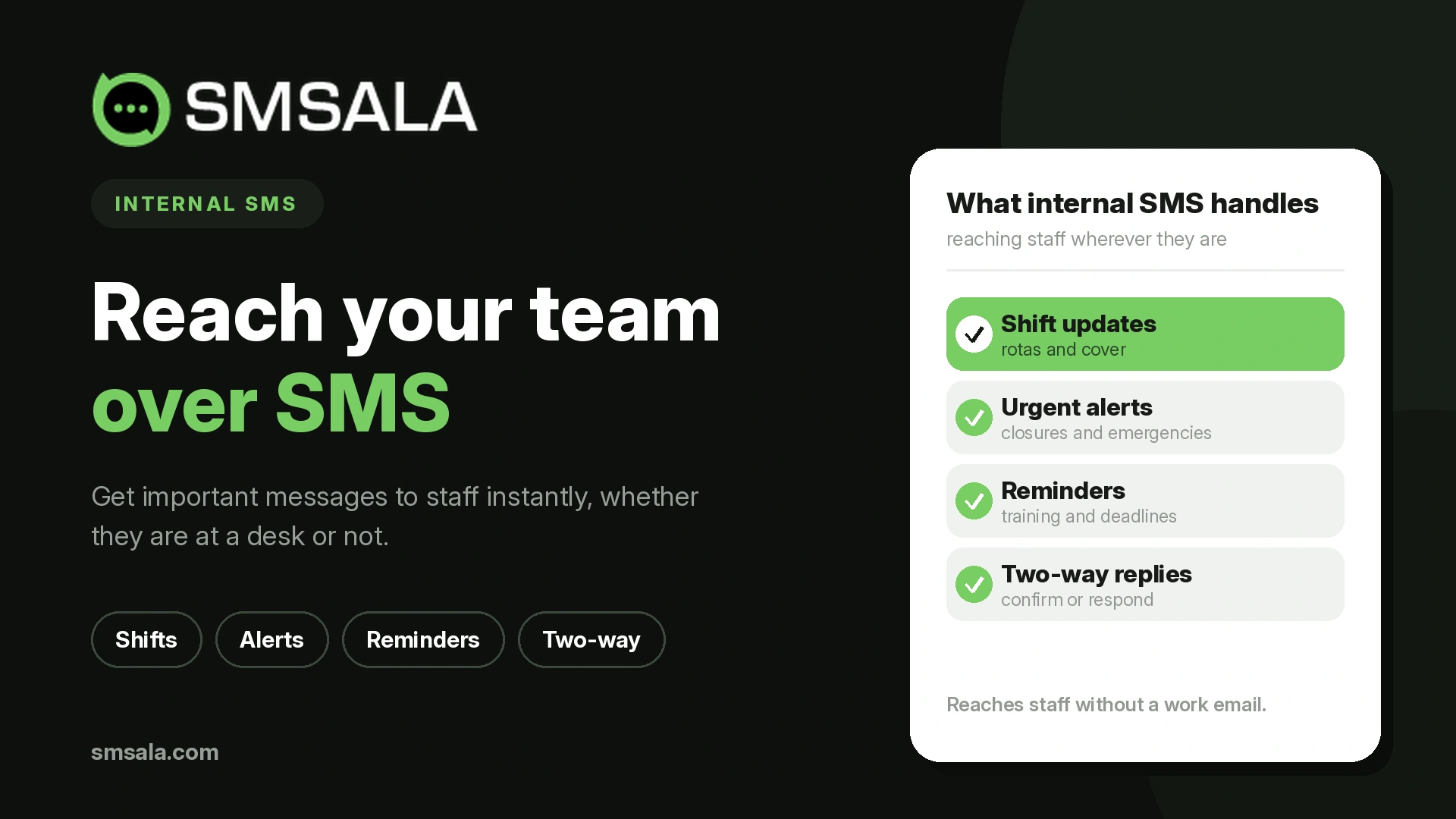
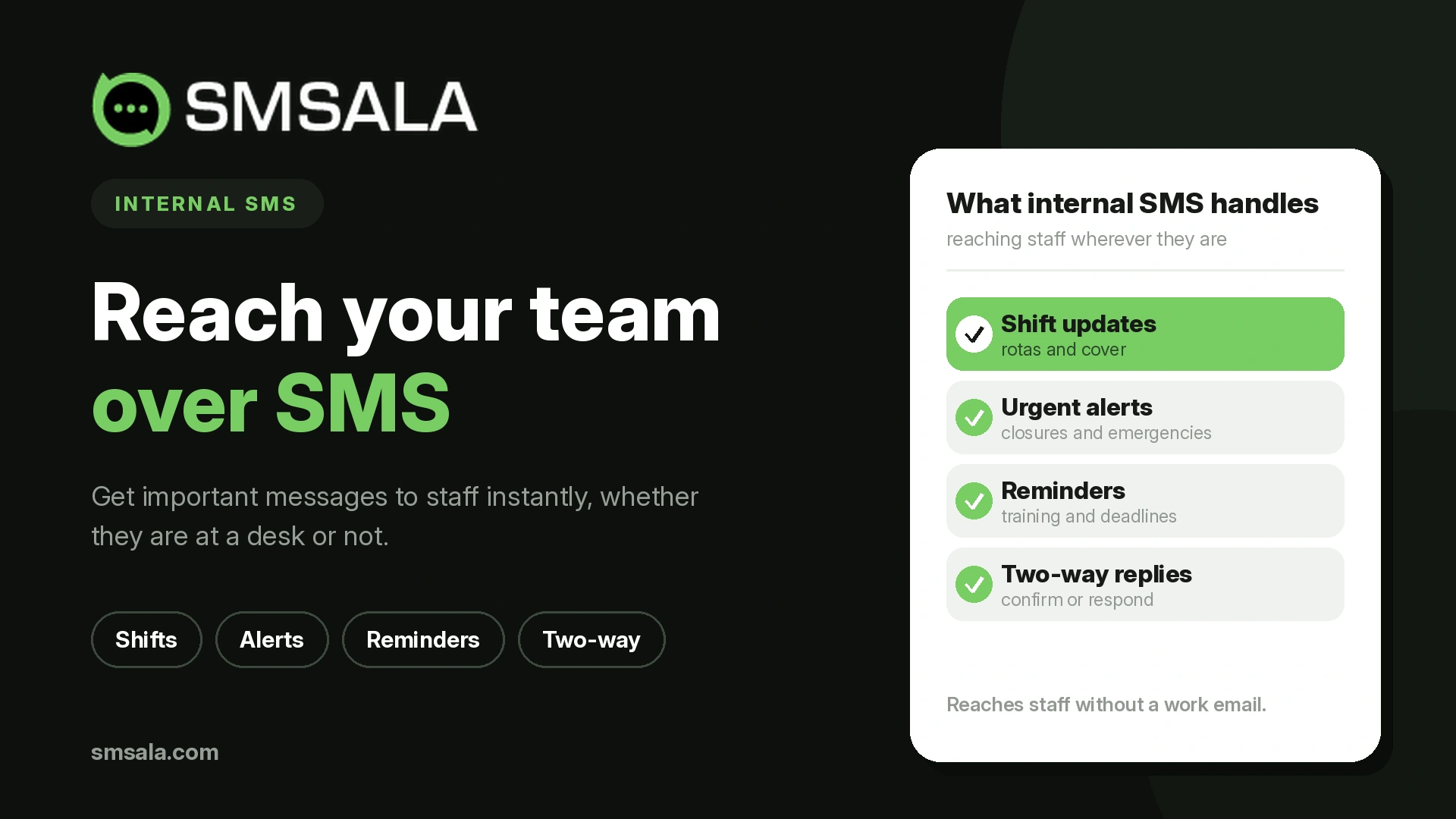
Urgent operational messages. Office or site closures, emergencies, safety alerts, sudden schedule changes — anything where everyone must know now. These are the highest-value uses because the cost of a missed message is highest, and SMS is the only channel that reliably reaches the whole workforce fast. Well-designed SMS alerts are the backbone here.
Shift scheduling and changes. For the many businesses running shifts — BPO, healthcare, retail, hospitality, logistics — texting shift assignments and changes reaches staff who'd never check email for it, and reaches them wherever they are. This is one of the most consistently useful frontline applications.
Time-sensitive reminders. Deadlines, mandatory training, document submissions, expense deadlines — the eleventh-hour reminder that reaches an employee who's already left the office.
Reaching field and off-site staff. Keeping in touch with employees working away from any screen — checking status, relaying instructions, coordinating — where SMS is the practical link between the office and the field.
Internal polls and feedback. Gathering the team's view on a decision quickly — a vote, a quick pulse-check — where SMS polling gets responses at rates internal email surveys never match, because replying to a text is effortless and reaches everyone.
Company information. Benefits updates, internal job openings (giving all staff, including the frontline, a fair chance to apply — which matters for internal mobility and connects to how SMS supports the wider recruitment process), and recognition or appreciation messages that reach and motivate the whole team.
The pattern: SMS is most valuable for the internal messages that are urgent, must reach everyone, or are aimed at deskless staff — and least necessary for detailed, non-urgent content that email handles better.
The part nobody addresses: consent and boundaries when texting employees
Here's the section every competing article skips, and it's the one that most needs saying: texting employees raises consent and boundary questions that texting customers doesn't, and getting them wrong causes real problems — legal, cultural, and relational.
The core issue is that you're often messaging employees' personal phones. Unlike a customer who opted into marketing, an employee hasn't necessarily agreed to receive work communication on a device they own, on their own number. This raises genuine questions a thoughtful employer must address:
Consent to be texted at all. Employees should agree to receive work SMS on their personal phones, ideally as a clear, voluntary opt-in with an understanding of what they'll receive — not an assumption that having their number means you can text them freely.
Privacy of personal numbers. An employee's personal phone number is their private data; collecting and using it for work communication carries data-protection obligations, and it should be handled with the same care as any personal data, not treated as a free company asset.
The distinction from personal messaging. Work texts to employees should be clearly professional and purposeful — the line between business and personal SMS matters here, because blurring it (casual over-texting, contacting for trivial things) erodes the boundary employees are entitled to.
An employer that handles this well — voluntary opt-in, clear scope, respect for the personal device — gets a channel employees accept and value. One that treats employees' personal phones as an always-available work line breeds resentment and, in some jurisdictions, legal exposure. This isn't a footnote; it's the foundation of doing employee SMS ethically and sustainably.
Where's the line between useful and intrusive
Flowing directly from consent is the boundary question: even with permission, when and how often you text employees determines whether the channel helps or harms.
The critical boundary is after-hours contact. A work text at 10pm or on a day off intrudes on an employee's personal time in a way an email (which they can ignore until working hours) doesn't — because a text demands attention now. Many jurisdictions are formalising a "right to disconnect," and beyond any legal duty, respecting employees' non-work time is basic decency and good management. The rule: reserve after-hours texting for genuine emergencies and things the employee needs for their next shift (a shift change for tomorrow), and keep routine communication within working hours. The other boundary is frequency — over-texting employees, like over-texting customers, trains them to tune out, so that when a genuinely urgent message arrives it's ignored along with the noise. Reserve SMS for messages that are genuinely urgent or genuinely must-reach-everyone, and use quieter channels for the rest. Used with restraint and respect for personal time, employee SMS stays a trusted, effective channel; used carelessly, it becomes an intrusion that damages morale.
When SMS is the wrong internal channel
The honest counterpart to all the uses — because using SMS for the wrong internal messages undermines it. Don't use employee SMS for:
Detailed or complex information — long policies, reports, anything needing formatting or depth belongs in email, where employees can read it properly. SMS should notify and link, not carry the detail.
Ongoing discussion or collaboration — that's what Slack and Teams are for; SMS is for one-way alerts and simple two-way responses, not threaded conversation.
Sensitive or confidential matters — performance issues, personal HR matters, disciplinary conversations. These deserve a private, appropriate setting, not a text, both for dignity and because SMS isn't a secure or suitable channel for confidential content.
Non-urgent routine updates — the day-to-day that doesn't need to reach everyone instantly. Overloading SMS with these dilutes its value for the urgent messages that do.
The principle: SMS is for urgent, universal, and deskless-reaching messages. Route everything detailed, collaborative, confidential, or non-urgent to the channel built for it. A business that keeps employee SMS to what it's genuinely best at keeps it a channel staff respect.
Making it two-way and writing the messages well
Employee SMS works best when it's not purely top-down. Enabling replies — for shift confirmations, poll responses, acknowledgements, or field-staff updates — turns broadcasts into genuine communication, and two-way messaging is what lets an employer hear back rather than just announce. As for the messages themselves, keep them short, clear, and professional, with the essential point up front. Some workable templates:
Closure: "Hi team, due to the weather forecast, please work from home tomorrow rather than coming to the office. Further updates to follow."
Shift change: "Hi , your shift for has changed to . Please confirm you've seen this by replying Y."
Poll: "Hi team, quick vote on this year's offsite location — reply 1 for , 2 for , 3 for . Thanks!"
Reminder: "Reminder: monthly expense submissions are due by Friday. Please submit via the usual portal."
Short, one purpose, clear action, sent from a recognisable company sender.
Setting it up: practical considerations
Getting employee SMS running comes down to a few practical choices. Gather voluntary opt-in and maintain accurate, consented contact details. Choose a provider offering reliable delivery, scheduling (so a message can be queued for the right time rather than sent at an odd hour), group management (so you can message teams, shifts, or locations rather than everyone), and two-way capability. Scheduling in particular helps you respect boundaries — drafting an update in the evening but scheduling it to send in working hours, using the kind of control any solid scheduled messaging setup provides. Keep it simple to use, since managers sending urgent messages shouldn't need technical skill, and keep the channel focused on the urgent-and-universal messages it's best for.
Mistakes employers make with employee SMS
Texting personal phones without proper consent — assuming a number means permission, creating legal and trust problems.
After-hours intrusion — sending routine messages at night or on days off, disrespecting personal time and the right to disconnect.
Over-texting — using SMS for everything until employees tune it out and miss the urgent messages.
Using it for the wrong content — cramming detailed, confidential, or discussion-based communication into texts instead of the right channel.
One-way only — broadcasting without enabling replies, missing the value of hearing back from staff.
Ignoring the frontline reality — not recognising that SMS's main value is reaching deskless workers, and using it only for office staff who Slack already reaches.
If you're setting up SMS to communicate with employees, the thing that makes it work is using it precisely — for the urgent, everyone-must-see-it messages that reach your frontline staff, with genuine consent and respect for personal time. SMSala's two-way business messaging provides the group management, scheduling, and reply handling to reach your whole workforce — desk-based and deskless alike — with the messages that actually can't afford to be missed.
FAQ
Why use SMS to communicate with employees instead of email or Slack?
Because SMS reaches the deskless, frontline workforce that email, Slack, and intranets miss — warehouse, retail, field, healthcare, and logistics staff who aren't at a screen. It's read within minutes on any phone with no login or app, making it the reliable channel for urgent messages that must reach everyone, not just office-based employees.
Is it legal and appropriate to text employees on their personal phones?
It requires care. Employees should give voluntary, informed consent to receive work SMS on personal devices, since a personal number is private data with protection obligations, not a free company asset. It's appropriate when consented, professional, and purposeful — but assuming you can text freely because you have someone's number risks both legal exposure and eroded trust.
When should I not use SMS for employee communication?
Avoid it for detailed or complex information (use email), ongoing discussion (use Slack or Teams), sensitive or confidential HR matters (which deserve a private setting), and non-urgent routine updates that would dilute the channel. SMS is best reserved for urgent, universal, and deskless-reaching messages — using it for everything undermines its value.
Is it OK to text employees after work hours?
Only for genuine emergencies or things needed for their next shift, like a change to tomorrow's schedule. A work text demands immediate attention, so after-hours messaging intrudes on personal time in a way email doesn't. Many places recognise a "right to disconnect," and respecting non-work time is good practice — keep routine communication within working hours.
What should I use employee SMS for?
Urgent operational messages (closures, emergencies, safety alerts), shift scheduling and changes, time-sensitive reminders, reaching field and off-site staff, quick internal polls, and company information like benefits, internal job openings, and recognition. It's most valuable for messages that are urgent, must reach everyone, or target deskless workers other tools can't reach.
How do I avoid annoying employees with work texts?
Get genuine opt-in, keep messages to what's genuinely urgent or universal, respect working hours for routine communication, and don't over-send. Route detailed, non-urgent, or confidential matters to the appropriate channel instead. Used with restraint and respect for personal time, employee SMS stays a trusted channel; overused, it becomes an intrusion staff tune out.