
Most businesses think about SMS in one direction only: what to send. They plan the campaign, write the message, schedule the blast, and measure the results. All of that is outbound, the business talking to the customer. What almost nobody plans with the same care is what comes back, the customer talking to the business. That is inbound, and treating it as an afterthought means running a megaphone when you could have a conversation.
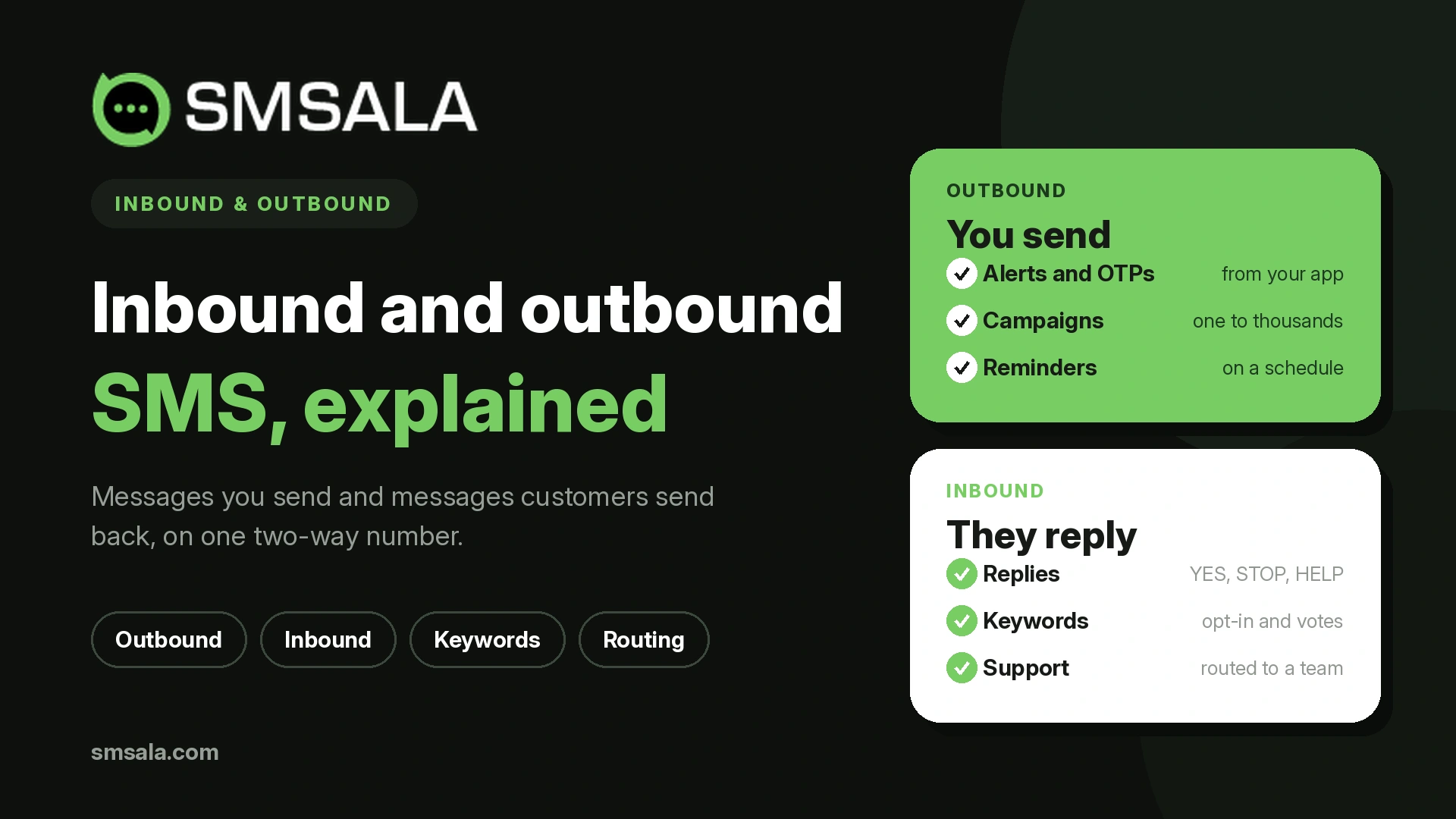
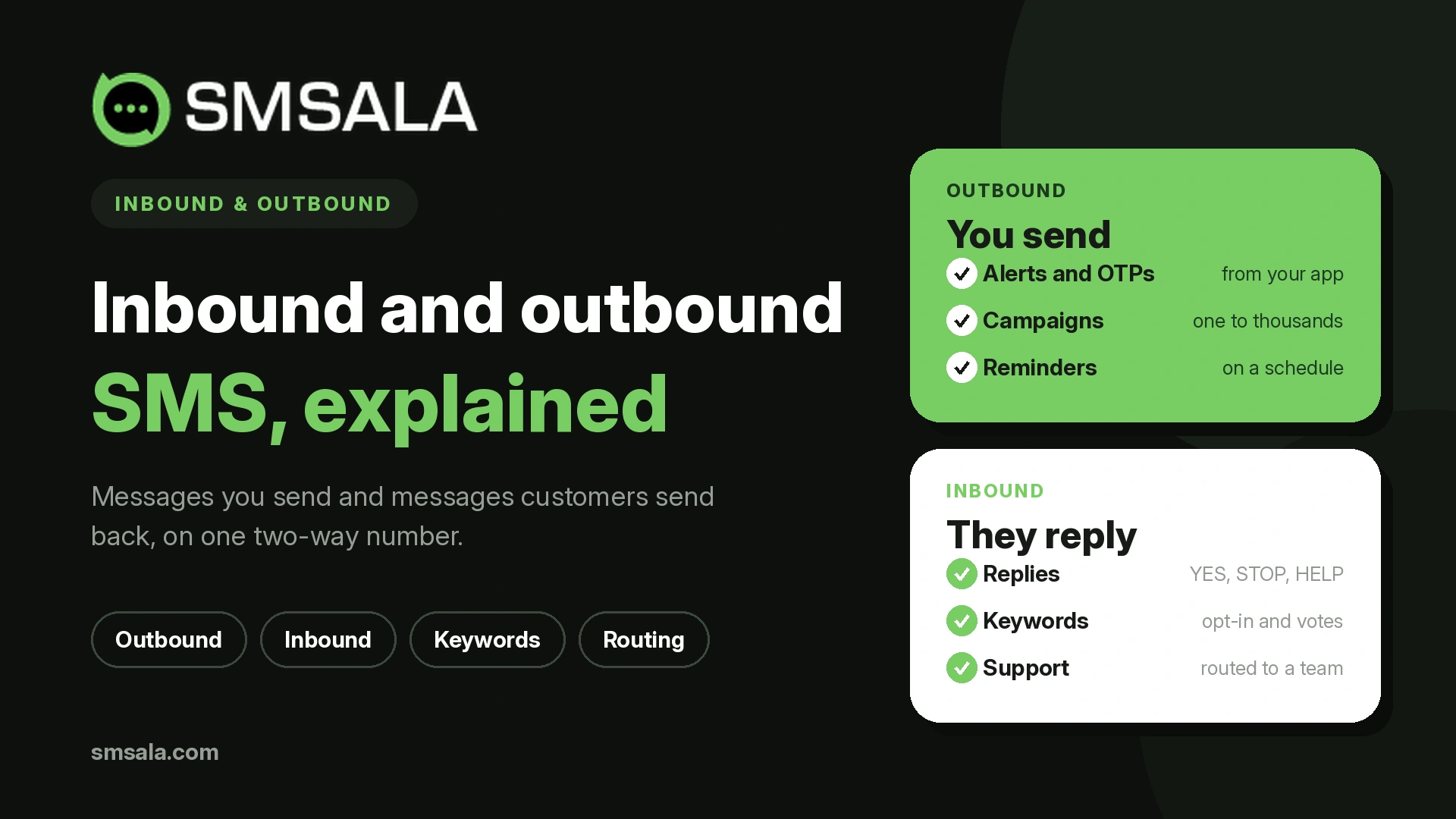
The distinction is simple. Outbound SMS goes from the business to the customer: promotions, alerts, reminders, verification codes. Inbound SMS goes from the customer to the business: replies, questions, opt-ins, keyword responses. Every SMS is one or the other, and the two are not just mirror images. They serve different purposes, need different setups, carry different consent, and, most importantly, only become truly powerful when you use both together.
This guide covers what each direction does, the setup inbound quietly requires (which is where businesses get caught), how the two combine into real conversation, and the compliance role inbound plays that you cannot skip.
Outbound SMS: the direction everyone already uses
Outbound is the familiar half, so it needs less explaining. It is the business initiating contact, and it covers most of what people picture when they think of business SMS.
The outbound jobs are the sending jobs: bulk SMS marketing promotions and offers, alerts and reminders about orders, appointments, and events, and the OTP codes that verify logins and transactions. It is proactive, it is scheduled or triggered by the business, and it is what most SMS strategies consist of almost entirely. As standard A2P messaging, it is well understood, and businesses generally do it competently.
The limitation is not that outbound is done badly. It is that outbound alone is one-directional. It broadcasts, informs, and prompts, but it cannot listen, and a channel that only talks is missing half of what makes messaging valuable.
Inbound SMS: the neglected half where value hides
Inbound is the customer messaging the business, and it is the direction most companies underuse despite it being where a lot of SMS value actually lives.
Consider what inbound enables. It powers keyword opt-ins, the "text JOIN to 12345" mechanism that grows your list with people who actively chose to be there. It handles customer support, letting people text a question and get help in the channel they already use, often deflecting calls and emails. It captures leads, when a prospect texts to enquire. It collects responses to surveys, votes, and confirmations, turning a broadcast into a two-way exchange. And, critically, it is how customers manage their own consent, texting STOP to opt out or HELP for information.
The reason inbound is neglected is not that it lacks value. It is that it requires a bit more setup than firing off outbound messages, and businesses focused on sending never build the receiving side. That is a mistake, because inbound is what converts SMS from a one-way announcement channel into a relationship. A customer who can reply, ask, and opt in is far more engaged than one who can only receive. The businesses getting the most from SMS are the ones that treat listening as seriously as talking.
The setup inbound quietly requires
Here is the practical gotcha that trips up businesses expecting inbound to just work: you cannot receive replies on every kind of sender. The setup for inbound is genuinely different from outbound, and understanding it prevents the frustrating discovery that customers' replies are going nowhere.
The core issue is the number you send from. An alphanumeric sender ID, the branded name that displays your company, is one-directional: it is excellent for outbound branding but there is no number behind it to receive anything, so a customer cannot reply. To accept inbound, you need a number that can receive.
Sender type | Good for outbound | Can receive inbound |
Alphanumeric sender ID | Yes, strong branding | No |
Long / virtual number | Yes | Yes |
Short code | Yes, high volume | Yes, with keywords |
Toll-free number | Yes | Yes |
Beyond the number, inbound needs handling. Short codes typically use keywords, where texting a specific word (JOIN, STOP, INFO) triggers a defined action or auto-response. Incoming messages are delivered to your systems through webhooks, the callbacks that push a customer's reply to your application in real time so you can route, log, or respond to it. And you decide what happens on receipt: an automated reply, routing to a support agent, adding the sender to a list, or updating a record. None of this is difficult, but all of it has to be set up deliberately, because inbound does not happen by default the way sending does.
Where they meet: two-way conversation
Inbound and outbound stop being separate concepts the moment you combine them, because together they are simply two-way messaging: a conversation.
This is where SMS becomes most powerful. An outbound appointment reminder that lets the customer reply to confirm or reschedule is worth far more than one they can only read. An outbound offer that invites a reply turns a broadcast into a dialogue. A support interaction flows naturally when the business can both send and receive. The whole is genuinely greater than the sum: outbound without inbound is talking at people, inbound without outbound is waiting passively, and the two together is a relationship conducted over text.
Handling the inbound side of these conversations at any scale usually means routing replies into a CRM so every message attaches to the right customer, and often using an SMS chatbot to answer common inbound queries automatically while escalating the rest to a person. The goal is that a customer's reply never disappears into a void, which is exactly what happens when a business sends from a number that cannot receive.
Inbound is how compliance actually works
There is a compliance dimension to inbound that businesses cannot treat as optional, because inbound is the mechanism through which consent is managed.
The clearest example is opt-out. When a customer texts STOP, that is an inbound message, and honoring it immediately is a legal requirement in most markets. A business that only does outbound and cannot properly receive and process a STOP is not just missing a feature, it is failing a compliance obligation. The same applies to HELP requests and to opt-in confirmations. Inbound is the machinery of consent.
There is also a subtler consent point worth knowing. Outbound marketing generally requires express, explicit opt-in before you send. Inbound, by contrast, often carries implied consent: when a customer texts you first, they have initiated contact, which changes what you can reasonably send in reply within that conversation. This is why inbound-led interactions (a customer texting your keyword or your support line) can be more straightforward than cold outbound: the customer started it. Understanding this asymmetry helps you use each direction correctly rather than applying one set of rules to both.
Inbound and outbound in the contact center
In a support or contact-center setting, the two directions map neatly onto proactive and reactive service, and the best operations use both.
Outbound is proactive: reaching out with reminders, updates, and follow-ups before the customer has to ask. Inbound is reactive: handling the questions and issues customers bring to you. A contact center that only does outbound misses the customers trying to reach it; one that only does inbound never gets ahead of problems. Together, proactive outbound reduces the inbound volume (a good delivery update prevents a "where is my order" text), while strong inbound handling catches what proactive messaging cannot anticipate. The same proactive-plus-reactive logic extends to voice, where inbound and outbound IVR play the equivalent roles, and a genuinely responsive operation coordinates across both.
Using both directions well
The practical guidance follows directly from everything above. Enable inbound deliberately by using a number that can receive, not just an alphanumeric sender, wherever replies matter. Run keyword campaigns to grow your list with people who opt in themselves, which produces a far more engaged audience than a purchased list. Route inbound messages to your CRM and team so nothing is lost and every reply builds the customer record. Automate the common inbound responses while making it easy to reach a human for the rest. Build STOP and HELP handling correctly from the start, because it is both required and expected. And measure both directions, not just outbound delivery and clicks but inbound volume, response rates, and what customers are actually telling you.
Common mistakes
The recurring errors all stem from treating SMS as one-directional. Sending from an alphanumeric sender and being surprised that no one can reply. Ignoring inbound entirely and running a broadcast channel when a conversation was available. Failing to handle STOP properly and creating a compliance problem. Letting inbound messages arrive with no routing, so customer replies go unanswered. And measuring only what you send, blind to what customers are sending back. Each is a version of the same oversight: planning the talking and forgetting the listening.
Checklist for inbound and outbound SMS
Use a receive-capable number (long code, short code, or toll-free) wherever customers should be able to reply.
Reserve alphanumeric sender IDs for genuinely one-way outbound like alerts and OTPs.
Set up keyword handling and webhooks so inbound messages trigger the right action.
Route inbound to your CRM and support team so no reply is lost.
Automate common inbound responses, with easy escalation to a person.
Handle STOP and HELP correctly and immediately, as both compliance and courtesy.
Use two-way flows (reply to confirm, reschedule, respond) rather than one-way broadcasts where a conversation adds value.
Measure both directions, including what inbound messages tell you about customers.
The bottom line
Inbound and outbound SMS are the two halves of the same channel, and most businesses run only one of them. Outbound, the sending, is familiar and well handled. Inbound, the receiving, is where SMS becomes a conversation, where opt-ins and support and lead capture happen, and where consent is actually managed, yet it goes neglected because it needs deliberate setup that sending does not. Build both, on a number that can receive, with inbound routed and handled and STOP working properly, and SMS stops being a megaphone and becomes a two-way relationship. That is the difference between broadcasting at customers and genuinely communicating with them.
SMSala supports both directions with receive-capable numbers, keyword and inbound handling, CRM routing, and reliable outbound delivery, so a single setup can send and listen, but the value comes from using both halves rather than treating SMS as a one-way street.
Frequently asked questions
What is the difference between inbound and outbound SMS?
Outbound SMS is sent from the business to the customer, such as promotions, alerts, reminders, and verification codes. Inbound SMS is sent from the customer to the business, such as replies, questions, keyword opt-ins, and STOP requests. Outbound is the business talking; inbound is the customer talking back. Both are needed for SMS to work as a conversation rather than a broadcast.
Why can't customers reply to my SMS?
Almost certainly because you are sending from an alphanumeric sender ID, the branded name that displays your company. It is excellent for outbound branding but has no number behind it to receive replies, so anything a customer sends goes nowhere. To accept inbound, send from a receive-capable number: a long number, short code, or toll-free number.
Do I need inbound SMS, or is outbound enough?
Outbound alone makes SMS a one-way broadcast. Inbound is what enables opt-ins, customer support, lead capture, survey responses, and, importantly, opt-out handling. If you want SMS to be a relationship rather than an announcement channel, and to meet compliance obligations like processing STOP requests, you need inbound too. Most of the underused value in SMS is on the inbound side.
How does inbound SMS handle opt-outs?
When a customer texts STOP, that is an inbound message, and your system must receive and honor it immediately, which is a legal requirement in most markets. HELP requests and opt-in confirmations work the same way. This is why inbound is not optional: it is the mechanism through which consent and opt-out are actually managed, not just a nice-to-have feature.
Can inbound and outbound SMS work together?
Yes, and that combination is the point. Together they form two-way messaging: an outbound reminder the customer can reply to, an offer that invites a response, a support exchange that flows both ways. Outbound without inbound talks at people; inbound without outbound waits passively. Used together, with replies routed to your systems, they turn SMS into a genuine conversation.