
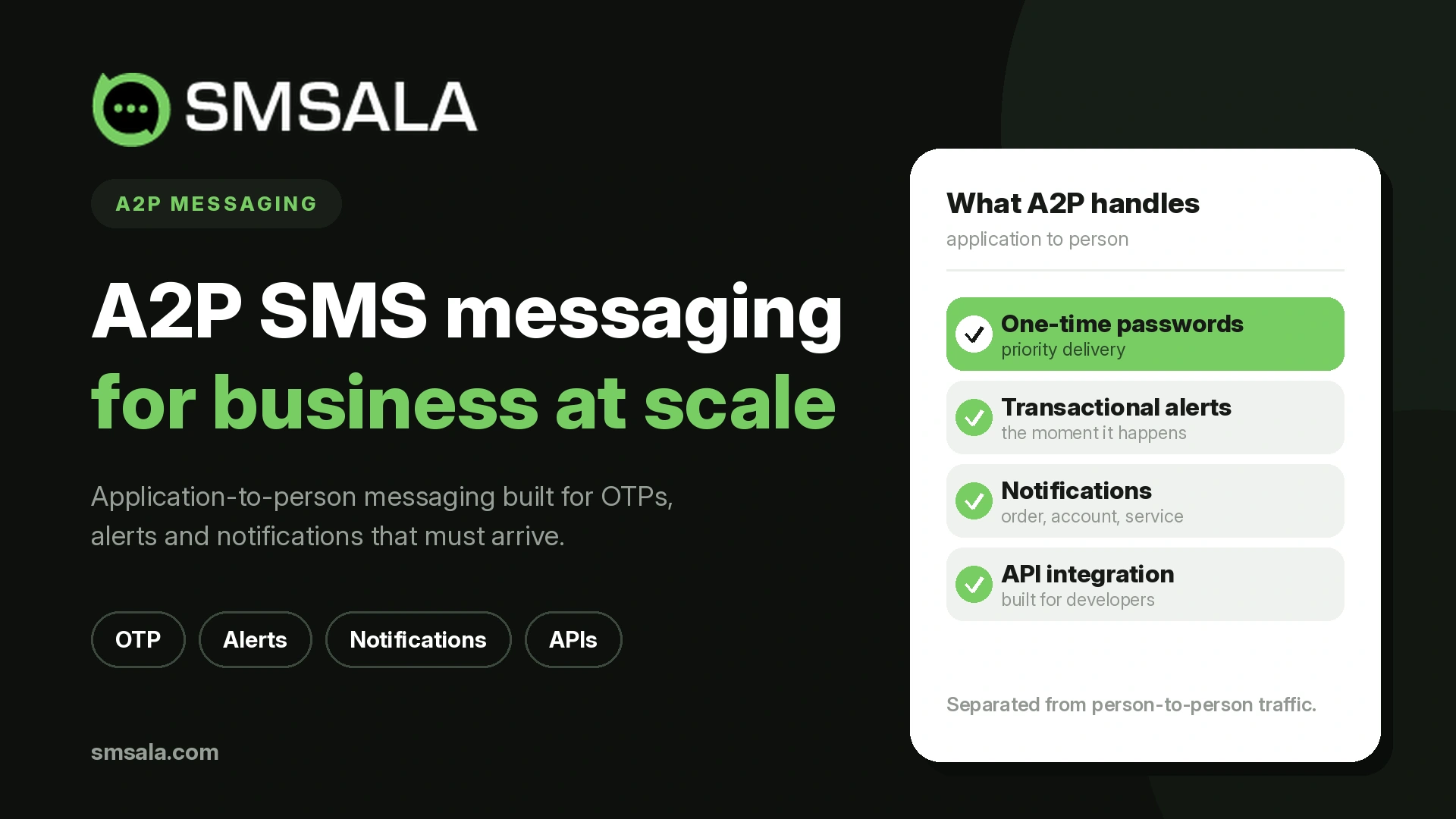
A2P SMS messaging is any text message sent from an application to a person's phone, rather than typed by one individual to another. Every one-time passcode, order confirmation, delivery alert, appointment reminder, and marketing text a business sends is A2P, short for application-to-person. It is the invisible layer that carries most of the world's commercial text traffic, and it operates under rules, routes, and economics that ordinary personal texting never touches.
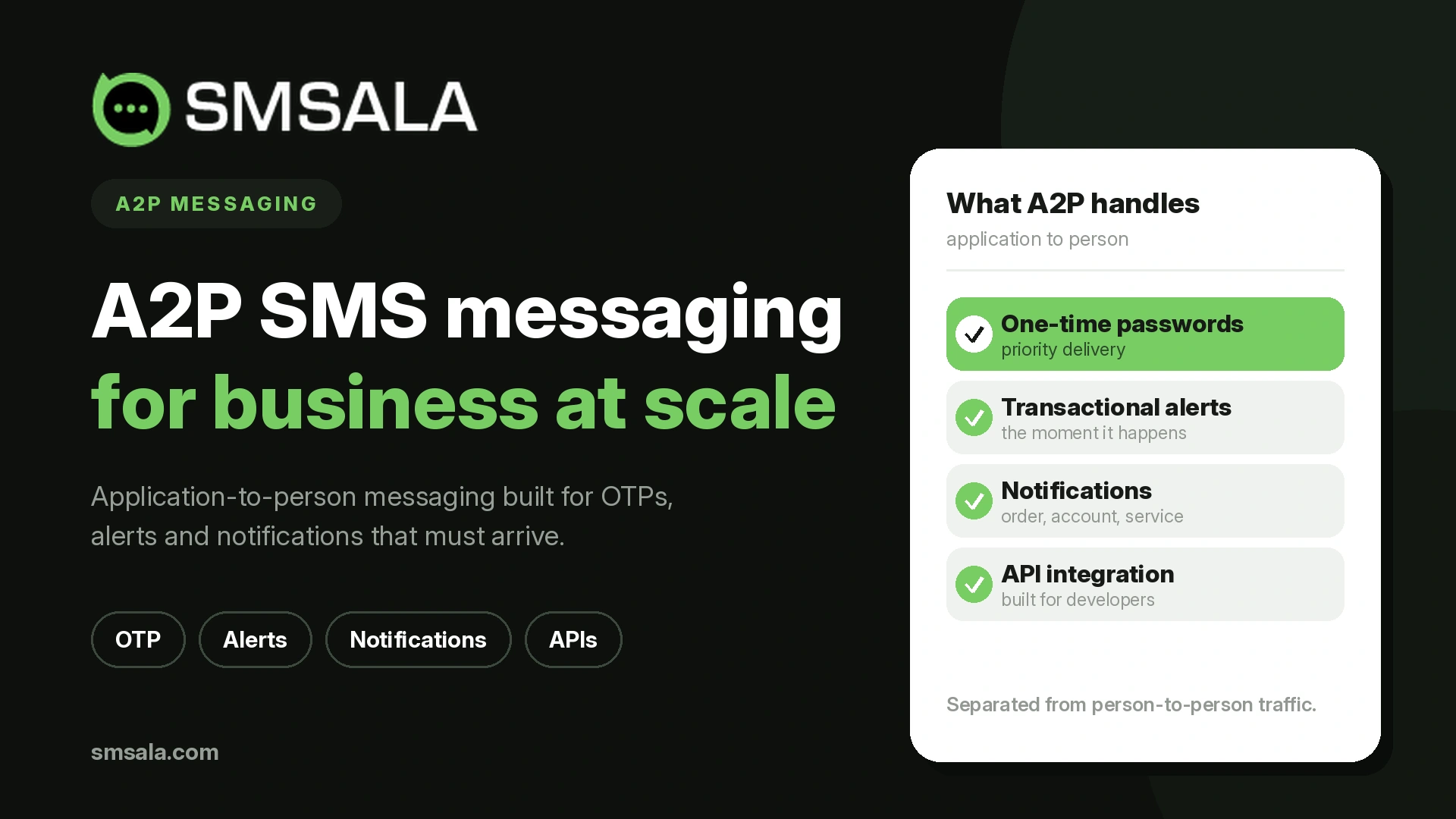
That distinction between a message a system sends and a message a human types, is not a technicality. It determines how the message is priced, how it is routed, whether it needs to be registered, and how carriers filter it. Anyone sending business messages at scale, whether OTPs for a bank, notifications for an app, or campaigns for a retailer, is operating in the A2P world, and understanding how that world works is the difference between messages that reliably arrive and messages that quietly vanish.
A2P versus P2P: the core distinction
The messaging ecosystem splits into two categories, and carriers treat them very differently.
A2P (application-to-person) traffic flows from software to a person, usually one-directional, high-volume, and commercial. It is what businesses use.
P2P (person-to-person) traffic flows between two individuals having a conversation, low-volume and two-way. It is what friends and family use.
Attribute | A2P | P2P |
Sender | An application or platform | A person |
Direction | Mostly one-way, some two-way | Two-way conversation |
Volume | High, often bursty | Low, steady |
Purpose | Commercial: alerts, OTPs, marketing | Personal communication |
Regulation | Registered, filtered, monitored | Minimal |
Pricing | Business A2P rates | Consumer plan |
Carriers care about this split because A2P traffic is where both the revenue and the abuse concentrate. Sending high-volume commercial messages over P2P channels to dodge A2P rates and rules, a practice at the heart of grey routing, is exactly what carriers and regulators work to stop. A message that needs to reach thousands of people reliably belongs on a proper A2P route, not disguised as personal texting. Genuine two-way business conversations, meanwhile, are a legitimate A2P use case and are handled through two-way messaging rather than P2P.
How A2P SMS actually works
Between the application that sends a message and the handset that receives it sits a chain of systems, and knowing the chain explains almost everything about A2P behavior.
A business application connects to a messaging provider, either through an API for modern, flexible integration or through an SMPP gateway for high-throughput carrier-grade sending. Most businesses today integrate through a bulk SMS API because it is simpler to build on. The provider converts the message into a format mobile networks understand and passes it to an aggregator or a direct carrier connection, which routes it across to the recipient's mobile operator, which finally delivers it to the handset. At the end, the operator returns a delivery receipt confirming what arrived.
Two elements of this chain decide results. The first is the route: legitimate A2P traffic travels over direct carrier agreements, while cheaper traffic often travels over grey routes that get blocked without warning and return unreliable receipts. The second is filtering: carriers run SMS firewalls that inspect A2P traffic and silently drop anything matching spam or fraud patterns. This is why accurate delivery reports exist only on quality routes, and why the honesty of a provider's reporting is as important as its price.
The types of A2P messages
A2P is not one kind of message. It spans several categories that behave and are priced differently.
Authentication messages deliver one-time passcodes and login verification. Secure, reliable OTP delivery is the highest-stakes A2P traffic, because a delayed passcode is a failed login, and it is a primary reason many businesses adopt A2P at all.
Transactional messages confirm or update something the customer set in motion: order confirmations, shipping updates, payment receipts, appointment reminders. They are expected and welcomed.
Promotional messages market offers and campaigns to opted-in recipients. They carry the strictest consent and timing rules because they interrupt.
Alerts and notifications cover service, security, and operational messages, from fraud warnings to outage notices, where speed matters most.
The pattern that separates strong programs from weak ones is understanding that authentication and transactional traffic, though less glamorous than marketing, often carry the highest value and the lightest regulatory burden, while promotional traffic carries the heaviest rules.
Why A2P is registered and regulated
The single biggest difference between A2P and personal texting is registration. Because A2P traffic is commercial and high-volume, carriers and regulators require senders to identify themselves before sending, and unregistered traffic is heavily filtered or blocked. The rules vary by market.
In the United States, A2P 10DLC requires registering your brand and each campaign use case through The Campaign Registry before sending over standard ten-digit numbers. Registered traffic earns higher throughput and deliverability; unregistered traffic is throttled or blocked.
In India, DLT registration requires registering your business entity, your sender headers, and every content template on the regulator's platform, with consent checked at the carrier.
Across the Gulf, Europe, and most of the world, registered Sender IDs and documented consent are required for commercial messaging, with details differing by country.
These regimes look like bureaucracy but function as a trust layer. A sender who registers correctly reaches the inbox; one who tries to skip registration gets filtered. For any business sending A2P at scale, treating registration as the first step rather than an afterthought is what separates a working program from a blocked one.
The economics of A2P
A2P messaging is a high-volume, thin-margin business, and understanding its cost structure explains how the whole industry behaves.
Each message is priced per delivery, and the price depends heavily on the destination country, because terminating a message on a local carrier costs different amounts in different markets. On top of the carrier fee sit aggregator and provider margins, which is why the same message can cost several times more in one country than another. Volume lowers the per-message rate, and route quality raises it, since direct routes cost more than grey routes precisely because they work.
For enterprises, the practical consequence is that a headline per-message rate means little without knowing the destination mix and the route quality behind it. A rate that looks cheap is often cheap because it rides grey routes that will eventually be blocked, at which point the true cost of the lost messages dwarfs the saving. The reliable way to evaluate A2P pricing is against your real traffic profile, the countries you send to and the categories you send, not a single advertised number. This is the same discipline that underpins any serious bulk SMS operation.
The fraud every A2P sender should understand
A2P's scale and per-message economics have created a specific form of fraud that has grown sharply, and most introductions to the topic ignore it. It goes by two names: SMS pumping and artificially inflated traffic, or AIT.
The mechanism is simple and costly. Fraudsters exploit any form on a website or app that triggers an SMS, most often a one-time passcode field. Using bots, they enter large numbers of phone numbers they control, or numbers on high-cost ranges tied to complicit operators, and force the application to send a flood of OTP messages. Each message is billed to the business, and the fraudsters collect a share of the inflated termination fees. The victim sees a sudden spike in OTP sends, a soaring bill, and almost no real signups behind it.
The defenses are concrete and worth building in from the start. Rate-limit how many messages a single user, number, or session can trigger. Apply geographic controls so you are not sending verification traffic to countries where you have no customers. Monitor for abnormal spikes in volume, unusual destination patterns, and low conversion between messages sent and accounts created. Use CAPTCHA or similar friction on the forms that trigger messages. And route through a provider whose firewall and monitoring can flag AIT patterns, since a good provider treats your delivery rate and traffic shape as signals worth watching, not just numbers to report. Businesses that ignore this discover it through a bill; businesses that plan for it treat verification traffic as an attack surface to defend.
A2P and the newer channels
A2P is not limited to SMS, and its future is broadening rather than shrinking. The same application-to-person model now spans richer channels. RCS brings branded, interactive A2P messaging into the native inbox on Android and iPhone, while the WhatsApp Business platform carries A2P conversations with media and buttons for opted-in users. SMS remains the universal backbone because it reaches every phone without an app or data connection, which is why it still carries the bulk of authentication and alert traffic even as richer channels grow. The practical view is not SMS versus the newer channels but A2P as a category that now travels several roads, with SMS as the dependable default and the others layered on where they reach.
Who uses A2P SMS
A2P underpins messaging across nearly every industry that communicates with customers at scale. Banks and fintechs send passcodes and fraud alerts. Retailers and marketplaces send order and delivery updates and promotions. Airlines and logistics firms send status changes. Healthcare providers send appointment reminders. Governments send public notices. Anywhere a system needs to reach a person reliably and instantly, A2P is the mechanism, whether the goal is security, service, or marketing through disciplined SMS marketing programs.
Frequently asked questions
What does A2P SMS mean?
A2P stands for application-to-person. It refers to any SMS sent from a software application to a person's phone, such as a one-time passcode, an order update, or a marketing text, as opposed to P2P messages typed by one person to another.
What is the difference between A2P and P2P SMS?
A2P traffic is sent by an application, is usually high-volume and commercial, and is registered and filtered by carriers. P2P traffic is a two-way conversation between individuals, low-volume and lightly regulated. Carriers price and route the two differently.
Do I need to register to send A2P SMS?
In most major markets, yes. The United States requires A2P 10DLC brand and campaign registration, India requires DLT registration, and most other countries require registered sender IDs and documented consent. Unregistered A2P traffic is filtered or blocked.
What is SMS pumping or AIT?
SMS pumping, also called artificially inflated traffic, is a fraud where bots trigger large volumes of messages, usually one-time passcodes, to numbers that generate revenue for the fraudsters, leaving the business with an inflated bill. Rate limiting, geographic controls, and traffic monitoring defend against it.
How much does A2P SMS cost?
It is priced per message and driven mainly by the destination country, then by volume and route quality. Because rates vary widely by market, the only reliable comparison is a quote based on your real destination mix and message types rather than a single headline rate.
Is A2P SMS only for marketing?
No. A large share of A2P traffic is authentication and transactional, such as passcodes, confirmations, and alerts, which often carry higher value and lighter regulation than promotional messages. Marketing is one A2P category among several.
A2P SMS messaging is the machinery behind almost every business text a person receives, and it rewards senders who respect how it works: register properly, route over direct carrier connections, watch delivery honestly, and defend the forms that trigger messages against inflated-traffic fraud. Get those right and A2P is one of the most reliable ways to reach a customer anywhere in the world.
For businesses that want their registration, routing, and fraud protection set up correctly across the markets they send to, that groundwork is where an experienced messaging partner earns its place, so every message from a passcode to a promotion arrives, complies, and is accounted for.