
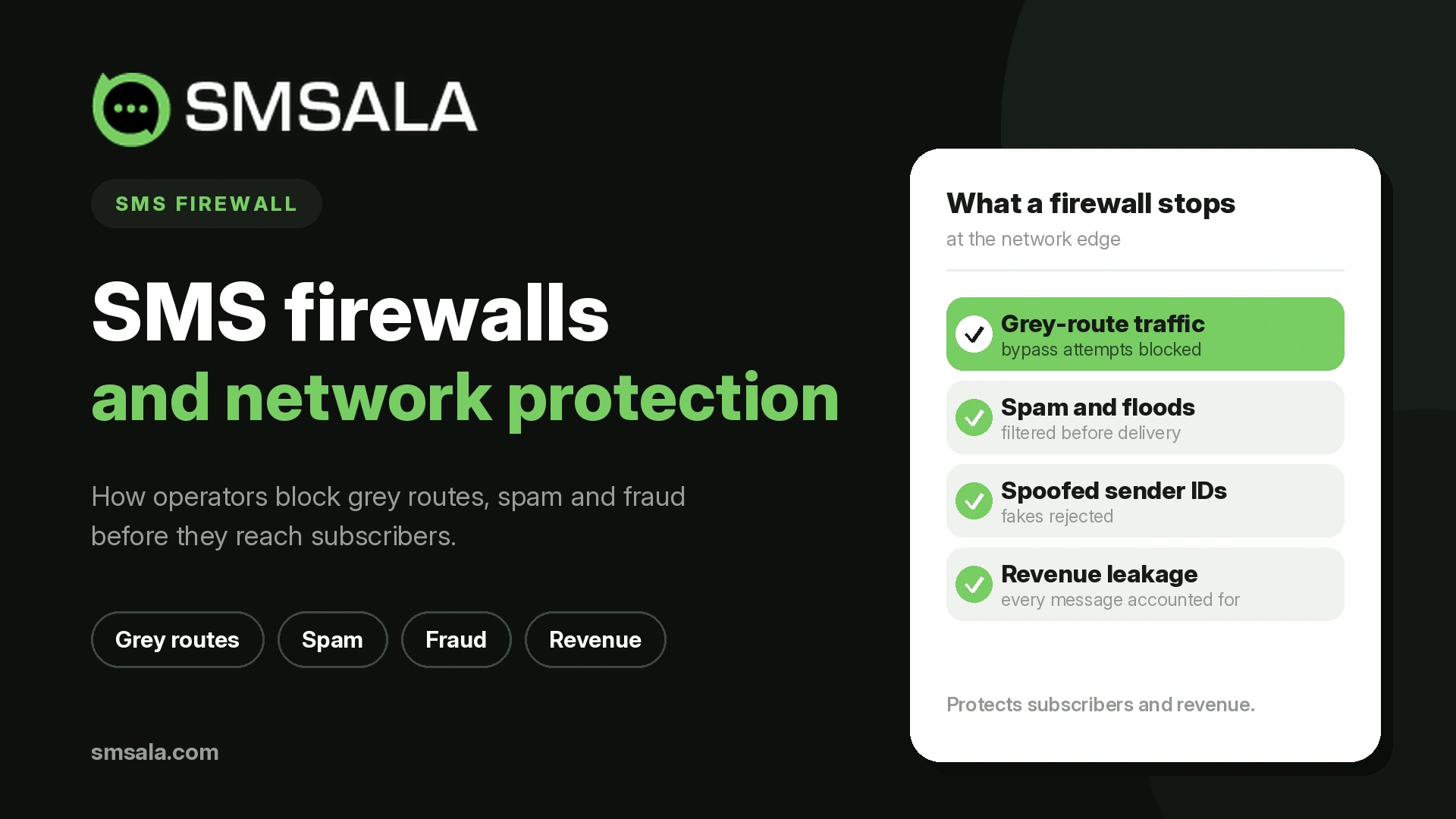
Every legitimate text message shares the network with a steady stream of spam, spoofed sender IDs, and traffic engineered to dodge billing. An SMS firewall is what stands in the way. It inspects the messages crossing a mobile network in real time, blocks the fraudulent and non-compliant ones, and makes sure commercial traffic is properly identified and charged. For mobile operators it protects revenue and subscribers, and for businesses that send messages it is the reason a clean, direct route reaches the inbox while a grey one does not.
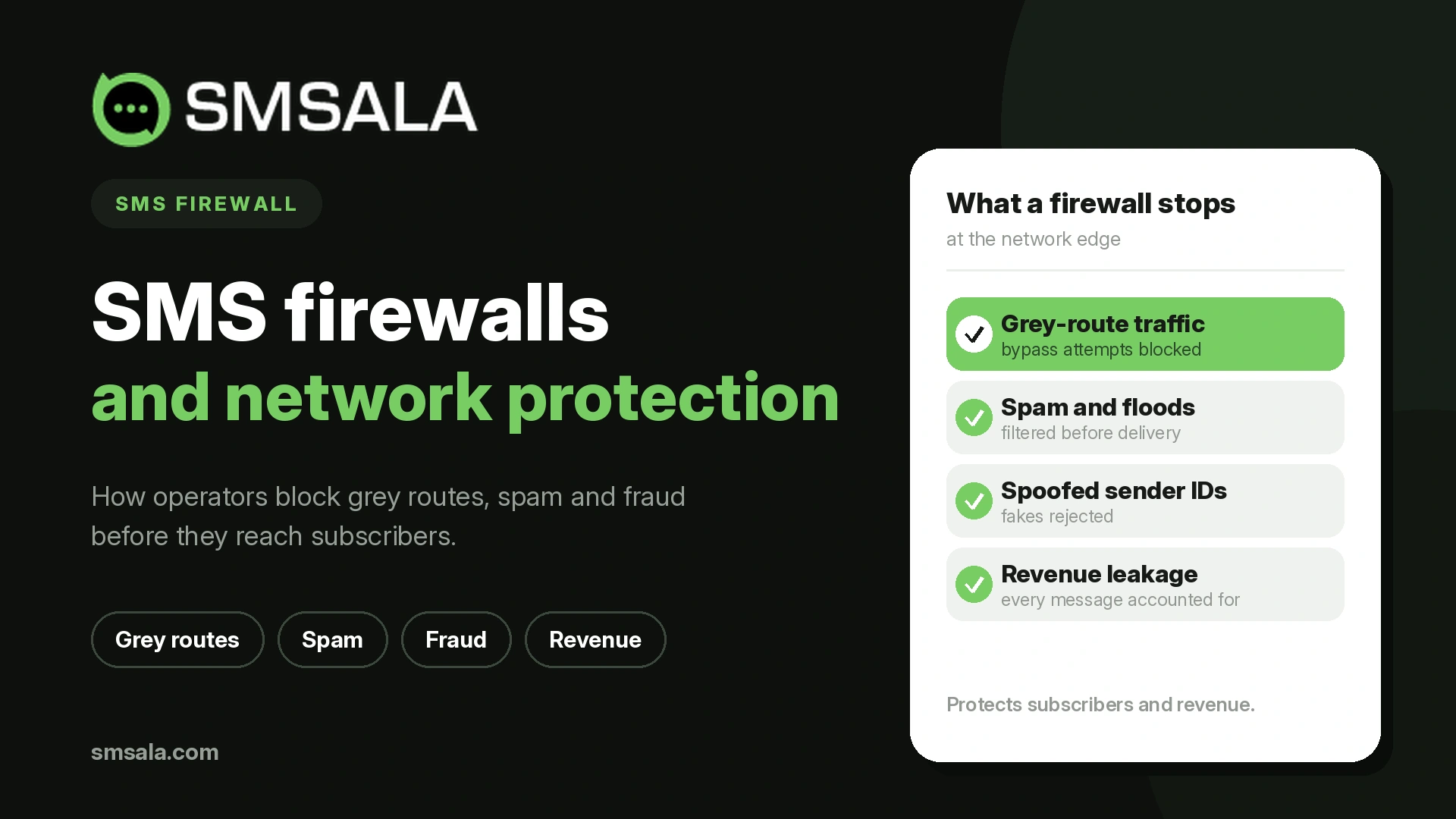
This guide explains what an SMS firewall is, how it works, the threats it stops, and why it matters whether you run a network or simply rely on SMS to reach customers.
What is an SMS firewall?
An SMS firewall is a network security and policy-enforcement system that mobile operators use to monitor, filter, and control SMS traffic. It sits between the signaling layer and the messaging flow, inspecting messages as they enter and leave the network and deciding, in real time, whether each one should be delivered, blocked, or rerouted.
Think of it as a checkpoint for every text. Rather than looking only at message content, it examines where a message came from, how it was routed, what sender ID it carries, and whether its pattern looks legitimate, then applies the operator's rules. The goal is to let genuine person-to-person and properly declared business traffic through while stopping fraud, spam, and revenue leakage.
How an SMS firewall works
A modern firewall combines several techniques to classify traffic accurately:
Real-time inspection: every inbound and outbound message is analysed against operator-defined rules before delivery.
Traffic classification: the system distinguishes application-to-person (A2P) business traffic from person-to-person (P2P) messages, which is central to both billing and security.
Sender and route checks: it verifies sender IDs, detects spoofing, and identifies messages arriving over unauthorised routes.
Number validation: an HLR lookup confirms whether a destination number is valid and which network it belongs to, which helps spot fraudulent or malformed traffic.
Pattern and behaviour analysis: rate limiting and increasingly machine-learning models flag flooding, unusual volumes, and known attack signatures.
Based on all of this, the firewall allows, blocks, or reroutes each message, and logs the decision for analytics and reporting.
A2P versus P2P and the grey route problem
The distinction between A2P and P2P traffic is where much of the money and fraud lives. P2P is ordinary personal texting. A2P messaging is business traffic such as OTPs, alerts, and marketing, and operators charge a higher, agreed rate to terminate it on their network.
A grey route is a path that disguises A2P traffic as P2P, or otherwise slips it onto the network through an unauthorised interconnect, to avoid paying the proper A2P rate. It looks cheap to the sender, but it is unreliable, often blocked, and it drains operator revenue. One of a firewall's core jobs is to detect this disguised traffic and stop it, which is exactly why messages sent over grey routes fail so often. The reliability gap between direct and grey routes is, in large part, the firewall doing its job.
The main threats an SMS firewall blocks
Firewalls defend against a range of abuse, not just spam. The table summarises the most common threats.
Threat | What it is | What the firewall does |
Grey-route bypass | A2P traffic disguised as P2P to dodge billing | Detects and blocks disguised or unauthorised traffic |
SIM box or SIM farm fraud | Banks of SIMs used to inject traffic as if it were local P2P | Identifies abnormal patterns and blocks the source |
Smishing (SMS phishing) | Fraudulent messages tricking users into revealing data | Filters malicious content and suspicious links |
SMS spoofing | Faking a trusted sender ID to deceive recipients | Verifies sender identity and blocks impersonation |
SMS flooding | High-volume bursts to disrupt or overwhelm | Applies rate limiting and volume thresholds |
Artificially inflated traffic | Fake OTP or verification requests that inflate a victim's bill | Flags abnormal verification patterns and throttles them |
Key features of an effective SMS firewall
The strongest systems share a common set of capabilities: real-time content and traffic filtering, robust sender ID and anti-spoofing controls, rate limiting to contain floods, HLR lookup for number validation, machine-learning detection that adapts to new fraud patterns, and detailed analytics so operators can see what is being blocked and why. Just as important is a regular update service, because fraud techniques evolve constantly and an unmaintained firewall quickly develops gaps. Home routing of inbound international messages is another common feature, giving the operator visibility and control over traffic entering its network.
Why SMS firewalls matter
The value shows up differently depending on where you sit in the messaging chain.
For mobile operators, the firewall protects two things at once: revenue and subscribers. By ensuring A2P traffic is correctly identified and charged, it recovers income that grey routes would otherwise steal, a practice often described as A2P monetisation. At the same time it shields subscribers from smishing, spoofing, and spam, which preserves trust in SMS as a channel and keeps the network compliant with industry guidance from bodies such as the GSMA.
For businesses that send messages, the firewall is the reason routing quality is not optional. Because firewalls block grey and unauthorised traffic, messages sent over cheap indirect routes are filtered out or delayed, damaging deliverability and, with it, customer experience. Sending through a provider that uses legitimate direct routes is what gets time-sensitive messages like OTPs delivered, and it is why SMS deliverability tracks so closely with route quality. A reliable bulk SMS service built on direct operator connections is designed to pass firewall checks rather than fight them, which is what keeps delivery consistent at scale.
Where the firewall sits in the network
An SMS firewall is positioned at the network's messaging boundary, working alongside the signaling layer and the message centre so it can see both the routing information and the message itself. This vantage point lets it inspect interconnect traffic, apply home-routing policies, and coordinate with the operator's wider fraud and route management systems. Sitting at this chokepoint is what allows a single system to enforce policy across all the traffic entering and leaving the network.
Challenges and limitations
No firewall is perfect. Overly aggressive rules can create false positives that block legitimate messages, so tuning matters. Fraud techniques change quickly, which is why ongoing updates and adaptive detection are essential rather than optional. And there is a constant balance to strike between tight filtering and smooth delivery of genuine traffic. The most effective deployments treat the firewall as a living system that is monitored and refined, not a set-and-forget appliance.
The future of SMS firewalls
Two forces are shaping what comes next. Fraud is getting more sophisticated, with artificially inflated traffic and evolving smishing campaigns pushing firewalls toward smarter, machine-learning-based detection. At the same time, messaging itself is broadening, with rich channels such as RCS growing alongside SMS, which extends the surface that operators need to protect. SMS remains central to authentication and notifications, so far from becoming less relevant, firewalls are becoming a more important part of keeping the whole messaging ecosystem trustworthy.
Frequently asked questions
What does an SMS firewall actually do?
It monitors, filters, and controls SMS traffic on a mobile network in real time, blocking fraud, spam, and unauthorised traffic while ensuring legitimate messages are delivered and commercial traffic is correctly identified.
What is a grey route, and why do firewalls block it?
A grey route disguises business (A2P) traffic as personal (P2P) messaging to avoid paying the proper rate. Firewalls detect and block it because it costs operators revenue and is unreliable for senders.
Does an SMS firewall protect businesses or just operators?
Both. Operators gain revenue protection and network security, while businesses benefit because legitimate direct routes are delivered reliably and grey routes are not, which protects deliverability and brand trust.
Can a firewall stop all SMS fraud?
No system is completely foolproof, but a well-maintained firewall with real-time detection and regular updates blocks the large majority of known threats and adapts to new ones.
How does a firewall affect my message delivery?
If you send over clean, direct routes with proper sender identification, firewalls let your messages through. If you use grey routes, they are likely to be blocked or delayed.
Conclusion
An SMS firewall is the quiet infrastructure that keeps text messaging trustworthy. It protects operators from revenue leakage and subscribers from fraud, and it rewards businesses that send responsibly over legitimate routes. As fraud grows more sophisticated and messaging expands into richer channels, the firewall's role only becomes more central. For any business that depends on SMS reaching real people, the practical lesson is simple: send over direct, compliant routes, and the firewall becomes an ally rather than an obstacle.