
Abandoned carts have a significant impact on your online business's success. Customers who add items to their shopping carts but do not complete the purchase result in lost sales and missed opportunities. According to research, the average cart abandonment rate across industries is a staggering 69.57%. This means that nearly seven out of ten potential customers leave your website without converting.
The first is permission: can you legally text this shopper at all? The second is worth: is a recovery text adding revenue, or claiming credit for sales that would have happened anyway? Most guides skip both and jump to the copy. This one starts where the real work is, then gives you the practical message and timing guidance too, because you need all of it to run this well.
The prerequisite nobody mentions: the number and the consent
Here is the uncomfortable truth. To send an abandoned cart text, you need two things before the cart is ever abandoned: the shopper's mobile number, and their consent to receive marketing texts. If someone browses, adds to cart, and leaves without ever giving you a consented number, there is no compliant recovery text to send. You cannot text a stranger because they left a cart.
This reframes the whole strategy. Cart recovery does not begin at abandonment. It begins at capture, well before checkout:
Collect the number early and explicitly. A clear SMS opt-in at list signup, account creation, or the first checkout step, with language stating that they will receive marketing and cart reminders. An email captured at checkout does not grant SMS permission.
Keep the consent provable. Store what they agreed to and when. Proactive marketing texts require prior express written consent under the US TCPA, and equivalent lawful basis under GDPR in Europe, and that traffic must run through proper 10DLC registration in the US.
Honor opt-out instantly. Every message needs a working STOP, handled through reliable two-way messaging that halts all future sends.
If your capture rate of consented mobile numbers is low, that, not your copy, is the ceiling on your recovery program. Fix capture first, because the best template in the world cannot reach a number you never collected with permission.
Fix the leak before you bail the boat
Recovery texts patch a problem you can often prevent. Aggregated research from the Baymard Institute puts the average cart abandonment rate at roughly 70%, and the reasons are consistent and, importantly, fixable. Before optimizing recovery messages, look at why people leave, because reducing abandonment at the source recovers far more revenue than chasing it afterward.
Common reason shoppers abandon | The fix that beats any recovery text |
Unexpected shipping, tax, or fees at the end | Show total cost early; be honest about shipping upfront |
Forced account creation | Offer guest checkout |
Long or confusing checkout | Cut steps; autofill; a clear progress indicator |
Payment security doubts | Visible trust signals and familiar payment options |
Just comparing or not ready | Nothing to fix; this is where recovery texts earn their keep |
Notice the last row. A meaningful share of "abandonment" is simply shoppers who were never going to buy in that session, and that is exactly the group a well-timed reminder can convert. The others are telling you something is broken. A recovery text that says "complete your order" to someone who left because shipping doubled at checkout is answering the wrong objection.
Not all abandonment is the same, so not all messages should be
The single biggest upgrade over a generic template is matching the message to why the cart was left. If your platform can tell where in the funnel a shopper dropped, use it.
Where they left | What it signals | Message angle that fits |
Added to cart, then browsed away | Distraction or comparison | A light reminder: "Your cart's still here" |
Reached shipping and stopped | Sticker shock on delivery cost | Address it: free shipping or a shipping estimate |
Entered checkout, did not pay | Friction or hesitation | Reassurance and a one-tap link back to a saved cart |
Repeat abandoner across sessions | Price sensitivity or low intent | A considered incentive, used sparingly |
Original examples, matched to the cause rather than sprayed at everyone:
Distraction: "Hi Sara, your cart at [Brand] is saved and ready whenever you are: [link]"
Shipping shock: "Still thinking it over? Shipping's on us today if you finish up: [link]"
Checkout hesitation: "Something go wrong at checkout, Sara? Your items are held here and we're happy to help: [link]"
Each speaks to a different reason, which is why it outperforms one message sent to all. Personalization here means relevance to the reason, not just dropping in a first name.
The recovery sequence, with the reasoning
A single text leaves money on the table; too many train people to ignore you or opt out. A short, reasoned sequence works better than a fixed formula copied from a blog.
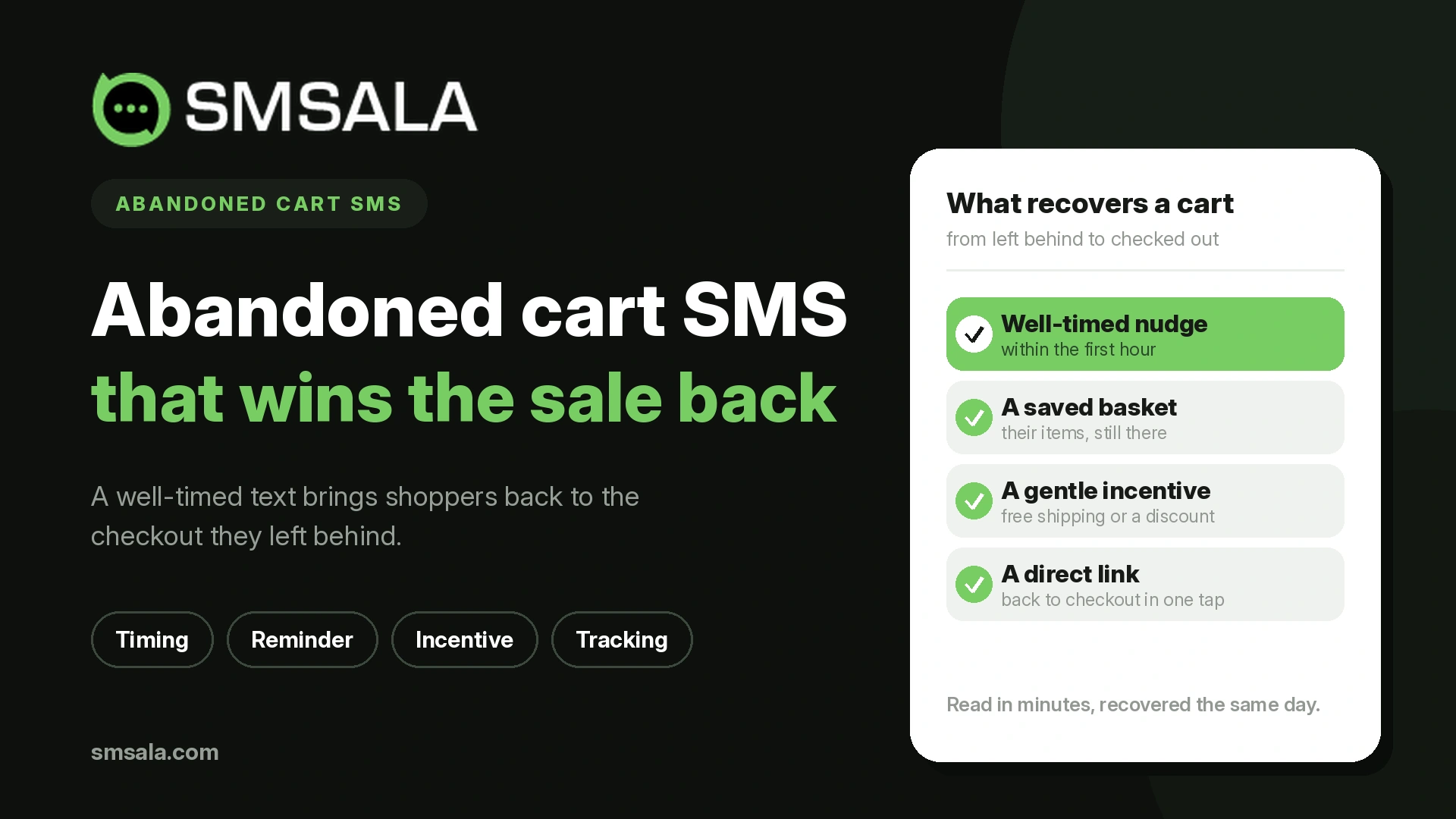
The first nudge, soon after leaving. Sent within roughly an hour, while intent is still warm and the shopper remembers what they wanted. Keep it a friendly reminder with a direct link back, no incentive yet. Many recoveries happen here, and offering a discount this early just gives margin away to people who would have returned anyway.
The reminder, about a day later. For those who did not return, a second message can add gentle urgency or address a likely objection, such as stock or shipping. This is where an incentive may be justified.
The last call, a few days out. A final message, clearly the last, with your strongest reasonable offer if you are going to make one. After this, stop.
Cap the frequency and end the sequence. A recovery program that keeps messaging indefinitely converts a warm prospect into an unsubscribe. Automating this as a triggered drip campaign keeps the timing consistent without manual effort, and lets you exit the sequence the moment someone buys.
The discount trap
The easiest recovery tactic is also the most dangerous one: reflexively offering a discount every time. Do it consistently and shoppers learn the game. They abandon on purpose, wait for the text, and pocket a discount they never needed. You have trained your best customers to stop paying full price.
Protect margin by treating discounts as a last resort, not a reflex. Lead with reminders and reassurance, reserve incentives for later in the sequence or for genuinely price-sensitive segments, and prefer non-discount levers where you can: free shipping, which often addresses the real objection anyway, a low-stock or back-in-demand nudge, or a trackable offer through coupon codes that lets you measure who actually needed the push. The goal is to recover the sale without teaching the behavior that loses the next one.
Writing a message that gets tapped
The copy matters least, which is why it is covered last, but a few things reliably help. Identify yourself clearly, since a message from an unknown number gets ignored; a recognizable Sender ID where supported, or a consistent number, tells the shopper who is texting. Keep it short and single-purpose, with one clear call to action rather than several. Link straight back to the saved cart or a fast checkout, ideally a mobile-optimized landing page that reloads their items rather than dumping them on a homepage. And make the opt-out visible, because a hidden STOP erodes trust and invites complaints.
Measuring what actually matters
This is where most programs fool themselves. "Recovery rate," the share of texted carts that convert, looks impressive and means little, because some of those shoppers would have come back on their own. Counting them as recovered revenue overstates your impact, sometimes dramatically.
The professional way to know your true effect is a holdout test. Randomly withhold recovery messages from a small control group, let the rest receive them, and compare completed purchases between the two. The difference is your incremental revenue, the sales the program actually caused rather than merely witnessed. Run it periodically, because the lift changes as your funnel and audience change.
Beyond incrementality, watch the metrics that reveal health rather than flatter it: opt-out rate as a fatigue signal, click-through as a copy-and-relevance signal, and the true delivery of your messages, since a recovery text that never arrives cannot recover anything. Grounding all of this in solid analytics and reporting is what separates a program you can improve from one you merely hope is working.
SMS is one channel, not the whole plan
Abandoned cart recovery usually works best across channels rather than SMS alone. Email carries detail, images, and longer persuasion at almost no cost, which suits a richer follow-up. SMS wins on immediacy and open rates, which suits the timely first nudge. Used together, and coordinated so a shopper is not hit on both at once, they cover more ground than either alone. This is where cart recovery folds into your broader SMS marketing for e-commerce and your customer data in the CRM, so the same shopper is recognized and messaged coherently wherever they are.
Frequently asked questions
Can I text someone who abandoned a cart if I have their number but no SMS opt-in?
No. Having a number is not the same as having consent to send marketing texts. Proactive recovery messages require prior express written consent, and sending without it risks penalties and carrier blocking. Capture explicit SMS opt-in before you rely on cart recovery.
How many abandoned cart texts should I send?
Usually two or three across several days, then stop. One misses recoveries; too many drive opt-outs. End the sequence as soon as the shopper buys, and cap frequency so a reminder never becomes a nuisance.
Should every abandoned cart text include a discount?
No, and doing so is a common mistake. Reflexive discounting trains shoppers to abandon on purpose. Lead with reminders and reassurance, reserve incentives for later messages or price-sensitive segments, and try free shipping or urgency before cutting price.
How do I know if abandoned cart SMS is actually working?
Run a holdout test. Withhold messages from a random control group and compare their purchase rate to the messaged group. The gap is your true incremental revenue, which is far more honest than a raw recovery rate that counts shoppers who would have returned anyway.
When should the first recovery text go out?
Roughly within an hour of abandonment, while intent is fresh. Keep that first message a simple reminder with a direct link back, and save any incentive for later so you are not discounting people who were going to return regardless.
The takeaway
Abandoned cart SMS is not a copywriting exercise. Its results are decided upstream by whether you captured a consented number, and downstream by whether you can prove the messages added revenue rather than shadowing sales you would have made anyway. Get consent capture right, fix the checkout leaks you can, match the message to why each shopper left, resist the reflex to discount, and measure with a holdout so you know the truth. The templates matter least of all, and they only work on top of that foundation. Building that foundation on compliant, well-delivered messaging, with a provider such as SMSala handling registration, routing, and automation, is what turns cart recovery from a hopeful tactic into a measurable line of revenue.