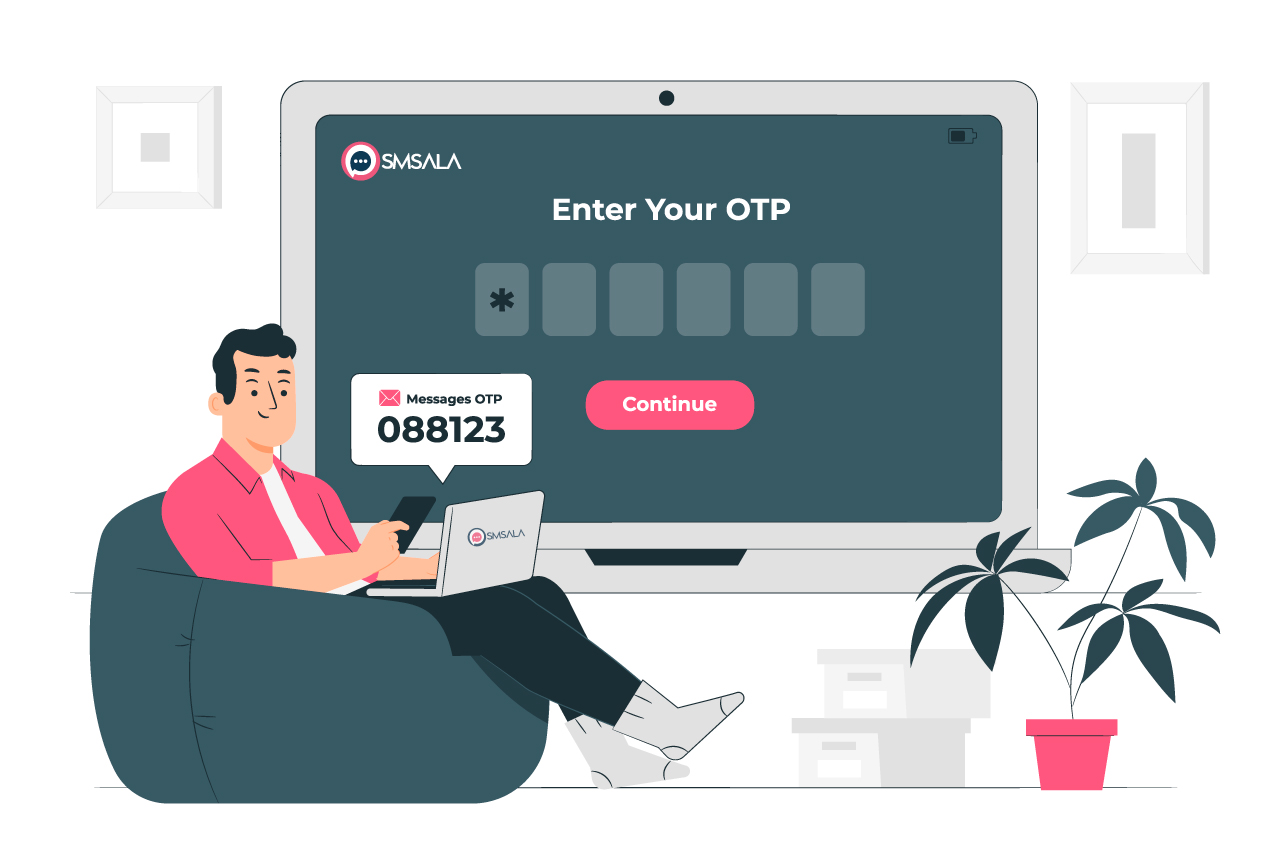
For most bank customers in India, the one-time password that arrives by SMS is the moment a transaction becomes real. It confirms a card payment, authorises a transfer, or verifies a login. Behind that short code sits a regulatory framework, a delivery chain across four mobile operators, and a constant contest with fraudsters.

This guide explains how OTP SMS works in banking, what the current Reserve Bank of India rules require, how banks deliver these messages reliably in India, and the security practices that keep them trustworthy.
What OTP SMS is and how it works in banking
An OTP is a temporary, single-use code, typically four to six digits, generated by the bank's system and valid for only a few minutes. It is sent to the customer's registered mobile number at the moment of a sensitive action and cannot be reused once entered or expired. Because the code is dynamic and tied to a specific transaction and time window, it is far harder to misuse than a static password.
In banking, OTP SMS almost always serves as the second factor in authentication. The customer proves who they are with something they know, such as a PIN or password, and then confirms with something they have, the phone that receives the code. That combination is what turns a login or payment into a verified action.
Why banks still rely on SMS OTP
The appeal of SMS for authentication is reach. A text message lands on any mobile handset, smartphone or basic phone, without an app installed and without a data connection. In a market as large and varied as India, no other channel matches that universality. A customer in a low-connectivity area receives the same OTP as one on a flagship phone.
SMS is also familiar. Customers already understand the flow, which reduces support friction and abandoned transactions. For time-sensitive actions, delivery in seconds matters, and a well-routed OTP arrives before the customer loses patience or the code expires. That is why reliable OTP SMS delivery across Indian networks is treated as core banking infrastructure rather than a convenience.
What RBI rules require: multi-factor authentication with a dynamic factor
Indian banks do not use OTP by preference alone. Authentication is governed by the Reserve Bank of India. Under the RBI (Commercial Banks: Digital Payment Security Controls) Directions, 2026, banks must apply multi-factor authentication to digital payments and fund transfers, and at least one of the authentication methods must be dynamic or non-replicable.
A one-time password is a recognised dynamic factor under this framework, alongside options such as biometrics, hardware tokens, device binding with SIM verification, and PKI. The framework is deliberately technology-agnostic, which means SMS OTP remains fully valid while banks are also free to adopt other dynamic methods.
Several specific requirements shape how banks use OTP:
Transaction alerts and OTPs for online payments should identify the actual merchant name rather than an intermediary, so the customer can see what they are approving.
Banks may use adaptive, risk-based authentication that selects factors according to the customer, transaction pattern, amount, and risk, rather than treating every action the same.
Multi-factor authentication and alerts apply not only to payments but also to changes such as adding a beneficiary or raising a transaction limit.
The direction also signals that banks may explore alternatives to SMS OTP, particularly within mobile apps. In practice this means SMS OTP continues as the default for broad reach, while app-based and biometric methods increasingly complement it for customers already inside a banking app.
Where banks use OTP SMS
OTP SMS appears at every point where a bank needs to confirm intent. Common triggers include:
Card-not-present payments, including online debit and credit card transactions.
Internet banking and mobile banking logins.
Fund transfers, especially higher-value or first-time transfers.
Adding or modifying a beneficiary.
Changing transaction limits or updating profile and contact details.
Resetting a password or reactivating a dormant service.
Each of these is a moment where a fraudulent actor could cause real harm, which is exactly why a dynamic second factor is required.
Delivering banking OTP reliably in India
A perfectly generated OTP is useless if it arrives late or not at all. Delivery in India depends on the same commercial-messaging framework that governs all application-to-person SMS.
Every bank sending OTP SMS must be registered on a Distributed Ledger Technology (DLT) platform, with the entity, sender ID, and content templates approved. Since December 2024, operators also enforce end-to-end message traceability, blocking any message whose telemarketer chain does not match the declared path. Getting DLT registration and template mapping right is therefore a prerequisite for delivery, not an afterthought.
Beyond registration, three factors decide whether banking OTPs arrive on time:
Route category. OTPs must travel on transactional or service routes, which are exempt from Do Not Disturb filtering. Sending them on promotional routes causes silent failures.
Route quality. Direct connections into Jio, Airtel, Vi, and BSNL deliver reliably; grey routes are unstable and often blocked, which is unacceptable for authentication traffic.
Visibility. Real-time delivery receipts (DLRs) let a bank confirm delivery and detect a failing route within minutes, before customers start calling support.
Security risks and how banks mitigate them
The OTP itself is strong, but the surrounding process is where fraud concentrates. The main threats and the standard defences are worth understanding together.
SIM swap fraud. An attacker convinces an operator to port the victim's number to a new SIM, then intercepts OTPs. Banks counter this with device binding and SIM-change checks, and by escalating authentication when a recent SIM change is detected.
Phishing and vishing. Fraudsters trick customers into revealing OTPs over fake calls, messages, or websites. The countermeasure is partly technical and partly communication: OTP messages should clearly state the purpose and merchant, and banks repeatedly remind customers that staff will never ask for an OTP.
OTP sharing and social engineering. Because customers can be manipulated into reading a code aloud, short validity windows, single-use enforcement, and clear message wording all reduce the window and the confusion an attacker relies on.
Interception in transit. Messages should move over secure, monitored infrastructure. SMS encryption protects content in transit, and operator-level SMS firewalls screen for spoofing, SIM-box abuse, and grey-route traffic that legitimate banking messages should never mix with.
Layered on top, the adaptive authentication that RBI permits lets banks demand a stronger factor when a transaction looks unusual, so the OTP is one control among several rather than a single point of failure.
OTP SMS best practices for banks
Keep the code short-lived and single-use. A validity window of a few minutes limits exposure without frustrating customers.
State the purpose and merchant in the message. Clear wording helps customers spot fraud and aligns with RBI's requirement to identify the actual merchant.
Never include actionable links in an OTP message. Links invite phishing and, in India, any URL must be whitelisted on the DLT platform anyway.
Use registered sender IDs consistently. A recognisable header builds trust and reduces the chance a genuine message is mistaken for spam.
Send only on transactional or service routes. This keeps OTPs exempt from DND and prioritised for speed.
Monitor delivery and failure rates by operator. Treat a rising failure rate on any network as an incident to investigate.
Design retries and fallback. If a code is not confirmed, retry on an alternate route and offer a fallback such as a voice OTP rather than resending endlessly.
Reinforce customer education. Regular reminders that OTPs are never to be shared remain one of the most effective anti-fraud measures.
Beyond SMS: complementary authentication factors
SMS OTP is dominant, but it works best as part of a layered approach. Within a banking app, methods such as fingerprint or face authentication, in-app approval prompts, and device binding provide strong, phishing-resistant factors for customers who are already logged in. For customers who cannot receive a text at a given moment, a voice OTP that reads the code aloud provides an accessible fallback.
RBI's technology-agnostic stance encourages exactly this mix. The practical model that most banks converge on is SMS OTP for universal reach, app-based and biometric factors for smartphone users, and risk-based logic deciding when to step up authentication. None of these removes the need for reliable SMS; they surround it.
Setting up OTP SMS for a bank
For a bank or fintech, implementing OTP SMS is less about generating codes, which is straightforward, and more about compliant, reliable delivery at scale. The essentials are a DLT-registered setup, direct operator routing, a robust API with retry and webhook support for real-time status, and delivery reporting granular enough to catch problems fast.
A messaging platform built for time-sensitive traffic handles most of this. SMSALA's transactional SMS service is designed for authentication and alert messages, with DLT-compliant routing, delivery tracking, and API integration suited to Indian banking workloads. The goal is to make authentication delivery dependable enough that the bank's teams can focus on the customer experience and fraud logic rather than on operator-level routing.
Frequently asked questions
Is SMS OTP still allowed for banking in India?
Yes. Under the RBI Digital Payment Security Controls Directions, 2026, banks must use multi-factor authentication with at least one dynamic factor, and OTP is a recognised dynamic factor. The rules are technology-agnostic, so SMS OTP remains valid alongside biometrics and other methods.
Why does my banking OTP now show the merchant name?
RBI directs that OTPs and alerts for online transactions identify the actual merchant rather than an intermediary, so customers can clearly see what they are approving before entering the code.
How long is a banking OTP valid?
Typically a few minutes. Banks keep the window short and enforce single use to limit the chance of interception or misuse.
Can OTP SMS be intercepted?
The main real-world risks are SIM swap fraud and social engineering rather than interception of the message itself. Banks mitigate these with device binding, SIM-change checks, short validity, secure routing, and customer education. Sending over encrypted, firewall-protected infrastructure reduces the technical risk further.
Will banks replace SMS OTP entirely?
Not in the near term. App-based and biometric methods are growing, especially inside banking apps, but SMS OTP remains the only factor that reaches every customer on any handset without an app or data, so most banks keep it as a core channel and layer other factors on top.
Conclusion
OTP SMS remains central to banking authentication in India because it is dynamic, single-use, and reaches everyone. Doing it well means treating it as a regulated, security-sensitive service: comply with RBI's multi-factor requirements, deliver over DLT-registered direct routes that meet the traceability rules, write messages that help customers spot fraud, and layer stronger factors where the risk justifies them. Handled that way, the short code that arrives in seconds does its real job, which is letting customers transact with confidence.