
Ask most online retailers what OTP protects them from, and the answer is usually a vague "fraud." That vagueness is the problem. A one-time password is a genuinely useful security control, but it protects against one specific thing and treating it as general-purpose fraud prevention leaves stores exposed to the fraud it was never designed to stop, while adding checkout friction that quietly costs legitimate sales.
An OTP proves that whoever is acting controls a particular phone number or email inbox. That's it. It does not prove the person is who they claim to be, that the card they're using is theirs, or that they intend to honour the purchase. Every real strength and weakness of OTP in e-commerce follows from that single, narrow fact.
This guide is the honest version most vendor content avoids: exactly which fraud OTP stops, which it doesn't, how attackers defeat OTP itself, the checkout-abandonment cost of using it carelessly, and how to deploy it so it protects revenue instead of draining it.
What an OTP actually verifies
A one-time password is a short, single-use code sent to a channel the user supposedly controls usually SMS, sometimes email or an authenticator app that they enter to confirm an action. As a category of business messaging it's classic A2P messaging: an application generating a message to a person, at scale, in real time.
What the successful entry of that code proves is possession: this actor can receive messages at this number right now. That is a meaningful thing to establish, because it defeats attacks that rely on knowing a secret without possessing the device. But it is much narrower than "this is a legitimate customer making a legitimate purchase," and the gap between those two statements is where a lot of e-commerce fraud lives.
The fraud OTP genuinely stops
Where the attack depends on someone acting without access to the real account holder's phone, OTP works well.
Account takeover is the headline case. If a fraudster has stolen or guessed a customer's password through a breach, phishing, or credential stuffing with reused credentials an OTP step at login stops them, because they have the password but not the phone. This is OTP's strongest use, and it's why protecting login matters as much as protecting checkout.
Fake account creation at scale is disrupted by requiring a verified phone number to register, since bots can generate email addresses freely but not endless working phone numbers. This blunts promo-signup abuse and spam registrations.
Unauthorized account changes are a quietly critical case. When someone tries to change the email, password, or most dangerously the shipping address on an account, an OTP to the number on file stops a hijacker from redirecting orders to themselves. Many stores protect checkout but leave account-detail changes unguarded, which is exactly the gap takeover fraud exploits.
Cash-on-delivery abuse, a major problem in markets where COD is common, is reduced by confirming orders with an OTP, filtering out fake orders placed with no intent to pay.
In each of these, the common thread is that OTP raises the cost of an attack that hinges on not having the legitimate user's device.
The fraud OTP does not stop and this is the part that matters
Here is what vendor content omits. A large share of e-commerce fraud doesn't care about OTP at all, because the fraudster either controls a valid phone or isn't impersonating anyone.
Fraud type | Does OTP stop it? | What actually addresses it |
Account takeover (stolen password) | Yes | OTP / step-up authentication |
Bot-created fake accounts | Largely | Phone verification + velocity checks |
Stolen card, fraudster's own account | No | 3DS/SCA, AVS, device and behaviour signals |
Friendly / chargeback fraud | No | Delivery proof, order records, dispute tools |
Promo and coupon abuse | Partly | Device fingerprinting, dedup, unique codes |
Triangulation fraud | No | Merchant-side fraud scoring |
Refund and return fraud | No | Policy controls, account history |
The recurring lesson: OTP verifies a channel, not a person's honesty or a card's ownership. A fraudster using a stolen card on their own verified account will pass an OTP check every time, because it's genuinely their phone the theft is the card, which OTP never examines. Friendly fraud, where a real customer disputes a charge they actually made, sails through OTP because the real customer really did approve it. Treating OTP as your fraud strategy leaves all of this untouched, which is why OTP has to be understood as one control among several, not the control.
How attackers defeat OTP itself
Even within its proper domain, OTP is not unbreakable. Understanding the ways it fails is what stops a store from over-trusting it.
SIM swapping is the most serious. An attacker socially engineers or bribes their way into having the victim's number ported to a SIM they control, after which every SMS OTP flows to the fraudster. High-value accounts are the usual targets, and SMS OTP alone is not enough to protect them.
OTP bots and social engineering have industrialised a simple trick: the attacker triggers a legitimate OTP to the victim, then, posing as the store or bank, calls or messages the victim and convinces them to read the code aloud. The victim's own phone received the code; they just handed it over. No system-level breach is required.
Real-time phishing uses adversary-in-the-middle kits that sit between the victim and the real site, relaying the OTP the instant the victim enters it on a fake page. Because the code is used immediately, its short expiry doesn't help.
The practical response is not to abandon OTP but to size it correctly: reliable for routine verification, insufficient as the sole guard on high-value or high-risk actions, and best backed by phishing-resistant methods where the stakes justify it. Using a consistent, registered sender ID so customers learn what a real message from you looks like also makes the social-engineering attacks meaningfully harder.
The OTP fraud vector almost nobody warns you about
There's a threat specific to running an OTP system that most guides never mention, and it attacks your costs rather than your customers: SMS pumping, also called artificially inflated traffic (AIT).
Here's the mechanism. Your OTP send endpoint is, from the outside, a machine that generates a paid SMS every time someone requests a code. Fraudsters exploit that directly: they script mass OTP requests to a range of phone numbers they control on premium-rate routes, and collect a share of the termination fees. Your fraud-prevention feature becomes a revenue stream for the attacker and a surprise five- or six-figure line on your messaging bill. It's one of the fastest-growing forms of messaging fraud precisely because it turns a security control into an attack surface.
Defending against it is a set of controls on the OTP endpoint itself: rate-limit requests per number and per IP, add invisible bot checks before triggering a send, monitor for abnormal spikes in OTP volume or sudden traffic to unusual destinations, apply number validation to filter suspicious ranges, and lean on provider-side SMS firewalls that detect pumping patterns. The point to internalise is that an OTP system needs to be defended, not just deployed the endpoint is a target.
The conversion cost, and why you shouldn't OTP everything
Every OTP step you add removes some legitimate customers, and this is the tradeoff the security-first framing ignores. A code that's delayed, filtered, or sent to a mistyped number is a customer who can't complete their purchase. A verification step at the wrong moment is a cart abandoned. In e-commerce, where a few percentage points of checkout completion decide profitability, blanket OTP is a self-inflicted wound.
The mature approach is risk-based, step-up authentication: apply OTP where the risk justifies the friction, and let low-risk actions flow freely. A returning customer buying a normal-value item from their usual device on their usual network is low risk challenge them and you lose sales to prevent fraud that wasn't going to happen. A login from a new device in a new country, a high-value order, or a shipping-address change is high risk that's where an OTP step earns its friction.
This reframes OTP from a gate everyone passes through into a scalpel applied precisely. The stores that do this well protect the transactions that matter while keeping checkout frictionless for the majority of honest customers, and reliable OTP delivery on quality routes ensures that when they do challenge someone, the code actually arrives fast enough to not lose them anyway.
Where OTP belongs in the e-commerce journey
Mapping OTP to the specific moments it helps rather than sprinkling it everywhere is how you get the protection without the abandonment.
Journey stage | OTP worth it? | Why |
Account creation | Often | Blocks fake/bot accounts; verifies a real contact |
Routine login (known device) | Rarely | High friction, low added protection |
Login (new device / risky signal) | Yes | Strongest defence against account takeover |
Checkout / payment | Via 3DS/SCA | Card authentication, often regulator-mandated |
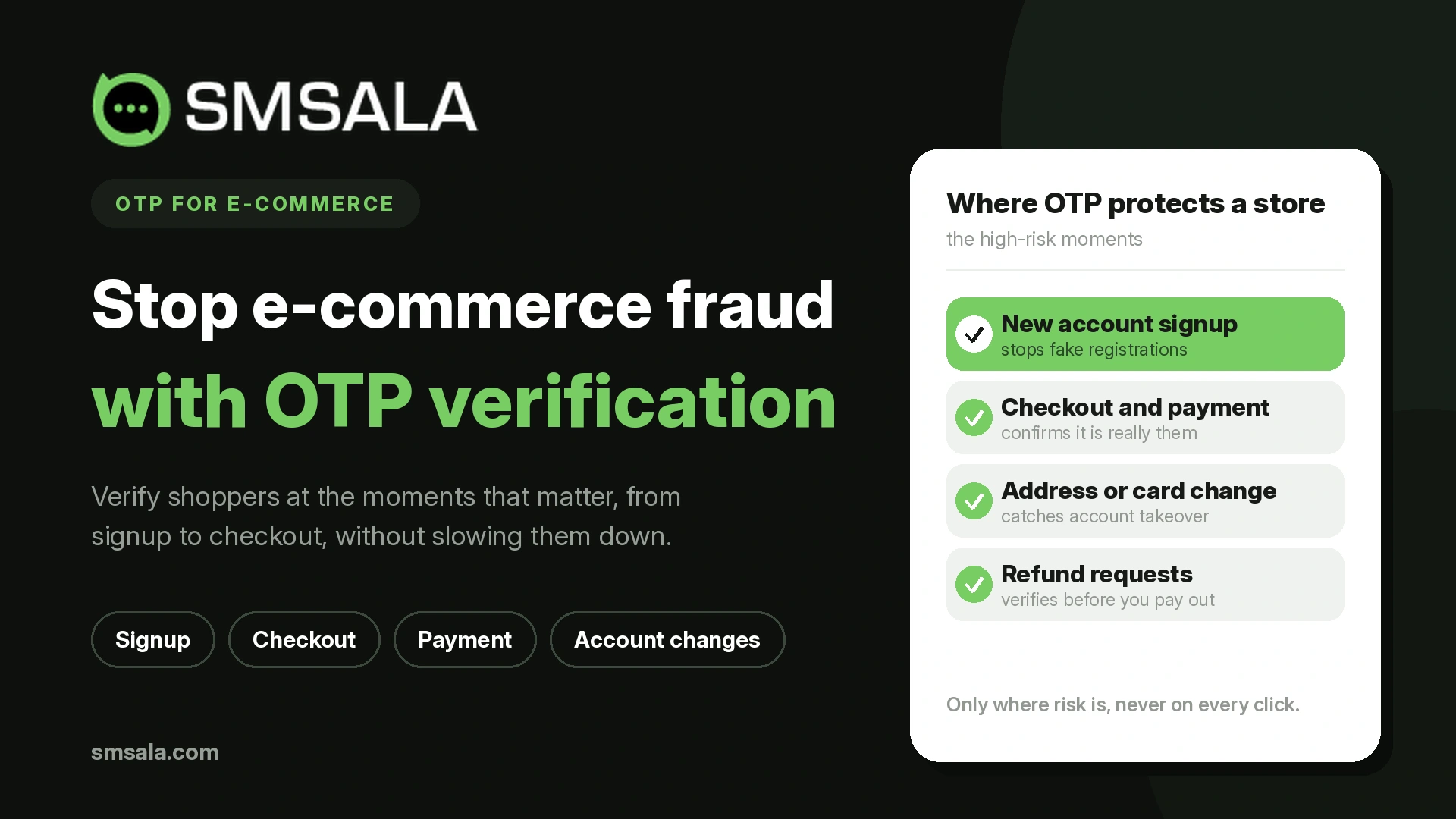
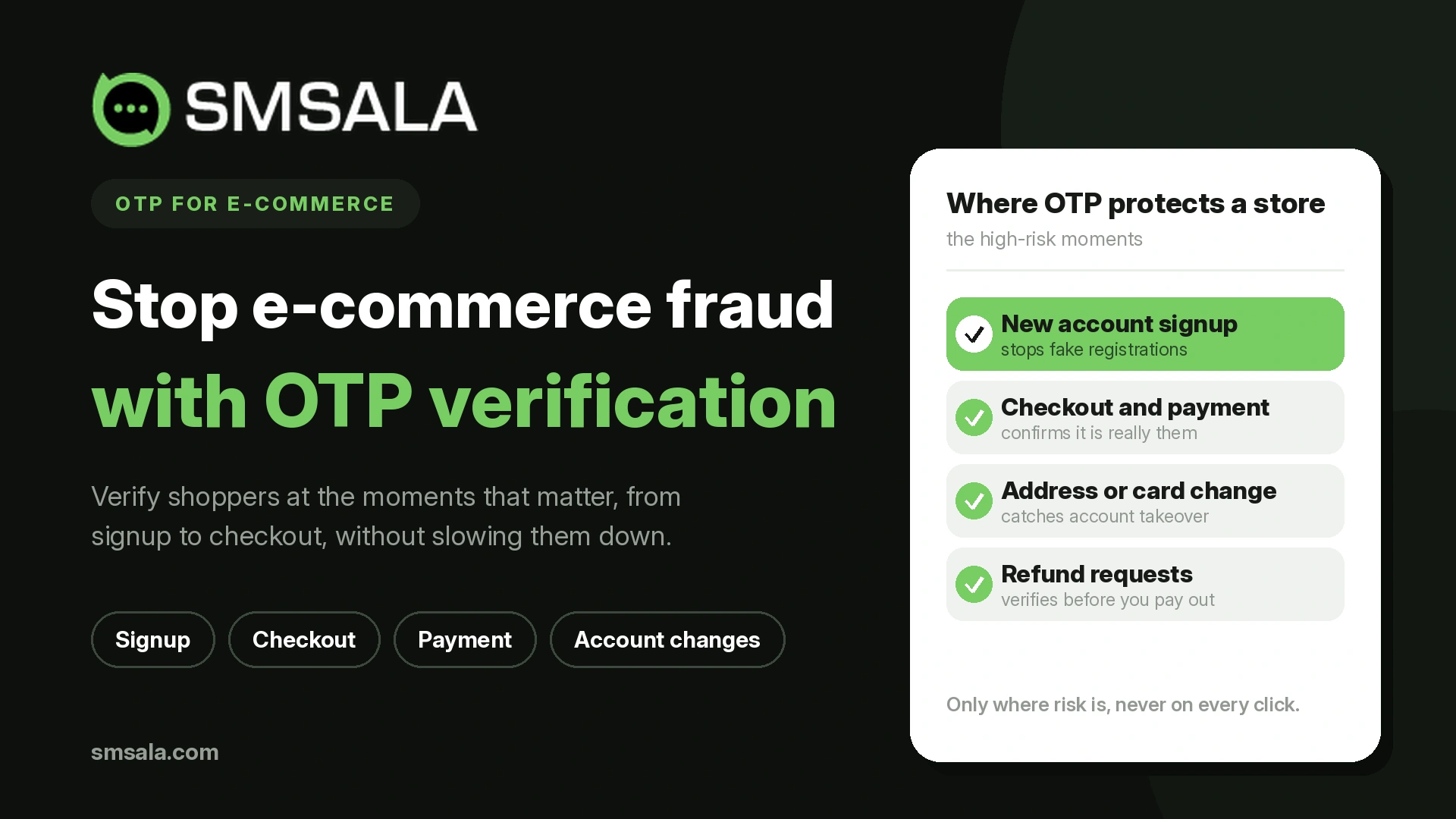
Account detail changes | Yes | Stops hijackers redirecting orders |
Cash-on-delivery confirmation | Yes | Filters fake orders in COD markets |
Refund / return requests | Sometimes | Adds a check on a common abuse point |
Two notes. At payment, OTP usually arrives through the card networks' 3-D Secure flow, which in regulated markets like the EU is tied to Strong Customer Authentication requirements so that step is often not optional. And the highest-value, lowest-friction place to add OTP is frequently the account-changes stage, not checkout, because it closes the takeover path most stores leave open.
OTP is one layer, not the wall
The stores that actually control fraud treat OTP as a single control inside a stack, each layer catching what the others miss. Around OTP sit device fingerprinting (is this a device you've seen?), velocity checks (how many orders, cards, or attempts from this source?), address verification and card authentication at payment, and behavioural signals that flag anomalies. OTP handles the possession question; these handle the questions OTP can't whether the payment is legitimate and whether the pattern looks like fraud.
Delivery infrastructure underpins all of it. An OTP that arrives late or not at all is both a security gap and a lost sale, so routing quality matters as much as the logic above; codes moving over unreliable grey routes undermine the whole system, and watching delivery reports tells you whether your codes are actually reaching customers. For stores that want a channel with richer verification and confirmation flows, delivering some of this through the WhatsApp Business API alongside SMS can improve both trust and reach.
Implementation checklist
To make OTP protect revenue rather than drain it:
Apply OTP by risk high-value, new-device, and account-change actions not to every login and purchase.
Protect account detail changes (email, password, shipping address), not just checkout.
Rate-limit and monitor the OTP endpoint to defend against SMS pumping.
Use short code expiry (a few minutes) and single-use codes.
Send from a consistent, registered sender so customers can recognise genuine messages.
Ensure fast, reliable delivery on direct routes, with a fallback channel.
Treat OTP as one layer alongside device, velocity, address, and behavioural checks.
Don't rely on SMS OTP alone for your highest-value accounts.
The bottom line
OTP is a precise tool, not a fraud shield. It proves someone holds a phone or inbox nothing more which makes it excellent against account takeover and fake accounts, useless against stolen-card and chargeback fraud, and vulnerable to SIM swaps, social engineering, and its own abuse through SMS pumping. Deployed with that clarity surgically, by risk, as one layer in a real fraud stack, on reliable delivery it meaningfully reduces the fraud it's suited to while barely touching legitimate customers. Deployed as a blanket "fraud prevention" checkbox, it adds friction, invites new abuse, and leaves you confident about a security posture that has real holes.
SMSala delivers OTP traffic on direct routes with the sender registration, delivery reporting, and firewall protection this kind of system depends on but the security comes from deploying OTP with a clear understanding of what it does and doesn't do, not from the codes themselves.
Frequently asked questions
Does OTP stop all e-commerce fraud?
No. OTP proves someone controls a phone or email it stops account takeover, fake-account creation, and unauthorized account changes. It does nothing against stolen-card fraud where the criminal uses their own verified account, friendly chargeback fraud, or refund abuse. It's one control in a fraud stack, not the whole defence.
Can fraudsters get past OTP?
Yes, in specific ways. SIM swapping reroutes a victim's SMS to the attacker; OTP bots and social engineering trick victims into reading out codes they legitimately received; and real-time phishing kits relay codes the instant they're entered. OTP is reliable for routine verification but insufficient as the only guard on high-value accounts.
What is SMS pumping and why does it matter for OTP?
SMS pumping, or artificially inflated traffic, is when fraudsters mass-trigger OTP sends to premium-rate numbers they profit from, running up your messaging bill. Because any OTP endpoint sends a paid message on request, it's a target. Rate-limiting, bot detection, spike monitoring, and provider-side firewalls are essential defences.
Will adding OTP hurt my checkout conversion?
It can, if applied to everything. Every verification step loses some legitimate customers to delays, delivery failures, or friction. The fix is risk-based authentication: challenge only high-risk actions new devices, high-value orders, account changes and let low-risk, familiar transactions flow without interruption.
Where should I add OTP in my store first?
Often the highest-value place is protecting account detail changes email, password, and especially shipping address because that's the path account-takeover fraud uses and many stores leave it open. New-device logins are the next priority. Routine logins and low-risk checkouts usually don't warrant the friction.