
A recruiter's email sits unopened. Their call goes to voicemail. Their follow-up email joins the first one. Meanwhile a competing recruiter texts the same candidate, gets a reply in four minutes, and books the interview. In hiring, the recruiter who reaches the candidate first often wins, and increasingly the channel that reaches them is text.
This is the real case for SMS in recruitment, and it's more specific than "high open rates." Candidates especially hourly, frontline, and passive ones screen calls and ignore recruiter emails, but they read and answer texts. Hiring is also a speed game where slow response loses people to faster competitors, and it's plagued by a costly, measurable leak: interview no-shows. SMS addresses all three directly.
But there's a trap in the phrase "bulk SMS for recruitment," and most guides walk straight into it. Recruitment is a relationship business, and the SMS that works is the one that doesn't feel bulk. This guide covers where texting genuinely fixes the hiring funnel, the discipline that separates effective recruitment SMS from spam candidates resent, and how to use it without damaging the candidate experience your employer brand depends on.
The paradox: recruitment SMS works only when it doesn't feel bulk
Start with the tension, because it shapes everything. The technology is bulk SMS sending texts to many candidates efficiently. But a candidate who receives an obviously mass-blasted "DEAR CANDIDATE, JOB VACANCY AVAILABLE" text feels like a number, not a prospect, and responds accordingly. The same candidate who gets a text that uses their name, references the specific role they applied for, and reads like a person wrote it will reply.
So the goal isn't to broadcast at candidates; it's to use bulk-messaging tools to have many individual-feeling conversations. That means personalization (name, role, context), a human tone, and crucially two-way capability so candidates can reply and it becomes a conversation rather than an announcement. Recruitment is one of the clearest cases where the naive "blast everyone" instinct actively backfires, because the product you're selling is a relationship and a job, and people don't accept those from spam.
Hold that principle through everything below: bulk in mechanism, personal in feel.
Where SMS fixes the hiring funnel
The value of recruitment SMS is easiest to see stage by stage, because it does a different job at each point in the funnel and each job has a version that works and a version that annoys.
Hiring stage | What SMS does | What good looks like |
Sourcing / outreach | Reaches passive candidates who ignore email | Personal, specific, easy to reply |
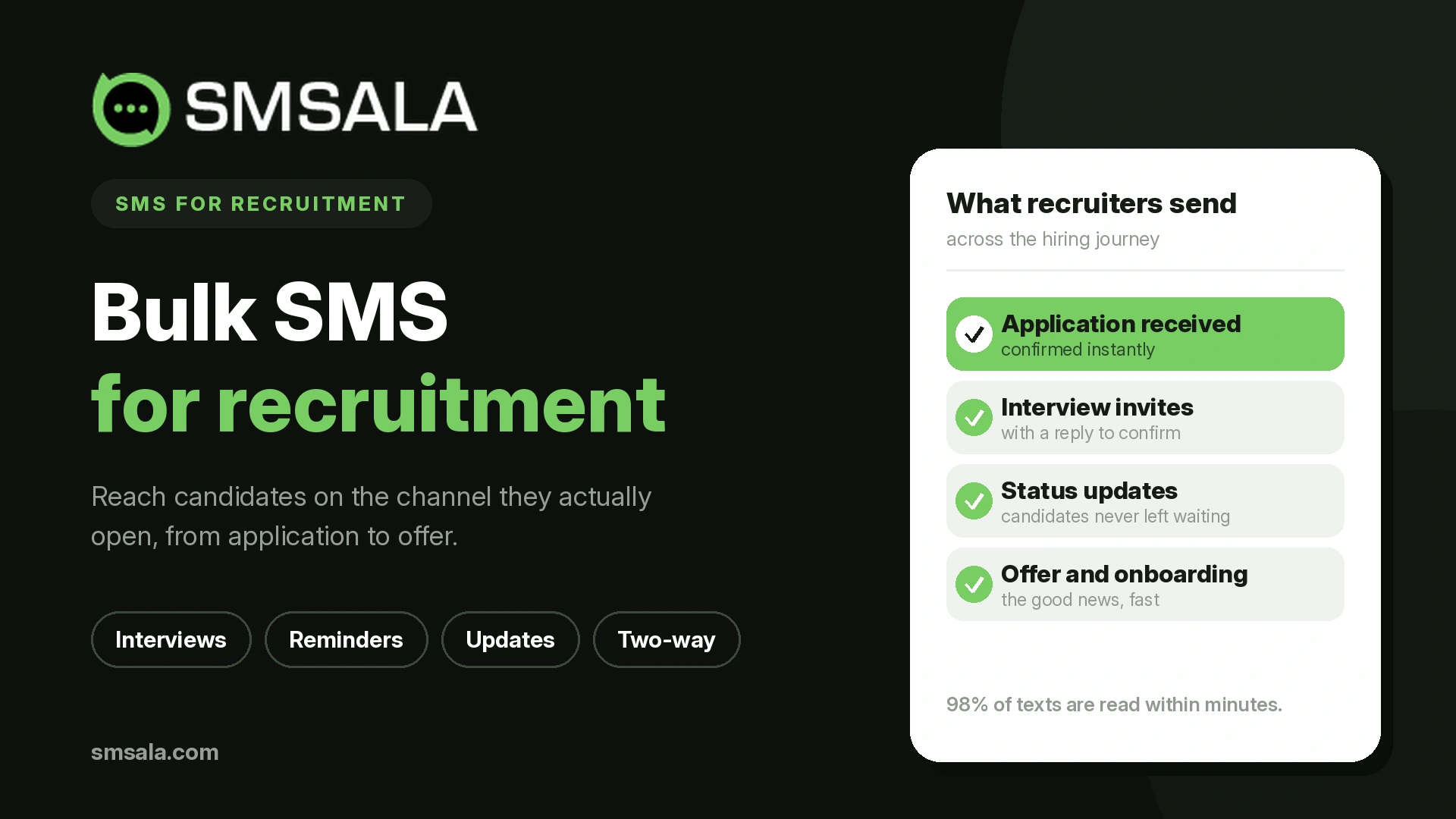
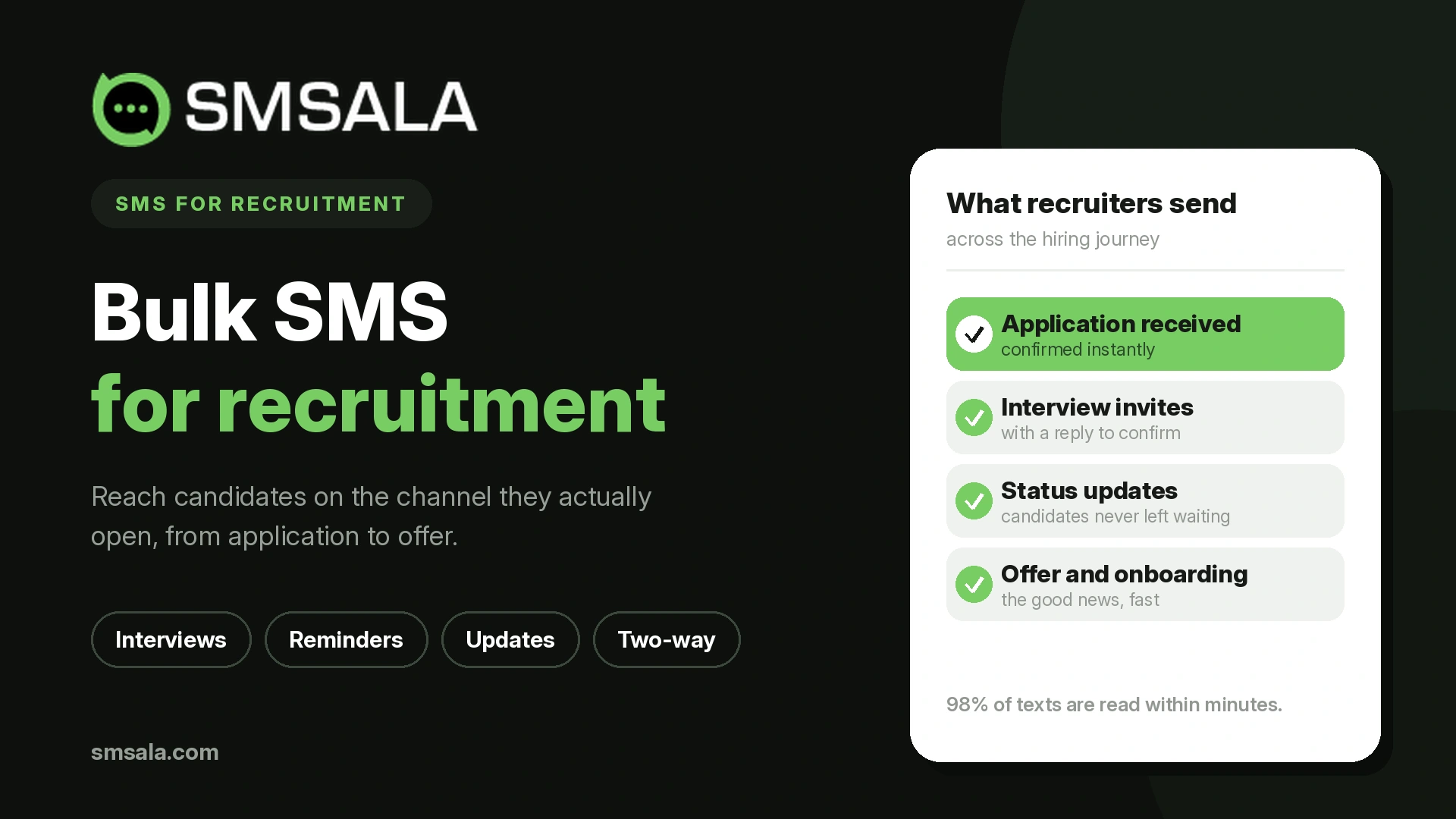
Application received | Confirms receipt, sets expectations | Immediate, reassuring acknowledgment |
Screening / scheduling | Books and coordinates interviews fast | Two-way candidate replies to pick a slot |
Interview reminders | Cuts no-shows | 24h + 2h before, with confirm/reschedule |
Status updates | Keeps candidates warm, protects brand | Timely progress notes, even rejections |
Offer / onboarding | Moves fast at the critical moment | Prompt offer alerts, document checklists |
Talent pool re-engagement | Revives past candidates for new roles | Relevant, occasional, opt-out respected |
Two of these deserve special attention because they're where SMS delivers the most and where recruiters most often under-use it.
The no-show problem SMS solves best
Interview no-shows are one of the most expensive, measurable leaks in hiring. A candidate who doesn't show wastes the interviewer's time, delays the hire, and often can't be recovered. Many no-shows aren't rejection they're forgetfulness, a scheduling mix-up, or a candidate who took another offer and didn't bother to cancel.
A well-timed reminder sequence attacks this directly, and it's the single highest-return use of recruitment SMS. A reminder the day before and again a couple of hours before the interview catches the forgetful, and this is the part that matters giving the candidate an easy way to confirm or reschedule by replying converts a silent no-show into either a kept appointment or an honest cancellation you can fill. A reminder that's one-way just nudges; one that invites a reply turns a lost slot into a manageable one. Treating these as proper reminder alerts rather than afterthoughts is what turns a chaotic interview calendar into a reliable one.
Two-way messaging isn't optional in recruitment
In most bulk SMS use cases, two-way is a nice-to-have. In recruitment it's essential, because hiring is a conversation. Candidates need to ask questions, pick interview times, confirm attendance, and respond to offers and a system that can only broadcast forces all of that back onto email and phone, undoing the reason you used SMS in the first place.
Enabling two-way messaging turns recruitment texts into dialogues: a candidate replies to schedule, asks about the role, or confirms they're still interested, and the recruiter (or an automated flow) responds. This is what makes SMS feel personal despite being sent at scale, and it's what separates a recruitment SMS strategy from a job-spam operation. If your setup can only send and not receive, you have half a tool.
Staffing agencies and high-volume hiring
There's one recruitment context where "bulk" genuinely applies in the naive sense: staffing and shift-based hiring, where an agency needs to fill many positions fast or activate a large pool for an urgent role. When a shift needs covering tonight or fifty warehouse roles open at once, texting a relevant, pre-consented candidate pool and taking the first responders is exactly the right move speed is the whole game, and email can't compete.
Even here, though, the personal principle holds. The message should still be relevant (texting warehouse candidates about warehouse roles, not blasting everyone), still two-way (so people can claim a shift by replying), and still respectful of frequency. Agencies that treat their candidate pool as a list to spam burn it out; those that text relevant opportunities to the right people build a responsive pool that answers when it matters. Managing this well often means automated, scheduled flows triggered by real events rather than manual blasting.
Candidate consent and compliance
Texting candidates sits under the same consent rules as any other business messaging, with a recruitment-specific nuance worth getting right. There's a meaningful difference between a candidate who applied to you and in doing so generally expects and consents to contact and a passive candidate you sourced, whom you're contacting without a prior relationship. The first is straightforward; the second requires more care about consent and how you obtained their number, and the rules vary by region.
The essentials are consistent: obtain proper consent, identify yourself clearly, honour opt-outs immediately, and follow the regional frameworks (such as GDPR-grade consent or the applicable calling and messaging rules in your market). Because these rules differ and change, confirm the current requirements for your regions, and treat compliance not as a formality but as part of the candidate experience a recruiter who respects consent and opt-out signals is one candidates trust.
Tone and the candidate-experience stakes
Here's something the feature pages miss: recruitment SMS isn't just an efficiency tool, it's a reflection of your employer brand, and bad texts do real damage. A candidate's experience of your hiring process shapes whether they accept an offer, reapply later, or warn others off and clumsy, spammy, or poorly timed texts leave exactly the wrong impression.
Good recruitment SMS is professional but human less stiff than a formal email, but not casual to the point of unprofessional. It always identifies who's texting and why, because an unknown number asking about a job reads as a scam. It respects timing, arriving during reasonable hours. It's personalized enough to feel individual. And it never over-texts; a candidate bombarded with messages disengages and remembers the company poorly. Sending from a recognisable sender ID so candidates know it's you, rather than a random number, is a small thing that materially improves both response and trust.
The rule of thumb: every recruitment text is a touchpoint a candidate will judge you by, so send as if the candidate is deciding whether to work for you because they are.
Automation without losing the personal touch
At any real volume, recruitment SMS has to be automated no recruiter manually texts every applicant a reminder but automation done badly is exactly what makes texts feel like spam. The resolution is to automate the triggers while keeping the content personal.
Integrating SMS with your applicant tracking system or recruitment CRM lets texts fire on real events an application received, an interview booked, a reminder due each populated with the candidate's name and role from the system, so an automated message still reads as individual. For nurturing a talent pool over time, drip sequences keep past candidates warm with occasional, relevant messages rather than a single forgotten contact. The aim throughout is automation that scales the sending without stripping out the personalization that makes recruitment SMS work in the first place. Where a conversation needs more than text sharing a job description, a location, a document pairing SMS with the WhatsApp Business API adds richness while keeping SMS as the universal first touch.
Common mistakes in recruitment SMS
The failures are consistent. Blasting generic, impersonal texts that make candidates feel like a list. Sending one-way only, so candidates can't reply and the conversation dies. Neglecting interview reminders and absorbing no-shows that a text would have prevented. Over-texting and burning out a candidate pool. Ignoring the consent difference between applicants and sourced candidates. And forgetting that every text reflects the employer brand, so careless messaging quietly costs you candidates. Each comes back to the same root: treating recruitment SMS as broadcasting rather than as conversation at scale.
Recruitment SMS checklist
Messages are personalized (name, role, context) and read as individual, not blasted.
Two-way replies are enabled so candidates can schedule, ask, and confirm.
Interview reminders go out 24 hours and 2 hours before, with easy confirm/reschedule.
SMS is integrated with your ATS or CRM so texts trigger on real events with personal content.
Consent is handled, with extra care for sourced (versus applied) candidates, and opt-outs honoured.
Texts identify the recruiter and company and send from a recognisable sender.
Frequency is controlled so candidates aren't over-messaged.
Tone is professional but human, and every message treats the candidate as someone deciding about you.
The bottom line
Bulk SMS for recruitment works because it reaches the candidates who ignore everything else, moves at the speed hiring demands, and closes the no-show gap that quietly wastes recruiter time. But it only works when the "bulk" is invisible when messages are personal, two-way, well-timed, and mindful that every text shapes how a candidate sees you as an employer. Use it as a way to have many individual conversations efficiently, and it becomes one of the most effective tools in hiring. Use it to blast job spam at a list, and you'll reach people who resent it and remember your company for the wrong reasons.
SMSala provides the two-way messaging, automation, ATS integration, and reliable delivery recruitment teams need to run this well but the results come from treating candidates as people worth a personal message, not as a list to broadcast to.
Frequently asked questions
Why is SMS effective for recruitment specifically?
Because candidates particularly hourly, frontline, and passive ones screen calls and ignore recruiter emails but read and reply to texts, usually within minutes. Hiring is also a speed game where slow contact loses candidates to competitors, and SMS closes the gap. Its single highest-value use is cutting interview no-shows through timely reminders.
Isn't bulk texting candidates just spam?
It is if you blast generic messages at a list and that backfires, because recruitment is a relationship business. Effective recruitment SMS uses bulk tools to send personal-feeling, two-way messages: the candidate's name, the specific role, a human tone, and the ability to reply. Bulk in mechanism, personal in feel, is the whole discipline.
How does SMS reduce interview no-shows?
With a reminder sequence typically the day before and a couple of hours before the interview that catches forgetful candidates, paired with an easy way to confirm or reschedule by replying. That turns a silent no-show into either a kept appointment or an honest cancellation you can fill, which is why reminders are the highest-return use of recruitment SMS.
Do I need consent to text job candidates?
Yes, and with a nuance: candidates who applied to you generally expect and consent to contact, while passive candidates you sourced require more care about consent and how you got their number. Follow your region's rules, identify yourself, and honour opt-outs. Because requirements vary and change, confirm the current rules for the markets you recruit in.
Should recruitment texts be automated or personal?
Both. At volume you must automate the triggers application confirmations, interview reminders but keep the content personal by pulling the candidate's name and role from your ATS, so each automated message still reads as individual. Automation should scale the sending without stripping out the personalization that makes recruitment SMS work.