
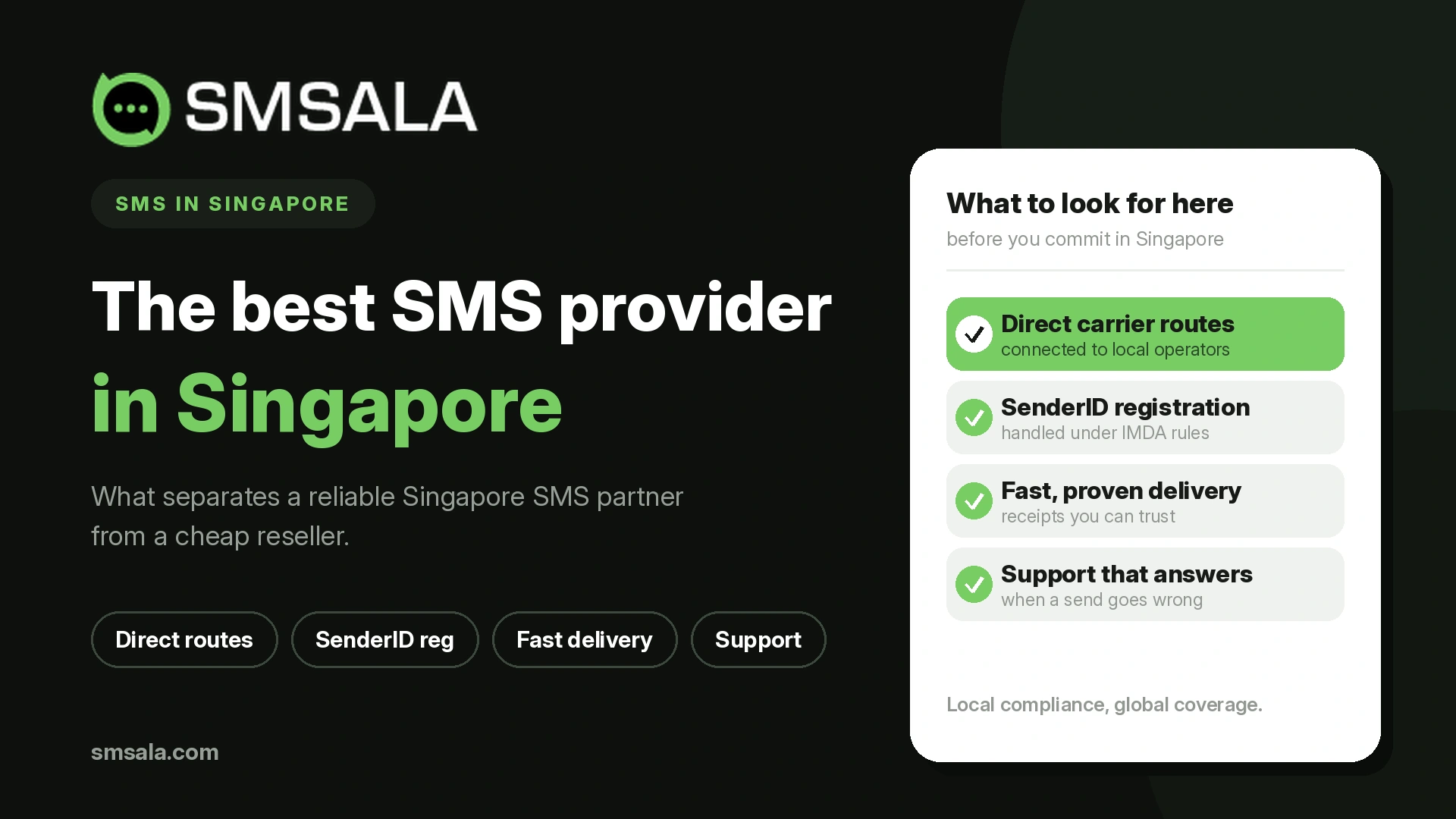
Choosing an SMS provider in Singapore is not the same exercise as in most markets. Singapore runs one of the strictest sender-identity regimes in the world, and a provider that cannot get you registered correctly will see your messages labeled as likely scams before customers even read them. So the real question is not just who is cheapest or fastest, but who keeps you compliant, reaches every local network reliably, and fits how your business actually sends.

This guide explains the rules that shape SMS in Singapore, the features that separate a strong provider from a weak one, what it really costs, and how to compare options before you commit.
Why Singapore businesses rely on SMS
Singapore has near-universal mobile usage and high smartphone penetration, and text messages are read within minutes. For anything that has to arrive reliably and fast, such as a one-time password, a delivery update, or an appointment reminder, SMS remains the most dependable channel because it needs no app and no data connection. Banks, government-linked services, e-commerce, healthcare, and logistics all lean on it for exactly that reason.
It is also a trusted channel precisely because Singapore has worked hard to keep it clean. That trust is enforced through the Sender ID Registry, which is where any serious evaluation of a provider has to start.
The rule that defines SMS in Singapore: the Sender ID Registry
Singapore operates a mandatory SMS Sender ID Registry (SSIR), managed by the Singapore Network Information Centre (SGNIC) under the Infocomm Media Development Authority (IMDA). Since the full regime took effect on 31 January 2023, any organisation that sends SMS to Singapore mobile users with an alphanumeric or numeric Sender ID must register that Sender ID. Messages sent under an unregistered Sender ID are marked "Likely-SCAM" on the recipient's phone, which is fatal for open rates and brand trust.
A few specifics matter when you choose a provider:
Registration is done through the SSIR portal, and you must send through IMDA-licensed participating aggregators. Your provider needs to be one, or work with one, and help you through the process.
Foreign companies are not exempt. To register a Sender ID, an overseas organisation needs a valid Singapore Unique Entity Number (UEN), which usually means registering a local subsidiary or branch.
The registry publishes fees: a one-time account setup fee of S545andanannuallistingfeeofS218 per Sender ID, both inclusive of GST. Registration is first-come, first-served, and the process typically takes around 19 calendar days when documents are in order.
The best providers treat SSIR registration as part of onboarding, not a problem they leave you to solve. When you evaluate options, ask directly whether they are a participating aggregator and how they handle Sender ID registration and renewals. Getting your SMS sender ID registered and displaying correctly is the single biggest factor in whether Singapore customers trust and open your messages.
Marketing consent: the PDPA and the Do Not Call Registry
Compliance does not end with the Sender ID. Marketing messages are governed by the Personal Data Protection Act (PDPA), administered by the Personal Data Protection Commission (PDPC). Under it, the Do Not Call (DNC) Registry lets individuals opt out of marketing messages, and organisations must check the relevant DNC register before sending marketing SMS to a Singapore number, unless they have clear consent or qualify for a defined ongoing-relationship exemption. Every marketing message should also identify the sender and offer a clear way to opt out.
Transactional messages such as OTPs and service alerts sit outside the marketing rules, but permission-based sending remains the safe standard for anything commercial. A provider that understands both the SSIR and the DNC obligations is worth more than one that only moves messages.
Reaching every network in Singapore
Singapore's SMS traffic runs across the main mobile networks, Singtel, StarHub, and M1, along with the newer entrant Simba and a range of mobile virtual network operators that ride on them. To reach your whole audience, a provider needs reliable delivery across all of them, not just the largest.
Routing quality is what makes that consistent. Direct connections deliver dependably and pass local filtering, while grey routes are cheaper but unstable and far more likely to fail or be blocked, which is unacceptable for OTPs and other time-sensitive traffic. The gap between direct and grey-route messaging is visible in the delivery receipts and widens under load.
Features that separate the best SMS providers
Beyond compliance and coverage, a handful of capabilities decide day-to-day quality.
Deliverability you can verify. Look past headline promises to real, per-network SMS deliverability and how it holds up during peak periods. Real-time delivery receipts let you confirm delivery and spot a failing route within minutes.
API and A2P capability. If you send OTPs or automated alerts, the API matters more than the dashboard. A capable A2P SMS platform offers clear REST documentation, high throughput, retry logic, and delivery webhooks. The ability to send SMS at scale through a bulk SMS REST API is what lets your systems trigger messages automatically at the moment they are needed.
Multilingual and Unicode support. Singapore is multilingual, and campaigns may need English, Chinese, Malay, or Tamil. Non-Latin scripts require Unicode SMS encoding, which reduces the per-segment character limit from 160 to 70 characters, so the platform should show segment counts clearly to keep messages readable and costs predictable.
Reporting and analytics. Per-campaign and per-network breakdowns, exportable reports, and clear delivery status turn sending into something you can measure and improve rather than guess at.
What SMS costs in Singapore
Two cost layers apply in Singapore. The first is the SSIR registration itself: the S545one-timeaccountsetupandS218 annual fee per Sender ID noted above, which are fixed and published. The second is the per-message rate, which varies by message category, monthly volume, and route quality.
Transactional and OTP messages generally cost a little more than promotional messages because they use premium routes, higher volumes lower the per-message rate through negotiated tiers, and Unicode messages cost more because they split into more segments. As always, the cheapest quote can be the most expensive in practice if it relies on grey routes that fail and force resends. Rather than fixing on a single per-message figure, which shifts with the market, ask any provider for a current written quote for your specific category and volume, and confirm the routes are direct.
How to compare providers before you commit
What to check | Why it matters in Singapore | Good sign |
SSIR participation | Unregistered Sender IDs are labeled Likely-SCAM | Provider is or works with a participating aggregator and handles registration |
DNC and PDPA support | Marketing without DNC checks risks penalties | Guidance on consent, DNC scrubbing, and opt-outs |
Network coverage | You need Singtel, StarHub, M1 and Simba | Stated direct routes to all local networks |
Route quality | Grey routes fail and get blocked | Direct connectivity, shown in delivery receipts |
API and documentation | Automated OTP and alert sending | REST and SMPP, retries, webhooks, clear docs |
Language support | Multilingual audience | Proper Unicode handling with segment previews |
Reporting | You need to see failures fast | Real-time, per-network delivery analytics |
Pricing transparency | Hidden costs distort the real total | Clear rates plus the SSIR fees stated upfront |
For a broader walkthrough of the selection process that applies beyond Singapore, this companion guide on how to choose the best SMS panel for your business covers the same criteria in more depth.
Where SMSALA fits
For businesses that want compliant sending, direct routing, and reporting in one place, SMSALA's bulk SMS service provides a platform and API built for international delivery, including Singapore, with carrier-grade routing, Unicode support for multilingual campaigns, real-time delivery reports, and REST and SMPP integration. The point of a provider like this is to keep the compliance and routing complexity out of your way so your team can focus on the message and the outcome.
Best practices for SMS in Singapore
Register your Sender ID with the SSIR before you send, and keep the annual listing current.
Check the DNC Registry before marketing sends, and honor opt-outs promptly.
Identify your brand and purpose clearly in every message.
Use direct routes and confirm coverage across all local networks.
Match the route to the message, keeping OTPs on premium routes and campaigns permission-based.
Check encoding and segment counts when sending in Chinese, Malay, or Tamil.
Monitor delivery receipts by network and treat a rising failure rate as an incident.
Test before scaling with a small live send across every network.
Frequently asked questions
Do I have to register my SMS Sender ID in Singapore?
Yes. Since 31 January 2023, any alphanumeric or numeric Sender ID used to send SMS to Singapore mobile users must be registered with the SSIR. Unregistered Sender IDs are marked "Likely-SCAM" on recipients' phones.
Can a foreign company register a Sender ID?
Yes, but it needs a valid Singapore UEN, which typically means setting up a local subsidiary or branch. A good provider or aggregator will guide you through this.
How much does Sender ID registration cost?
The SSIR lists a one-time account setup fee of S545andanannuallistingfeeofS218 per Sender ID, both inclusive of GST. Per-message rates are separate and depend on volume, category, and routing.
What is the difference between the SSIR and the DNC Registry?
The SSIR governs the identity your messages are sent under, for all commercial SMS. The DNC Registry, under the PDPA, governs consent for marketing messages, and you must check it before sending promotional SMS unless you have valid consent or an applicable exemption.
Can I send SMS in Chinese, Malay, or Tamil?
Yes, using Unicode encoding. Note that non-Latin scripts reduce the per-segment limit from 160 to 70 characters, so longer messages split into more billable segments.
Conclusion
The best SMS provider in Singapore is the one that gets you registered and compliant, reaches every local network over direct routes, supports the languages and APIs you actually use, and prices transparently including the SSIR fees. Treat Sender ID registration and consent as the foundation, judge deliverability with a real test rather than a claim, and weigh total cost rather than the lowest rate. Get those right, and SMS remains one of the most trusted and effective ways to reach customers in Singapore.