
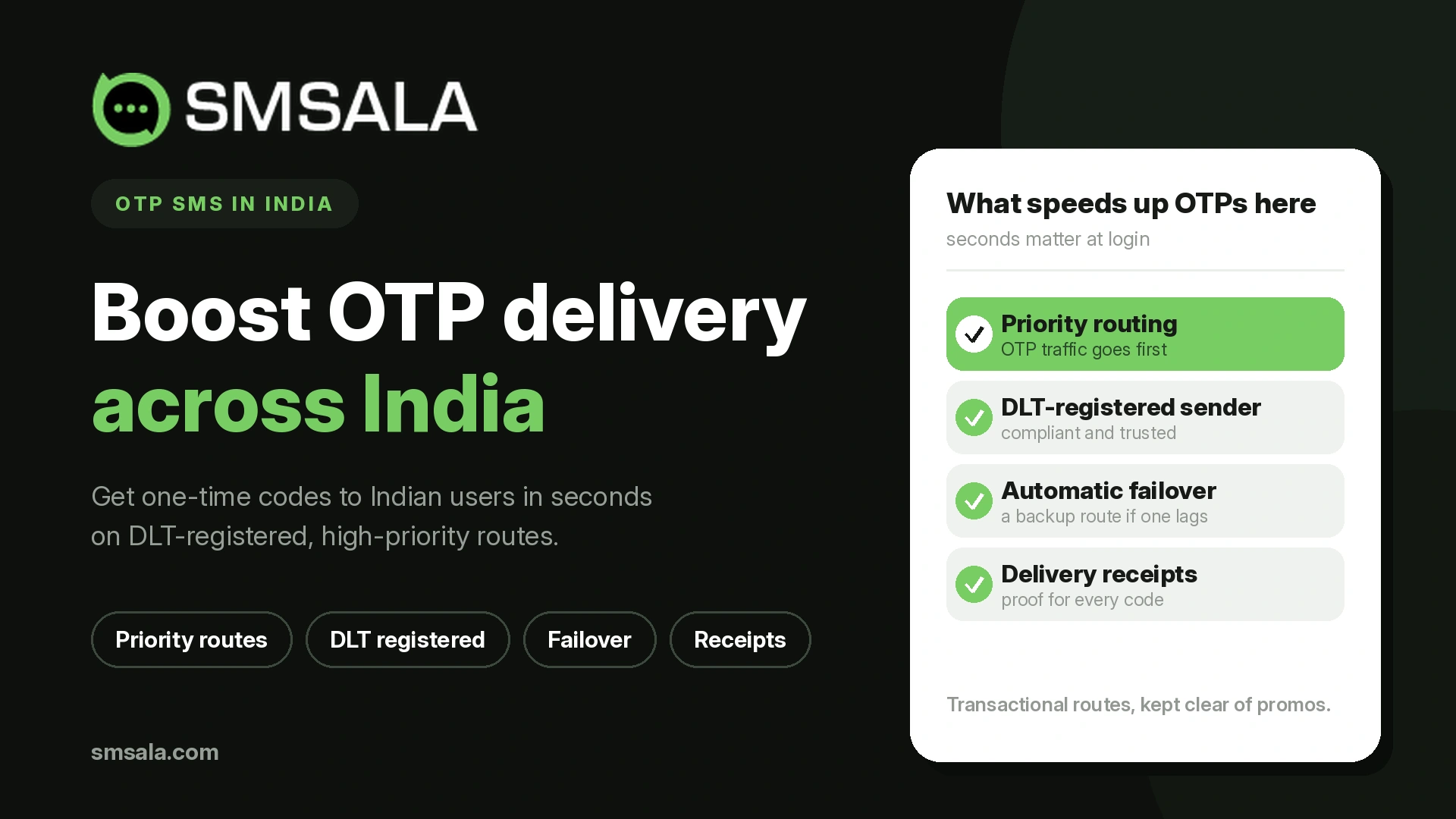
A one-time password is only useful if it arrives on time. In India, that is harder than it sounds. Between DLT registration, message traceability rules, content scrubbing, and peak-hour congestion across Jio, Airtel, Vi and BSNL, an OTP can be delayed or silently dropped even when your code and your provider are working fine.
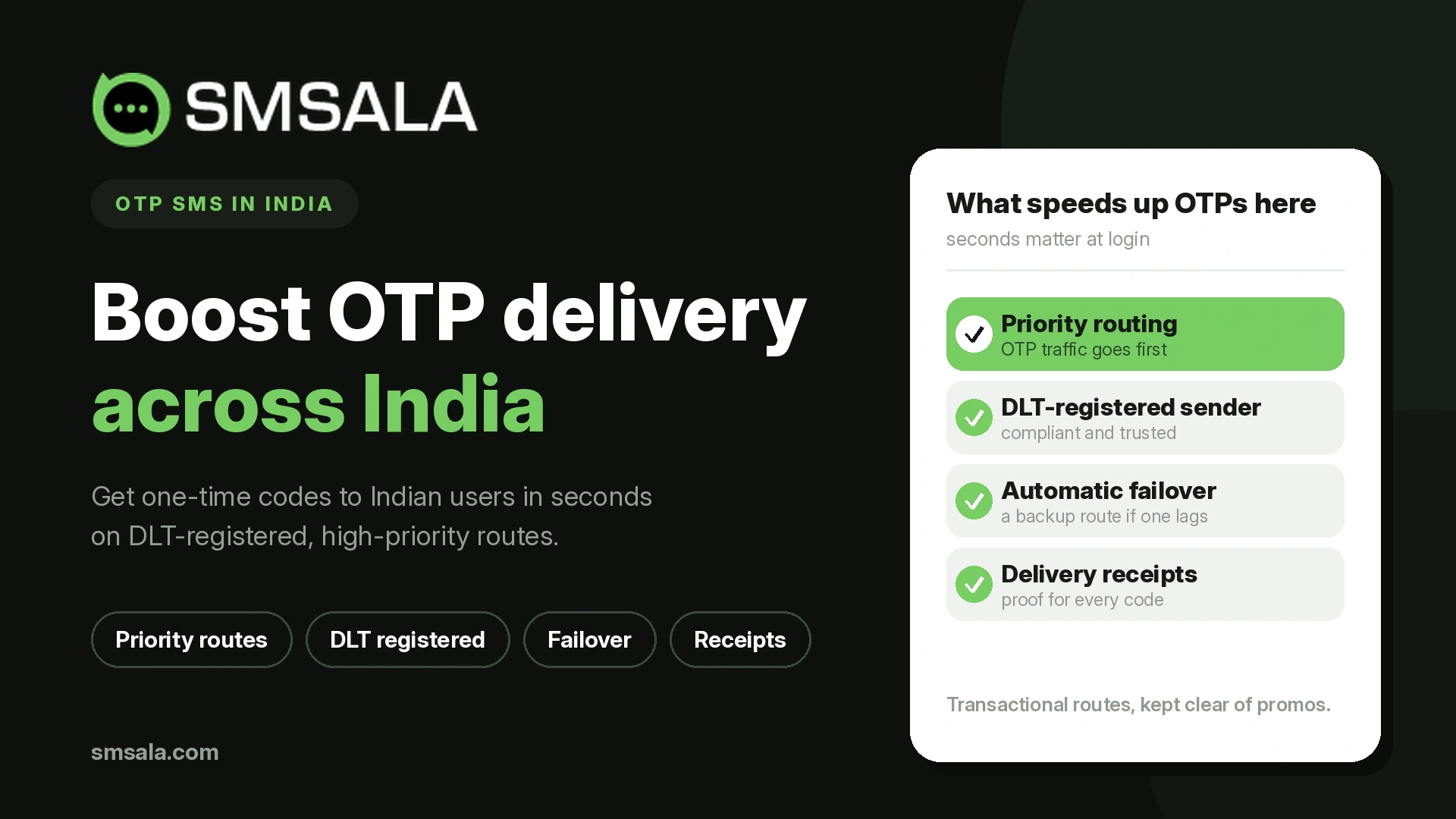
This guide explains why OTP SMS fails in India, what has changed in the regulatory rules through 2025 and 2026, and the practical steps that reliably improve delivery speed and success rates. It is written for product teams, developers, and businesses that depend on SMS authentication for logins, payments, and account verification.
Why OTP SMS delivery is business-critical in India
For most Indian consumers, an SMS OTP is still the default second factor. It works on any handset, needs no app, and does not depend on a data connection. That universality is exactly why banks, payment apps, e-commerce platforms, ride-hailing services, and government portals lean on it so heavily.
The cost of a failed OTP is immediate and measurable. A shopper who cannot complete checkout abandons the cart. A user who never receives a login code assumes the service is broken. In regulated sectors the stakes are higher still, which is why reliable OTP SMS in the banking sector is treated as core infrastructure rather than a nice-to-have. When authentication messages are slow, businesses lose transactions, support tickets rise, and trust erodes.
India also runs one of the largest and most competitive mobile markets in the world, with more than a billion active mobile connections spread across four network operators. Each operator manages traffic, filtering, and routing slightly differently, so an OTP setup that performs well on one network can underperform on another. Consistent delivery means designing for all of them at once.
What actually blocks OTP SMS in India
Most delivery problems trace back to a handful of causes. Understanding them individually is the fastest way to diagnose a drop in success rates.
DLT registration and template mismatches
India's Telecom Commercial Communications Customer Preference Regulations (TCCCPR, 2018) require every business sending application-to-person SMS to register on a Distributed Ledger Technology (DLT) platform operated by the telecom operators. Registration happens in layers: the principal entity, the sender ID (header), and each content template. If your OTP message does not match an approved template exactly, or if variable fields fall outside the registered pattern, operators can scrub the message before it reaches the handset.
Template mismatch is one of the most common and least obvious reasons OTP messages disappear. A single extra character, an unregistered variable, or a promotional phrase inside a transactional template can trigger filtering. Getting the DLT registration process right, and keeping templates updated whenever your message copy changes, prevents most of these silent failures.
Message traceability and telemarketer-chain mismatches
The bigger structural change came in 2024. TRAI directed access providers to enforce end-to-end traceability of commercial messages, meaning the telemarketer chain declared for a message must match the actual path the message travels. Messages with an undefined or mismatched chain are blocked rather than delivered. After phased deadlines, this traceability enforcement came into effect in December 2024 and has since become a permanent gatekeeper for A2P traffic.
For OTP senders, the practical implication is that your provider and every intermediary in the delivery chain must be correctly registered and mapped to your entity. If your aggregator uses routes or partners that are not part of the declared chain, delivery can fail regardless of how well your template is configured.
Content scrubbing and URL whitelisting
Alongside traceability, operators tightened content-level scrutiny. URLs, APK download links, and call-back numbers embedded in commercial SMS must be pre-registered (whitelisted) on the DLT system, and content containing unlisted links is liable to be blocked. OTP messages rarely need links, but many businesses append a verification URL, a support number, or an app link that has not been whitelisted, which drags the whole message into the filter. Keeping OTP content lean and free of unregistered links keeps it moving.
Beyond regulatory scrubbing, operator-level SMS firewalls inspect traffic for spam patterns, SIM-box fraud, and grey-route abuse. Legitimate OTP traffic sent through clean, direct routes generally passes; traffic that resembles spam or arrives over unauthorised routes does not.
Wrong route: promotional versus transactional and service
India separates commercial messaging into categories, including promotional, transactional, and service traffic. OTPs must travel on transactional or service routes, which are not blocked by a subscriber's Do Not Disturb (DND) preferences. Sending an authentication code over a promotional route is a frequent mistake: promotional messages are subject to DND blocking and time-of-day restrictions, so a large share of OTPs sent this way will never arrive. Correct categorisation at the header and template level is what keeps OTPs exempt from DND filtering.
Peak-hour carrier congestion
Even a perfectly compliant message competes for network capacity. During festival sales, paydays, exam-result days, and major sporting events, A2P traffic spikes and operator queues back up. The result is latency: codes that arrive several minutes late, long after the on-screen timer has expired. Congestion is not a compliance problem, so it cannot be fixed by registration alone. It has to be engineered around with redundancy and smart retry logic.
Sender ID and number-quality issues
An unregistered or inconsistent sender ID (in India, a six-character alphanumeric header) undermines both deliverability and user trust. Separately, sending to invalid, ported, or inactive numbers wastes capacity and distorts your success metrics. Validating destination numbers before dispatch, for example with an HLR lookup before messaging, filters out numbers that were never going to receive the message.
How Jio, Airtel, Vi and BSNL handle OTP traffic
India's four operators, Reliance Jio, Bharti Airtel, Vodafone Idea (Vi), and BSNL, each run their own DLT scrubbing, firewall policies, and routing behaviour. A message that clears one operator's filters quickly can be queued or scrubbed differently on another.
The most reliable way to smooth out these differences is routing. Direct operator connections, sometimes called direct routes, deliver A2P messages straight into the operator network without passing through unverified intermediaries. Grey routes may look cheaper, but they are unstable, more likely to be blocked by firewalls, and frequently fail traceability checks. The difference between direct and grey-route messaging shows up directly in delivery receipts and success rates, especially during high-traffic periods.
Because operator conditions vary and change over time, the practical goal is not to optimise for one carrier but to maintain strong, compliant routing into all four.
Best practices to improve OTP SMS delivery in India
The following steps address the causes above in the order they typically matter.
Complete DLT registration correctly and keep it current. Register your entity, headers, and content templates, and update any template the moment your OTP copy changes. Match variable fields to the registered pattern exactly.
Send OTPs on transactional or service routes only. This keeps authentication messages exempt from DND blocking and time restrictions. Never push OTPs through promotional routes.
Use direct operator routes. Prioritise providers with direct connections into Jio, Airtel, Vi and BSNL, and avoid grey routes that fail traceability and firewall checks.
Verify your telemarketer chain. Confirm that your provider and every intermediary are part of the declared, traceable chain so messages are not blocked under the 2024 traceability rules.
Keep OTP content clean. Use short, template-compliant text, avoid unregistered URLs, APK links, or call-back numbers, and stick to a consistent registered sender ID.
Build in aggregator redundancy. Route through more than one compliant provider or path so a single operator queue or outage does not take down all your traffic.
Monitor delivery in real time. Track delivery receipts (DLRs) as they come in so you can spot a failing route or operator within minutes rather than after customers complain.
Design intelligent retries with fallback. If a code is not confirmed within a set window, retry over an alternate route, then fall back to another channel such as voice OTP rather than resending endlessly on a congested path.
Validate destination numbers. Filter invalid and inactive numbers before dispatch to protect capacity and keep your success metrics accurate.
Track your overall success rate. Watch your SMS deliverability rate as a trend, not a single number, so gradual degradation on one network becomes visible early.
Common OTP delivery problems and how to fix them
Symptom | Likely cause | Fix |
OTPs delivered on one network but not another | Operator-specific scrubbing or routing differences | Use direct routes into all four operators and monitor per-operator DLRs |
Messages silently dropped, no error | Content or template mismatch with DLT registration | Re-check the approved template and variable fields; remove unregistered content |
OTPs blocked for some senders entirely | Telemarketer-chain mismatch under traceability rules | Verify the declared chain and remove non-compliant intermediaries |
Codes arrive minutes late during sales events | Peak-hour network congestion | Add route redundancy and smarter retry logic; consider a fallback channel |
Promotional-looking OTPs not reaching users | Sent over a promotional (DND-restricted) route | Move authentication traffic to transactional or service routes |
High spend, low success rate | Sending to invalid or inactive numbers | Validate numbers with HLR lookup before dispatch |
Choosing an OTP SMS partner in India
The provider you choose determines how well most of the practices above are handled for you. When evaluating options for the Indian market, look for direct operator connectivity rather than resold grey routes, correct DLT and traceability handling, real-time delivery reporting, and support for intelligent retries and multi-route failover.
A provider built around time-sensitive delivery matters here, because OTP windows are short. SMSALA's transactional SMS service is designed for exactly this kind of traffic, handling authentication codes, alerts, and notifications with DLT-compliant routing and delivery tracking suited to Indian networks. The right partner should make compliance and routing largely invisible to your product team, so your engineers can focus on the login flow rather than on operator-level plumbing.
Multi-channel fallback: RCS, WhatsApp and voice OTP
No single channel delivers perfectly all the time, so mature authentication flows treat SMS as the primary channel and add fallbacks. If an SMS OTP is not confirmed within a defined window, the system can retry over an alternate route or switch channels: a voice call that reads the code aloud, a WhatsApp message where the business is verified and the user has opted in, or increasingly RCS on supported handsets.
Fallback is most effective when it is automatic and tied to real delivery signals rather than a fixed timer alone. Combining channels also improves accessibility, since a voice code reaches users who struggle with a delayed or undelivered text.
The future of OTP SMS delivery in India
Two trends are shaping the next few years. First, richer messaging is growing. RCS Business Messaging is expanding on Android in India, offering branded, interactive messages, and WhatsApp remains widely used for verified business communication. These channels are strong complements to SMS, especially for confirmations and richer notifications.
Second, regulation continues to tighten around trust and traceability. Through 2025 and into 2026, TRAI has kept building out the framework, including phased rollout of dedicated numbering series such as the 1600 series for service and transactional voice calls, and ongoing enforcement against unsolicited commercial communication. The direction of travel is clear: cleaner, fully traceable, consent-aware messaging.
For authentication specifically, SMS is not going away soon. Its reach across every handset and network, without app installation or data, keeps it the default OTP channel in India. The winners will be businesses that treat SMS as compliant, well-routed infrastructure while layering fallbacks on top, rather than those that hope a single route will always get through.
Frequently asked questions
Why do my OTP SMS messages get delayed only during sales events?
Peak-period congestion. When A2P traffic spikes across the network, operator queues lengthen and messages arrive late. Route redundancy and smarter retries reduce the impact more than registration changes do.
Does DND blocking affect OTP messages?
No, provided the OTP travels on a transactional or service route. Those categories are exempt from Do Not Disturb preferences. OTPs sent over a promotional route can be blocked by DND, which is why route category matters.
What is message traceability and why can it block my OTPs?
Since December 2024, operators must be able to trace the full telemarketer chain of a commercial message, and messages whose declared chain does not match the actual delivery path are blocked. If any intermediary in your route is not part of the declared, registered chain, delivery can fail even with a valid template.
Do I need DLT registration for OTP SMS in India?
Yes. Registering your entity, sender ID, and content templates on a DLT platform is mandatory for A2P SMS. OTP templates must be approved and matched exactly, or the message can be scrubbed.
Can I put a link in my OTP message?
Only if that URL is whitelisted on the DLT system. Unregistered URLs, APK links, and call-back numbers can cause the message to be blocked. For most OTPs, the safest choice is to omit links entirely.
Which is more reliable, a direct route or a grey route?
Direct operator routes. Grey routes are cheaper but unstable, more likely to be caught by firewalls, and prone to failing traceability checks, which makes them a poor choice for time-sensitive OTP traffic.
Conclusion
Reliable OTP delivery in India is less about the code you generate and more about compliance and routing. Register correctly on DLT and keep templates current, send authentication traffic on transactional or service routes, verify your telemarketer chain against the traceability rules, use direct operator connections, and monitor delivery receipts so problems surface in minutes. Add channel fallbacks for the moments when even a clean route is congested. Handle those fundamentals well, and the OTP arrives before the timer runs out, which is the only outcome your users actually notice.