
Your application decides to send a text — an order confirmation, a one-time passcode, a promotion to 40,000 people at once. A second or two later, the recipient's phone buzzes. Everything that happens in the gap between those two moments is the bulk SMS gateway, and almost nobody thinks about it until messages start failing to arrive, sender IDs get mangled, or the delivery report says "sent" for texts that clearly never landed.
That's the problem with most explanations of a bulk SMS gateway. They describe it as "software that sends texts to lots of people" — technically true, practically useless. It's like describing an airport as "a building where planes are." The parts that actually determine whether your messages arrive, how fast, at what cost, with your brand name intact, and whether the delivery data you're paying attention to is even real — those all live in the routing machinery inside. This is a walk through that machinery, because understanding it is exactly what lets you tell a serious provider from one that will quietly lose a fifth of your traffic while charging you less for the privilege.
What a bulk SMS gateway actually is
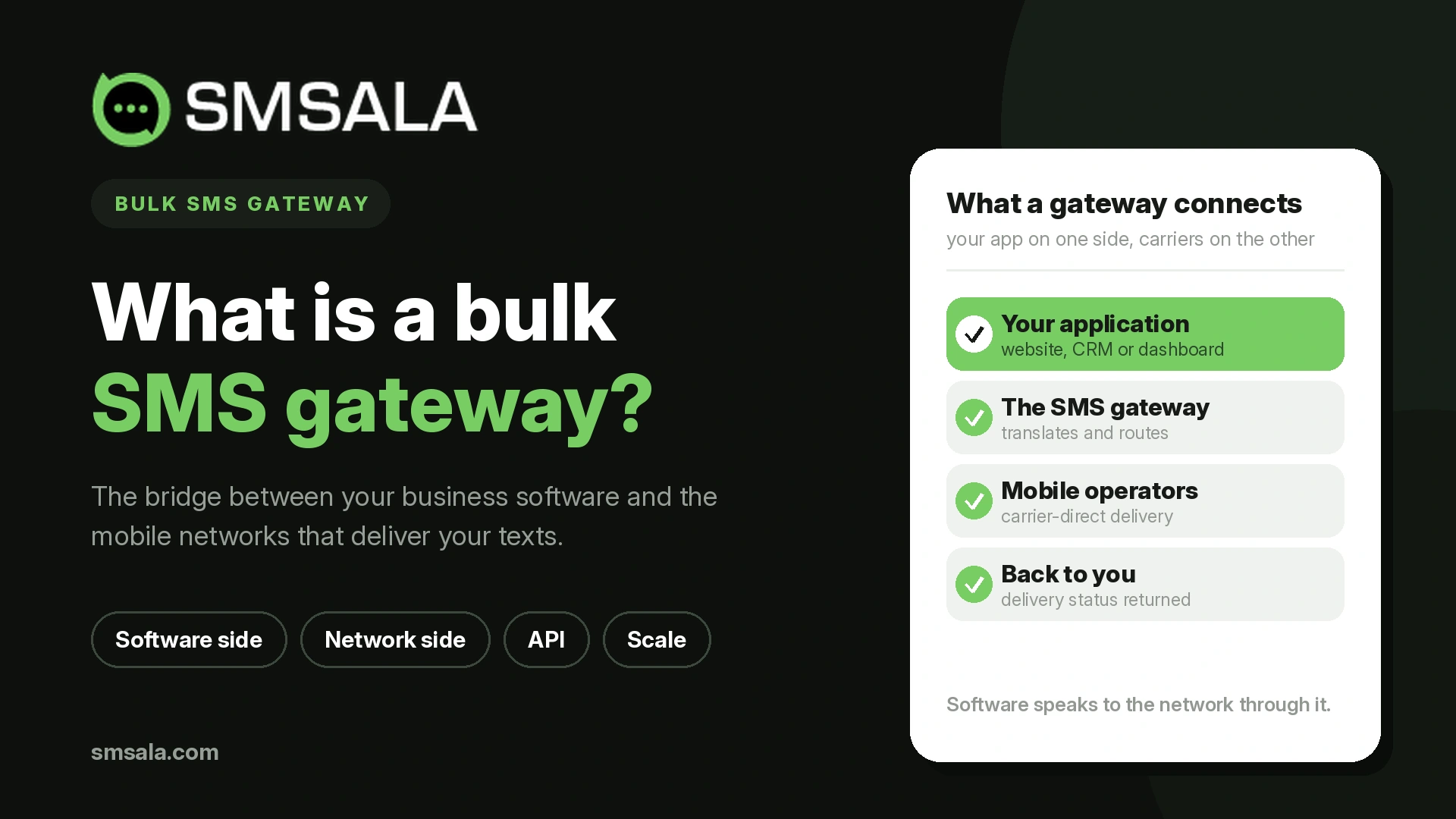
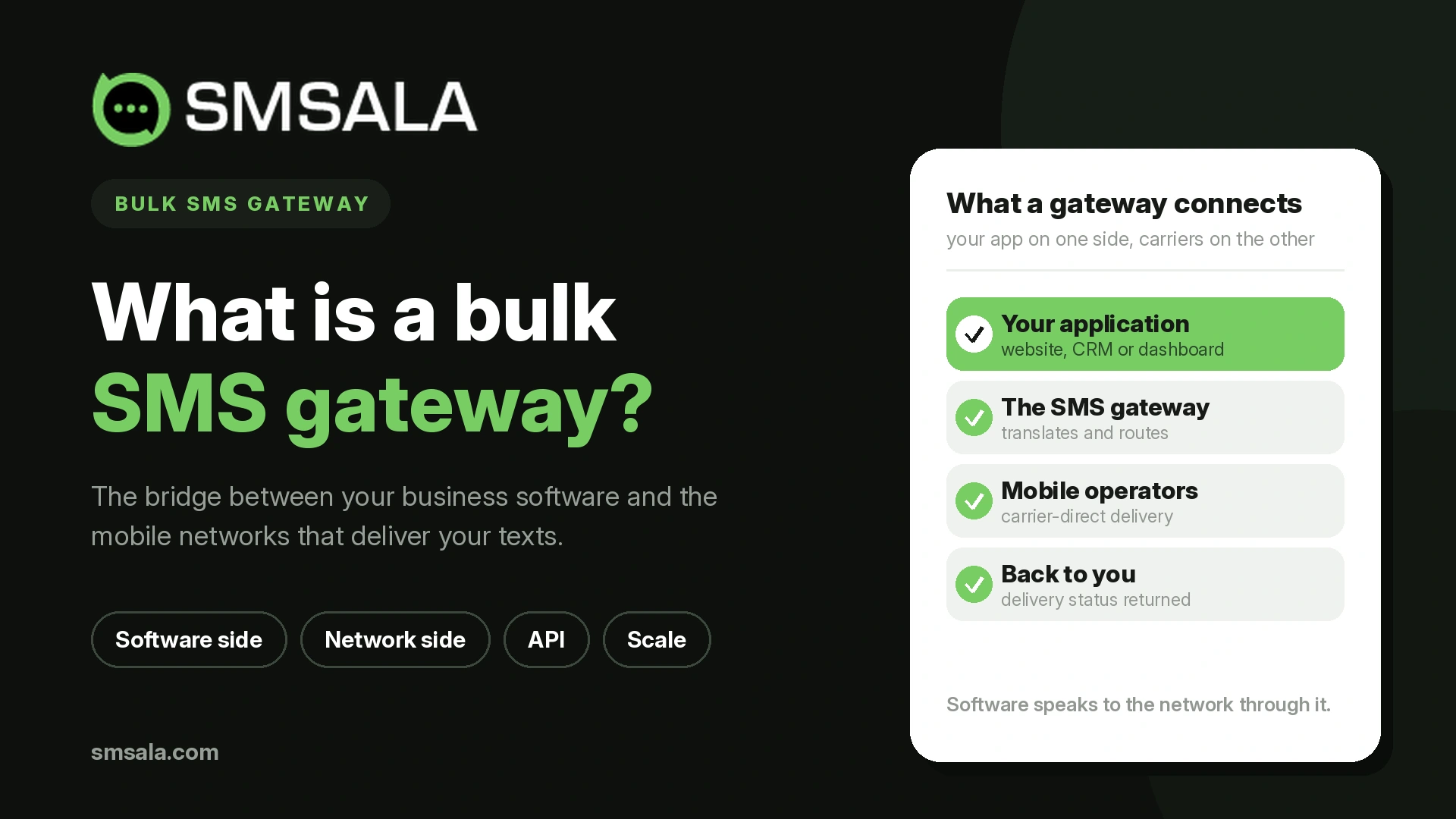
A bulk SMS gateway is the intermediary that takes messages from your software and delivers them into the mobile carrier networks that hand them to phones. It does three core jobs. It translates between the protocols your application speaks — a REST API call, an HTTP request, an entry written to a database — and the protocol the telecom world runs on, which is SMPP. It finds a route to each recipient's specific carrier and hands the message across. And it collects the delivery status the carrier returns and reports it back to you.
Compressed into one sentence: a bulk SMS gateway is the bridge that converts your application's send request into a message the carrier network can deliver, routes it to the right destination carrier at scale, and reports back what happened to it. Everything else a gateway offers — templates, scheduling, contact lists, dashboards, analytics — is convenience layered on top of that core. The bridge is the actual product. The dashboard is the packaging.
It's worth retiring one image immediately, because the source material this topic usually draws from is badly dated. A modern bulk SMS gateway is not a GSM modem with a SIM card plugged into a Windows PC, and it is not an Excel macro firing messages one at a time. That describes hobbyist hardware from fifteen years ago, throughput of a few messages per second, and no path to legitimate carrier delivery. A real A2P (application-to-person) gateway is cloud infrastructure holding persistent, authenticated connections directly into carrier networks or into aggregators that connect to them, capable of sustaining hundreds or thousands of messages per second. If a provider is still describing SIM-based sending, that's a signal to walk away.
How a message travels through the gateway, step by step
The path a single text takes is worth following closely, because every step is a point where delivery can succeed or silently fail.
Your system submits the message. This happens through an SMS API — your code sends the recipient's number, a sender ID, and the message body over an HTTP or SMPP connection. Alternatively, in queue-based setups, the gateway monitors a database table your application writes outgoing messages into and picks them up from there.
The gateway authenticates you. Before anything sends, it verifies your credentials — an account ID and password, or an API key issued at signup. No valid credentials, no send. This is what stops anyone else from firing messages under your account and running up your bill or your reputation.
It validates and normalises the number. The gateway parses the destination into E.164 international format, identifies the country, and — on better platforms — runs an HLR lookup to confirm the number is live and to identify which carrier currently owns it (numbers get ported between carriers constantly). Skipping this step means paying to send messages to dead numbers and misrouting live ones.
It selects a route. Knowing the destination carrier, the gateway chooses a path to reach it. This single decision is the most consequential thing the gateway does, and it's where good and bad providers diverge completely. More on this below.
It hands off to the carrier. The message crosses into the destination carrier's network, almost always over SMPP, either directly or through one or more aggregators that manage routes linking the gateway to the world's carriers.
The carrier's own filters screen it. Before delivery, the destination carrier's SMS firewall inspects the message for spam signals, unregistered sender IDs, forbidden content, and grey-route origin. Messages that fail these checks are dropped here — often without an honest failure report, which is why some texts vanish with no explanation.
The carrier delivers to the handset. The recipient's network pushes the SMS to the phone.
A delivery receipt returns. The carrier sends back a status — delivered, failed, expired, rejected — which the gateway relays to you as a delivery report (DLR). This is your only real proof the message arrived, and its honesty depends entirely on the route it travelled.
The whole sequence takes a couple of seconds. Run it 40,000 times in parallel and you have bulk SMS. The reason to know the steps is that "message didn't arrive" almost always traces to a specific one — bad number validation at step 3, a grey route at step 4, or a firewall block at step 6 — and knowing which lets you actually fix it.
The part that actually decides everything: routing
Here's what the "sends texts to many people" definition hides completely. Two gateways can accept the identical message, from the identical account, to the identical number, and produce completely different outcomes — because they route it differently. And routing quality is invisible from the outside until you inspect delivery data, which is exactly why cheap providers can get away with bad routing.
A direct route connects the gateway to the destination carrier through a legitimate, contractually approved path — the gateway (or its aggregator) has a commercial agreement with that carrier. Messages arrive reliably, alphanumeric sender IDs are preserved, delivery receipts reflect what actually happened, and the traffic is carrier-sanctioned so it isn't targeted by firewalls for being illegitimate.
A grey route reaches the carrier through an unauthorised or exploited connection — often by disguising A2P (business) traffic as P2P (person-to-person) traffic to dodge the higher A2P termination fees carriers charge. Grey routes are cheaper per message, which is the entire reason they exist and the entire reason they're tempting. But carriers actively hunt and shut them down, so a route that works today disappears tomorrow. When it's working, sender IDs frequently get stripped or replaced with a random number, and — most damaging of all — the delivery reports lie. A grey route will often return "delivered" for messages the carrier firewall actually dropped, because the fake status is generated before the real carrier ever confirms anything. You think you reached 40,000 people. You reached 31,000 and were told you reached all of them.
That last point is the one most buyers miss. The danger of a grey route isn't only that it loses messages — it's that it hides the loss. You can't fix a delivery problem you can't see, and a gateway on grey routes is structurally unable to show you the truth. The full mechanics of how direct versus grey routes distort your delivery data are worth understanding before you sign with anyone, because this is precisely the thing a low price-per-message is buying you.
Which is why "how much per SMS" is the wrong first question to a gateway provider. The right questions are: what's your delivery rate on my specific destination countries, are these direct routes, and can you prove delivery with real carrier DLRs rather than gateway-generated ones.
How throughput and connection type affect large sends
For low volumes, how you connect to the gateway barely matters. At scale, it becomes a hard constraint — and it's a dimension most introductory articles skip entirely.
An HTTP/REST API is the simplest way to integrate: a single web request per message or per batch, easy to build, fine for transactional volumes and moderate campaigns. But REST carries overhead per request, and there's a ceiling to how fast you can push messages through it.
An SMPP connection is the telecom-native protocol. It holds a persistent, always-open session ("binding") between your system and the gateway, so messages stream through continuously without the setup cost of a new connection each time. This is what makes genuinely high throughput possible — the difference between clearing a 40,000-message campaign in seconds versus minutes. If you're sending at real scale, or you need time-critical delivery like OTPs where a queue backlog means passcodes arriving after they've expired, SMPP is the connection that matters.
Throughput itself is usually expressed as messages per second (MPS), and it's not one fixed number — it's constrained by your gateway plan, the route, and often the destination carrier's own acceptance rate. A provider quoting a headline MPS figure isn't necessarily lying, but the number that matters is sustained MPS to your destinations, which is a very different thing from a burst rate on a favourable route. For OTP and other time-sensitive traffic, ask specifically about latency and guaranteed throughput on the relevant countries, not the marketing figure.
Where the gateway connects to how you already work
The gateway doesn't operate in isolation — it plugs into your existing systems and workflows, and the ways it connects are where much of its day-to-day value lives.
For developers, integration means an API or an SMPP bind, as above. The gateway can also work off a database queue: your application writes outgoing messages to a table, the gateway sends them and writes the results back to another table. That pattern suits systems where SMS is one small component of a larger workflow — an e-commerce backend, a logistics platform, a banking system — and the messaging should happen without a human ever opening a dashboard.
For non-technical teams, the gateway appears as a web dashboard: compose a message, upload a contact list, save reusable templates, build recipient groups, schedule a send for a future date and time, and watch queued messages move through to delivered. Scheduling in particular is where a lot of practical value sits — being able to line up a campaign for the right moment across time zones, or set recurring sends, without anyone needing to be at a keyboard when it fires.
And when the gateway connects to a CRM, the targeting stops depending on exported spreadsheets. Segments and personalisation flow directly from records you already maintain — purchase history, location, lifecycle stage — so a message to "customers in Dubai who bought in the last 90 days" is a filter on live data rather than a manual list-build. That integration is what turns bulk SMS from a blast tool into a targeted one.
Sender ID: how recipients know the message is from you
One gateway function deserves singling out because it decides whether messages get read at all. The gateway attaches a sender ID — the name or number the recipient sees as the source. Set to an alphanumeric string like "SMSala," it tells the recipient who's messaging before they open anything, which materially lifts trust and response, especially in markets where fraud texts from unknown numbers are common.
But — and this ties directly back to routing — sender IDs only survive clean routes. Grey routes routinely strip an alphanumeric sender ID and replace it with a random long number, so a message you carefully sent as "YourBrand" arrives from an unrecognised number and gets treated as spam or ignored. You can configure the perfect sender ID, but only a direct route actually delivers it intact. There's also a regulatory layer: many countries require sender IDs to be pre-registered before they'll deliver — India's DLT system, and sender ID registration requirements across the UAE, Saudi Arabia, and much of Europe. A gateway that handles this registration for you is doing real work; one that doesn't will leave your messages blocked in those markets with no obvious reason why.
What separates a good bulk SMS gateway from a bad one
Now the definition earns its keep. Judge a gateway on the things that actually determine outcomes, not the feature checklist every vendor copies from the last one:
Route quality — direct carrier routes, not grey ones. This governs whether messages arrive at all, whether sender IDs survive, and whether your delivery data is truthful. It is the single most important factor and the one most obscured by low prices.
Honest delivery reporting — real carrier DLRs, not gateway-fabricated "sent" statuses. If a provider can't explain where their delivery confirmations come from, assume they're generating them.
Coverage on your destinations — a gateway with excellent India routes and weak Brazil routes is the wrong choice if you send to Brazil. Coverage is country-specific; there's no such thing as universally good routing.
Throughput and connection options — sustained MPS to your actual destinations, and SMPP availability if you send at scale or need low-latency OTP delivery.
Compliance handling — support for the registration each market demands: 10DLC in the US, DLT in India, sender ID registration in the Gulf and Europe. A2P messaging is regulated differently in every country, and a gateway that manages this is saving you from silent blocks.
Number validation — HLR lookup and cleaning, so you're not paying to message dead numbers or misrouting ported ones.
Failover routing — automatic rerouting when a primary route degrades, so a carrier issue doesn't stop your traffic dead.
Templates, scheduling, and a tidy dashboard are pleasant. They are not what determines whether your SMS programme works. Routing, reporting, coverage, and compliance are — and notice that four of those seven criteria trace directly back to routing quality, which is why it's the thing to press hardest on.
How to actually evaluate a gateway before you commit
The claims above are only useful if you can test them. A practical evaluation looks like this: send a real test batch to live numbers on your actual destination carriers — not a demo, real phones you control — and compare the gateway's reported delivery against what physically arrived. If the DLRs say 100% delivered and only 85% of the phones buzzed, you've found a grey route generating fake receipts, and no price justifies that. Check whether your alphanumeric sender ID survived intact on each destination. Measure the real latency on time-sensitive routes. Ask directly whether routes are direct or grey and watch whether the answer is specific or evasive. A provider running clean infrastructure answers these questions concretely because they can afford to; one running grey routes deflects, because the honest answers would lose the sale.
The takeaway
A bulk SMS gateway is the bridge between your software and the world's carrier networks — it authenticates your request, validates and routes each message to the recipient's specific carrier, delivers it, and reports back what happened. The scheduling, templates, and dashboards sit on top, but the real value is underneath, in the routing and the honesty of the delivery reporting. Get those right and everything else is easy. Get them wrong — usually by following the lowest price straight into grey-route territory — and no dashboard feature compensates for messages that quietly never arrive and delivery reports that assure you they did.
If you're evaluating gateways, the thing worth pressing hardest on is route transparency, because it silently determines every metric you'll later care about. SMSala runs on direct carrier routes with real DLR reporting and handles the market-specific sender ID and A2P registration that keep messages from being blocked — which is the part of the A2P messaging chain that actually decides whether your messages land, and the part cheaper gateways stay quietest about.
FAQ
What is a bulk SMS gateway in simple terms?
It's the intermediary between your software and mobile carrier networks. It takes messages from your application, translates them into telecom protocols, validates and routes each one to the recipient's specific carrier, and reports back whether delivery succeeded — letting you send to many recipients at once at high speed.
How does a bulk SMS gateway send messages?
Your system submits a message via API or database queue; the gateway authenticates you, validates the number and identifies the carrier, selects a route, and hands the message off over SMPP. The destination carrier's firewall screens it, delivers it to the phone, and returns a delivery receipt the gateway relays back to you.
What is the difference between a direct route and a grey route?
A direct route uses a legitimate, carrier-approved path, so messages arrive reliably with sender IDs and accurate delivery reports intact. A grey route uses an unauthorised connection — cheaper, but carriers block it, causing intermittent failures, stripped sender IDs, and fabricated "delivered" reports that hide the messages that never arrived.
Why do my SMS messages show as delivered but never arrive?
This is the signature symptom of a grey route. The gateway generates a "delivered" status before the carrier confirms anything, so the report says success while the carrier's firewall silently dropped the message. Only direct routes with genuine carrier DLRs give delivery data you can trust.
Do I need technical skills to use a bulk SMS gateway?
No. Developers integrate via API or SMPP, but non-technical users work through a dashboard to compose messages, upload contacts, use templates, schedule sends, and track results. Many gateways also connect to CRMs so targeting runs directly off existing customer data rather than exported spreadsheets.
What is the most important factor when choosing a bulk SMS gateway?
Route quality and honest delivery reporting. Together they determine whether messages arrive, whether your brand's sender ID survives, and whether the delivery data is truthful. Price per message is misleading, because cheap gateways often use grey routes that lose a significant share of traffic while reporting it as delivered.
What throughput do I need from an SMS gateway?
It depends on volume and urgency. Transactional and moderate campaigns run fine over an HTTP API, but high-volume or time-critical traffic like OTPs needs an SMPP connection for sustained messages-per-second. Ask about guaranteed throughput and latency on your specific destination countries, not a headline burst figure.