
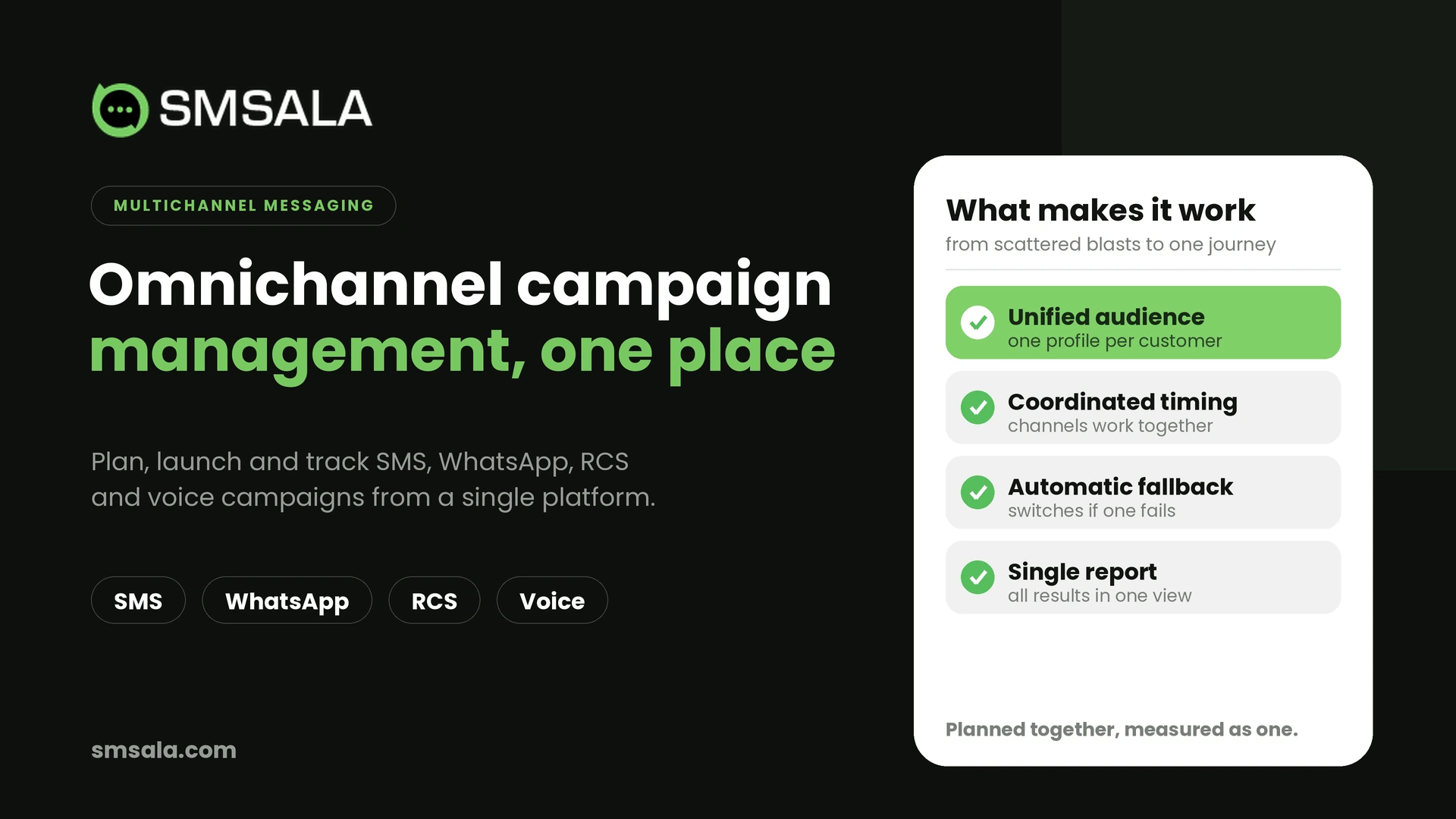
A marketer running a mid-size promo this week probably has four tabs open: an SMS panel, a WhatsApp Business dashboard, maybe an RCS tool, and a spreadsheet holding the audience list that stitches them together. Omnichannel campaign management is the practice of collapsing all of that into a single console, where you build the audience once, compose channel-appropriate versions of the message, and send across SMS, WhatsApp, RCS, and Viber from one place. A campaign studio is the software that makes this work, and the reason it exists is that running channels in separate tools costs far more than the tool licenses ever show on an invoice.
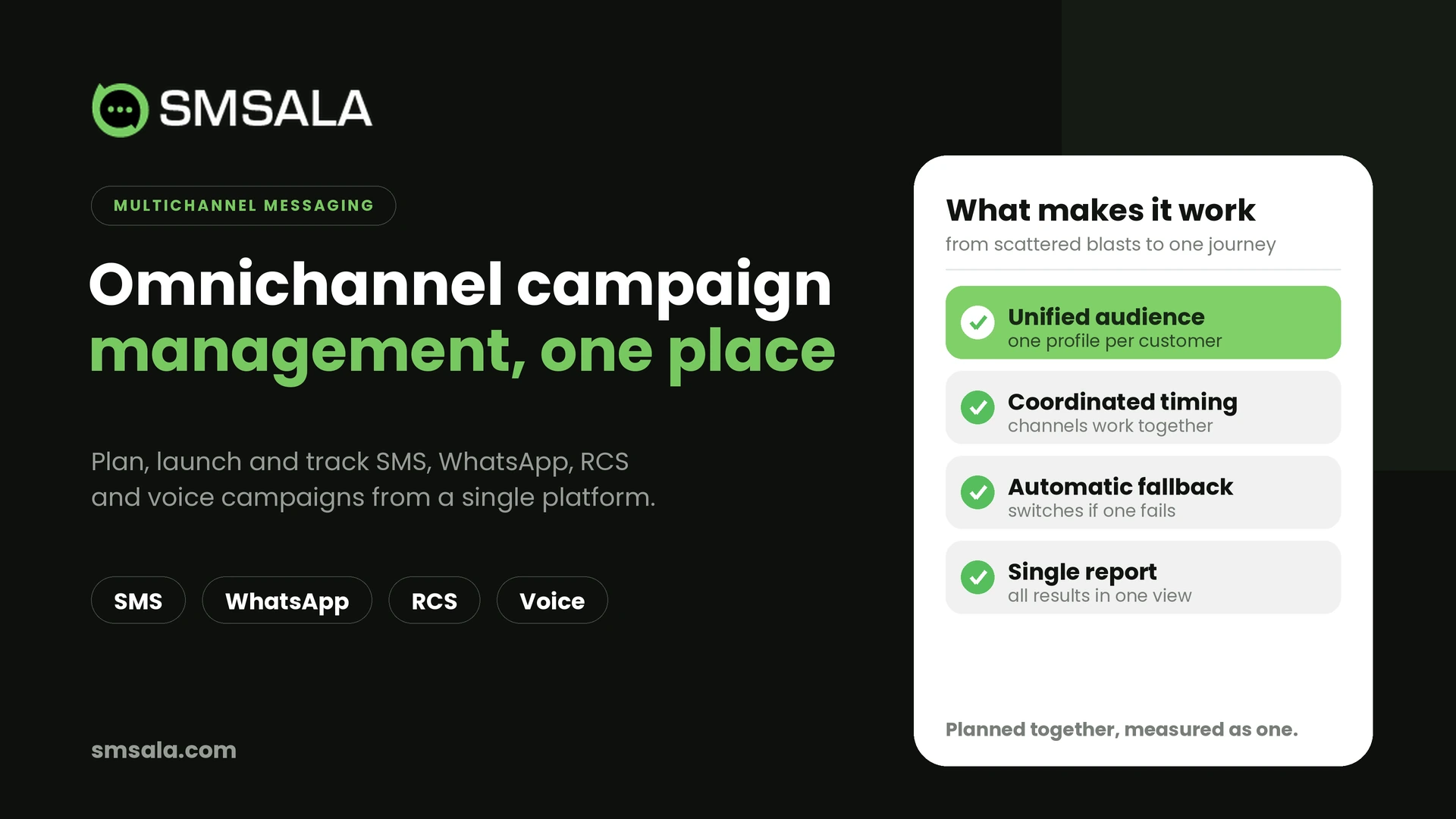
That hidden cost is the whole story here. It shows up as duplicated audience uploads, reports that don't reconcile, a customer getting the same offer three times on three channels, and a launch that takes a full afternoon instead of twenty minutes. This piece walks through what an omnichannel campaign studio actually consolidates, how you decide which channel carries which message, what launching a campaign really involves once you get past the demo, and the compliance traps that come specifically from working across channels rather than one.
The real cost of running channels in separate tools
Start with what happens when you don't have a unified console. Each channel lives in its own system with its own login, its own audience format, and its own idea of what a "delivered" message means. To run one coordinated promotion you export a segment from your CRM, reformat it for the SMS tool, reformat it again for WhatsApp, and hope you didn't fat-finger a column somewhere between the two.
The audience drift is the first tax. By the time you've uploaded the same list into three places, those three lists have already diverged. Someone unsubscribed from SMS an hour ago but they're still in the WhatsApp file you exported this morning. Now they get a message they opted out of, which in most markets is a compliance problem, not just an etiquette one.
The second tax is reporting. Each tool reports its own numbers in its own format, so measuring a single campaign that ran across three channels means manually pulling three exports and reconciling them in a spreadsheet. You end up comparing a WhatsApp "read" against an SMS "delivered" against an RCS "seen," which aren't the same event, and drawing conclusions from a comparison that was never valid to begin with. Teams that run bulk SMS marketing at real volume feel this fastest, because the numbers are big enough that a reconciliation error hides a meaningful amount of money.
The third tax is the one nobody schedules time for: coordination. Without a shared view, two people on the same team can send overlapping campaigns to overlapping audiences on the same day, and the customer experiences it as noise. A campaign studio fixes this less through clever features and more through simple consolidation. One audience, one calendar, one place where you can see what's already going out before you add to it.
What an omnichannel campaign studio actually pulls together
Underneath the marketing gloss, a campaign studio is doing four concrete jobs, and it helps to see them separately.
It holds the audience in one place, synced to your real customer data, so the segment you send to reflects opt-out status and attributes as they are right now, not as they were when you last exported a CSV. It handles the channel connections, so you're not maintaining separate accounts and separate sender registrations for each messaging type; the console talks to the SMS, WhatsApp, RCS, and Viber gateways on your behalf. It gives you a composer where you write the version of the message that fits each channel, because a 160-character SMS and a WhatsApp message with an image and buttons are not the same asset. And it gives you one reporting surface where the results of a cross-channel send land together in comparable terms.
The composer piece deserves a second look, because "one console" gets misread as "one message everywhere." That's not omnichannel, that's just a blast with extra steps. Real omnichannel messaging means the same campaign intent expressed correctly per channel: a plain text nudge over SMS, a rich card with a product image over RCS or WhatsApp, and a fallback path so that if the rich channel can't reach someone, the plain one still does. The console's job is to coordinate those variants under a single campaign, not to flatten them into one lowest-common-denominator message.
Which channel should carry which campaign
This is where a lot of the actual thinking lives, and it's a decision the console surfaces but doesn't make for you. Channels aren't interchangeable, and picking by cost alone gets expensive in a different way.
SMS is the workhorse. It reaches essentially every handset, it needs no app, and open rates stay high because a text is a text. The trade-off is that it's plain, character-limited, and priced per segment, so long or high-frequency SMS campaigns add up. Use it for time-sensitive, universal reach: alerts, OTP-style confirmations, short promos, anything where "does it arrive on every phone" matters more than "does it look rich."
WhatsApp changes the economics and the format. You get images, buttons, structured templates, and two-way conversation, but you're inside a template-approval system and a per-conversation pricing model, and you can only proactively message people on templates the platform has approved. It suits richer, higher-consideration messages and ongoing customer relationships more than one-off blasts. If you're weighing where it fits, the mechanics of WhatsApp Business messaging and its template rules decide a lot about what campaigns are even possible on it.
RCS sits between the two, giving you branded, app-free rich messaging on supported Android devices, with carrier and device coverage that's still uneven enough that you plan for fallback rather than assuming reach. The value of RCS business messaging is the branded, interactive experience without asking anyone to install anything, and the catch is that coverage gaps mean you rarely run it as a solo channel. You run it as the preferred channel with SMS underneath.
The practical decision framework is less "which channel is best" and more "which channel first, with what falling back to what." A common pattern for a high-value send is RCS or WhatsApp as the primary, SMS as the guaranteed fallback, so the people who can get the rich version do, and everyone else still gets reached. A campaign studio is what lets you configure that fallback logic once instead of running the same audience through two tools and deduping by hand afterward. When you're comparing messaging against other channels entirely, the trade-offs between text and email marketing usually come down to urgency and open rate, which is why messaging tends to win the time-sensitive sends and email keeps the long-form ones.
What launching a campaign from one console actually involves
The demo makes it look like you write a message and press send. The real sequence has a few steps that decide whether the campaign lands well or lands you in trouble.
First is the audience. You define or import the segment, and the thing that matters is that the console is reading live opt-out and attribute data, not a stale snapshot. Get this wrong and every other step is built on a bad list. Second is the message and, for WhatsApp or RCS, the template, which may need platform approval before it can send. This approval step is the one that wrecks timelines, because a template submitted the morning of a launch can sit in review and miss the window entirely. Anything on WhatsApp or RCS gets its templates approved days ahead, not hours.
Third is sender identity. The name or number your message comes from affects both trust and deliverability, and a properly registered SMS sender ID is the difference between a recognized brand message and something a recipient reports as spam. Fourth is throttling and timing. Blasting your entire list in one burst can trip carrier rate limits and get your traffic filtered, so the console should meter the send at a rate the routes and carriers accept, and let you schedule for a sensible local hour rather than firing at 3am in the recipient's timezone.
None of these steps is difficult on its own. The value of doing them inside one console is that they're connected: the audience knows the opt-out status, the composer knows the channel rules, the sender settings and throttling apply across the whole send, and you're not re-checking each one in a separate tool and praying they line up.
The reporting problem, solved by comparing like with like
The single biggest reason to consolidate isn't the sending, it's the measuring. When every channel reports into the same system, you can finally see a campaign as one thing instead of three disconnected sends.
That means real cross-channel numbers: how many people you reached in total, how many you reached on the rich channel versus the fallback, which channel drove the clicks, and what the whole thing cost per conversion rather than per channel. It also means you can spot the coordination failures you couldn't see before, like the segment overlap where a chunk of your audience got hit on two channels for the same campaign. Seeing that once usually changes how a team schedules forever.
The honest caveat is that unified reporting only works if the events feeding it are clean. Delivery receipts vary in reliability by route and by channel, and a "delivered" that's really just "accepted by the carrier" can flatter your numbers. Watch the gap between sent and genuinely delivered, and treat any channel where that gap is wide as a route quality problem to fix, not a metric to celebrate.
Consent and compliance get harder across channels, not easier
Running one channel, consent is relatively simple: someone opted in to SMS, you send SMS. Running four channels, the question becomes what exactly they consented to, and the answer is rarely "all of them."
Opt-in on one channel does not automatically grant permission on another. Someone who agreed to transactional SMS hasn't agreed to marketing on WhatsApp, and treating those as the same consent is how brands end up with complaints and blocked sender IDs. A campaign studio should track consent per channel per contact, and honor an opt-out on one channel without silently assuming it applies to, or doesn't apply to, the others. This is a policy decision your team has to make deliberately, and the console should enforce whatever you decide rather than leaving it to whoever exports the next list.
The channels also carry their own rulebooks. WhatsApp restricts proactive messaging to approved templates and penalizes accounts that generate blocks and reports. SMS is governed by local regulations that differ sharply by country, from sender ID registration requirements to quiet-hours rules. The console doesn't remove these obligations, but centralizing sends at least gives you one place to apply frequency caps and quiet-hours logic across every channel at once, instead of hoping each separate tool was configured the same way.
Campaign Studio and Journey Builder are not the same tool
It's worth drawing this line clearly, because the two get conflated. A campaign studio is for deliberate, one-to-many sends that you compose and launch: the promo going out Thursday, the announcement, the seasonal push. You decide the audience and the timing, you press send, it goes.
Automated flows that react to individual behavior are a different job, and that's what a customer journey builder handles, running triggered sequences that fire on a cart abandonment or a renewal date without anyone pressing anything. Most teams need both, and they work together: the studio for the campaigns you plan, the builder for the automation that runs itself. Using an omnichannel campaign management console for behavior-triggered automation, or a journey builder for your weekly promo, means fighting the tool instead of using it. Pick by whether the send is something you launch or something that fires on its own.
Frequently asked questions
What does omnichannel campaign management actually mean?
It means planning and running a single campaign across multiple messaging channels, such as SMS, WhatsApp, RCS, and Viber, from one system, with a shared audience and coordinated content per channel. The point isn't sending everywhere at once; it's coordinating channels so each carries the version of the message that fits it, with fallback when a channel can't reach someone.
Is a campaign studio just a bulk SMS tool with extra channels?
No. A bulk sender pushes one message to a list on one channel. A campaign studio manages the audience, per-channel message variants, sender registration, throttling, and unified reporting across several channels, and coordinates fallback between them. The difference is orchestration, not just added channels.
Do I have to use every channel?
No, and most teams shouldn't start that way. Begin with the one or two channels your audience actually uses, usually SMS plus WhatsApp, and add others only when there's a clear reason. The console's value holds even with two channels, because it's the coordination and shared reporting that pay off, not the channel count.
Why do WhatsApp and RCS campaigns need approval when SMS doesn't?
WhatsApp and RCS use structured templates that the platforms review before you can send them proactively, to control spam and protect the channel. SMS has no equivalent template review, though it has its own sender ID registration and local regulatory requirements. Submit rich-channel templates several days before a launch so approval delays don't cost you the send window.
How do I measure a campaign that ran on three channels?
Through a console that reports all three into one comparable view, so you can see total reach, per-channel contribution, and cost per conversion for the campaign as a whole. Measuring by pulling separate exports and reconciling them by hand is where most cross-channel reporting goes wrong.
Before you consolidate
The mistake to watch for isn't choosing the wrong console. It's moving your channels into one place while leaving the messy parts untouched, so you inherit the same divergent audiences and unregistered senders in a nicer interface. Consolidation only pays off if you also clean up what feeds it.
So before you run your first cross-channel campaign, get one thing straight: is your audience data actually unified and current, with opt-out status that's accurate per channel? If it is, an omnichannel campaign management console will save you hours on every launch and finally let you measure what your messaging is doing. If it isn't, fix that first, because a single console pointed at fragmented data just fragments your campaigns faster. Start with two channels you can run cleanly, prove the reporting tells you something the old spreadsheet couldn't, and add channels from there.