
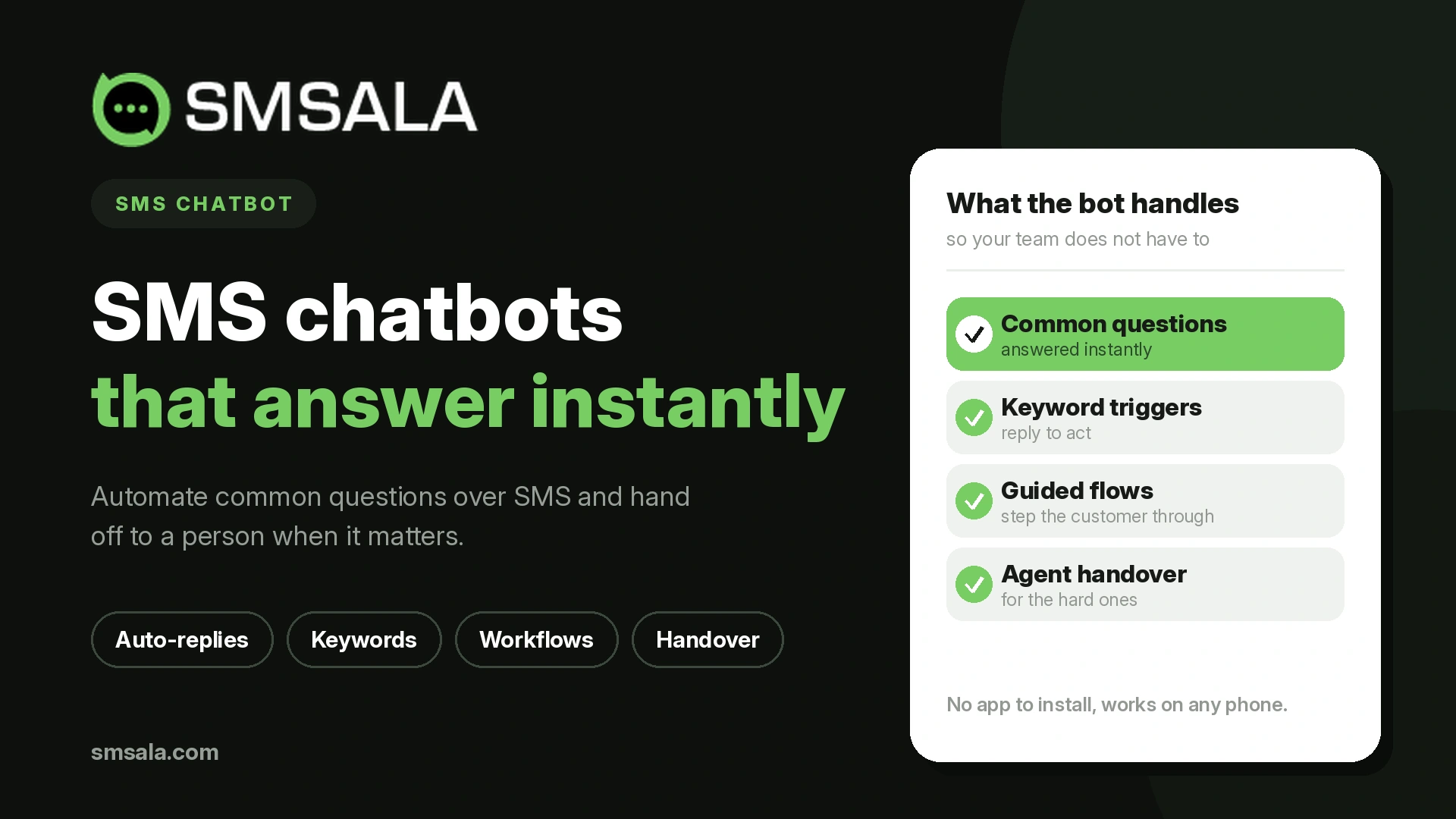
An SMS chatbot is software that holds a conversation with a person over text message, automatically. It reads incoming texts, works out what the sender wants, and replies without a human typing the answer, handling everything from confirming an appointment to answering a question to qualifying a lead. Because it lives in the standard SMS inbox, it reaches almost anyone on any phone, with no app to install and no account to create.
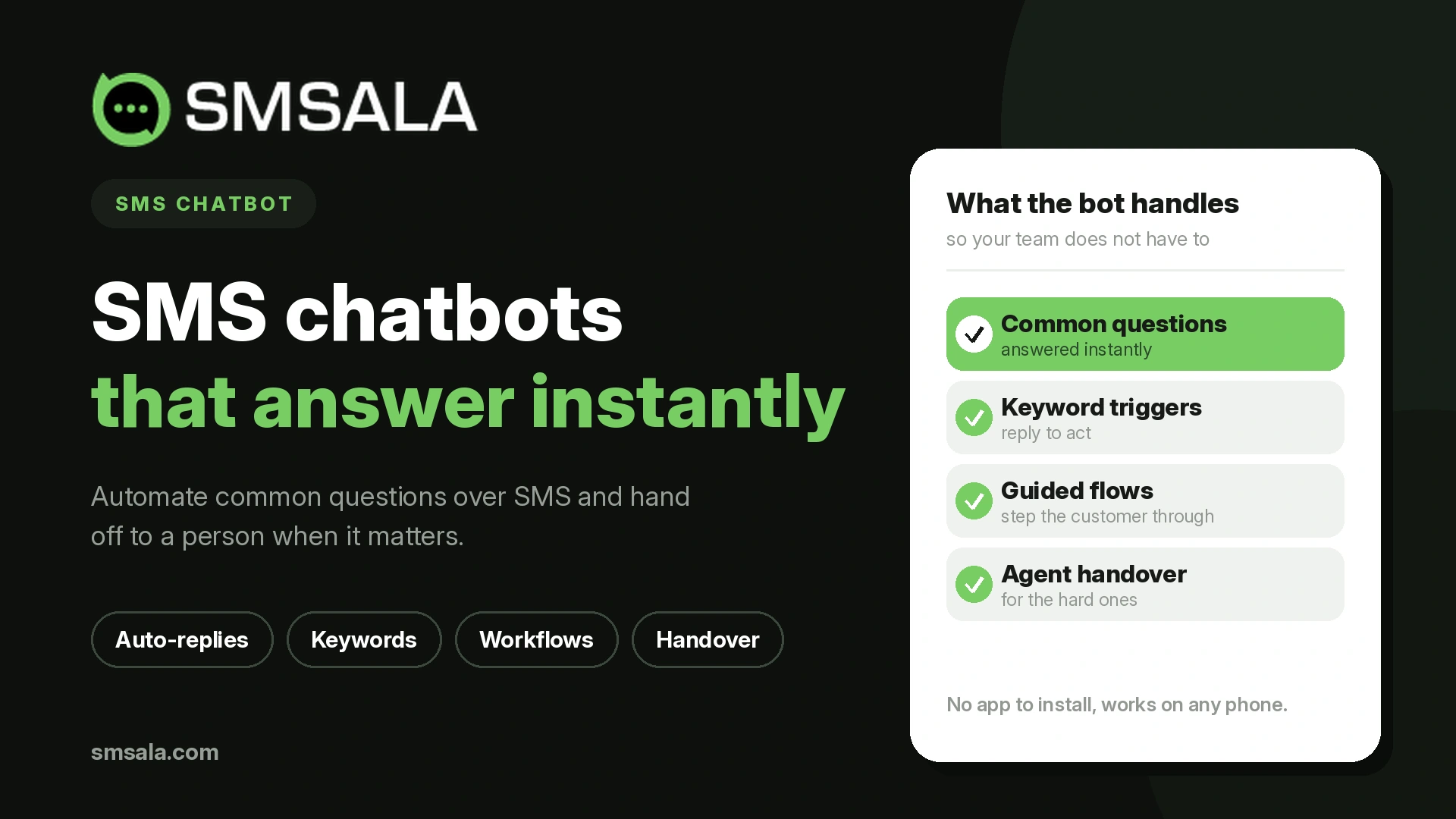
What makes SMS chatbots worth understanding now is not the idea, which has existed for years, but what artificial intelligence has done to it. Early text bots could only follow rigid keyword rules. Modern ones can understand a message written in plain, messy human language and respond in kind, which turns a clunky menu system into something closer to a real conversation. That shift is changing what businesses can automate over text, how much human support work looks like, and where the limits still sit. All of it starts with how these systems actually work.
What an SMS chatbot is
An SMS chatbot is an automated conversational agent that operates through text messages. It connects a business phone number to a system that receives inbound texts, interprets them, decides on a response, and sends a reply, all in seconds and without human involvement for routine cases. It is the automation layer built on top of two-way messaging, turning the ability to receive replies into the ability to respond to them at scale.
The distinction from ordinary SMS is direction and intelligence. A standard business text is one-way: it goes out and, at most, a person reads it. A chatbot needs the full mix of inbound and outbound SMS, listening as well as sending. A chatbot is two-way and reactive: it responds to what the customer says, carries context through a conversation, and can take actions such as booking a slot, checking an order, or escalating to a human. That responsiveness is what makes it a conversational tool rather than a broadcast one.
How SMS chatbots work
The flow behind an SMS chatbot is straightforward, and knowing it clarifies both the capability and the constraints. A customer texts the business number. The message arrives at the messaging provider and is passed to the chatbot system, usually through a webhook on an SMS API. The system interprets the message, either by matching it to a rule or by using language models to understand intent, decides on a response, optionally pulls or updates data in a connected system such as a booking calendar or an order database, and sends the reply back out over SMS. The whole round trip takes seconds.
Two parts of that flow determine how capable the bot feels. The interpretation step decides whether it understands only exact keywords or genuine natural language. The integration step decides whether it can actually do things, such as retrieve a real order status, or only talk about them. A chatbot wired into the business's real systems is useful; one that can only recite scripted answers is a menu in disguise.
Rule-based, AI-powered, and hybrid chatbots
Not all SMS chatbots are the same kind of system, and the difference decides what they can handle.
Type | How it works | Strengths | Limits |
Rule-based | Matches keywords or menu choices to scripted replies | Predictable, cheap, easy to control | Breaks when users phrase things their own way |
AI-powered | Uses natural language processing to understand intent and generate replies | Handles free-form, messy, human language | Needs guardrails; less deterministic |
Hybrid | Rules for critical flows, AI for open-ended input | Control where it matters, flexibility elsewhere | More to design and maintain |
Rule-based bots are still the right choice for narrow, high-stakes flows such as a keyword opt-in or a fixed confirmation, where predictability matters more than flexibility. AI-powered bots suit open-ended interactions such as support, where customers will not follow a script. The hybrid approach, using rules for the paths that must never go wrong and AI for everything else, is where most serious deployments land, because it combines control with the ability to understand real language.
How AI is changing SMS automation
The arrival of capable language models has changed what a text bot can do, and this is the shift worth understanding rather than the mechanics alone.
Older text automation depended on the customer cooperating with the machine, choosing option 1 or texting an exact keyword. If they wrote anything unexpected, the bot failed. Modern AI-driven automation reverses that burden. A language model can read a message written in natural, imperfect language, including typos, slang, and incomplete sentences, infer what the person actually wants, and respond appropriately. It can carry context across several messages, personalize replies using what it knows about the customer, and handle a far wider range of questions without a developer scripting each one in advance.
The practical result is that automation now reaches conversations it could never handle before. Support questions that once required a person because they did not fit a menu can be resolved by an AI bot that understands them. Lead qualification can adapt to what each prospect says rather than marching everyone through the same fixed questions. This is the substance behind the claim that AI is transforming SMS: not that texting is new, but that the share of text conversations a machine can handle well has grown dramatically. The same intelligence increasingly spans channels, so the logic that powers an SMS bot can also drive conversations on WhatsApp Business and RCS, where buttons and media add richness that plain SMS lacks, as part of a wider omnichannel messaging setup.
What SMS chatbots are used for
The value of an SMS chatbot shows up wherever a business has repetitive text conversations that follow patterns. The common use cases group into a few types.
Use case | What the chatbot does |
Customer support | Answers common questions instantly, day and night, and escalates the rest |
Appointment management | Confirms, reminds, and lets customers reschedule by replying |
Order and delivery tracking | Responds to status queries by pulling live data |
Lead qualification | Asks and adapts questions to score and route prospects |
Surveys and feedback | Collects responses conversationally and records them |
Interactive notifications | Sends an alert and handles the reply, such as confirming or opting out |
Across these, the unifying benefit is deflection with satisfaction: the chatbot resolves the routine cases automatically, instantly, and at any hour, while passing the genuinely complex ones to a person with context attached. Done well, customers get faster answers and staff spend their time on the problems that actually need judgment. Connected to broader SMS campaigns and SMS marketing, the same conversational layer turns one-way sends into interactions that can qualify and convert.
AI, automation, and the human side of support
Automating conversations changes the work people do, and an honest view of that matters more than pretending nothing shifts. The fear is that AI chatbots simply replace support staff. The reality in most well-run operations is more nuanced.
What AI text automation removes is the high volume of repetitive, low-complexity questions that consumed the bulk of a support team's time: where is my order, what are your hours, how do I reset this. Handing those to a bot does reduce the headcount needed to answer them. What it does not remove is the need for people on the difficult cases, the judgment calls, the upset customers, and the situations where being understood by a human is the point. Those interactions become a larger share of the human workload, which tends to raise the skill and value of the remaining roles rather than eliminate them.
New roles also appear. Someone has to design the conversation flows, train and monitor the AI, review what it gets wrong, and manage the handoff between bot and human. The shift is less a straight replacement and more a redistribution, with machines taking the repetitive volume and people concentrating on the complex, emotional, and strategic work, plus the new job of supervising the automation itself. Businesses that treat the chatbot as a teammate for their staff, handling the routine so people can focus on the rest, get more from it than those that treat it as a way to cut the team and hope quality holds.
The constraints of plain SMS
An SMS chatbot works within the limits of the SMS channel, and ignoring those limits leads to a poor experience. SMS has no buttons, so a customer must type replies rather than tap options. It caps a single segment at 160 characters, or 70 for messages using non-Latin scripts, so responses must stay concise. It carries no images, video, or rich cards. And it requires proper consent, with a clear opt-out, because it is regulated commercial messaging.
These constraints shape good design. Keep the bot's replies short and unambiguous, guide customers with clear text prompts since there are no buttons, and know when a conversation has outgrown SMS and should move to a richer channel or a human. Where interactivity and media genuinely matter, layering the same conversational logic onto RCS or WhatsApp adds the buttons and rich content that plain SMS cannot provide, while SMS remains the universal fallback that reaches everyone.
Building an SMS chatbot
Getting an SMS chatbot into production follows a predictable path, and doing the steps in order avoids most problems.
Define the purpose. Decide the specific conversations the bot will handle, such as support FAQs or appointment booking, rather than trying to automate everything at once.
Get a number and a provider. Set up a business number capable of two-way SMS through a provider with reliable routes behind its SMS gateway and a solid API.
Map the conversations. Design the flows, the questions, the responses, and crucially the points where the bot hands off to a human.
Choose rule-based, AI, or hybrid. Match the approach to the job, using rules for fixed flows and AI for open-ended input.
Integrate with your systems. Connect the bot to the data it needs, such as orders, bookings, or a customer record, so it can act rather than just talk.
Add guardrails and escalation. Define what the bot must not do, how it behaves when unsure, and how it escalates to a person.
Test, launch, and monitor. Trial it on real conversations, watch where it fails, and refine continuously.
The steps teams most often shortcut are the handoff design and the monitoring. A bot with no graceful escalation frustrates customers the moment it hits its limits, and a bot no one reviews drifts into giving wrong answers unnoticed.
Automation, security, and trust
Automating business communication introduces responsibilities that a purely human process handled implicitly, and getting them right is what keeps an SMS chatbot trustworthy.
Consent and compliance come first: the same opt-in and opt-out rules that govern any A2P messaging apply to chatbots, and a bot must honor them automatically. Data handling matters because chatbots often touch personal and account information, which must be protected and never exposed in a message to the wrong person. For AI-powered bots specifically, guardrails are essential: the system needs limits on what it can say and do, protection against being manipulated into harmful or false responses, and a clear escalation path when it is uncertain, so it does not confidently invent an answer. And identity matters, since a chatbot sending from a recognized, registered Sender ID reassures customers the conversation is genuine rather than a scam. Automation that respects consent, protects data, and knows its own limits earns trust; automation that cuts those corners erodes it fast.
Frequently asked questions
What is an SMS chatbot?
It is software that automatically holds a text-message conversation with a person, reading incoming messages, understanding what they want, and replying without a human, over the standard SMS inbox that works on any phone.
What is the difference between a rule-based and an AI SMS chatbot?
A rule-based bot matches keywords or menu choices to scripted replies and breaks when users phrase things unexpectedly. An AI bot uses natural language processing to understand free-form messages and respond conversationally. Many businesses use a hybrid, with rules for critical flows and AI for open input.
How is AI changing SMS chatbots?
AI language models let bots understand messages written in natural, imperfect language and respond appropriately, rather than requiring exact keywords. This expands the share of conversations a bot can handle well, from support to lead qualification, and makes text automation far more capable than the old keyword systems.
Will SMS chatbots replace customer service jobs?
They automate the high volume of repetitive, simple questions, which reduces the staff needed for those, but they increase the relative importance of human roles on complex and sensitive cases and create new roles in designing, training, and supervising the automation. The effect is usually a shift in work rather than wholesale replacement.
What can an SMS chatbot not do?
Plain SMS has no buttons, a tight character limit, and no media, so bots must keep replies short and text-only, and long or highly interactive conversations suit richer channels. Chatbots also need consent, guardrails, and human escalation, and should not handle situations that genuinely require human judgment.
How do I build an SMS chatbot?
Define the conversations to automate, set up a two-way number with a capable provider and API, map the flows and handoffs, choose a rule-based, AI, or hybrid approach, integrate it with your systems, add guardrails and escalation, then test and monitor it in production.
Conclusion
SMS chatbots have moved from rigid keyword responders to genuinely conversational systems, and AI is the reason. Used well, they resolve the routine text conversations instantly and at any hour, free people to handle the cases that need human judgment, and do it on the one channel that reaches almost everyone. Used carelessly, without guardrails, escalation, or respect for consent, they frustrate customers and erode trust.
For businesses that want an SMS chatbot built on reliable two-way infrastructure, with the routing, integration, and compliance handled correctly, that foundation is where an experienced messaging partner earns its place, so the automation reaches customers dependably and hands off gracefully when a person is needed.