
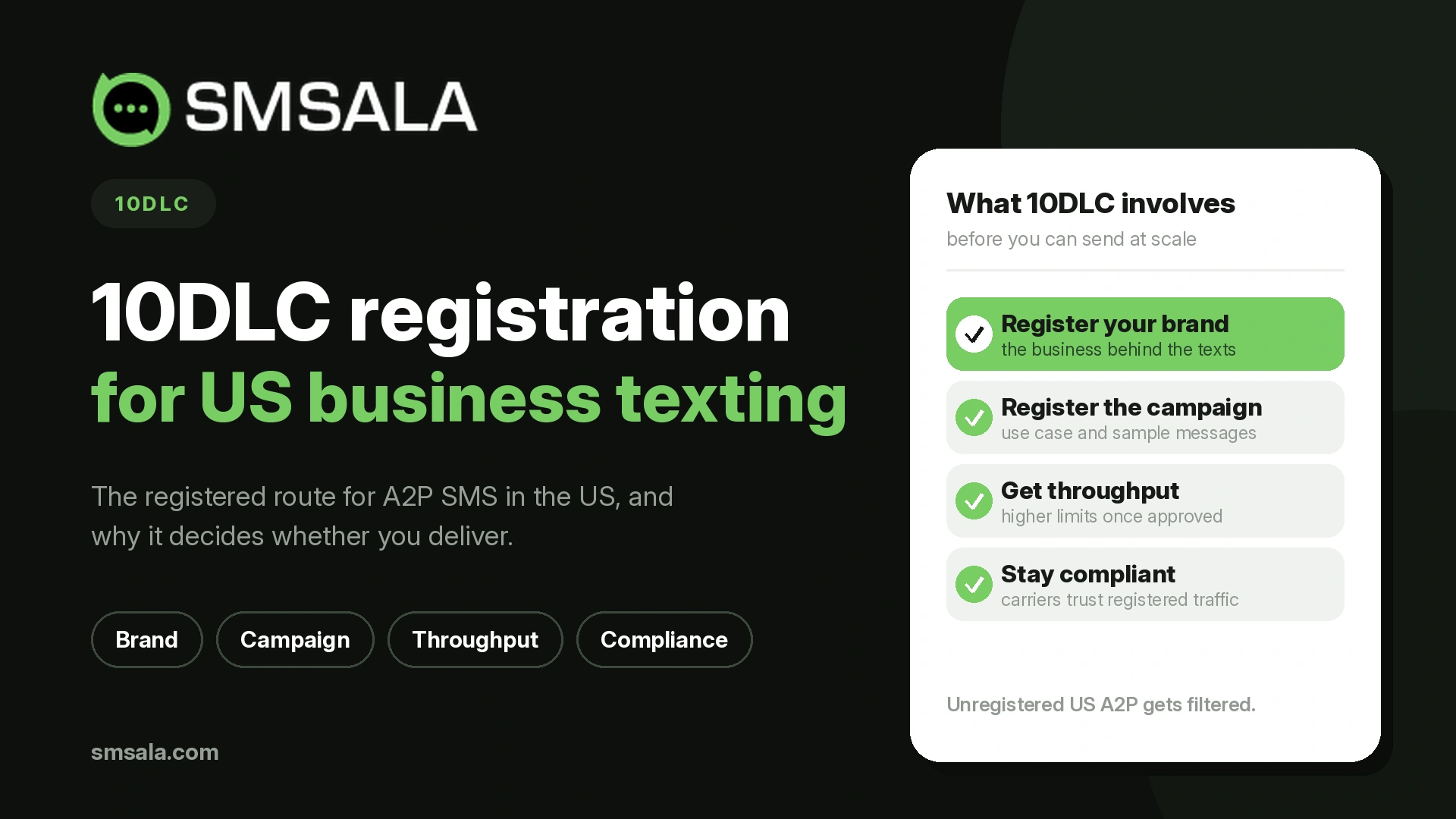
Since February 1, 2025, US carriers block unregistered A2P traffic on standard long numbers. That single change turned 10DLC from an optional upgrade into a toll gate: if your business sends text messages to US mobile numbers and you are not registered, your messages do not get filtered, they get stopped.
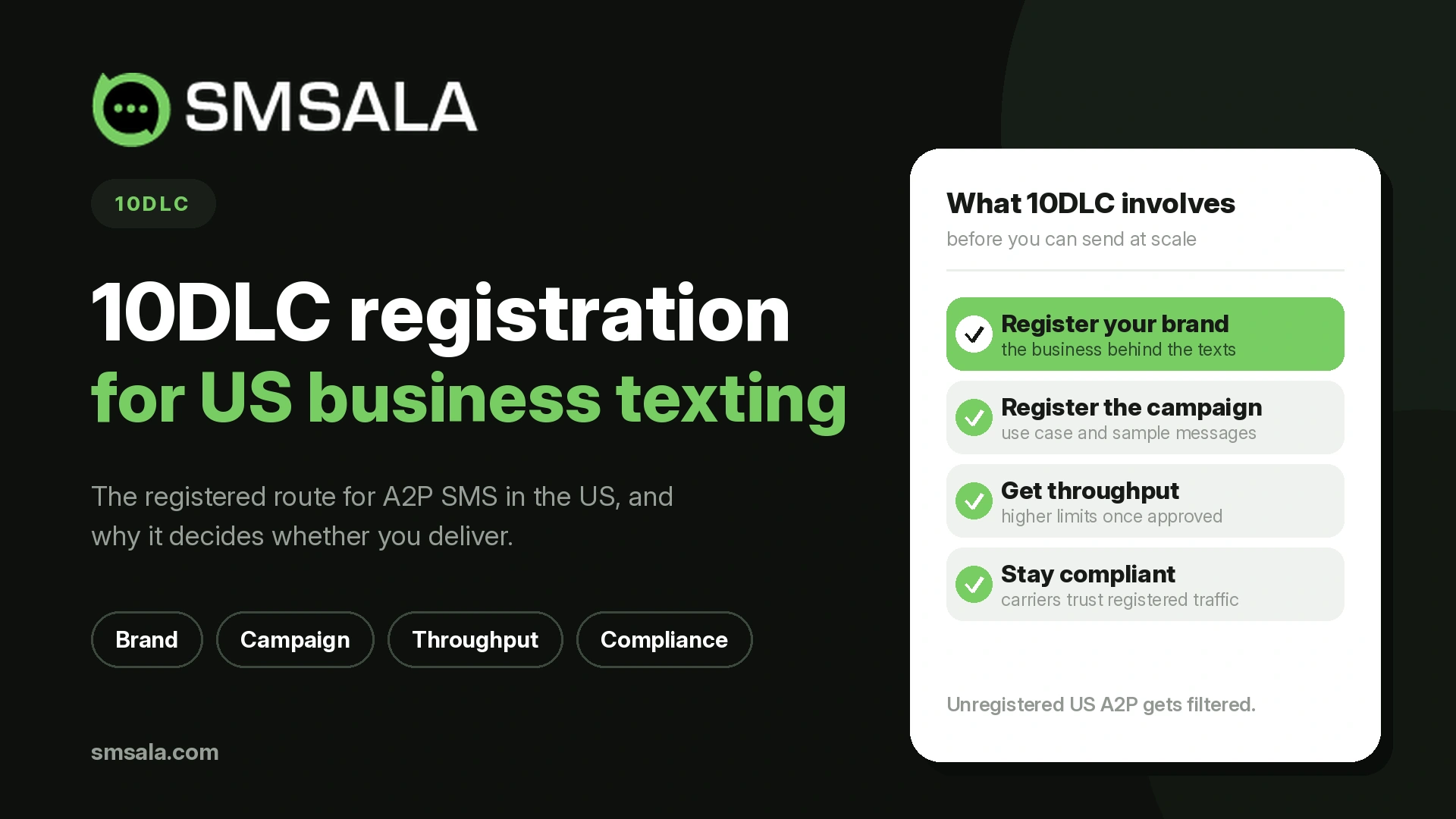
Most guides on this topic explain what 10DLC is and stop there. That is the easy part. The hard part, the part that costs businesses weeks of delay and blocked launches, is getting through registration and vetting without rejection, earning enough throughput to actually send at the volume you need, and staying compliant after approval. This guide focuses on those problems. It is provider-neutral, current for how the system works now, and written for the business that has to get this done.
What 10DLC is, and why it exists
A 10DLC is a 10-digit long code, an ordinary US local phone number that carriers have sanctioned for application-to-person business messaging once it is registered. The "registered" qualifier is the whole point.
For years, businesses sent automated texts over regular long numbers that were designed for personal conversation. Carriers could not tell a legitimate appointment reminder from a scam, so they filtered aggressively and unpredictably. 10DLC fixed the visibility problem by requiring every sender to identify itself and declare what it sends. In exchange for that transparency, registered traffic gets higher throughput, better deliverability, and protection from the blunt filtering that now hits everything unregistered.
This is fundamentally about the difference between A2P messaging and P2P messaging. If software sends your texts at scale, it is A2P, and in the US that means 10DLC registration is not optional. Trying to route business traffic over unregistered numbers now behaves much like using grey routes: it looks cheaper until the messages quietly stop arriving.
Who is who in the registration chain
The acronyms are the first thing that confuse people, so here is the ecosystem in plain terms.
Brand. Your business, as a registered legal entity.
The Campaign Registry (TCR). The central database where all brands and campaigns are registered. It is the system of record the carriers trust.
Campaign Service Provider (CSP). The platform that submits your registration and sends your messages, usually your messaging provider.
Direct Connect Aggregators (DCAs) and mobile carriers. The networks that ultimately approve, meter, and deliver your traffic, chiefly T-Mobile, AT&T, and Verizon.
Registration itself is a three-step chain, and each step gates the next:
Register your brand. Submit your legal business name, tax ID (EIN in the US), address, and website. Carriers verify these against public records.
Register your campaign. Declare your use case, describe how you collect opt-in, and provide sample messages.
Attach your numbers. Link your 10DLC numbers to the approved campaign so they can send.
You cannot register a campaign before the brand is verified, and you cannot send before numbers are attached. Most delays happen at steps one and two, for reasons that are entirely avoidable.
Choosing your brand type without boxing yourself in
Before you register, you pick a brand and campaign classification, and this choice quietly determines your ceiling. Getting it wrong means re-registering later.
Brand type | Who it fits | Trade-off |
Sole Proprietor | Individuals and very small senders without an EIN | Lowest throughput and daily caps; not built for growth |
Low-Volume Standard | Registered businesses sending modest volume | Skips paid external vetting, but throughput stays limited |
Standard | Businesses that need real scale | Full throughput available, external vetting recommended |
The common trap is registering as a Sole Proprietor to save a little money or effort. It carries strict daily limits and is meant for genuinely small, individual senders. Any business with an EIN that expects to grow should register as a Standard brand. Low-Volume Standard is a reasonable middle ground if your volume is genuinely low and predictable, but understand that you are accepting a throughput cap in exchange for skipping the vetting step.
Trust score and throughput: what actually determines how much you can send
Registration gets you in the door. Your trust score determines how fast you can send once you are inside.
When your brand is registered, it can be assigned a score, broadly on a 0 to 100 scale, based on the verifiable information about your business. A higher score unlocks more throughput. The mechanics differ by carrier in a way that trips people up: T-Mobile applies a daily message cap at the brand level tied to your score tier, while AT&T and others meter your speed in messages per second per campaign. So the same brand can be limited by a daily ceiling on one network and by send-rate on another.
The lever most businesses miss is external vetting. For a small one-time fee, an approved third party reviews your business and issues a score that is often substantially higher than the default. If you send any meaningful volume, this usually pays for itself immediately by lifting your daily caps and send rate. Below are the practical thresholds:
If you send low volume from an established business, the default score may be enough.
If your default throughput is throttling your sends, buy external vetting before adding more numbers. More numbers do not raise a brand-level cap; a higher score does.
If you are being blocked specifically on T-Mobile, that is almost always a trust-score cap, not a routing problem.
Getting throughput right matters because it directly shapes your real-world SMS deliverability. A registered campaign that exceeds its rate limit does not fail loudly; the overflow is delayed or dropped.
Why campaigns get rejected, and how to pass the first time
This is the section the product pages leave out, and it is where most of the pain lives. Campaign vetting is a real review, and rejections are common for a handful of predictable reasons. Fix these before you submit.
Rejection reason | What triggers it | The fix |
Brand not verified | Legal name, EIN, or address does not match public records | Use the exact business name and EIN as filed with the IRS |
Website issues | Site is down, or has no privacy policy covering SMS | Publish a privacy policy stating how consent is collected and that data is not sold |
Weak opt-in description | Vague or missing account of how consent is obtained | Describe the exact opt-in flow: where, what the user agrees to, what they see |
Samples do not match use case | Message samples are generic or off-topic | Provide real samples that include your brand name and match the declared use case |
No opt-out language | Samples omit STOP and HELP instructions | Include "Reply STOP to opt out, HELP for help" in at least one sample |
Prohibited or high-risk content | SHAFT or restricted categories | Do not register restricted content; some verticals need special approval |
The single most important asset is your call-to-action and consent evidence. Carriers want to see exactly where and how a person agreed to receive your texts, whether that is a checkbox at checkout, a web form, or a keyword opt-in. A screenshot or a clear written description of that moment prevents more rejections than anything else. If your opt-in language and your sample messages tell a consistent story that a reviewer can follow, you will usually pass on the first attempt.
The compliance stack that stays on after approval
Approval is not the finish line. Several obligations run continuously, and violating them can get your campaign suspended after it is live.
Consent under the TCPA. US law requires prior express written consent before sending marketing texts. Registration does not grant consent; you still have to collect and keep proof of it for every contact.
Honoring opt-outs promptly. FCC rules tightened in 2025 around how quickly opt-out requests must be honored, and a consumer can revoke consent through any reasonable method, not only the word STOP. Your system needs to detect and act on opt-outs quickly, and the safest practice is to process them immediately. Building genuine two-way messaging that recognizes STOP, HELP, and plain-language opt-outs is now a baseline requirement, not a nicety.
Content rules. SHAFT restrictions, covering sex, hate, alcohol, firearms, and tobacco, apply to all traffic, and several other categories such as high-risk financial offers draw extra scrutiny. Registration does not exempt you from content filtering; messages that look like spam still get filtered by carrier SMS firewalls even on a registered campaign.
New use cases mean new campaigns. If you start sending a different kind of message, for example adding marketing to a brand that only registered for account notifications, that is a new campaign registration. Do not stretch an approved use case to cover traffic it was never vetted for.
What it actually costs, and how long it takes
10DLC has a layered cost structure rather than a single price, and the individual amounts are set by TCR and the carriers and do change, so confirm current figures with your provider. The components are stable even when the numbers move:
One-time brand registration fee, typically a few dollars.
Campaign registration fee, usually a small one-time charge per campaign.
Recurring monthly fee per campaign, which varies by use case.
Optional external vetting fee, a one-time cost, usually worth it above low volume.
Carrier pass-through fees, small per-message or per-segment surcharges the carriers levy on registered A2P traffic.
That last item surprises people: even after registration, carriers add a small fee to each message segment. It is minor per message but real at volume, and it is separate from what your provider charges to send.
On timing, brand verification is often quick, sometimes within a day. Campaign vetting typically takes a few business days to about two weeks, and certain sensitive use cases take longer. Build this lead time into any launch. The fastest way through is a clean first submission, because a rejection sends you back to the start of the review queue.
10DLC, toll-free, and short codes: choosing the right channel
10DLC is not the only registered path, and the honest comparison has shifted now that toll-free numbers also require verification.
Factor | 10DLC | Toll-free (verified) | Short code |
Number format | Local 10-digit | 8xx number | 5-6 digit code |
Registration | Brand + campaign via TCR | Toll-free verification | Full carrier provisioning |
Setup time | Days to ~2 weeks | Days | Several weeks |
Throughput | Scales with trust score | High | Highest |
Cost | Low, layered fees | Low to moderate | High, monthly lease |
Best for | Most business messaging | High-volume with a national number | Enterprise, very high volume |
For most businesses, 10DLC is the right default: local presence, reasonable cost, and throughput that scales with your trust score. Toll-free verification suits senders who want a single national number and higher out-of-the-box throughput. Short codes remain the choice for the largest, highest-volume programs that can absorb the cost and setup time. Whichever you choose, the era of sending unregistered is over on all of them.
For businesses outside the US messaging into the US
A frequent and under-answered question: if my company is not based in the US, can I skip 10DLC when texting American customers? No. The requirement attaches to the destination network, not your location. Any business sending A2P messages to US mobile numbers must register.
Non-US businesses register as a foreign entity, generally using their local business registration and tax identifier, and in some cases a DUNS number helps verification. The practical friction is that verification systems are built around US records, so a provider experienced with international brands makes a real difference in getting a foreign entity verified without repeated rejections. This is one of the clearer cases for working with a partner who handles the registration on your behalf. Businesses that operate globally often lean on a provider like SMSala precisely because it manages A2P messaging in the USA alongside international routes, so the same bulk SMS program can reach US and non-US recipients under one compliant setup.
Frequently asked questions
Is 10DLC registration mandatory?
Yes, for A2P messaging to US mobile numbers. Since carriers began blocking unregistered A2P traffic in February 2025, sending business texts over an unregistered long number effectively means they will not be delivered.
How long does 10DLC approval take?
Brand verification is often same-day. Campaign vetting usually takes a few business days up to about two weeks, longer for sensitive use cases. A rejection restarts the review, so a clean first submission is the fastest route.
Will registering guarantee my messages are delivered?
No. Registration lifts the block on unregistered traffic and raises your throughput, but content still passes through carrier filtering. Spammy-looking messages get filtered even on a registered campaign. Registration is necessary, not sufficient.
Can I use one campaign for all my messaging?
Only if it is all the same use case. Marketing, two-factor authentication, and account notifications are distinct use cases. Sending OTP traffic under a campaign registered for marketing risks suspension. Register separate campaigns for genuinely different message types.
What happens if a customer replies STOP?
You must stop messaging that number. Under current FCC rules, opt-outs must be honored promptly and consumers can revoke consent in ways beyond the exact word STOP, so your system should recognize common opt-out phrasing and act on it without delay.
Does 10DLC support two-way conversations?
Yes. A registered 10DLC number can send and receive, which is what makes it suitable for support, confirmations, and handling opt-outs. Short codes and toll-free numbers can also be two-way, but 10DLC keeps a local number your customers recognize.
The takeaway
10DLC stopped being a cost-saving option and became the price of entry for texting US customers. The businesses that struggle with it are the ones that treat it as a form to fill in; the ones that succeed treat it as a review to pass. Register your brand with details that match your public records, describe your opt-in honestly, submit samples that match your use case, and buy external vetting if you need real throughput. Get those right and approval is routine. If your traffic crosses borders or your volume is significant, registering through a provider that manages 10DLC and carrier relationships directly is usually faster and less error-prone than navigating the registry alone, and it keeps the messages you send on the accountable side of the filter.