
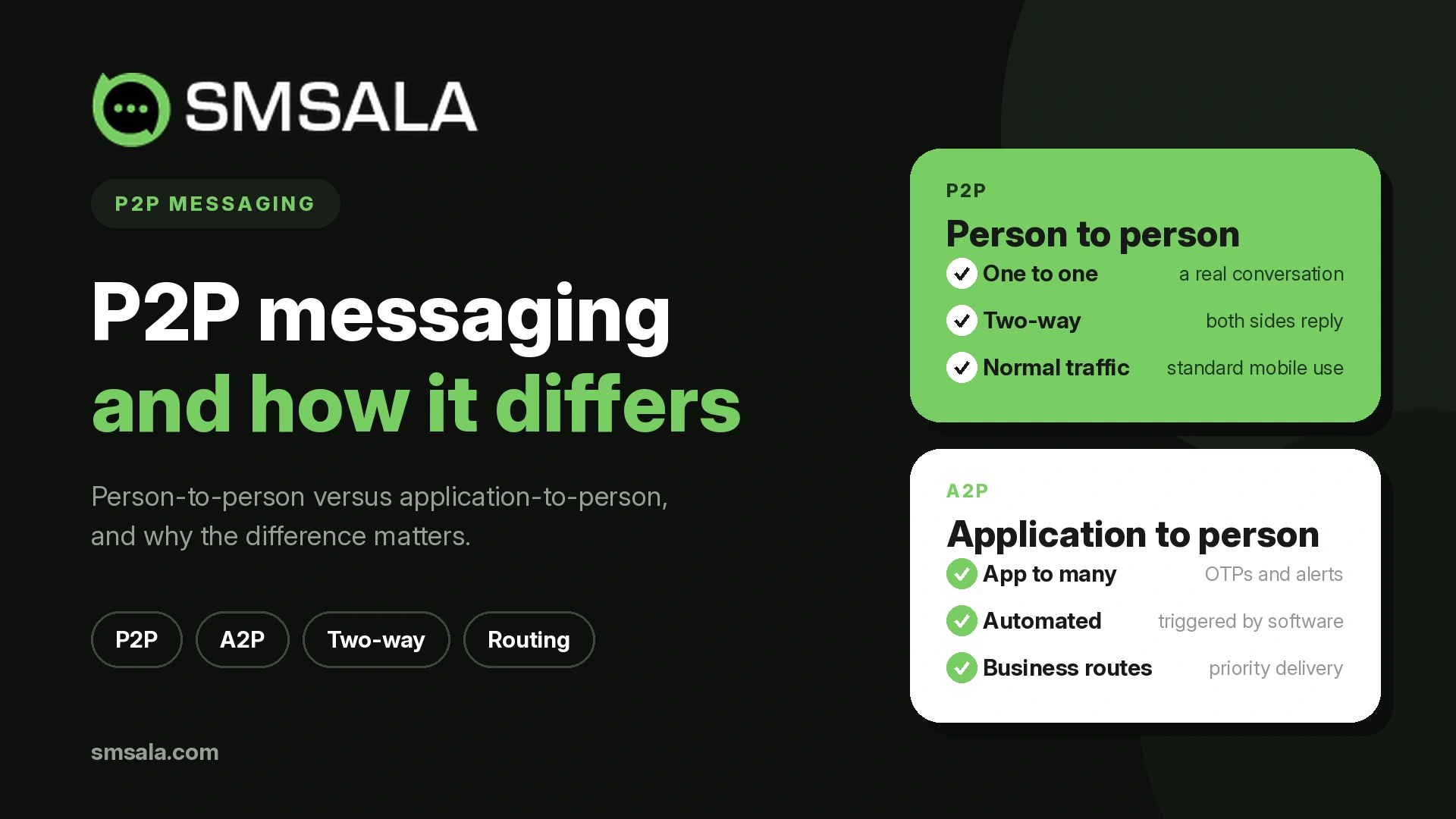
The term "P2P messaging" gets used in two different ways, and the gap between them is where businesses lose money, get their numbers blocked, or unknowingly break the law.
In its original sense, P2P (person-to-person) messaging is simple: two people texting each other from their phones. But walk through a few vendor websites and you will also find "P2P messaging services" sold to companies for marketing and re-engagement. Those are not the same thing, and treating them as interchangeable is the single most expensive mistake in this topic.
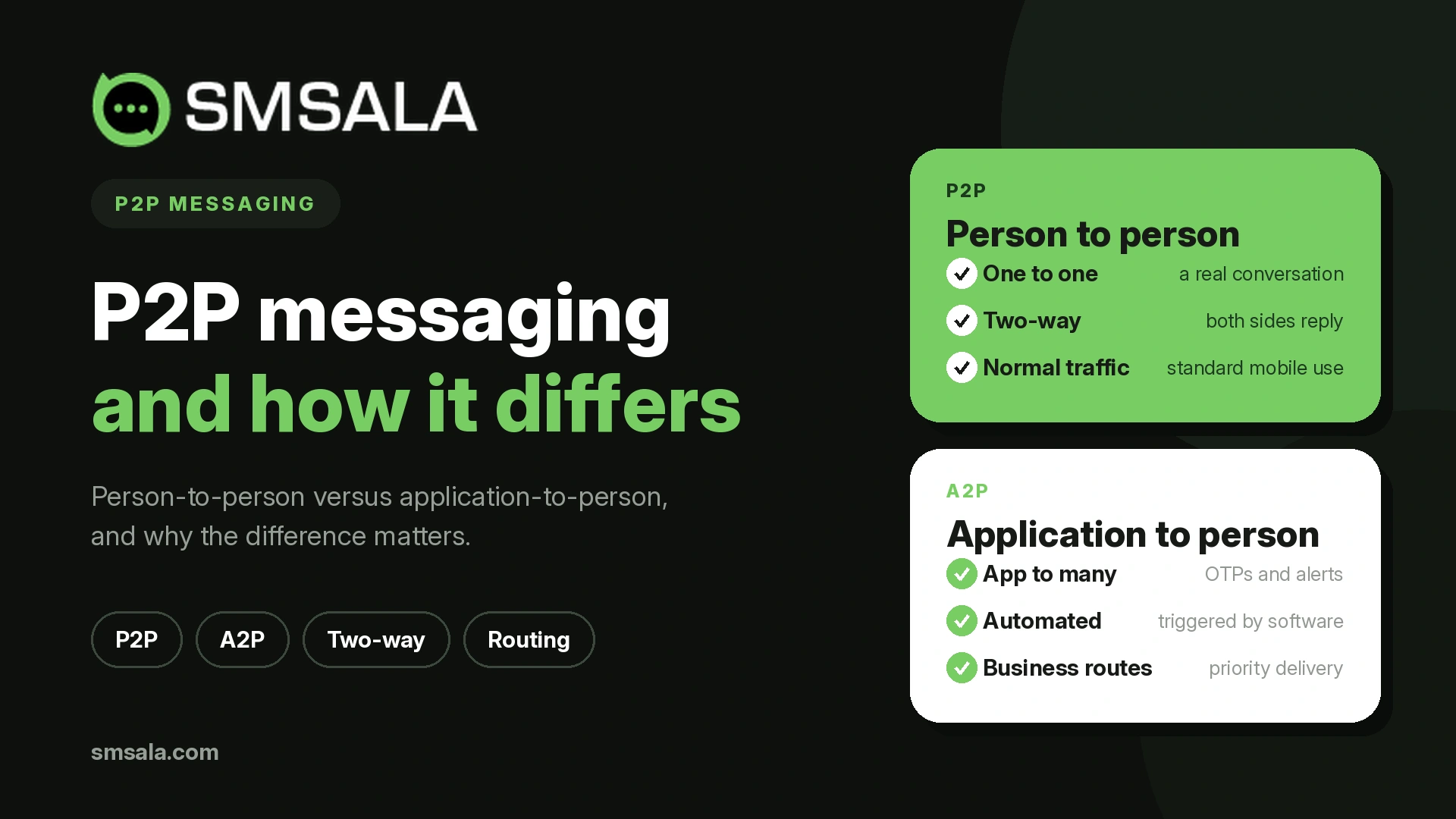
This article does two jobs. First, it defines P2P messaging precisely, including the part most explanations skip: who actually decides whether your traffic counts as P2P. Second, it gives you a way to classify your own messaging correctly, because that classification determines your cost, your compliance obligations, and whether your messages arrive at all.
What P2P messaging actually is
P2P messaging is a text conversation between two individuals, sent from one mobile number to another, where a human writes and sends each message. It is the texting you do with a friend. In telecom terms, it has a recognizable fingerprint: low volume per number, roughly balanced traffic in both directions, unpredictable timing, and human-written content that varies every time.
That fingerprint matters more than the dictionary definition, because mobile carriers do not read intent. They read patterns. A number that sends a handful of varied messages a day and receives replies looks like a person. A number that sends thousands of near-identical messages in an hour does not, no matter who is behind it.
The counterpart to P2P is A2P messaging, or application-to-person, where software sends messages to people at scale: one-time passcodes, order updates, appointment reminders, marketing campaigns. A2P is automated, high-volume, usually one-directional, and templated. Most business messaging is A2P by definition, even when it feels conversational.
The distinction that actually matters
Most articles draw the P2P/A2P line as "personal versus business." That is the intuition, but it is not how the line is enforced. The real distinction is how the message is generated and injected into the network, and carriers infer it from measurable signals.
Signal | Looks like P2P | Looks like A2P |
Who composes the message | A human, each time | An application or template |
Volume per number | Low, irregular | High, sustained |
Direction | Two-way, balanced | Often one-way |
Sender type | Standard mobile number | Short code, registered long code, or Sender ID |
Timing | Sporadic, human-paced | Bursts, scheduled |
Content | Varies naturally | Repeated or lightly personalized |
Read that table again with one idea in mind: a message can be genuinely written to one person and still be classified as A2P if it rides through an application platform at scale. Intent does not override the pattern. This is the point almost every competing article misses, and it leads directly to the most common misconception in the field.
Who decides whether your traffic is P2P
You don't. The carrier does, and increasingly, so does the regulator.
In the United States and Canada, carriers apply a strict interpretation: any message that passes through a messaging application or platform is treated as A2P, full stop, even a one-to-one message a human typed. Under that rule, "sending P2P through a provider" is close to a contradiction. If it went through an API or a platform, it is A2P traffic and subject to A2P rules, including the 10DLC registration regime that requires businesses to register their brand and campaigns before sending over standard long numbers.
Other markets enforce the split differently but just as firmly. India's framework requires commercial senders to complete DLT registration with approved sender identities and message templates; genuine personal texts are exempt, business traffic is not. The common thread across regions is that the classification is applied to you from the outside based on how your traffic behaves, not on how you describe it.
This is why the definition is not an academic point. Misclassify your traffic and you are not bending a naming convention, you are sending unregistered A2P traffic that carrier SMS firewalls are specifically built to catch.
The tempting mistake: using P2P routes for business messages
Here is the scenario that brings most businesses to this topic in the first place. A2P messaging costs more and requires registration. P2P routes are cheaper and lightly policed. So the question forms: can I send my business traffic over P2P routes and avoid the cost and paperwork?
Technically, for a while, sometimes. Practically, it is a trap.
Sending A2P traffic disguised as P2P is exactly what SIM farms do: banks of physical SIM cards pushing commercial messages through consumer-grade channels to dodge A2P fees and filtering. Carriers treat this as abuse, because it is. The consequences arrive on their own schedule:
Detection and blocking. Pattern analysis flags the number, and delivery drops without warning. Your messages stop arriving while your send logs still look busy.
Number and Sender ID bans. Carriers blacklist the offending numbers, and rebuilding sender reputation is slow and uncertain.
Unreliable delivery reports. These routes frequently return delivery statuses that do not reflect reality, so you cannot even tell what failed.
Legal exposure. In registered markets like India, sending commercial traffic outside the DLT system is a compliance violation, not a clever workaround.
The saving is real until the route dies, and it dies at the worst possible time, usually mid-campaign when volume spikes and the pattern becomes obvious. If you are weighing this shortcut, the honest framing is that you are not choosing a cheaper channel. You are borrowing against your own deliverability and your legal standing.
What "P2P messaging services" are really selling
If P2P is person-to-person and business messaging is A2P, why do vendors sell "P2P messaging services" to businesses? Because the label carries a promise people want: higher trust, better deliverability, fewer filtering problems, and a more human feel than mass blasts.
What these services usually deliver is conversational, one-to-one A2P — real agents or lightly automated systems sending individualized messages and handling replies, run through compliant, registered infrastructure. That is a legitimate and often effective model. It performs well precisely because it behaves more like a conversation than a broadcast. But it is still A2P underneath, still subject to registration and consent rules, and it is worth knowing that when you buy it. A vendor promising you can bypass A2P registration by calling the traffic "P2P" is describing a grey route, whatever name is on the invoice.
The useful takeaway is not that these services are bad. It is that the value comes from the conversational approach and proper two-way messaging, not from escaping A2P classification. You can build the same advantage on compliant infrastructure without the risk.
How to classify your own traffic
Before you choose a provider or a route, classify what you are actually sending. Work through these questions in order.
Does a human compose and send each message individually? If no, it is A2P. If yes, continue.
Does it originate from a standard mobile number rather than a short code, registered long code, or alphanumeric sender? If it uses business sender types, it is A2P.
Is the volume low and irregular, matching normal human texting? Sustained or bursty volume reads as A2P regardless of content.
Is it genuinely two-way and conversational? One-directional broadcasts are A2P.
Does it pass through an application, API, or platform? In North America especially, this alone classifies it as A2P.
If you answered in a way that lands on A2P at any step, treat your traffic as A2P: register properly, use approved sender identities, secure consent, and route it over direct, compliant infrastructure. Most business messaging, including one-to-one outreach that feels personal, lands here. Genuine P2P is narrower than most people assume, and if your use case is commercial, it almost certainly is not P2P.
Where genuine P2P still matters, and where it's going
Person-to-person SMS volume has declined for years as messaging apps absorbed everyday conversation. That decline is real, but it overstates the death of the channel. SMS still works on every phone, needs no app or internet connection, and delivers with near-universal reach, which keeps it relevant for emergencies, low-connectivity regions, and anyone without a smartphone.
The more interesting shift is what "person-to-person" is becoming. Conversation between individuals has largely moved to richer channels: WhatsApp Business API for verified business conversations, RCS messaging bringing app-like features to the native messaging inbox, and OTT platforms for daily chat. For businesses, the practical implication is that the "human, conversational" quality people associate with P2P is now best delivered through compliant conversational A2P and modern channels, not by trying to inject business traffic into consumer P2P routes.
Regional rules at a glance
Because classification is enforced locally, the same traffic can be handled differently by market. A short reference:
Region | How business messaging is governed |
United States / Canada | Platform-mediated traffic is A2P; 10DLC registration required for long-code business sending |
India | DLT registration mandatory for commercial senders; approved templates and sender IDs enforced |
United Kingdom / EU | A2P permitted with consent under GDPR and PECR; Sender ID and opt-out rules apply |
Gulf region | Registration and sender verification increasingly required; unregistered A2P often rejected |
The table is a starting point, not legal advice. Rules change and local carriers add their own conditions, so verify current requirements in each market before you send.
Frequently asked questions
Is P2P messaging cheaper than A2P?
Per message, P2P routes are usually cheaper, which is why the shortcut is tempting. But if your traffic is actually A2P, using P2P routes is a compliance and deliverability risk, not a saving. The realistic comparison is between compliant A2P and blocked traffic, and blocked traffic costs far more.
Can I send one-to-one business texts as P2P?
Usually no, at least not in North America, where platform-mediated messages are classified as A2P even when a human sends them individually. One-to-one business outreach is best run as compliant conversational A2P with proper registration and consent.
What happens if I misclassify A2P traffic as P2P?
Carriers detect the pattern and can throttle or block delivery, ban the sending numbers, and return unreliable delivery reports. In markets with mandatory registration, you also face regulatory penalties. The failure is usually silent at first, which makes it worse.
Is WhatsApp or iMessage considered P2P?
When two individuals chat, yes, that is person-to-person communication over an OTT channel. When a business messages customers through the WhatsApp Business API, that is a business channel with its own verification and template rules, closer to A2P in how it is governed.
Does P2P messaging require consent and opt-out like A2P?
Genuine personal texting between individuals is not subject to commercial consent rules. Any business messaging is, regardless of what it is labeled. If you are sending on behalf of a company, assume consent, opt-out, and registration obligations apply.
The one thing to take away
P2P and A2P are not marketing labels you get to choose between. They are classifications applied to your traffic based on how it behaves and where it is sent. For almost any business, the honest answer is that your messaging is A2P, and the goal is not to escape that category but to run it well: registered, consented, and routed over direct infrastructure that gives you real delivery visibility.
If you are evaluating how to send business messages the right way, the practical next step is to run them on direct carrier connections where SMS deliverability and reporting hold up at scale. That is where the "human, reliable" quality people want from P2P actually comes from, minus the risk of pretending business traffic is something it is not.