
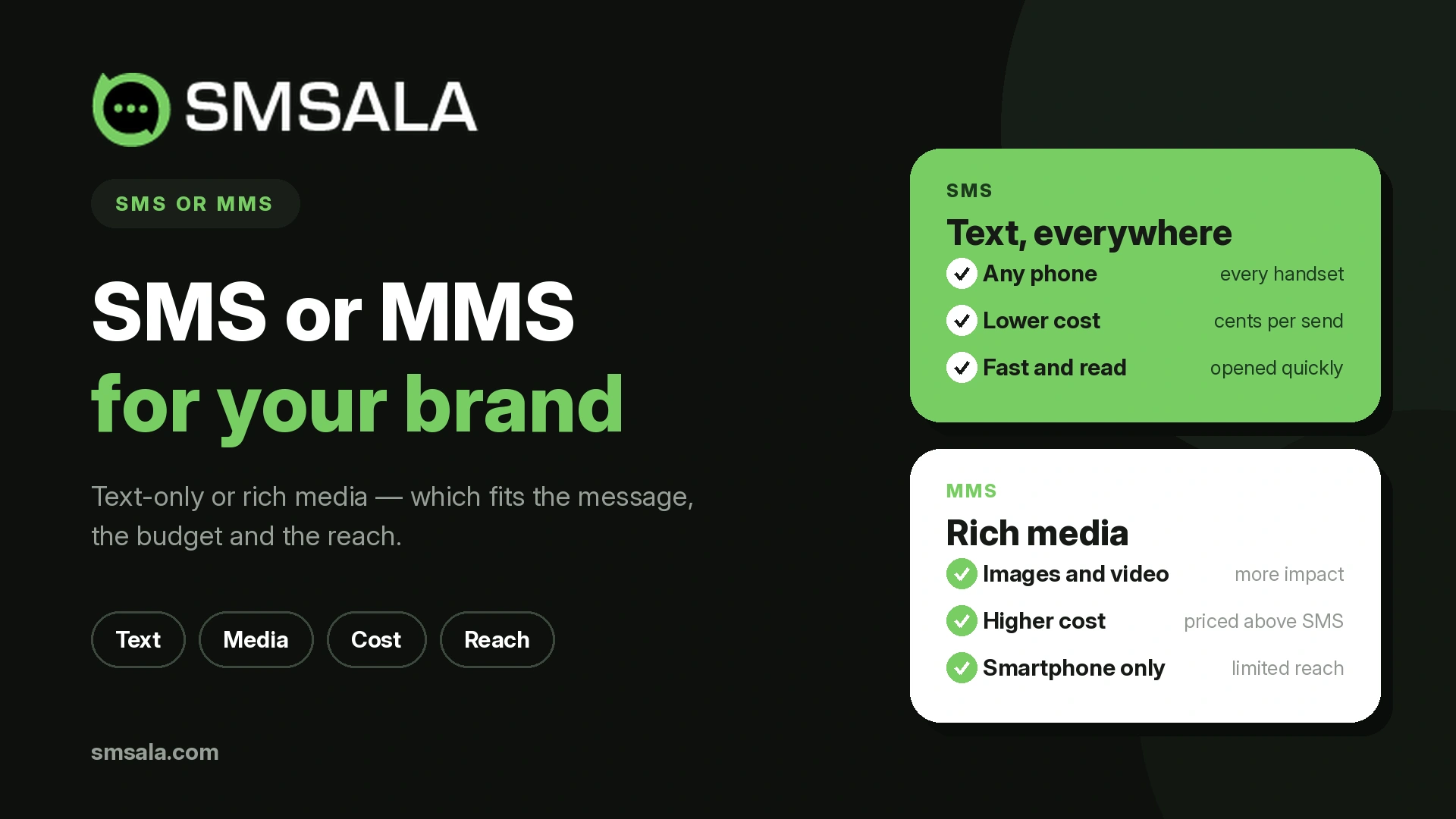
A brand wants to send customers something visual — a product photo, a promo graphic, a short video. The obvious question is "SMS or MMS?" And the honest answer surprises most people: for the majority of businesses, the real choice usually isn't between SMS and MMS at all. Because while MMS can send that image, in practice it's expensive, its support is patchy, its rendering is inconsistent, and there's a simpler, cheaper, more reliable way to get rich content in front of customers that the SMS-versus-MMS framing completely ignores.
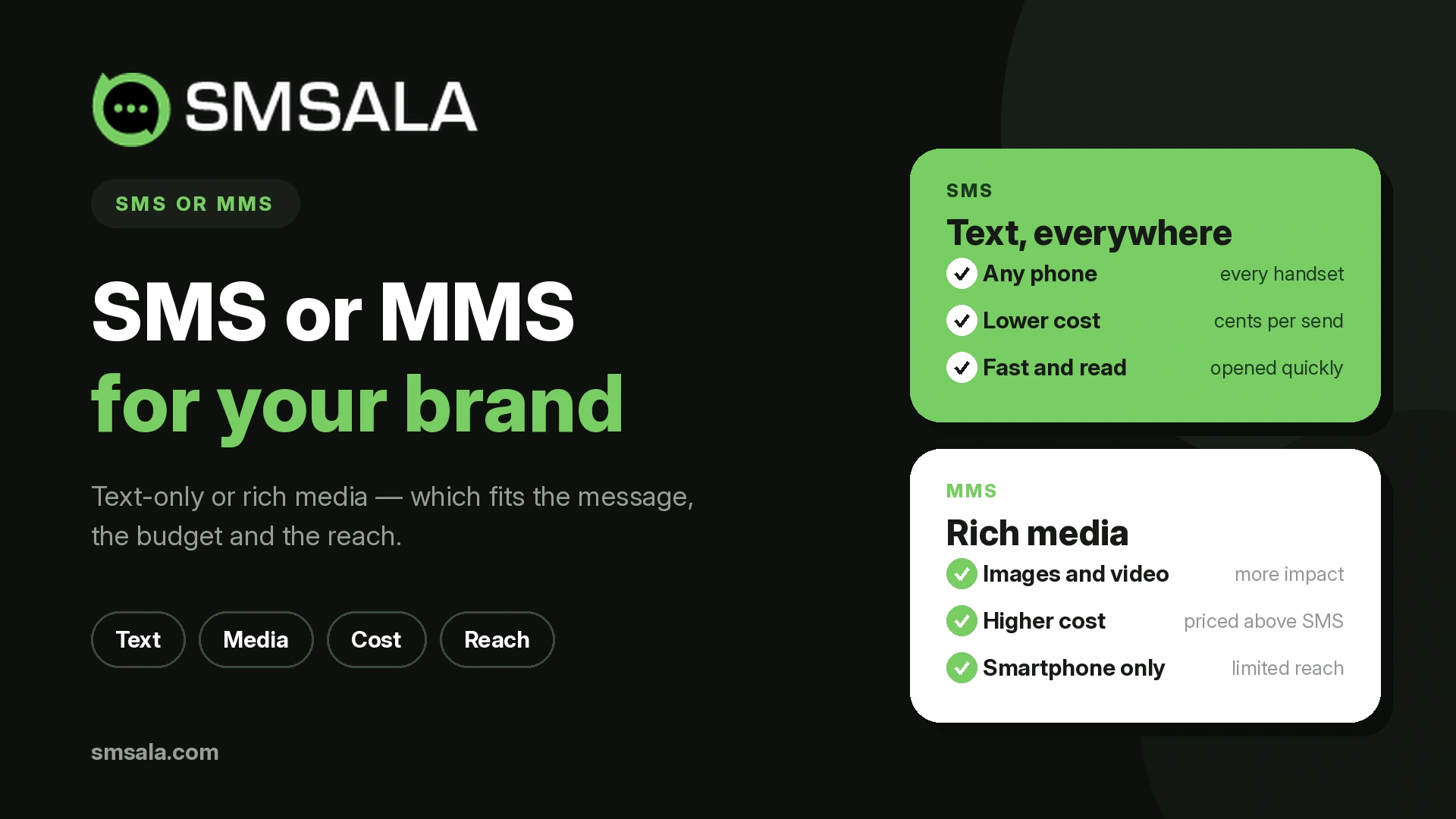
Most comparisons of SMS and MMS end in a shrug — "both have advantages, it depends on your needs." That's not an answer, it's an evasion, and it leaves you no better off than before you asked. This guide gives you a decisive one: what genuinely separates SMS and MMS, exactly when each wins, and — the part the dated comparisons miss — why the modern reality of linking from SMS and of RCS has reshaped the whole question, so that "should I use MMS?" is often the wrong thing to be asking in the first place. By the end you'll know not just the difference, but what your brand should actually do.
SMS vs MMS: what each actually is
The technical difference is real and worth stating precisely, because it drives everything else.
SMS (Short Message Service) sends plain text, traditionally limited to 160 characters per message (longer messages split into segments). It works on every mobile phone, needs no internet, and is the universal baseline of mobile messaging.
MMS (Multimedia Messaging Service) sends media — images, video, audio, longer text (up to around 1,600 characters) — alongside or instead of plain text. It's "picture messaging," and it makes a message visual rather than text-only.
So the core distinction is simple: SMS is text; MMS adds media. MMS can show a product photo where SMS can only describe it. On the surface, that makes MMS sound clearly better for anything visual — which is exactly where the shallow comparisons stop, and exactly where the real analysis needs to begin, because "can send media" and "should send media this way" are different questions.
The decisive comparison: when SMS wins, when MMS wins
No hedging — here's when each genuinely wins.
SMS wins for:
Universal reach — every phone receives SMS; you're guaranteed to reach everyone.
Speed and reliability — SMS is fast, dependable, and consistently rendered.
Cost — dramatically cheaper per message, which matters enormously at volume.
Transactional and time-critical messages — OTPs, alerts, confirmations, reminders, where text is all you need and reliability is paramount.
Anything where the message is fundamentally information — most business messaging.
MMS wins for:
Genuinely visual messages — where an image or video is the whole point and text can't substitute (a product reveal, a visual promo, a branded graphic).
Longer messages — where you need more than SMS's character limit in one message.
High-impact campaigns to a known-compatible, high-value audience — where the visual impact justifies the higher cost and you're confident recipients can receive it.
The decisive rule: use SMS unless the message genuinely requires media that nothing else can deliver, and the visual impact justifies MMS's real costs. SMS is the default for the vast majority of business messaging because most business messages are information, and SMS delivers information reliably to everyone cheaply. MMS is the specialist tool for the minority of messages where a visual is essential and worth its price and support limitations. But before reaching for MMS even then, there's a problem with it you need to weigh — and an alternative most brands overlook.
The honest problem with MMS: cost, support, and rendering
Here's what the "MMS is more appealing" framing glosses over, and why MMS is less attractive than it looks. MMS carries three real problems that undercut its visual advantage:
Cost. MMS costs substantially more per message than SMS — often several times more. At the volumes businesses send, that difference is significant, and it means every MMS has to earn its premium. Sending an MMS where an SMS would do is simply paying more for no gain.
Inconsistent support and rendering. Not every phone and carrier handles MMS reliably or identically. While smartphones are near-universal now, MMS delivery and rendering are less consistent than SMS — messages can arrive degraded, resized, poorly formatted, or occasionally not at all, and you have less certainty about how your carefully-designed visual actually looks on the recipient's screen. SMS's plain text always renders; MMS's media doesn't always render as intended.
No guarantee of the experience. With SMS you know exactly what the recipient sees. With MMS you're depending on their device, carrier, and settings to display your media as you designed it — a dependency that introduces uncertainty into the very thing (visual impact) you paid extra for.
These problems don't make MMS useless — but they mean its visual advantage comes with real cost and reliability trade-offs. And they set up the question that reshapes the whole decision: is there a way to get rich content to customers without MMS's cost and inconsistency? There is, and it's what most brands should actually use.
The alternative the binary ignores: SMS plus a link
Here's the reframe that changes the SMS-versus-MMS question entirely. For most cases where a brand thinks it needs MMS, the better answer is SMS with a link to rich content — and this is what a large share of effective "visual" business messaging actually is.
The approach is simple: send a cheap, reliable, universally-delivered SMS containing a short, tracked link to a web page, image, video, or landing page hosting your rich content. The customer taps the link and sees the full visual experience — hosted on the web, where it renders perfectly on any device, can be as rich as you like, and costs you nothing extra per message beyond the SMS. Using an SMS URL shortener keeps the link tidy and, crucially, lets you track who clicked — something MMS can't tell you. Compared to MMS, SMS-plus-link is cheaper (SMS pricing, not MMS), universally deliverable (everyone gets the SMS), consistently rendered (the content lives on the web, not squeezed into a message), unlimited in richness (a whole landing page, not one image), and measurable (you see engagement). The only thing MMS does that SMS-plus-link doesn't is show the image inside the message thread without a tap — and for most purposes that single advantage doesn't justify MMS's cost and inconsistency. This is why so much "rich" business messaging is really SMS driving traffic to rich web content — it's the pragmatic best of both worlds, and the option the SMS-vs-MMS binary pretends doesn't exist. A QR code works on the same principle for physical touchpoints, letting QR codes bridge to rich content the same way a link does in a text.
Where RCS changes the whole question
The other development that dates the SMS-vs-MMS debate: RCS (Rich Communication Services), the modern successor to SMS that supports rich, interactive, branded content natively in the messaging app — images, carousels, buttons, branding — without MMS's cost and clunkiness, where it's supported.
RCS matters because it's what MMS always wanted to be but wasn't: genuinely rich in-thread content, with verified brand identity and interactivity, on a modern footing. Where RCS is available on a recipient's device, it offers the in-message visual experience MMS promised, done better. Its limitation is that support isn't yet universal — it depends on the recipient's device, carrier, and messaging app — which is why the sensible modern approach often uses RCS where available and falls back to SMS (with a link) where it isn't. Understanding RCS messaging and where it fits is increasingly part of the rich-messaging decision, and it further shifts the calculus away from MMS: between SMS-plus-link and RCS, the specific case for MMS keeps shrinking. The broader shift toward rich media messaging is really a shift toward RCS and web-linked SMS, not toward MMS.
So which should your brand use?
The decisive answer, pulling it together:
Default to SMS for the vast majority of your messaging — all transactional, time-critical, and information messages, which is most of what businesses send. It's universal, reliable, and cheap.
When you need to deliver rich or visual content, reach for SMS-plus-a-link before MMS — it's cheaper, universally deliverable, consistently rendered, richer, and measurable. This should be your go-to for "visual" messaging.
Use RCS where it's supported for native in-thread rich, branded, interactive content, with SMS fallback for recipients who can't receive it — the modern best option for rich messaging.
Reserve MMS for the narrow cases where you specifically need media to appear inside the message thread without a tap, you've confirmed your audience can reliably receive it, and the visual impact justifies the higher cost — a genuinely narrow set of situations.
In short: SMS for information (most messages), SMS-plus-link or RCS for rich content, and MMS only in the specific cases where in-thread media without a tap is worth its cost and inconsistency. For most brands, that means SMS does the bulk of the work and MMS does very little — which is the decisive answer the "it depends" hedge refuses to give.
Cost implications, concretely
Cost deserves a clear word because it drives the decision. SMS is the cheapest option per message. SMS-plus-link costs the same as SMS (you're sending an SMS; the content is hosted separately for free or cheaply). RCS pricing varies but is generally positioned for rich business messaging. MMS is the most expensive per message, often several times an SMS. So for a campaign to a large list, choosing MMS over SMS-plus-link can multiply your cost for a marginal in-thread-display benefit — money better spent reaching more people or sending more often. At scale, the cost gap is a strong argument for SMS-plus-link as the default rich-content approach, reserving MMS's premium for where it genuinely pays off. Running your rich campaigns through cost-efficient business messaging that combines SMS reach with linked or RCS content gets you the impact without the MMS premium.
Mistakes brands make choosing SMS vs MMS
Reaching for MMS whenever they want a visual — paying MMS's premium when SMS-plus-link would deliver richer content cheaper and more reliably.
Assuming MMS reaches everyone — overlooking its inconsistent support and rendering versus SMS's universal delivery.
Ignoring the SMS-plus-link option — treating it as a binary SMS-or-MMS choice and missing the pragmatic middle.
Overlooking RCS — not considering the modern rich-messaging option that outdoes MMS where supported.
Not tracking engagement — using MMS (which can't tell you who engaged) instead of trackable linked SMS.
Paying for in-thread media that isn't worth it — spending the MMS premium for a marginal display benefit customers barely value.
If you're choosing between SMS and MMS for your brand, the decisive answer for most messaging is SMS — with a link to rich content when you need visual impact, and RCS where it's supported — reserving MMS for the narrow cases that justify its cost. SMSala's rich media and RCS messaging lets you deliver rich, branded content the modern way, combining SMS's universal reach with the visual impact MMS promised but rarely delivers reliably.
FAQ
What's the difference between SMS and MMS?
SMS (Short Message Service) sends plain text, limited to around 160 characters per message, and works on every phone without internet. MMS (Multimedia Messaging Service) sends media — images, video, audio — and longer text (up to about 1,600 characters). The core difference is that SMS is text-only while MMS adds media, but MMS costs more and has less consistent support and rendering.
Should my brand use SMS or MMS?
Default to SMS for most messaging — it's universal, reliable, and cheap, and suits all transactional and information messages. When you need rich or visual content, use SMS with a link to web-hosted content rather than MMS, since it's cheaper, universally deliverable, and trackable. Reserve MMS for the narrow cases where in-thread media without a tap genuinely justifies its higher cost.
Is MMS worth it for businesses?
Usually not, for most messages. MMS costs several times more than SMS, has inconsistent support and rendering across devices, and can't tell you who engaged. For nearly all cases where a brand wants to send something visual, an SMS with a link to rich web content delivers more impact more cheaply and reliably. MMS is worth it only for specific high-value visual messages to a confirmed-compatible audience.
What's better than MMS for sending rich content?
For most businesses, an SMS containing a link to web-hosted rich content — a page, image, or video — is better than MMS: it's cheaper (SMS pricing), reaches every phone, renders perfectly on any device, can be as rich as you like, and lets you track clicks. Where supported, RCS offers native in-thread rich content that also outperforms MMS.
Does MMS reach all phones?
No. While smartphones are near-universal, MMS delivery and rendering are less consistent than SMS — some devices, carriers, or settings handle it unreliably, and media can arrive degraded or fail to display as intended. SMS, by contrast, reaches and renders on every phone. This support gap is a key reason SMS-plus-link is often more dependable than MMS for reaching everyone.
How does RCS compare to SMS and MMS?
RCS (Rich Communication Services) is the modern successor to SMS, supporting rich, interactive, branded content natively in the messaging app — what MMS attempted, done better. Where it's supported on the recipient's device it offers superior in-thread visual messaging; where it isn't, systems fall back to SMS. It's increasingly the best option for rich messaging, further reducing the case for MMS.