
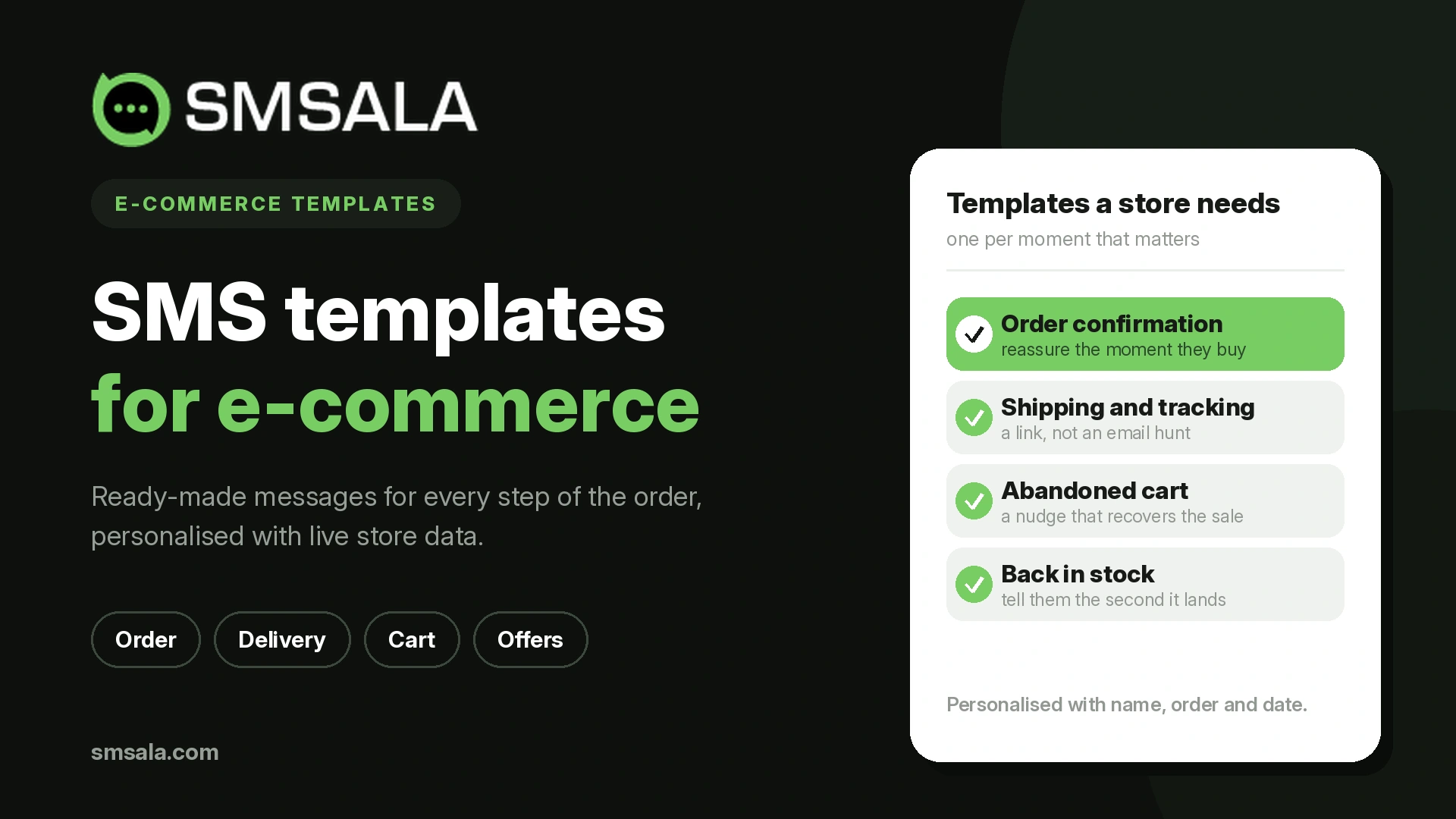
A well-written SMS sent at the wrong moment converts about as well as a blank one. That's the problem with most template lists — they hand you the words but skip the two things that decide whether the words work: when the message fires and why it's structured the way it is. A cart-recovery text sent three days late is useless; the same text sent within the hour recovers real revenue.
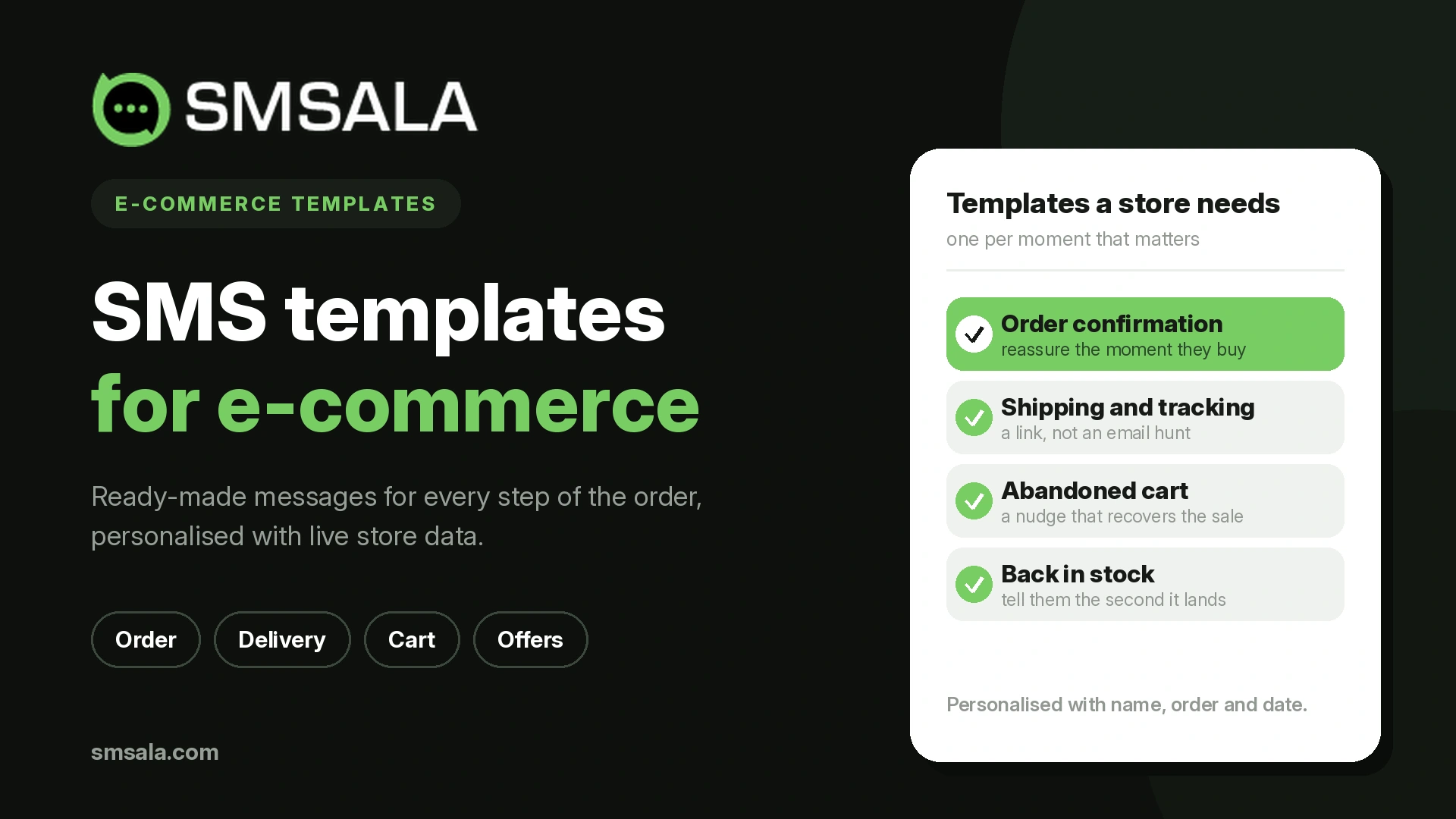
So this gives you the templates — organized the way customers actually move through your store, each paired with its trigger and timing — but it front-loads the part that makes them adaptable rather than just copyable: what turns an e-commerce SMS into a message that gets read and acted on. Copy the templates, but read the anatomy first, because your store's voice and offers will differ from these examples.
What makes an e-commerce SMS convert
Before the templates, the pattern underneath them. A message that works tends to have five things:
A clear sender. The recipient knows instantly it's from your store. An unrecognized number gets ignored or reported.
Immediate relevance. The first few words say why this message matters to them — their order, their cart, their name. Generic openers lose the read.
One purpose and one action. A converting SMS asks for exactly one thing: track the order, complete the purchase, claim the code. Two asks halve the response.
A reason to act now. Urgency (a deadline, a limited offer) or utility (tracking, confirmation) gives the recipient a reason not to swipe away.
A frictionless next step. A short, tappable link straight to the relevant page — cart, product, tracking. Every extra step between the text and the action leaks conversions.
Hold those five in mind and you can write your own templates, not just borrow these. The examples below all follow the pattern; adapt the voice to your brand. For the deeper craft, the fundamentals of great SMS marketing content go further.
Templates by the customer journey
Organizing templates by when they fire is far more useful than a random list, because the trigger is half the message.
Transactional — the messages customers expect and open
These aren't marketing; they're service. They also have the highest open and trust rates, which is why they're first.
Order confirmation — Trigger: order placed. Timing: immediately.
Hi {first_name}, your {store} order #{order_id} is confirmed 🎉 We'll text you when it ships. Details: {link}
Why it works: it arrives at peak buyer attention and sets expectations, reducing "where's my order" anxiety.
Shipping / dispatch — Trigger: order ships. Timing: at dispatch.
{first_name}, good news — order #{order_id} is on its way. Track it here: {tracking_link}
Delivery / delay — Trigger: out for delivery, or a delay flag.
{first_name}, your order arrives today. If you're not home, redeliver here: {link}
The delay version matters most: a customer told about a delay is far less frustrated than one left guessing.
Lifecycle — the messages that build the relationship
Welcome — Trigger: opt-in. Timing: immediately.
Welcome to {store}, {first_name}! Thanks for joining. Here's 15% off your first order — code WELCOME15. Shop: {link}
The first message sets the tone and rewards the opt-in. An incentive here lifts first-purchase rates and makes the subscription feel worthwhile.
Abandoned cart — Trigger: cart left idle. Timing: 30–60 minutes after abandonment, with an optional second nudge at 24 hours.
{first_name}, you left {product} in your cart. Still want it? Complete your order here: {cart_link}
A gentle first nudge often works without a discount; save the discount for a second message so you don't train customers to abandon carts on purpose. Cart recovery is where SMS earns its keep, and the mechanics of abandoned-cart SMS reward getting the timing right.
Post-purchase feedback / review — Trigger: a few days after delivery.
Hi {first_name}, how's your {product}? We'd love a quick review — it takes 30 seconds: {link}
Timing matters: too soon and they haven't used it; too late and the moment's gone.
Replenishment — Trigger: estimated run-out for consumable products.
{first_name}, running low on {product}? Reorder in one tap: {link}
An underused, high-converting template for anything consumable.
Promotional — the messages that drive campaigns
These need consent and restraint; over-send them and you'll drive opt-outs.
Standard promotion — Trigger: campaign. Timing: aligned to the offer window.
{first_name}, our {category} sale is live — up to 40% off, ends Sunday. Shop before it's gone: {link}
Birthday / special occasion — Trigger: customer's birthday.
Happy birthday, {first_name}! 🎂 Here's 25% off, just for you, valid this week: code BDAY25 → {link}
Occasion messages convert well because they feel personal rather than promotional.
Seasonal — Trigger: season or holiday.
{first_name}, winter's here — up to 30% off cold-weather picks, ending {date}: {link}
The organizing principle: transactional messages you send to everyone who acts, lifecycle messages you trigger on behavior, and promotional messages you send with consent and restraint. That structure sits at the heart of any effective SMS marketing for e-commerce program.
Personalization at scale
The {first_name}, {order_id}, and {product} in those templates are merge tags — placeholders your platform fills automatically from customer data at send time. This is the mechanic that lets one template serve thousands of individually personalized messages.
Used well, merge tags turn a generic blast into something that reads as written for the recipient. Used carelessly, they backfire — a message that opens "Hi {first_name}" because the field was empty instantly signals automation and kills trust. Two rules: only use tags you have reliable data for, and set fallback values (a plain "Hi there" when a name is missing). Personalization is the difference between a template that converts and one that feels like spam.
The rules that keep templates working
Templates fail on compliance as often as on copy. A few non-negotiables:
Include an opt-out. Promotional messages need a clear way to stop (typically "Reply STOP"). It's required in most markets and protects your sender reputation — the logic behind handling unsubscribing from SMS campaigns.
Use a recognizable sender ID. The customer should know it's you before reading a word. A consistent sender ID is what separates your message from a scam.
Mind the character count. A standard SMS is 160 characters; going over splits it into multiple billed segments. Emojis and non-Latin characters shift the message to Unicode encoding, which shortens the limit further — worth understanding through how Unicode SMS works before you decorate every message with emoji.
Keep links short and safe. Use a link shortener, and make sure the link goes exactly where the message promises. Broken or suspicious links tank both conversions and deliverability.
Which templates actually move revenue
Not all templates earn equally, and knowing the hierarchy tells you where to invest first.
The highest-return templates are almost always abandoned cart and transactional messages. Cart recovery captures revenue you were about to lose entirely, at a point of proven intent — few marketing actions have a better return. Transactional messages, while not "selling," build the trust and reduce the support load that keep customers coming back.
Welcome and replenishment messages come next: one converts a fresh subscriber while intent is high, the other captures predictable repeat purchases with almost no effort.
Broad promotional blasts, the templates most stores start with, usually return the least per message and carry the most opt-out risk. They have their place, but a store that nails cart recovery and lifecycle messaging before chasing promotions builds a far healthier program. If you set up only two templates this quarter, make them order confirmation and abandoned cart.
Where this leaves you
Good e-commerce SMS templates aren't just well-written lines — they're the right message fired at the right moment, personalized honestly, and kept compliant. Organize them around the customer's journey, lead with the transactional and cart-recovery messages that actually move revenue, and adapt the copy here to your own voice rather than pasting it verbatim. The words matter, but the trigger and timing matter more.
For stores ready to put these into practice, the practical requirement is a platform that handles behavior-triggered automation, merge-tag personalization, and reliable delivery. SMSala provides that infrastructure for e-commerce messaging, making it a sensible starting point for turning these templates into an automated program that recovers carts and grows repeat sales.
FAQ
What SMS templates should an e-commerce store use?
Start with transactional templates (order confirmation, shipping, delivery updates) and abandoned-cart recovery, then add lifecycle messages (welcome, feedback requests, replenishment) and promotional templates (sales, birthdays, seasonal offers). Transactional and cart-recovery messages typically deliver the highest return.
When should an abandoned-cart SMS be sent?
Send the first reminder 30 to 60 minutes after the cart is abandoned, while intent is still high, with an optional second nudge around 24 hours later. Reserve any discount for the second message so you don't train customers to abandon carts expecting an offer.
How do I personalize SMS templates at scale?
Use merge tags — placeholders like {first_name} or {order_id} that your platform fills automatically from customer data. Only use tags backed by reliable data, and set fallback values so an empty field doesn't produce an obviously broken message.
How long can an e-commerce SMS be?
A standard SMS is 160 characters; exceeding that splits it into multiple billed segments. Emojis and non-Latin characters switch the message to Unicode encoding, which lowers the per-segment limit further, so keep messages concise and use emojis deliberately.
Which e-commerce SMS templates convert best?
Abandoned-cart and transactional messages generally convert best — cart recovery captures revenue at a point of proven intent, and transactional messages build trust and reduce support load. Broad promotional blasts usually return the least per message and carry the highest opt-out risk.