
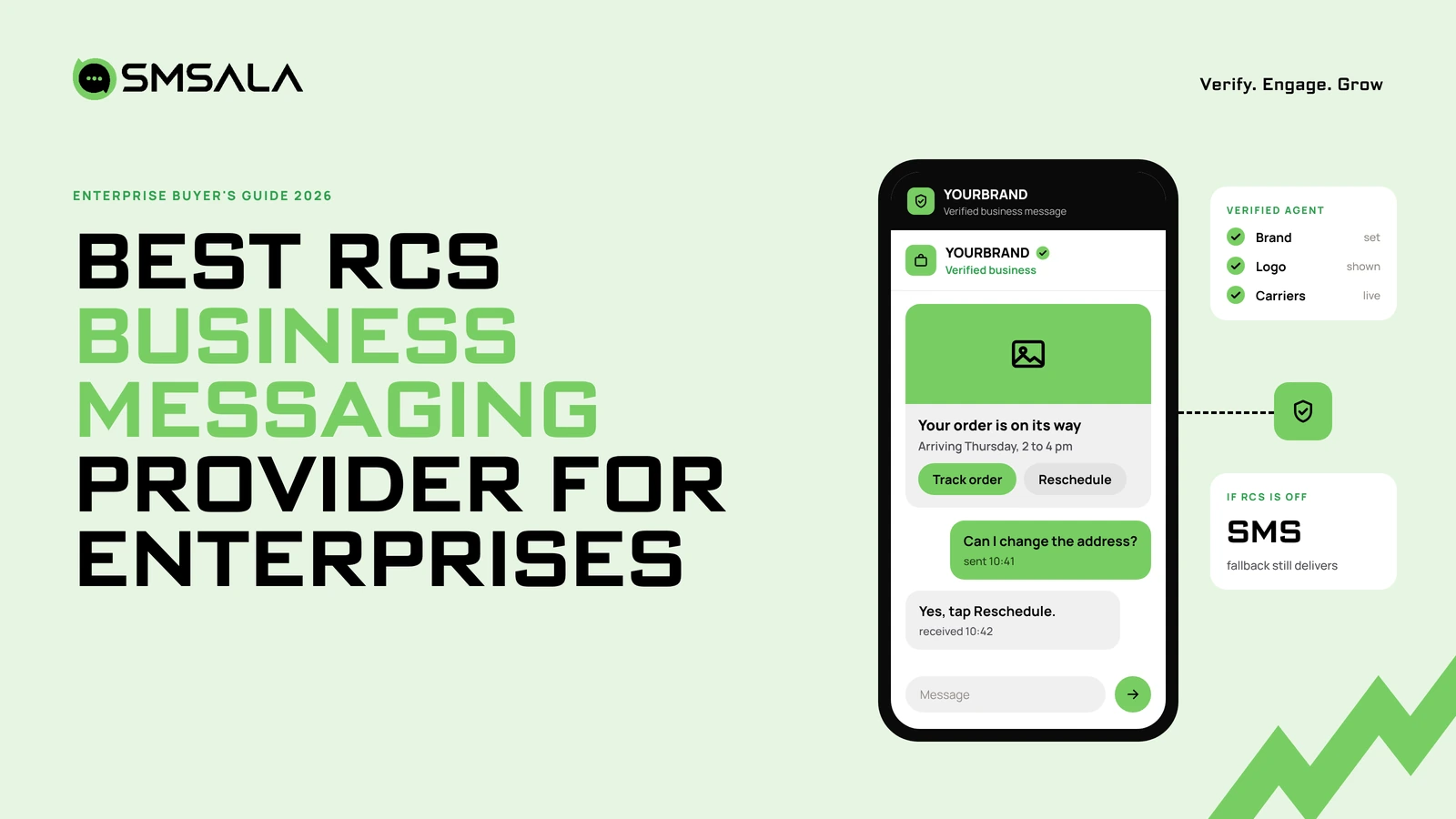
The best RCS business messaging provider for an enterprise is the one that can get your brand verified and live on carriers in the markets you actually serve, fall back to SMS when a recipient can't receive RCS, and show you clear pricing and delivery data per country. Rich cards, carousels and suggested reply buttons look almost identical from one provider to the next, because they come from the same RCS Business Messaging standard. Where providers really differ is reach, onboarding speed, fallback handling, billing and support.
That changes how enterprises should compare them. A demo of a beautiful product carousel tells you very little. A list of which carriers in Mexico, India or the UK the provider has launched agents on tells you almost everything.
What an RCS Business Messaging Provider Actually Does
RCS messaging replaces plain text with a branded, app-like experience inside the phone's default messaging app: verified sender name and logo, images, carousels, buttons, read receipts and typing indicators. A business can't send it directly to handsets. It needs a provider to handle the layers in between.
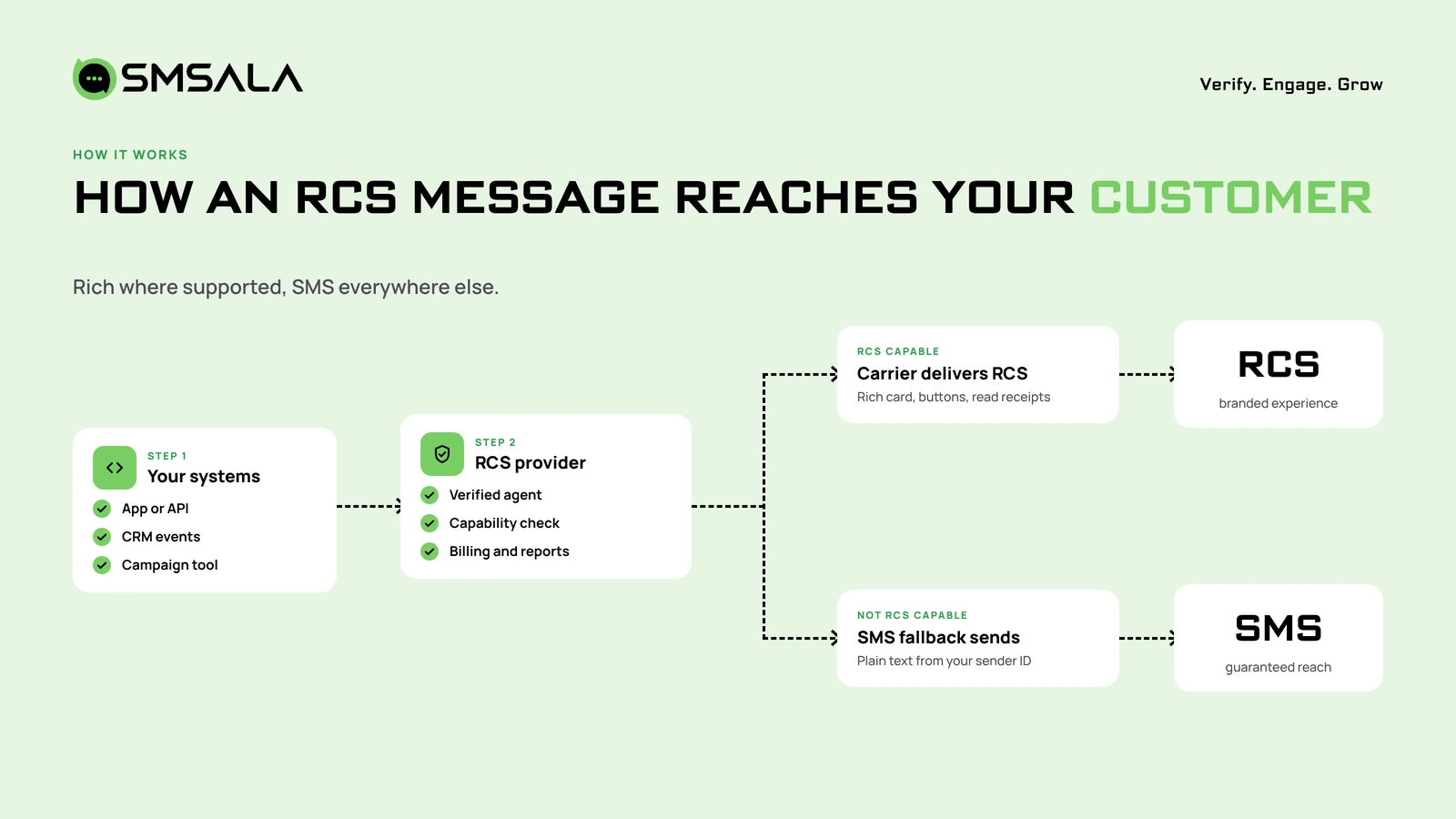
In practice, an RCS business messaging provider does six jobs:
• Agent setup. Every brand sends RCS through an "agent," the branded sender profile with name, logo, colors and description.
• Brand verification and carrier launch. The agent has to be verified as genuinely belonging to your company, then approved for launch by each carrier you want to reach.
• API access. Your systems send messages, rich cards and media through the provider's API, and receive replies and events back.
• Capability checks and fallback. The provider checks whether a number can receive RCS and routes to SMS when it can't.
• Billing. RCS is priced differently from SMS, and the provider turns carrier and platform charges into one bill.
• Reporting. Delivery, read status, clicks on suggested actions and replies come back as events.
The first two are where enterprises lose the most time, and they are the least visible part of any sales pitch.
Why Most RCS Provider Comparisons Miss the Point
Most comparison lists rank providers on features: rich cards, carousels, suggested replies, analytics dashboards. Nearly every serious provider supports all of these, because they are defined by the standard and exposed through the same underlying platform. Ranking providers on them is like ranking SMS providers on whether they can send 160 characters.
The variables that decide whether an RCS rollout succeeds sit elsewhere. How many of your customers can actually receive RCS today, through which carriers? How long will verification and launch take for a regulated brand? What happens to the message when RCS fails? How will you be billed, and will you be able to reconcile it?
Those questions don't fit neatly into a feature table, which is why they get left out. They are also the reason two enterprises can choose the "same" category of provider and have completely different results.
How to Choose an RCS Business Messaging Provider
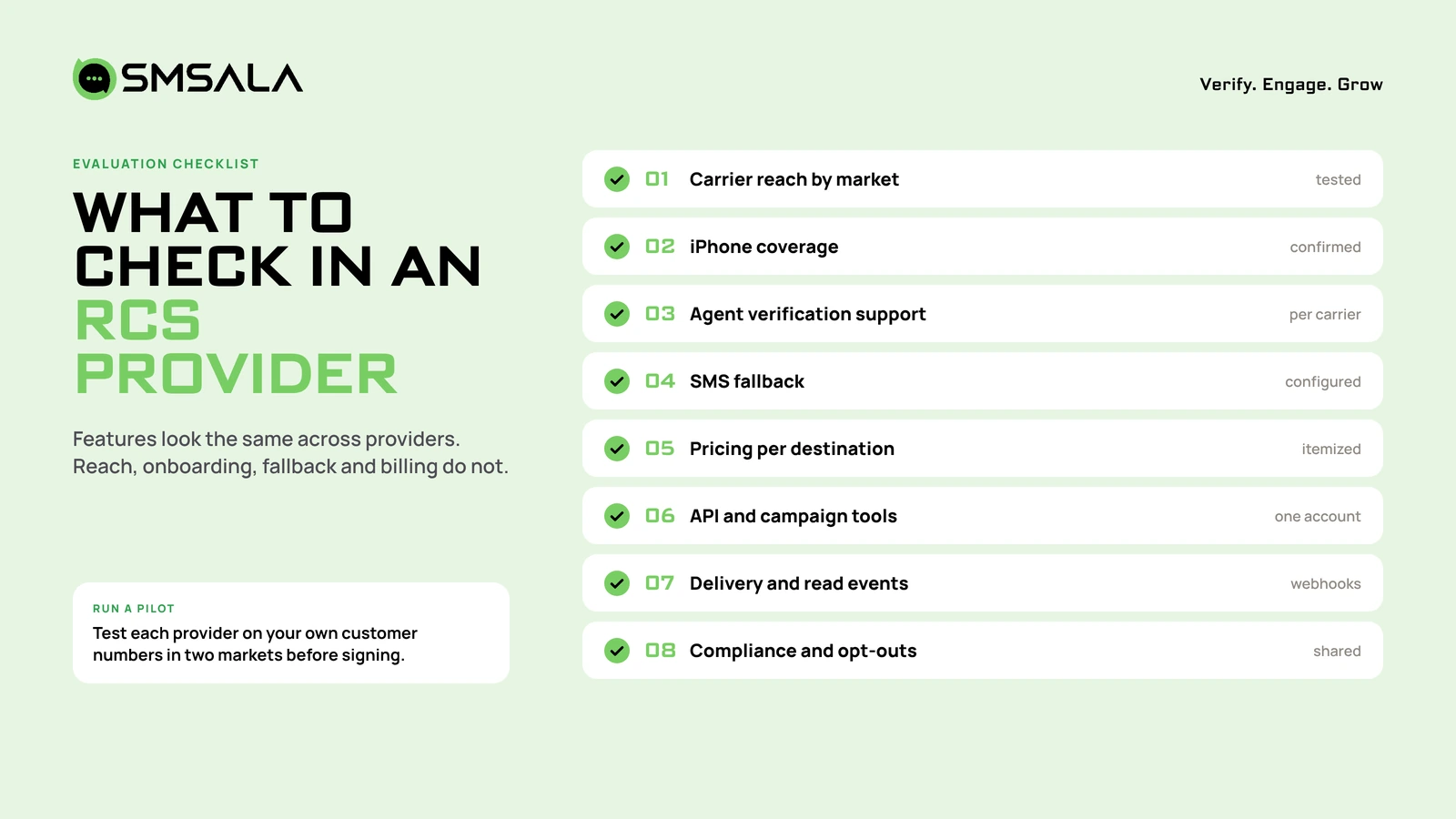
These are the criteria worth weighting most heavily, roughly in order of how often they decide the outcome.
Carrier Reach in Your Markets
RCS business messages only reach users whose carrier has launched RCS business messaging and whose device and messaging app support it. Coverage varies widely by country and, within a country, by carrier. A provider with strong reach in Western Europe may have very little in the Gulf or Southeast Asia.
Ask for reach by destination and by carrier, not a global headline number. Then test it: send capability checks against a sample of your own customer numbers and see what share are RCS-capable. That figure, not the provider's marketing, is your realistic RCS audience.
RCS on iPhone: Check iOS Coverage by Market
Apple added RCS support to iOS in 2024, which changed the economics of RCS for many brands, since iPhone users previously received only SMS. Support for business messaging on iPhone has been expanding since then, but it still depends on market and carrier. If a large share of your customers use iPhones, ask each provider exactly where they can deliver RCS business messages to iOS today, and how they confirm it.
RCS Agent Verification and Launch Support
RCS agent verification confirms that the brand behind the agent is who it says it is. After that, each carrier approves the agent for launch on its network. For enterprises in banking, insurance, healthcare or government, this process involves documents, contact verification and sometimes several rounds of questions. It can take weeks, and it moves at a different pace on each carrier.
A good RCS partner prepares the submission properly the first time, tracks approval by carrier, and tells you which networks are live before you plan a campaign around them. Ask how many agents the provider has launched in your sector and your markets, and what their typical timelines look like. Vague answers here usually mean the provider resells access without much hands-on experience.
Verification is also one of RCS's biggest advantages. A verified brand name and logo are much harder to imitate than a plain sender, which matters in sectors plagued by SMS spoofing and impersonation scams.
RCS SMS Fallback and Capability Checks
No enterprise can run RCS on its own. Some recipients will always be unreachable over RCS: older devices, unsupported carriers, data switched off, roaming. RCS SMS fallback decides what happens to those messages, and it is the single most important technical capability to examine.
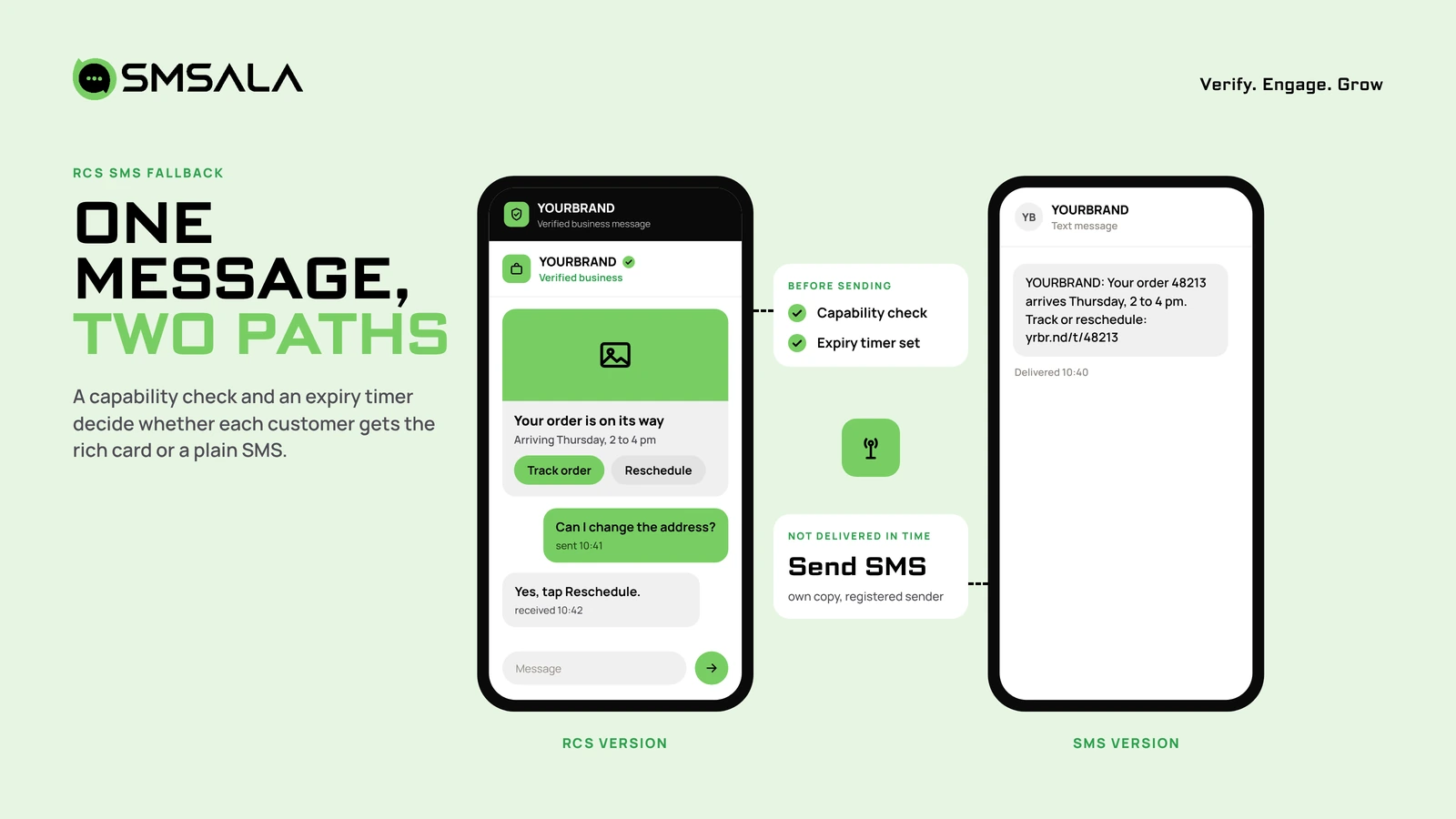
There are two common approaches. A capability check before sending routes non-RCS numbers straight to SMS. An expiry timer on the RCS message (for example, if it isn't delivered within a set time) withdraws it and sends SMS instead. Time-sensitive messages need both; a delivery update that arrives by RCS three hours late is worse than an SMS that arrives now.
Ask how fallback is configured, who writes the fallback text, and how it appears in reporting. A rich card with a carousel and three buttons cannot simply be truncated into a text message. The fallback needs its own copy, sent from alphanumeric sender IDs registered in each destination so that the SMS version still looks like it came from your brand.
RCS Messaging Pricing and Billing
RCS messaging pricing doesn't work like SMS, and that surprises finance teams. Depending on the market and carrier, charges may differ between basic text messages and rich messages, and some markets have billed by conversation session rather than by message. On top of that you pay for SMS fallback traffic.
Ask providers for pricing per destination that separates RCS message types, fallback SMS and any setup or agent fees. Then ask for a sample invoice. If you can't work out from it what a typical campaign would cost, you won't be able to work it out from the real one either.
Integration, Campaign Tools and Two-Way Conversations
Enterprises usually need RCS in two places: inside applications (alerts, notifications, customer service) through an API, and inside marketing campaigns through a campaign tool. A provider that offers both on the same account, with the same agents and the same reporting, saves you from duplicate integrations.
RCS is also conversational. Customers tap suggested replies, ask questions and expect answers. Decide early where those replies go: a chatbot, a contact center, or both. If the provider can't route replies into your support tools, the rich, two-way channel you paid for behaves like a one-way broadcast.
Reporting, Read Receipts and Analytics
RCS returns far more data than SMS: delivered, read, suggested-action clicks, replies. Make sure that data reaches you as events (through webhooks or an API) rather than only as a dashboard, and that RCS and fallback SMS appear in the same report. Otherwise every campaign has two partial results and nobody can say how the whole thing performed.
Security, Compliance and Data Handling
For regulated enterprises, the usual questions apply: where message content and logs are stored, how long they are kept, which certifications the provider holds, and how opt-outs are handled across RCS and SMS together. A customer who opts out on one channel should not keep receiving promotions on the other.
Types of RCS Providers: Which Model Fits Your Enterprise?
RCS providers fall into a few broad models. None is universally best; each fits a different kind of buyer.
Provider model | Strengths | Limitations | Best fit |
Multichannel CPaaS with RCS | RCS, SMS, WhatsApp and other channels on one platform; fallback and reporting in one place | Depth of RCS experience varies by provider and market | Enterprises using several channels |
RCS specialist or direct carrier partner | Deep RCS expertise, close carrier relationships in specific markets | Often narrow geographic or channel coverage | Brands focused on one or two RCS-heavy markets |
Marketing platform reselling RCS | Easy campaign building for marketing teams | Limited API access, less control over routing and fallback | Marketing-led RCS campaigns |
Managed service or agency | Handles creative, verification and campaigns end to end | Higher cost, less in-house control | Brands piloting RCS without internal resources |
Which RCS Provider Model Should You Choose?
Choose a multichannel CPaaS when RCS is one channel among several and you need fallback, consent and reporting to work across all of them.
Choose an RCS specialist when one or two markets with high RCS adoption are your priority and you need deep carrier relationships there.
Choose a marketing platform or managed service when the goal is a contained campaign pilot and nobody internally will run the integration.
Most large enterprises end up with the first model, because RCS rarely reaches more than part of the audience and the rest has to be served by something else.
RCS vs SMS vs WhatsApp: Where RCS Business Messaging Fits
The main difference is that SMS reaches almost every phone, WhatsApp reaches only people using WhatsApp, and RCS reaches people on supported carriers and devices inside the phone's default messaging app.
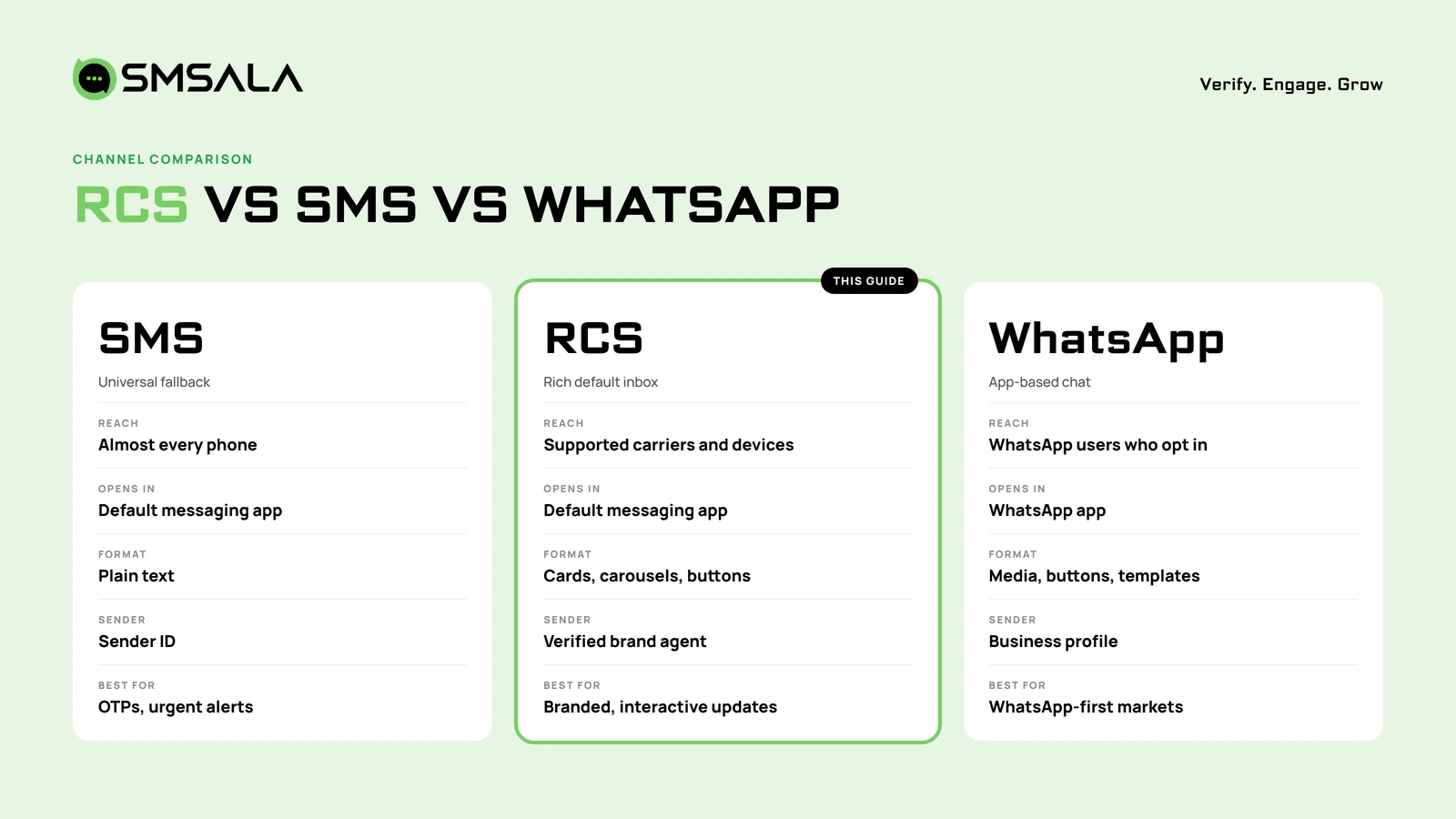
RCS vs SMS is less of a contest than it looks, because RCS depends on SMS for everyone it can't reach. RCS improves the experience for capable users with branding, media and buttons; SMS guarantees delivery for everyone else. The question is which messages benefit enough from the richer format to justify the extra cost and design effort. Booking confirmations with a map, product carousels and boarding passes do. A plain OTP usually doesn't. Brands still weighing SMS or MMS for media-rich messages should know that RCS now covers most of what MMS was used for, with better branding and interaction.
RCS vs WhatsApp is mostly a question of geography. In markets where nearly everyone uses WhatsApp, WhatsApp Business often reaches more customers with similar rich features. Where WhatsApp use is lower, or where reaching customers in the default messaging app matters, RCS has the advantage. Many enterprises run both and choose per market. That only works if both channels sit inside one omnichannel messaging setup with shared consent and reporting.
Mistakes Enterprises Make When Rolling Out RCS
Setting a Launch Date Before Carriers Approve the Agent
Verification and launch can take weeks and finish at different times on different networks. Plan campaigns around carriers that are actually live.
Writing Only the RCS Version and Neglecting SMS Fallback
The fallback SMS is read by a large share of the audience, sometimes the majority. It deserves the same care as the rich card.
Comparing RCS and SMS Conversion Rates Directly
RCS-capable recipients skew toward newer devices and particular carriers, so they are not a random sample of your customers. An RCS campaign that "beats SMS by 40%" may simply be reaching a different audience. Fair comparisons need a randomized test within the RCS-capable group.
Overloading RCS Messages With Media
Large images and long carousels look great on fast connections and load poorly on slow ones. Keep the first card readable on its own.
Using One RCS Agent for Every Use Case
Marketing, service notifications and fraud alerts often deserve separate agents, so that customers can tell a promotion from a security alert at a glance and so a problem with one doesn't affect the others.
Where SMSala Fits Among RCS Providers
SMSala offers RCS business messaging with branded, rich messages including carousels, buttons and read receipts, alongside SMS, WhatsApp, Viber and Truecaller on the same platform. RCS can be used through the Omnichannel Conversations API for application traffic and through Campaign Studio for multichannel campaigns, which suits enterprises that want RCS as part of a wider messaging setup rather than as a separate project.
For enterprises comparing an [RCS business messaging platform] alongside other providers, the criteria above apply to SMSala as much as to anyone: ask for reach in your specific markets, verification timelines for your sector, fallback configuration and per-destination pricing, and test them against your own numbers.
FAQ
What is an RCS business messaging provider?
An RCS business messaging provider connects businesses to the RCS network so they can send branded, interactive messages to customers' default messaging apps. The provider handles agent setup, brand verification, carrier launch, API access, SMS fallback for non-RCS recipients, billing and reporting. Businesses cannot send RCS business messages without one.
Does RCS business messaging work on iPhone?
Increasingly, yes. Apple added RCS support in iOS 18, and business messaging to iPhones has been expanding since then. Availability still depends on the country and carrier, so ask providers where they can currently deliver RCS business messages to iOS users, and keep SMS fallback in place for everyone else.
How long does RCS agent verification take?
It varies by market, carrier and sector. Brand verification can be relatively quick, but carrier launch approvals often take several weeks, and regulated industries such as banking may face additional checks. Each carrier approves separately, so an agent can be live on one network while still pending on another.
Is RCS more expensive than SMS?
Usually, per message, though pricing depends on the market and message type. Some markets distinguish basic text from rich messages or have billed by conversation. You also pay for SMS fallback. The fair comparison is cost per outcome, such as cost per booking or purchase, rather than cost per message.
Should OTPs be sent over RCS?
They can be, and a verified brand sender helps customers trust the code. But OTPs are time-critical, so they need a short expiry on the RCS attempt and immediate SMS fallback. For many enterprises, OTP is a channel decision made per market based on delivery speed rather than presentation.
Run a Two-Market Pilot Before Choosing an RCS Provider
Before signing a long contract, shortlist two or three providers and run a pilot in two of your most important markets. Measure four things: the share of your real customer numbers that are RCS-capable through each provider, how long agent verification and carrier launch take, how fallback behaves for time-sensitive messages, and what the invoice looks like when the pilot ends.
That pilot will tell you more than any comparison article, including this one. The provider that wins it is usually not the one with the best demo. It's the one that got your brand live on the carriers your customers actually use, and could explain every line of the bill.