
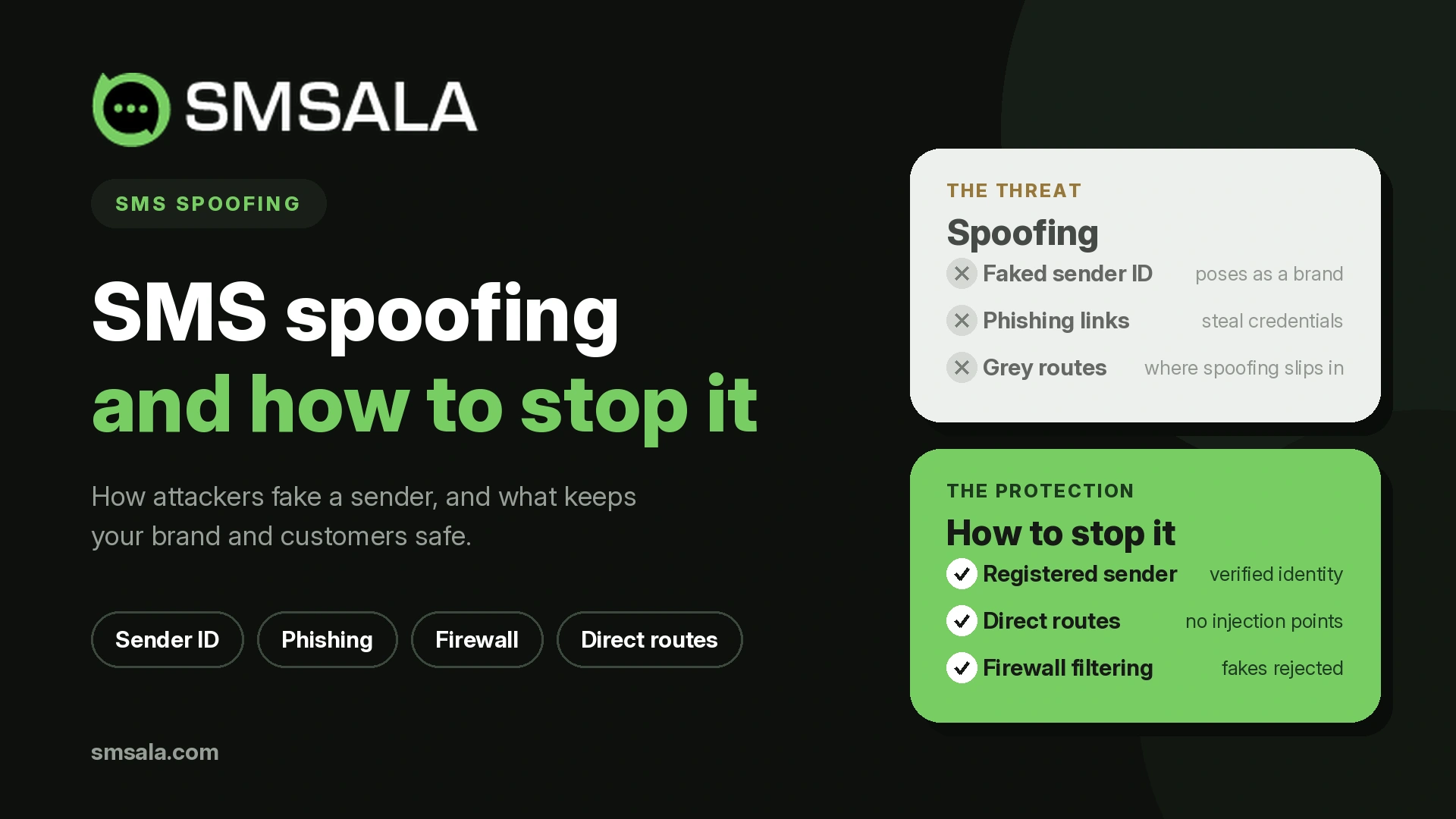
The name at the top of a text message is a suggestion, not a fact. When your phone shows a message from "HDFC" or "Amazon" or your own bank, nothing about the SMS system guarantees that the message actually came from them. That single design decision, made decades ago, is the reason SMS spoofing exists and the reason it remains so hard to eliminate.
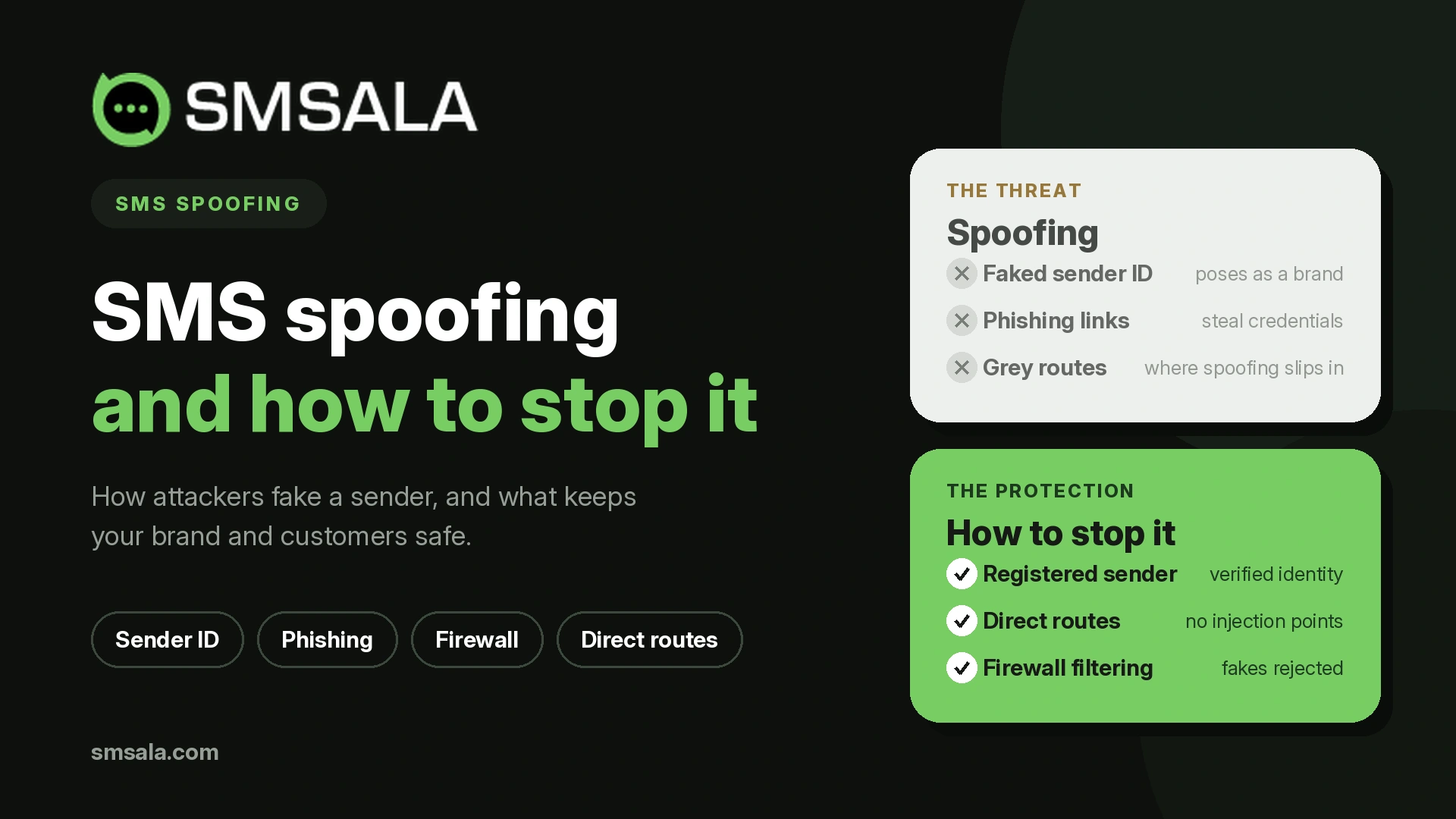
So this covers both. What spoofing is and how it differs from the terms it gets confused with, how the attack actually works, how a recipient spots it, and — the part that matters most and gets covered least — the concrete defenses a business can deploy so its identity is harder to forge in the first place.
What SMS spoofing actually is
SMS spoofing is the act of altering the sender information on a text message so it appears to come from someone other than the true sender. The forged element is usually the "sender ID," the name or number shown as the origin of the message. A spoofed message can display a trusted brand name, a government department, or even a number already saved in the recipient's contacts.
It helps to separate spoofing from the terms it gets confused with, because they describe different things and call for different defenses.
Term | What it means | Relationship to spoofing |
Spoofing | Forging the sender identity of a message | The impersonation technique |
Smishing | Phishing carried out over SMS | Often uses spoofing to look legitimate |
Faking | Sending from a misleading but unregistered sender | A cruder cousin of spoofing |
SMS pumping | Inflating traffic to a number to earn fees | A separate fraud, not impersonation |
Grey-route bypass | Injecting traffic through unofficial routes | The channel spoofed traffic often travels |
Spoofing is the disguise. Smishing is usually the crime committed while wearing it. Keeping the two distinct matters because blocking one does not automatically stop the other.
Why the SMS protocol allows it
To defend against spoofing you have to understand that it is not a hack in the usual sense. It exploits how SMS was built.
When a message is sent, the originating address, the field that becomes the visible sender, is set by whoever submits the message. The core SMS standards were designed in an era of trusted carrier interconnects, so that field was never bound to a verified identity the way a domain is bound to a website through certificates. Along many routes, especially international and wholesale ones, the sending party can place almost any value in it, and the receiving network passes it through to the handset as displayed.
There are two broad ways this gets abused. The first is at the application layer, where a sending platform simply permits an arbitrary sender ID, and alphanumeric names like "MyBank" are especially easy to set because they carry no ownership check by default. The second is deeper in the network, where weaknesses in legacy signaling protocols such as SMPP interconnects and older SS7 signaling let traffic be injected with a forged origin. This is why "just check who it's from" is weak advice. The sender field is exactly the thing the attacker controls.
A common misconception is that the STIR/SHAKEN framework fixes this. It does not. STIR/SHAKEN authenticates caller identity for voice calls and has no equivalent authority over SMS sender IDs. Protection for SMS comes from a different stack: registered sender identities, network filtering, and route control, covered below.
Who actually gets hurt
Spoofing produces two victims from a single message, and businesses often only think about one of them.
The customer is defrauded directly. They receive what looks like a genuine alert, act on it, and lose money or credentials. Because the message appeared to come from a brand they trust, they had little reason to doubt it.
The impersonated brand absorbs the second, quieter cost. Every successful scam sent in your name erodes confidence in your real messages. Customers start ignoring or distrusting legitimate alerts, including the one-time passcodes and fraud warnings that protect them. Support lines fill with people asking whether a message was real. In regulated sectors, repeated impersonation can draw scrutiny from regulators who expect you to protect your channel. The financial loss lands on the customer; the reputational loss lands on you, and it compounds.
How a business detects it is being spoofed
You cannot respond to impersonation you never see, and spoofed messages do not pass through your own systems, so your send logs will look normal while the attack happens elsewhere. Detection has to come from other signals.
Customer reports. A rise in "did you send me this?" contacts, screenshots of messages you never sent, or complaints about links you do not use. Make it easy to report suspicious messages, because your customers are often your earliest sensor.
Sender ID monitoring. Providers and firewall operators can watch for traffic using your registered sender name from routes that are not yours. Ask whether your provider offers this.
Brand and link monitoring. Spoofed campaigns usually point to lookalike domains. Watching for newly registered domains that resemble yours can surface a campaign before it scales.
Unusual OTP or reset activity. A spike in password resets or login attempts can indicate a smishing campaign harvesting credentials in your name.
The pattern to internalize is that spoofing is detected at the edges, through customers and monitoring, not in your outbound reports.
Building a defense: the business playbook
No single control eliminates spoofing, so the realistic goal is to make your brand expensive to impersonate and quick to shut down when it happens. Layer these.
Register and protect your sender identity. A registered, reserved Sender ID is the foundation, because it gives networks a way to know which traffic is legitimately yours and to treat everything else as suspect. Registration does not make forgery impossible everywhere, but it turns your sender name from an open field into a claimed one.
Send through carrier-grade filtering. Modern SMS firewalls at the operator level inspect inbound traffic and block messages that use protected sender IDs from unauthorized sources, along with the grey routes spoofed traffic tends to travel. Markets with strong firewall deployment see materially less brand impersonation reaching handsets.
Route on direct, accountable connections. Spoofed traffic thrives on unofficial routes. Sending your legitimate messages through direct carrier connections rather than opaque wholesale chains keeps your own traffic clean and makes you a more credible party when you ask a carrier to act on abuse. It also matters which SMS aggregators sit between you and the networks, since a transparent partner can escalate impersonation faster than a reseller optimizing only for price.
Use regulatory registration where it exists. India's DLT registration system is among the strongest anti-spoofing frameworks in the world precisely because it binds every commercial sender ID and message template to a verified entity on a shared ledger. Where such a regime applies to your market, full compliance is not just a legal box, it is one of the most effective anti-impersonation tools available to you.
Design messages that resist impersonation. Keep your messaging consistent so anomalies stand out: a stable sender name, predictable message formats, and a firm policy that you never ask for passwords, full card numbers, or OTPs by text. When customers know what you will never do, a spoofed message asking for exactly that becomes easier to spot. Where you need richer, verifiable interactions, consider channels with built-in sender verification and, for sensitive payloads, appropriate SMS encryption practices.
When it happens: incident response
Discovering an active impersonation campaign is not the time to improvise. A basic response sequence:
Confirm and capture. Collect the spoofed message, the sender ID used, the destination links, and the timing. You need evidence before anyone will act.
Notify your provider and carriers. Report the abused sender ID so filtering can be tightened and the offending routes investigated. This is where an A2P messaging partner with real carrier relationships earns its value.
Take down the infrastructure. Report lookalike domains and phishing pages to registrars and hosting providers to break the campaign's payload.
Warn your customers. Publish a clear notice through channels you control, telling customers what the scam looks like and what you will never ask of them. Silence lets the fraud run longer.
Report to authorities. File with the relevant cybercrime or telecom regulator. Beyond compliance, this feeds pattern data that helps shut down repeat offenders.
What individuals should watch for
The business controls the channel, but customers are the final line. A short, honest checklist to share with them:
Treat urgency as a warning sign. Real institutions rarely demand action within minutes.
Never share OTPs, PINs, or passwords in reply to a message, regardless of who it appears to be from.
Do not tap links in unexpected messages. Open the official app or type the known web address instead.
Verify through a separate channel. If a "bank" texts, call the number on the card, not one in the message.
Remember that a trusted name in the sender field proves nothing, because that is the field attackers forge.
Is SMS spoofing illegal?
The technique itself sits in a gray zone; the use determines legality. Modifying sender information has narrow legitimate applications, such as a business displaying its brand name as the sender of its own service alerts. The moment spoofing is used to deceive, defraud, steal credentials, or harass, it becomes a crime in most jurisdictions, prosecuted under fraud, impersonation, and telecom regulations. In markets with mandatory sender registration, sending commercial traffic with an unregistered or forged sender ID is itself a violation, separate from any fraud committed with it.
Spoofing in the age of AI
The mechanics of spoofing have not changed, but the messages have gotten better. Generative tools let attackers produce fluent, well-targeted text at scale, stripping away the spelling and grammar errors that once gave scams away. That shift quietly retires the most common piece of consumer advice. If you cannot rely on clumsy wording to spot a fake, verification and channel-level defenses matter more, not less. The long-term answer is structural: authenticated senders, registered identities, and networks that refuse to carry forged traffic in the first place.
Frequently asked questions
Can SMS spoofing be blocked completely?
Not universally, because the vulnerability is rooted in how SMS handles sender identity across many networks. What works is reducing the attack surface: registered sender IDs, carrier firewalls, direct routing, and fast takedown response together make impersonation far harder and shorter-lived, even if no single control is absolute.
How is spoofing different from smishing?
Spoofing forges the sender's identity. Smishing is the phishing attack, an attempt to trick you into revealing information or installing malware over SMS. Smishing frequently uses spoofing to appear credible, but you can be smished without spoofing and spoofing can exist without a phishing payload.
Will a registered Sender ID stop others from impersonating my brand?
It substantially raises the barrier. Registration lets networks distinguish your legitimate traffic from forgeries and, in firewall-protected markets, block unauthorized use of your name. It is the most important single step, though it works best combined with monitoring and direct routing.
Does two-factor authentication help against spoofing?
It protects accounts even if credentials leak, so it limits the damage of a successful smishing attack. It does not prevent the spoofed message from being sent. Treat it as damage control, not prevention.
We found messages impersonating our company. What is the first step?
Capture the evidence, then report the abused sender ID to your messaging provider and the destination carriers so filtering can be applied. In parallel, warn your customers through a channel you control. Speed matters, because these campaigns are designed to extract as much as possible before they are shut down.
The takeaway
SMS spoofing persists because the channel was built to trust a sender field that anyone can fill in. You cannot patch that from the outside, but you can make your brand a poor target: register and defend your sender identity, route through networks that filter aggressively, monitor for impersonation, and respond fast when it appears. For businesses, the safest messaging is not the cheapest, it is the traffic that travels accountable routes and carries an identity the network can actually verify. Working with a provider that maintains direct carrier connections and proper sender registration is how you keep the name on your messages meaning something.