
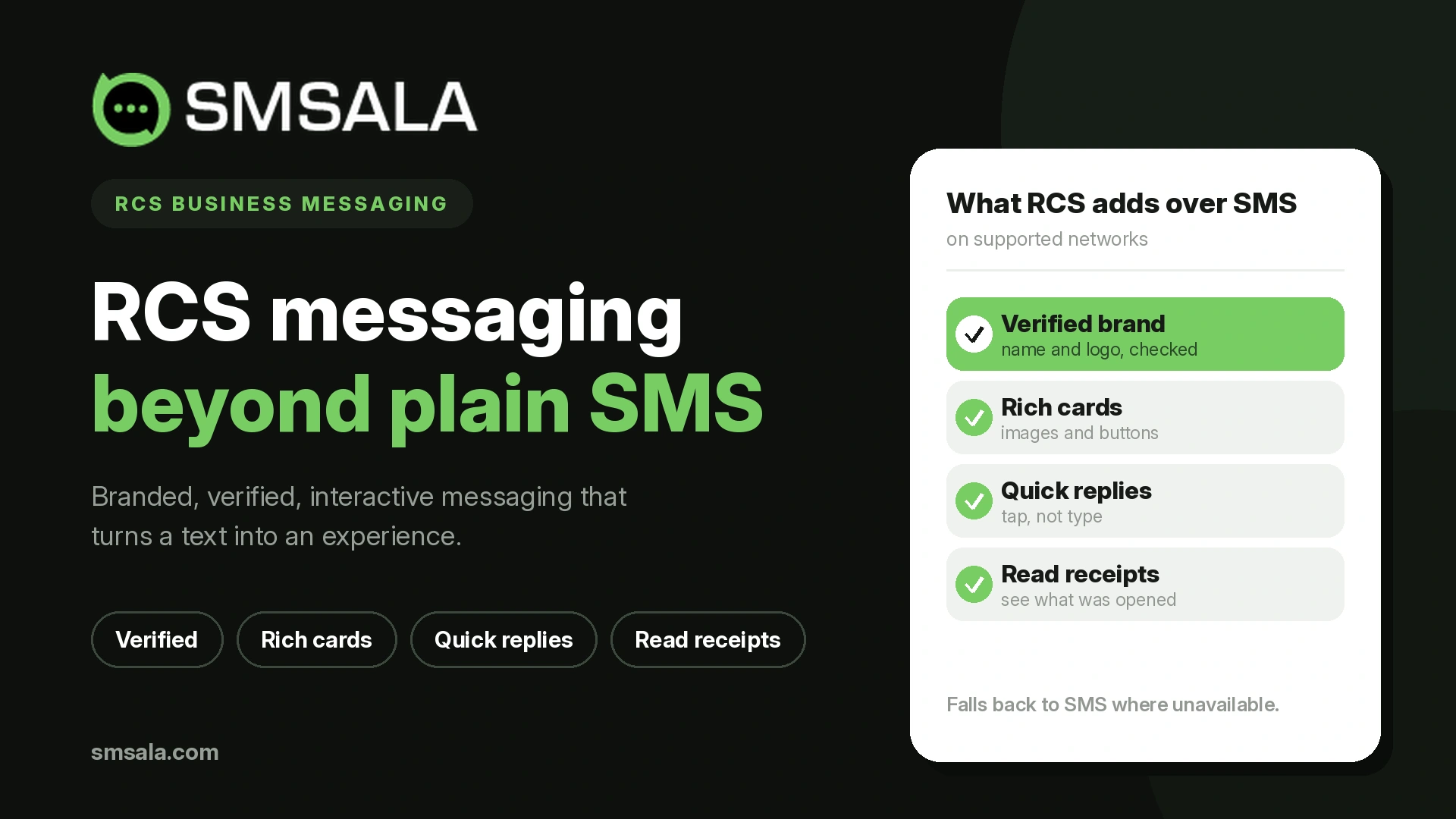
RCS is what text messaging looks like when it finally catches up to the apps people actually use. It puts branded senders, images, carousels, tappable buttons, and read receipts inside the phone's default messaging app, with no download required. For years it was an Android-only curiosity that few businesses could rely on. That changed when Apple added support on the iPhone, and RCS shifted from "interesting someday" to a channel worth understanding now.
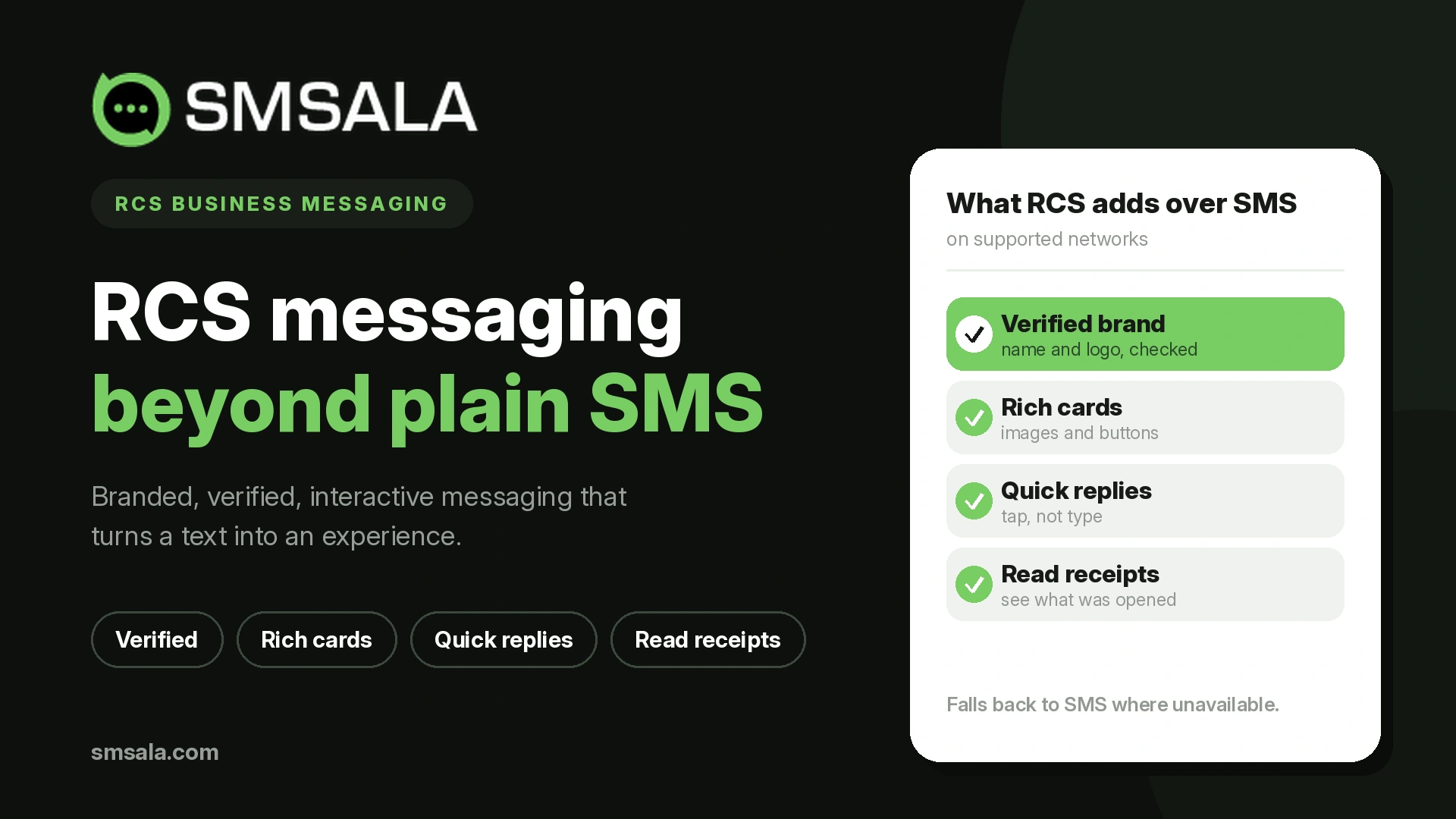
This guide explains what RCS actually is, what it does that SMS cannot, where it works today after Apple's move, how businesses send it, and the practical catches that most introductions skip. It also settles the two questions people ask most: how RCS compares to SMS, and whether it competes with WhatsApp.
What RCS is, in plain terms
RCS stands for Rich Communication Services. It is an upgraded messaging standard built to replace SMS and MMS, delivering interactive, internet-based content through the native messaging app already on a phone. Where SMS sends 160 characters of plain text, RCS sends high-resolution media, longer messages, buttons, product carousels, and verified business branding, and it shows read receipts and typing indicators the way a modern chat app does.
The important distinction is that RCS is not a separate app. It runs inside the same inbox where SMS lives, which is exactly what makes it different from WhatsApp or Telegram. There is nothing for the customer to install and no new account to create. When both sides support RCS and have a data connection, the conversation is rich. When they do not, it falls back to SMS. That fallback is central to how RCS behaves in the real world, and we will return to it.
Why RCS exists: the limits it was built to fix
SMS has one great strength and several hard limits. It reaches virtually any phone instantly without an app, which is why it remains the backbone of bulk SMS and time-critical alerts. But it caps messages at 160 characters, carries no real media, offers no branding beyond a number or short sender name, and gives the sender almost no feedback beyond a basic delivery receipt. MMS added media but stayed clumsy and inconsistent across carriers.
RCS was designed by the mobile industry, through the GSMA's Universal Profile standard, to close those gaps while keeping the one thing that made SMS universal: it lives in the default messaging app. The goal was a single, carrier-supported standard that gives businesses the richness of a chat app and gives customers a verified, trustworthy sender inside the inbox they already use.
What RCS does that SMS cannot
The gap between the two is wide enough that they are better thought of as different tools than as versions of the same thing.
Capability | SMS | RCS |
Message length | 160 characters per segment | Around 3,000 characters, no segmenting |
Media | None | High-resolution images, video, audio, PDFs, GIFs |
Interactivity | None | Suggested replies, tappable action buttons, carousels |
Sender identity | A number or short sender name | Verified brand name, logo, and colors |
Feedback | Delivery receipt only | Read receipts and typing indicators |
Analytics | Delivered vs not | Delivered, read, and interaction data |
App required | No | No |
Data connection | Not required | Required, with SMS fallback |
Two of these deserve emphasis because they change how customers respond. The first is verified branding. An RCS business message arrives with your name, logo, and a verified badge instead of an anonymous number, which raises trust and cuts the "is this a scam?" hesitation that plagues SMS. The second is interactivity. A customer can tap a button to confirm an appointment, browse a product carousel, or pick a reply without leaving the message, turning a one-way notification into an action. This branded, verified identity is a step beyond even a registered Sender ID in SMS.
The Apple moment, and where RCS actually works today
For most of its life, RCS was effectively Android-only, because the iPhone did not support it. That single fact kept businesses from committing, since no channel is worth building on if it cannot reach half your customers. Apple's decision to add RCS support in iOS 18 removed that barrier and is the reason RCS is worth planning for now rather than later.
But "Apple supports it" is not the same as "it works everywhere for everyone," and this is where honest guidance matters. RCS availability depends on a chain of conditions: the sender's platform, the recipient's device, their carrier, and their country. Business RCS, the application-to-person kind used for marketing and notifications, has rolled out market by market rather than switching on globally, and some regions and carriers are far ahead of others. The industry is also still finalizing end-to-end encryption across the Universal Profile so that protected messaging works consistently between Android and iPhone.
The practical implication: RCS is not yet a channel you can assume reaches every customer, the way SMS does. It is a channel that reaches a growing share of them richly, and reaches the rest through SMS fallback. That is a strength, not a flaw, as long as you plan for both.
RCS vs SMS vs WhatsApp: choosing the right channel
Because RCS overlaps with both SMS and WhatsApp, the useful question is not which is best overall but which fits a given message.
Factor | SMS | RCS | WhatsApp Business |
Reach | Every phone, no app | Growing, with SMS fallback | Only people who use WhatsApp |
App needed | No | No, lives in the default inbox | Yes |
Rich media and buttons | No | Yes | Yes |
Verified branding | Limited | Yes | Yes |
Opt-in required | For marketing | For marketing | Always, strictly enforced |
Best for | Universal, urgent, simple messages | Branded, interactive messages to the native inbox | Two-way conversations with opted-in users |
The short version: SMS is for universal reach and urgency, RCS is for branded and interactive messaging inside the phone's own inbox, and WhatsApp Business is for rich two-way conversations with an audience that already lives in the app. Most businesses will not pick one. They will use SMS as the reliable floor layer RCS where it is available for a richer experience, and use WhatsApp for conversational relationships, which is simply omnichannel messaging applied sensibly.
How businesses actually send RCS
Consumer RCS is the person-to-person chatting that happens automatically between supported phones. Business RCS is a separate, managed product, usually called RCS Business Messaging, and sending it works differently from firing off an SMS.
To send business RCS, a brand registers a verified agent, which is the branded sender profile customers see, complete with name, logo, and colors. That agent goes through a verification process, similar in spirit to registering a business identity for other regulated messaging, before it can send. Once verified, businesses typically reach RCS the same way they reach other channels at scale, through a provider that connects to the ecosystem and offers an interface or API.
RCS business messages generally come in a few forms. Basic messages cover simple utility notifications. Single rich messages deliver one-way branded content with media and buttons. Conversational messages support genuine two-way interaction, where a customer taps and replies and the business responds. The conversational type is where RCS starts to resemble a chat channel, and it pairs naturally with a chatbot that can handle routine replies and hand off to a human when needed.
For businesses already running SMS at volume, the mental model is familiar: it is the same discipline as A2P messaging, with registration, opt-in, and provider routing, extended to a richer format.
The catches most introductions skip
RCS is genuinely useful, and it is also easy to oversell. An experienced team plans for these realities from the start.
Fallback is not optional, it is the design. Because not every recipient can receive RCS, every RCS program needs an SMS fallback so the message still arrives as plain text when the rich version cannot be delivered. Your content has to make sense in both forms, which means the core message cannot depend entirely on a button or a carousel.
It needs data. RCS travels over the internet, not the cellular signaling that carries SMS. A customer with no data connection receives the SMS fallback, not the RCS message. For urgent alerts that must reach someone in a dead zone, SMS remains the safer choice.
Availability is uneven. Device, carrier, and country all affect whether a given customer can receive business RCS. Two customers on the same message list may get very different experiences, which is why measuring delivery by channel matters.
Billing differs from SMS and varies. RCS is priced differently from SMS and the model is still settling across markets, often per message or per conversation depending on the type. Model your cost on your real message mix rather than assuming SMS rates.
Spam controls are strict. Verified sender status and opt-in requirements exist to keep RCS trustworthy, and abusing them gets an agent suspended. RCS is not a channel for cold, purchased lists any more than modern SMS or WhatsApp is.
Planning for these is the difference between RCS as a reliable upgrade and RCS as a disappointing experiment.
Where RCS delivers the most value
RCS pays off wherever visual richness or interactivity improves on a plain text notification. A few patterns recur across industries.
Industry | High-value RCS use |
Retail and e-commerce | Product carousels with tap-to-buy, order tracking with images, visual promotions |
Banking and fintech | Branded, verified alerts, interactive onboarding, secure notifications |
Travel and hospitality | Boarding passes, itineraries with maps, real-time change alerts with rebooking buttons |
Automotive and services | Appointment booking and reminders with one-tap confirm or reschedule |
Telecom and utilities | Bill notifications with pay-now buttons, plan upgrades, outage updates |
Events and entertainment | Rich invitations, tickets, countdowns, one-tap RSVP |
Across these, two themes hold. First, the verified brand identity lifts trust for exactly the messages, financial alerts and account notices, where trust matters most, which is why RCS is a strong home for branded verification and even one-time passcodes where availability allows. Second, RCS shines when a message invites an action rather than just informing, so the best use cases replace a link-and-hope with a tap-and-done. Connected to a CRM, these messages can be triggered by real events and logged automatically, and broader automation turns them into flows that run without manual sending.
Regional reality: adoption is not uniform
Where you operate changes what RCS can do for you today, more than for almost any other channel.
Mobile-first markets have moved quickly. In regions across the Middle East, businesses are adopting RCS to add branded, interactive messaging on top of already strong SMS habits, and it fits naturally alongside SMS marketing in Dubai and the wider Gulf. In markets where RCS vs SMS is an active decision, such as parts of North Africa and the broader MENA region, the honest answer is usually "both": RCS for the richer experience where it reaches, SMS as the universal fallback and for the segments RCS does not yet cover. India and several Asian markets have seen fast business RCS growth, while some Western markets are earlier in their carrier rollout.
The takeaway for anyone operating across borders is to check RCS availability country by country, the same way you would check routing and registration rules, and to lean on SMS wherever RCS coverage is thin. A provider with strong reach in your specific markets will tell you plainly where RCS is live and where fallback will carry most of the traffic.
Getting started: a readiness checklist
If RCS looks like a fit, work through these before committing.
Confirm your markets. Check where business RCS is actually available among the countries and carriers you send to.
Choose a provider with real coverage. Pick one that supports RCS in your markets and handles SMS fallback in the same flow.
Register a verified agent. Prepare your brand name, logo, and colors for the verification process.
Design for fallback. Write every message so it still works as plain SMS when RCS cannot be delivered.
Confirm opt-in. Apply the same consent discipline you use for other marketing messages.
Model the cost. Price your real mix of message types and destinations rather than assuming SMS rates.
Plan the integration. Connect RCS to the systems that will trigger and log messages.
Measure by channel. Track how much traffic lands as RCS versus SMS so you can see the real reach.
A program built this way captures the richness of RCS where it exists without losing the reliability of SMS where it does not.
Frequently asked questions
Is RCS replacing SMS?
Not in the near term. RCS adds rich, branded, interactive messaging where devices, carriers, and countries support it, but SMS remains the universal fallback and the only channel that reaches every phone without a data connection. For now they work together rather than one replacing the other.
Does RCS work on iPhone?
Yes. Apple added RCS support in iOS 18, so iPhones can send and receive RCS, subject to carrier and country availability. Before that, RCS was effectively Android-only, which is why its business adoption accelerated after Apple's move.
What is the difference between RCS and RCS Business Messaging?
RCS is the underlying standard that powers rich messaging between phones. RCS Business Messaging is the managed product businesses use to send branded, verified messages to customers, with registration, message types, and provider routing built around it.
Do customers need an app to receive RCS?
No. That is RCS's defining advantage over WhatsApp and similar apps. RCS lives inside the phone's default messaging inbox, so there is nothing to download and no separate account to create.
How is RCS priced compared to SMS?
Differently, and the model is still settling by market, often per message or per conversation depending on the message type. It is generally not the same as SMS pricing, so you should model cost on your actual message mix and destination countries.
What happens if a customer cannot receive RCS?
The message falls back to SMS automatically, arriving as plain text. This is why a well-built RCS program always pairs with SMS fallback and writes messages that make sense in both formats.
Is RCS secure?
RCS supports encryption, and the industry is extending end-to-end encryption across the Universal Profile so it works consistently between Android and iPhone. As with any channel, security also depends on your provider and your own handling of customer data.
conclusion
RCS is the most meaningful upgrade to native messaging in years, and Apple's adoption is what makes it worth acting on now. The businesses that benefit first are the ones that treat it as a rich layer on top of dependable SMS rather than a wholesale replacement: verified branding and interactivity where RCS reaches, plain-text reliability everywhere else.
If you are evaluating RCS and want to know exactly where it is available for your markets, how it will fall back to SMS, and how to set up a verified sender correctly, that groundwork is where an experienced messaging partner earns its place, so you launch with reach and reliability instead of guesswork.