
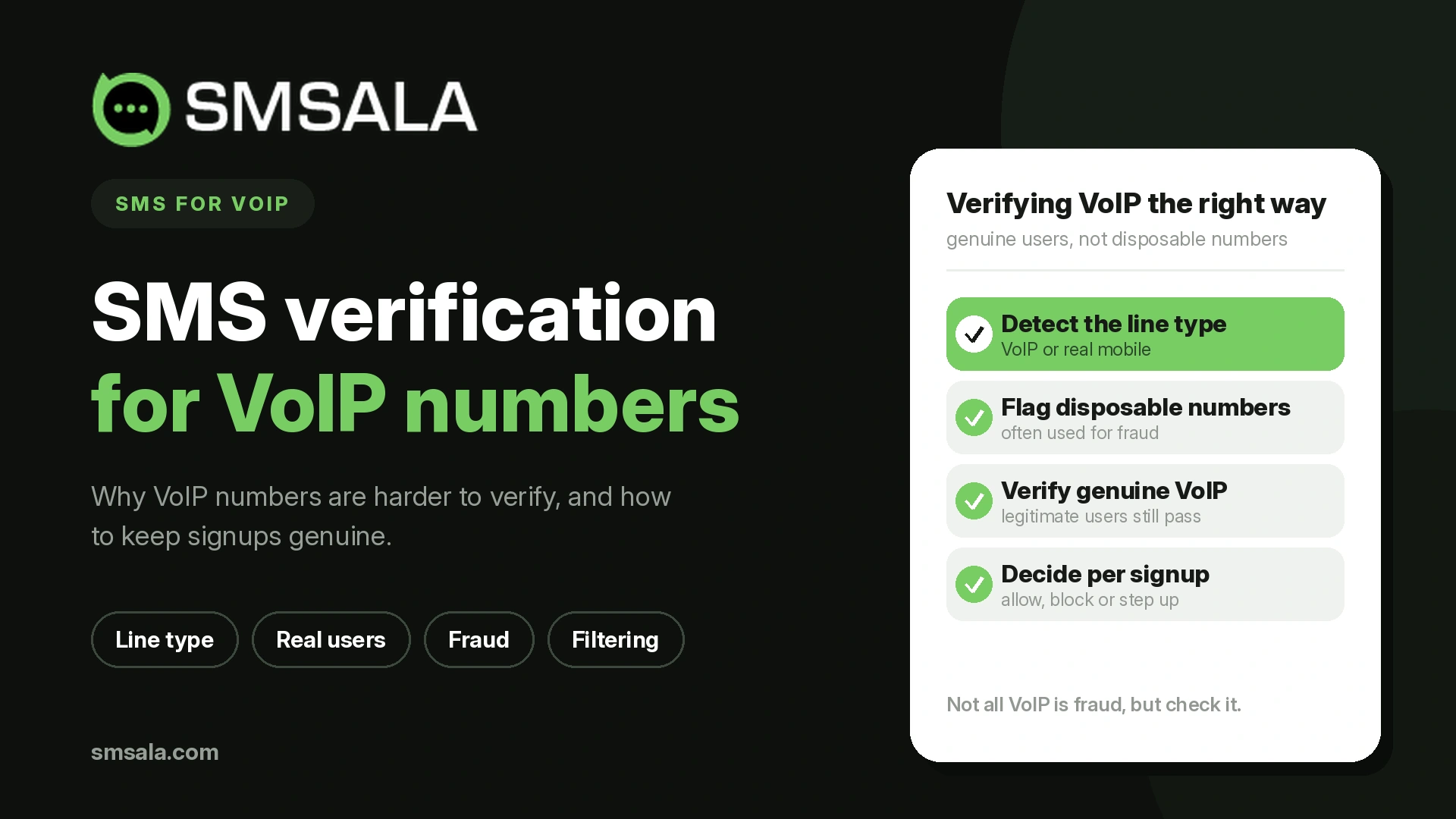
A VoIP number looks like any other phone number, but for SMS verification it behaves differently in two ways that matter. It is easier to obtain in bulk, which makes it a favorite tool for fraud, and it is less reliable at receiving a one-time code, which makes it a source of failed verifications. How you should handle that depends entirely on which situation you are in: trying to keep fraudulent numbers out of your signups, or verifying real users who legitimately use VoIP.
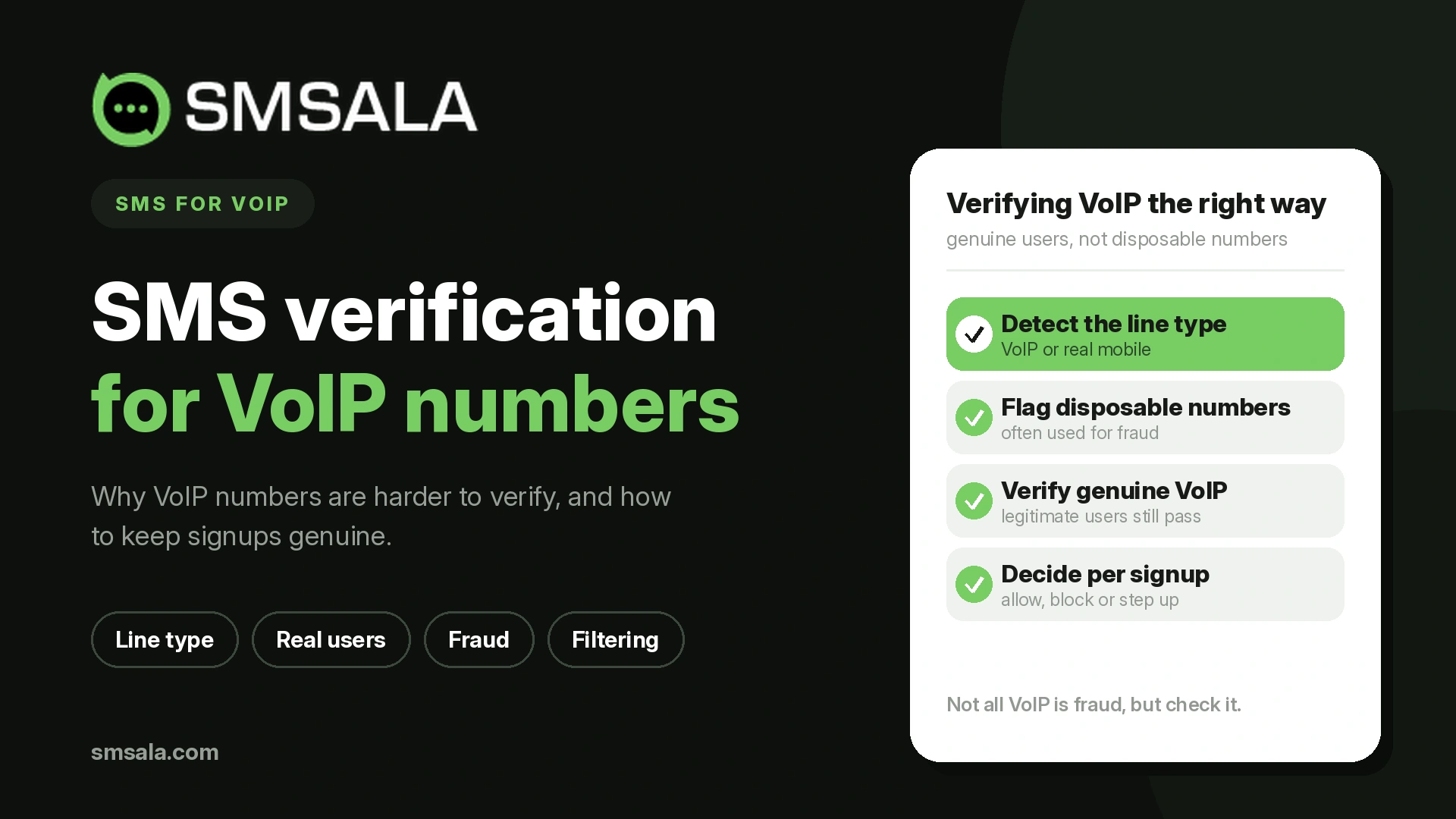
These call for almost opposite responses, so the first job is knowing which problem you actually have.
Why VoIP numbers are different
A VoIP number is a phone number delivered over the internet rather than tied to a SIM card in a physical handset. Services like Google Voice, TextNow, and countless business VoIP providers hand them out, sometimes for free, often in large quantities, and they can be discarded and replaced in seconds.
That single property, being cheap and disposable rather than scarce and tied to a device, is the root of everything that follows. A traditional mobile number carries a small cost and a link to a real SIM, which is what made "verify by phone" a useful signal in the first place. A free virtual number carries neither, so it is both a weaker signal of a real person and a less predictable place to deliver a text.
The fraud problem: why services block VoIP numbers
Phone verification exists partly to enforce "one real person, one account." VoIP numbers break that assumption. Because a fraudster can generate dozens or hundreds of virtual numbers at near-zero cost, they can pass phone verification repeatedly to create fake accounts, claim signup bonuses and free trials over and over, and evade bans that are tied to a number.
This is why so many services quietly refuse to send a verification code to a VoIP number, and why a legitimate user with a Google Voice number sometimes hits a wall at signup. The service is not being arbitrary. It is treating the VoIP number as the higher-risk signal it often is. If your platform offers anything worth abusing, from free credit to referral rewards, unrestricted VoIP signups are an open door, and layering a verification step into your efforts to prevent fraud in e-commerce only works if that step accounts for disposable numbers.
The delivery problem: codes that never arrive
Even setting fraud aside, VoIP numbers complicate the mechanics of verification. Whether a given VoIP number can receive an SMS at all depends on the provider behind it. Some virtual numbers support inbound texting; some do not. Others receive messages with delay or drop application-to-person traffic inconsistently.
The result is failed verifications that look like a bug in your product. A user enters a VoIP number, your system sends the code, and nothing arrives, so they abandon the signup or flood your support queue. This makes SMS deliverability to VoIP numbers a practical concern separate from fraud. A code that cannot be delivered is a broken flow regardless of whether the user is legitimate.
Allow, block, or flag: the decision
The instinct to simply block all VoIP numbers is understandable, and for some businesses it is right. But a hard block also turns away genuine customers, since millions of people use a VoIP number as their main line. The better framing treats VoIP status as one risk signal among several, not an automatic verdict.
Approach | What it does | When it fits |
Allow all | Accept VoIP numbers like any other | Low-abuse products where friction costs more than fraud |
Block VoIP | Refuse verification to VoIP numbers | High-abuse targets: free credit, financial signups, giveaways |
Flag and step up | Accept, but apply extra checks to VoIP signups | Most businesses, balancing fraud control against real users |
The flag-and-step-up path is usually the smartest. Rather than rejecting a VoIP number outright, you accept it while adding scrutiny: a secondary verification, a limit on what a new VoIP-registered account can do until it builds trust, or a stronger factor at the moment of real risk. This is the same logic behind risk-based two-factor authentication, where the strength of the check scales with the stakes rather than punishing everyone equally.
How to tell whether a number is VoIP
You cannot make any of these decisions without knowing a number's type, and you cannot tell from the digits alone. Detection relies on a lookup.
A line-type or number-intelligence check returns metadata about a number, including whether it is a mobile, landline, or VoIP line, and which carrier serves it. An HLR lookup and related number-intelligence services provide this, letting you screen a number the moment it is entered and route your decision accordingly.
Two honest caveats matter. First, number portability and "non-fixed" VoIP can blur the picture, so a lookup gives you a strong probability, not a certificate. Second, detection is a starting point for a policy, not the policy itself. Knowing a number is VoIP only helps if you have decided in advance what to do about it.
If you are the one verifying VoIP users
There is a case where blocking VoIP is not an option: when you are a VoIP provider or app whose users' numbers are, by their nature, VoIP. Here the goal is not to keep VoIP out but to verify those users reliably despite the delivery quirks above.
A few adjustments make this work. Lean on the delivery methods that actually reach the user, which may mean pairing SMS with a voice OTP fallback that reads the code aloud when a text does not arrive, or offering email and app-based verification alongside it. Give users a clear way to retry through a different channel rather than trapping them at a code that will never come. And because your legitimate users share the same number type that fraudsters exploit elsewhere, lean more heavily on behavioral and account-level signals for fraud detection, since the number type itself tells you little in this context.
Doing SMS verification well, whichever side you are on
Beyond the VoIP specifics, the fundamentals of a verification code apply. Keep codes short-lived and single-use, so an intercepted or delayed code is worthless after a minute or two. Rate-limit requests to stop someone from hammering the endpoint. Route the traffic over reliable, compliant A2P messaging so time-critical codes are not delayed or filtered, and deliver them through a verification API that manages generation, expiry, and retries for you. The strength of any OTP delivery flow rests on the code arriving quickly and being useless the moment it expires.
Frequently asked questions
Why won't some services accept my VoIP number for verification?
Because VoIP numbers are cheap to obtain in bulk and are commonly used for fraud, so many services block or restrict them at signup to enforce one account per real person. It is a fraud-control measure, not a judgment about you specifically.
Can you receive an SMS verification code on a VoIP number like Google Voice?
Sometimes. It depends on whether the VoIP provider supports inbound texting and whether the sending service allows delivery to VoIP numbers. Some work fine, others receive codes late or not at all, which is why VoIP verification can be unreliable.
Should my business block all VoIP numbers?
Usually not outright. Blocking stops some fraud but also turns away legitimate customers who use VoIP as their main number. Flagging VoIP numbers for extra scrutiny, rather than hard-blocking them, is a better balance for most businesses.
How can I detect whether a number is VoIP?
Use a line-type or number-intelligence lookup, which reports whether a number is mobile, landline, or VoIP. Treat the result as a strong signal rather than certainty, since porting and non-fixed VoIP can obscure a number's true type.
Is SMS verification still worthwhile if fraudsters use VoIP numbers?
Yes. SMS verification still blocks the large majority of low-effort abuse and adds real friction. The point is to combine it with VoIP detection and risk-based handling, so the numbers most associated with fraud get extra scrutiny rather than a free pass.
The takeaway
VoIP and SMS verification intersect at two problems that pull in opposite directions: keeping disposable numbers out of your signups, and reliably reaching the real users who depend on VoIP. Decide which one you are solving, detect line type so your policy has something to act on, and prefer flagging and stepping up over blunt blocking so you catch fraud without punishing genuine customers. When you do send codes, their value comes down to fast, reliable delivery, which is where a provider such as SMSala fits, with compliant routing and OTP delivery built to get time-critical codes where they need to go.