
There's a moment a lot of small business owners recognize: your personal cell has become the company phone. Customers text it at 9 p.m. Two staff members share the same number. Nobody can pick up where someone else left off, and when an employee leaves, your customer conversations walk out the door with them. VoIP texting is often pitched as the fix — and for the right business, it is. For others, it solves a problem they don't have while introducing a few they didn't expect.
This is a decision article, not a sales one. VoIP texting is a real tool with a specific shape. Understanding that shape is the difference between adopting it because it fits and adopting it because a landing page said "endless possibilities."
What VoIP texting actually is
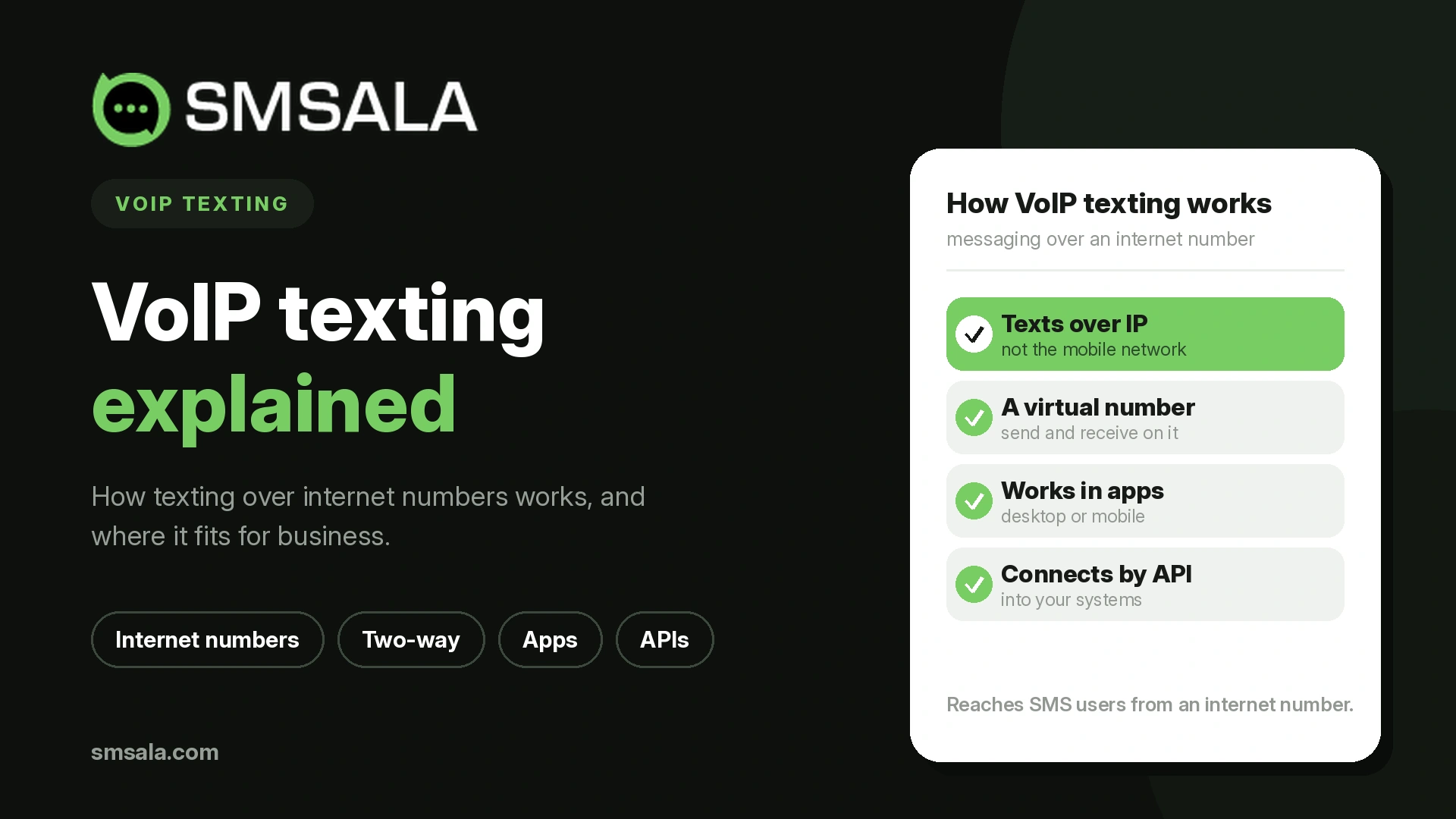
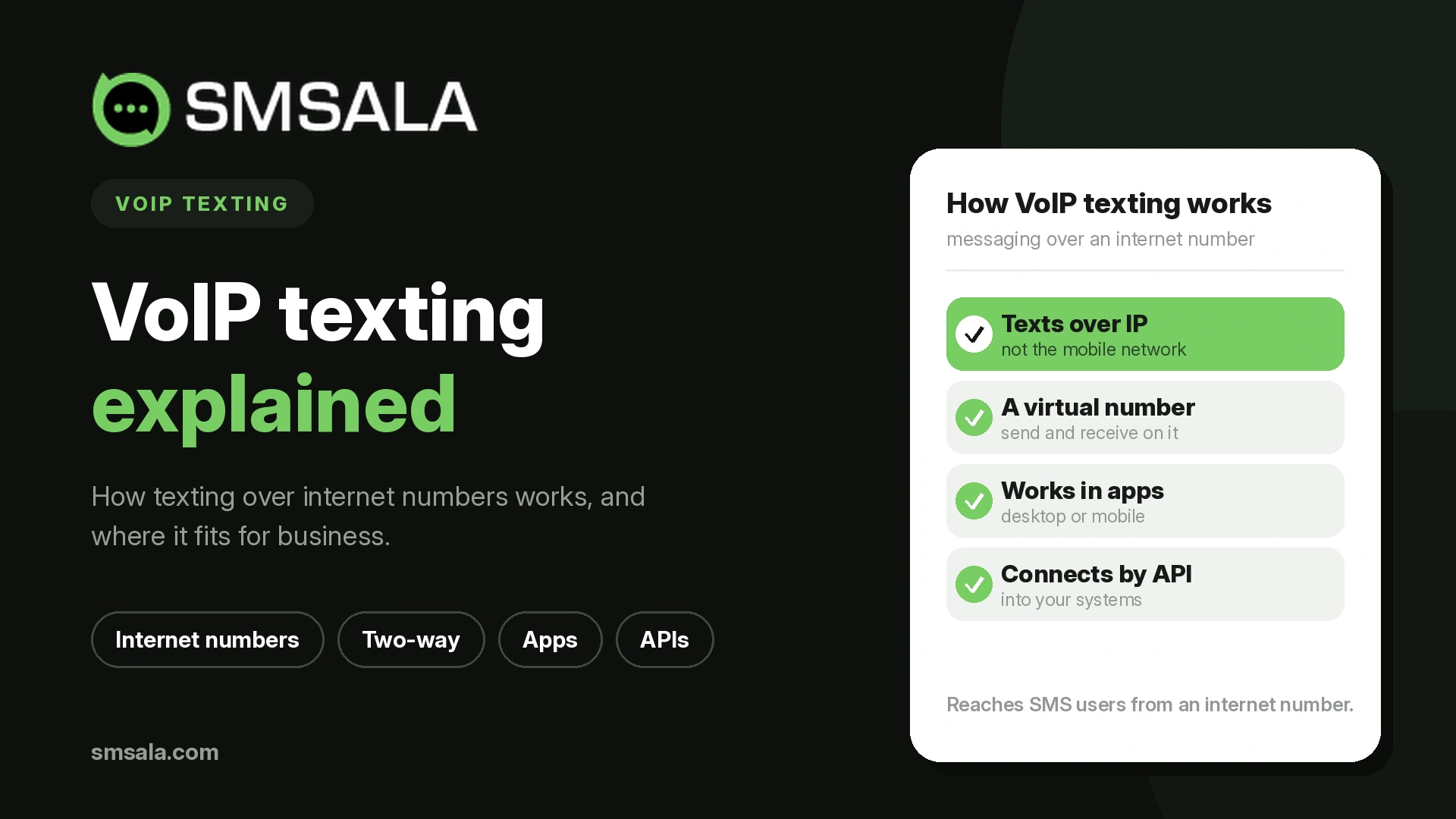
VoIP texting is sending and receiving text messages through an internet-connected virtual number rather than through a SIM card tied to a physical phone.
The number behaves like a phone number — customers see it, reply to it, and can't tell it isn't a traditional cell line. But it lives on a platform, not a handset. You send and receive from a laptop, a browser, a tablet, or an app, as long as you have a connection. That's the whole idea: the number is decoupled from the device, so it can be shared across a team, accessed from anywhere, and kept separate from anyone's personal line.
If regular texting is a message tied to a specific SIM in a specific pocket, VoIP texting is a message tied to an account that any authorized person can open.
The distinction people get wrong
Here's a confusion worth clearing up, because it trips up nearly every explanation of this topic: VoIP texting and bulk SMS are not the same thing, even though they're often used interchangeably.
VoIP texting is conversational. It's built for two-way exchanges — a customer texts your business number, someone on your team replies, back and forth. Think shared inbox, customer service, appointment coordination, a real-time thread with a named person on the other end.
Bulk SMS is a one-to-many broadcast. You send the same or a templated message to thousands of recipients at once, usually through a dedicated messaging platform routed over carrier infrastructure. It's built for scale, delivery reporting, and campaign management, not intimate back-and-forth. If your goal is mass promotion or alerts, that's the territory covered by bulk SMS services and SMS marketing campaigns — a different tool with a different engine underneath.
There's also A2P (application-to-person) messaging, the carrier-recognized channel used for high-volume automated traffic like verification codes and transactional alerts. VoIP texting sits closer to person-to-person conversation than to that automated pipeline, which matters for a reason we'll get to under limitations.
Why does this distinction matter for your decision? Because if you actually need to blast 50,000 promotional messages with delivery tracking, a VoIP texting product will disappoint you — and if you need a shared team line for customer conversations, a bulk SMS platform is the wrong shape. Naming what you need is half the decision.
How it works, briefly
The mechanics are simpler than the acronym suggests.
You sign up with a provider and get assigned a virtual number — often you can pick one, and in many cases you can port an existing business number over. That number is registered to your account, not to a SIM. When you send a text, it travels over the internet to the provider, who hands it off to reach the recipient's phone as an ordinary SMS. Incoming replies come back the same way, landing in your platform rather than on a single device.
Because it's software, features stack on top naturally: shared inboxes, saved contact lists (from customers who've opted in), keyword subscriptions, and automated replies through autoresponders that handle common questions without a person watching the screen. A two-way messaging setup is really what's happening here — the virtual number just makes it portable and shareable.
What VoIP texting is genuinely good at
Where it earns its place:
Separating business from personal. The most common and most legitimate reason. Your team texts customers from a company number; nobody hands out their private cell. When someone leaves, the number and its history stay.
Shared team access. Multiple people can see and respond to the same conversations, which turns texting from a personal channel into an actual customer-facing function. That continuity — anyone can pick up a thread — is something a single SIM can't offer.
Location independence. A number that isn't tied to a device or a region lets a business serve customers across time zones and geographies without juggling handsets.
Conversational service and coordination. Appointment confirmations, order questions, quick support — the informal, high-response-rate exchanges where texting outperforms email. For customer-relationship use specifically, this overlaps with how SMS strengthens customer relationships.
Where it falls short — the honest limits
No tool is all upside, and VoIP texting has real constraints that promotional copy tends to skip.
It's not built for mass broadcast at scale. VoIP numbers typically have throughput limits and can face carrier filtering when used to push high volumes of promotional traffic — precisely the behavior carriers watch for. If your real goal is large campaigns, you'll hit walls fast and should be looking at a purpose-built bulk platform instead.
Deliverability isn't automatic. Because some VoIP numbers have been abused for spam, carriers apply scrutiny. Messages can be filtered or blocked if traffic patterns look promotional and unregistered. Sender registration and compliance — including consent and honoring opt-outs — aren't optional niceties; they're what keeps your messages arriving at all. The dynamics behind this are worth understanding through the lens of what hinders text message delivery.
It depends entirely on connectivity. No internet, no texting. For most offices that's a non-issue; for field operations it's worth noting.
It's the wrong tool for critical automated messaging. Time-sensitive verification codes and transactional alerts belong on infrastructure optimized for guaranteed, fast delivery, not on a conversational virtual number. That's a job for secure OTP delivery, which is engineered differently.
The decision: do you actually need it?
Strip away the marketing and the choice comes down to a few honest signals.
Lean toward VoIP texting if:
You or your staff are using personal phones for business texts and want that to stop.
Multiple people need to handle customer conversations from one number.
Your texting is mostly two-way — service, coordination, replies — not mass promotion.
Your team is distributed or you serve customers across regions.
Lean away from it if:
Your primary need is sending large promotional or alert campaigns — you want a bulk SMS platform.
You need guaranteed, high-speed delivery of OTPs or transactional alerts.
Your texting volume and complexity are low enough that a single business phone already works fine.
A useful way to frame it: VoIP texting upgrades how your team has conversations by text. It does not, on its own, give you a marketing broadcast channel. Businesses that need both usually run a conversational tool for service and a dedicated platform for campaigns — the two aren't competitors so much as different jobs.
What to check before you commit
If the signals point toward yes, a short due-diligence list saves regret:
Number porting. Can you bring your existing business number, or are you starting fresh?
Compliance handling. Does the provider support consent management, opt-out keywords, and sender registration for your country?
Team features. Shared inbox, assignment, conversation history — the things that make it a business tool rather than a fancy personal line.
Automation. Autoresponders, keyword subscriptions, and any integration with your existing systems.
Realistic limits. Ask directly about throughput and how the provider handles promotional versus conversational traffic, so you don't discover the ceiling mid-campaign.
Where this leaves you
VoIP texting is worth adopting when your problem is conversations — shared, portable, separated from personal lines, reachable from anywhere. It's the wrong answer when your problem is scale, where broadcast reach and delivery guarantees matter more than back-and-forth. Most of the disappointment with the tool comes from expecting one when you needed the other.
If your business is weighing where texting fits — conversational service, marketing at scale, or both — it's worth mapping your actual use case before choosing a provider. SMSala works across that full range, from two-way business messaging to large-scale campaigns, which makes it a practical place to sort out which channel your situation really calls for.
Not sure whether conversational texting, bulk SMS, or both fit your business? Map your use case with SMSala and choose the channel that actually matches your goals.
FAQ
Is VoIP texting the same as bulk SMS?
No. VoIP texting is built for two-way conversations from a shared virtual number, while bulk SMS is a one-to-many broadcast channel for large campaigns with delivery reporting. They solve different problems, and businesses often use both for different purposes.
Can customers tell a text came from a VoIP number?
No. Messages sent from a VoIP virtual number arrive as ordinary SMS on the recipient's phone. The recipient can't distinguish it from a text sent by a traditional mobile line.
Do I need a mobile phone to use VoIP texting?
No. Because the number lives on an internet-connected platform rather than a SIM, you can send and receive from a laptop, tablet, browser, or app — you only need an internet connection.
Is VoIP texting good for sending marketing campaigns?
Not really. VoIP numbers face throughput limits and carrier filtering on high-volume promotional traffic. For large campaigns you're better served by a dedicated bulk SMS platform built for scale and delivery tracking.
What's the main reason businesses adopt VoIP texting?
The most common reason is separating business from personal — giving a team a shared company number for customer conversations instead of relying on individual staff members' personal cell phones.