
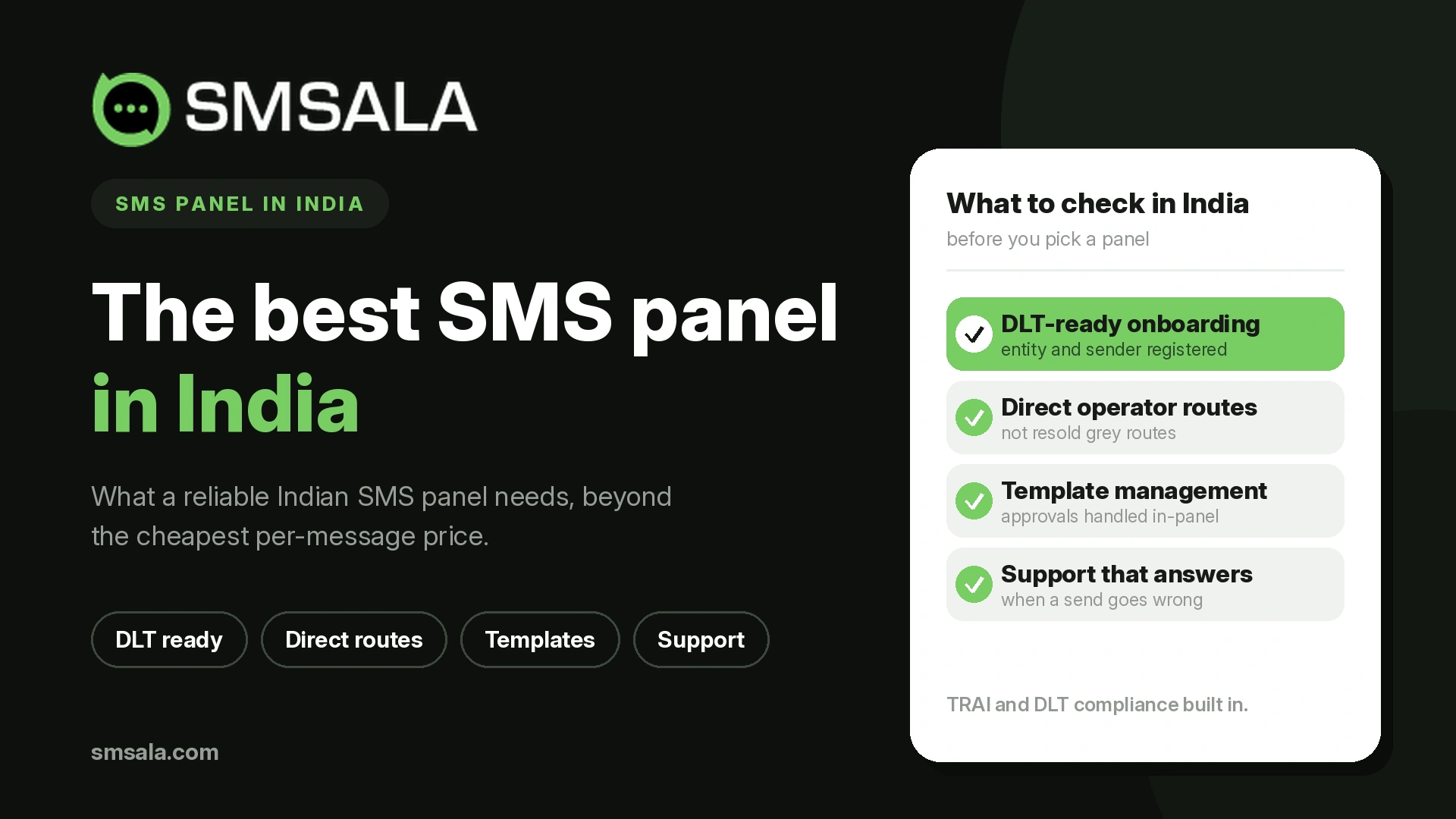
Picking an SMS panel in India is not really about who has the flashiest dashboard. It comes down to three things: whether the panel keeps you compliant with DLT and TRAI rules, whether your messages actually reach the handset, and whether the pricing makes sense at your volume. Get those right and the rest is convenience.
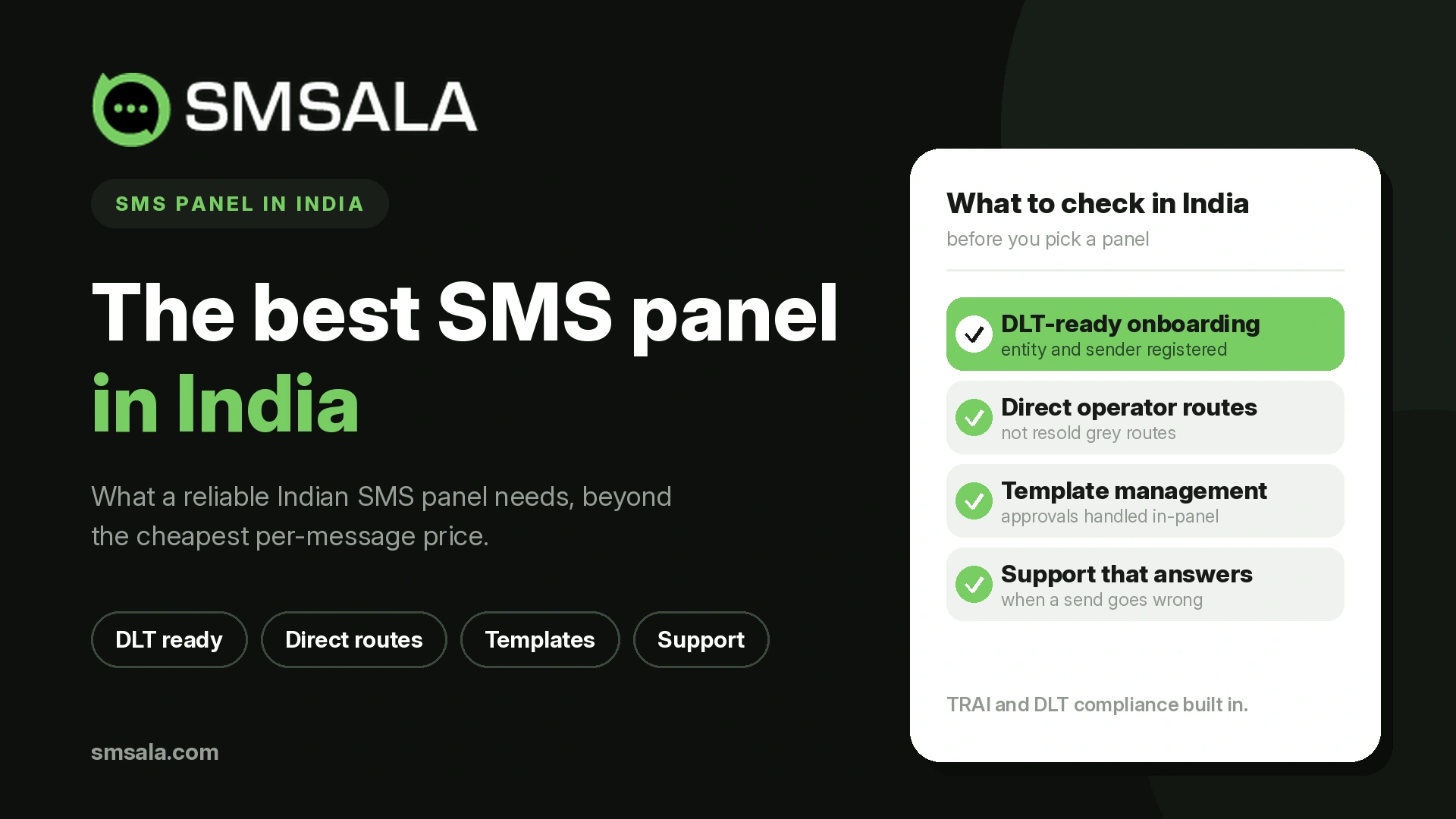
This guide walks through what an SMS panel is, the features that separate a strong provider from a weak one, how pricing works in the Indian market, and a practical way to compare options before you commit. It is written for businesses that send OTPs, alerts, and campaigns at scale and need delivery they can rely on.
What an SMS panel actually is
An SMS panel is a web-based platform for sending and managing SMS at scale without wiring up messaging infrastructure yourself. From a single dashboard you can upload contacts, create and send campaigns, register and manage sender IDs and templates, and track delivery. Most panels also expose an API so your own application can trigger messages automatically, which is how OTPs and transactional alerts are usually sent.
In practice, the panel is the layer between your business and the telecom operators. A good one hides the complexity of routing, DLT, and delivery reporting while still giving you visibility into what is happening to each message.
Why Indian businesses rely on SMS panels
India has more than a billion active mobile connections, and SMS remains the one channel that reaches nearly all of them without an app or a data connection. That reach is why banks, e-commerce platforms, logistics companies, clinics, and schools use SMS for authentication, order updates, reminders, and promotions.
For anything beyond a handful of messages, sending manually is impractical and non-compliant. A panel lets a marketing team run bulk SMS campaigns across India while a product team fires OTPs through the same account over an API, all within the DLT framework the operators require.
What separates the best SMS panels in India
Every provider claims to be the best. The differences show up in six areas that directly affect compliance, delivery, and total cost.
DLT and TRAI compliance built in
Under the Telecom Commercial Communications Customer Preference Regulations (TCCCPR, 2018), every business sending application-to-person SMS in India must register on a DLT platform: the principal entity, each sender ID (header), and every content template. Since December 2024, operators also enforce end-to-end message traceability, so any message whose telemarketer chain does not match the declared path is blocked. A strong panel guides you through DLT registration and keeps your headers and templates mapped correctly, rather than leaving you to discover the rules after messages start failing.
Compliance is not optional and it is not a one-time task. Whenever your message copy changes, the template has to be updated, or the message can be scrubbed before delivery.
Direct routes and high deliverability
A panel is only as good as the routes behind it. Direct operator connections deliver messages straight into the Jio, Airtel, Vi, and BSNL networks and pass traceability and firewall checks. Grey routes look cheaper on the rate card but are unstable, frequently blocked, and a poor fit for time-sensitive traffic like OTPs. When you evaluate a provider, look past the headline price to the actual SMS deliverability rate and how it holds up during peak periods such as festival sales.
API and integration depth
If you send OTPs or transactional alerts, the API matters more than the dashboard. Check for clear REST documentation, SMPP support for high throughput, retry and queueing logic, and webhooks for real-time delivery status. The ability to send SMS at scale through a bulk SMS REST API is what lets your application trigger messages automatically at the moment they are needed, without manual steps.
A usable dashboard and sender ID control
The dashboard should make everyday tasks fast: importing contacts, scheduling campaigns, and managing approved templates. Sender ID control is part of this. In India, transactional and service messages use a registered six-character alphanumeric header, and a consistent, recognisable SMS sender ID improves both trust and open rates. A good panel makes header and template management straightforward instead of a support ticket.
Analytics and delivery reporting
You cannot improve what you cannot see. Look for real-time delivery receipts (DLRs), per-campaign and per-operator breakdowns, and exportable reports. Strong bulk SMS analytics and reporting let you catch a failing route within minutes and understand which messages convert, rather than guessing after the fact.
Regional language and Unicode support
India is multilingual, and campaigns in Hindi, Tamil, Bengali, or other regional scripts consistently outperform generic English in many segments. That requires proper Unicode SMS support. Keep in mind that Unicode messages have a shorter per-segment character limit than plain English text, which affects both readability and cost, so the panel should show segment counts clearly.
What an SMS panel costs in India
SMS in India is priced per message, and the rate depends on the category, the route quality, and your monthly volume. A few principles hold across providers.
Transactional and OTP messages generally cost slightly more than promotional messages, because they run on premium routes that are exempt from Do Not Disturb filtering. Higher volumes bring the per-message rate down through negotiated tiers. And the cheapest quote is often the most expensive in practice, because it usually signals grey routing that fails and forces resends.
Beyond the per-message rate, budget for the parts that are easy to overlook:
DLT registration and template approvals, handled through the operators' DLT platforms.
Operator and telco charges that apply on top of the aggregator's rate.
Unicode segmentation, since regional-language messages split into more billable segments.
Per-message rates in India are low, often a fraction of a rupee, but they move with the market and vary by provider and volume. Rather than anchoring on a single number, ask any provider for a current written quote for your specific category and volume, and confirm the routes are direct.
How to compare providers before you commit
Use a consistent checklist so you are comparing like with like. The table below covers the criteria that matter most.
What to check | Why it matters | Good sign |
DLT and traceability handling | Non-compliant messages are blocked in India | Provider helps register and maps your chain correctly |
Route type | Direct routes deliver; grey routes fail | Stated direct connections to all four operators |
Deliverability during peaks | OTPs fail when networks are congested | Redundancy and consistent success rates, shown in DLRs |
API and documentation | Automated OTP and alert sending | REST and SMPP, retries, webhooks, clear docs |
Reporting | You need to see failures fast | Real-time DLRs and per-operator analytics |
Support | Delivery issues need quick answers | Responsive technical support, not just sales |
Pricing transparency | Hidden charges distort the real cost | Clear per-category rates plus DLT and operator charges |
For a deeper walkthrough of the evaluation process, this companion guide on how to choose the best SMS panel for your business covers the same criteria in more detail and applies beyond the Indian market.
Getting the most out of your SMS panel
Choosing well is half the job; using the panel well is the other half. A few habits consistently improve results.
Send at sensible times. Transactional messages and OTPs go out the moment they are triggered, but promotional campaigns land better in mid-morning and early evening windows, and they must respect DND and the permitted sending hours for promotional traffic. Mind frequency too, since over-messaging drives opt-outs and complaints that can hurt your sender reputation.
Write for the format. SMS rewards clarity: lead with the point, keep it short, and include only the sender ID and the essential detail. Avoid unregistered links, because URLs and call-back numbers must be whitelisted on the DLT platform or the message can be blocked. Clean, template-compliant copy moves faster through operator filters.
Keep your lists healthy and measure everything. Remove invalid and inactive numbers so you are not paying to message handsets that will never receive anything, and use HLR number lookup where volume justifies it. Then let delivery data guide you: watch delivery rates by operator, test message variants, and adjust based on what the reports show rather than assumptions.
Common mistakes when choosing an SMS panel
The most frequent error is choosing on price alone and ending up on grey routes with unpredictable delivery. Others include ignoring DLT until messages start failing, overlooking the API when transactional traffic is the real need, and skipping a trial. Before you sign a longer commitment, run a small live test across all four operators, send at least one OTP and one Unicode message, and check the delivery reports. Real delivery data beats any claim on a pricing page.
Where SMSALA fits
For businesses that want compliance, direct routing, and reporting in one place, SMSALA's bulk SMS service provides a panel and API built for the Indian market, including DLT registration support, REST and SMPP integration, Unicode messaging, and carrier-verified delivery reports. The point of a panel like this is to keep the operator-level plumbing out of your way so your team can focus on the message and the outcome rather than on routing and paperwork.
Frequently asked questions
What is the difference between an SMS panel and an SMS gateway?
A panel is the user-facing platform for managing and sending SMS, including a dashboard and reporting. A gateway is the underlying system that routes messages to operators. Most panels include gateway access; the panel is what you log into, the gateway is what moves the message.
Do I need DLT registration to use an SMS panel in India?
Yes. Registering your entity, sender ID, and content templates on a DLT platform is mandatory for application-to-person SMS. A good panel helps with this, but the registration is tied to your business.
Which is cheaper, promotional or transactional SMS?
Promotional messages are usually a little cheaper, but they run on routes subject to Do Not Disturb rules and time restrictions. OTPs and alerts must use transactional or service routes, which are exempt from DND and therefore priced slightly higher.
How can I tell if a provider uses direct or grey routes?
Ask directly, then verify with a live test. Direct routes show consistent delivery and clean receipts across operators; grey routes tend to fail intermittently, especially during peak traffic, and can breach traceability rules.
Can I send messages in Hindi and other regional languages?
Yes, through Unicode support. Note that Unicode messages hold fewer characters per segment than English, so a longer regional-language message may split into more billable segments.
Final thoughts
The best SMS panel in India is the one that keeps you compliant, delivers reliably across every operator, and prices fairly for your volume. Treat compliance and routing as the foundation, judge deliverability with a real test rather than a claim, and weigh total cost rather than the lowest per-message rate. Get those three right, and the dashboard, the API, and the reporting all become tools you actually trust.