
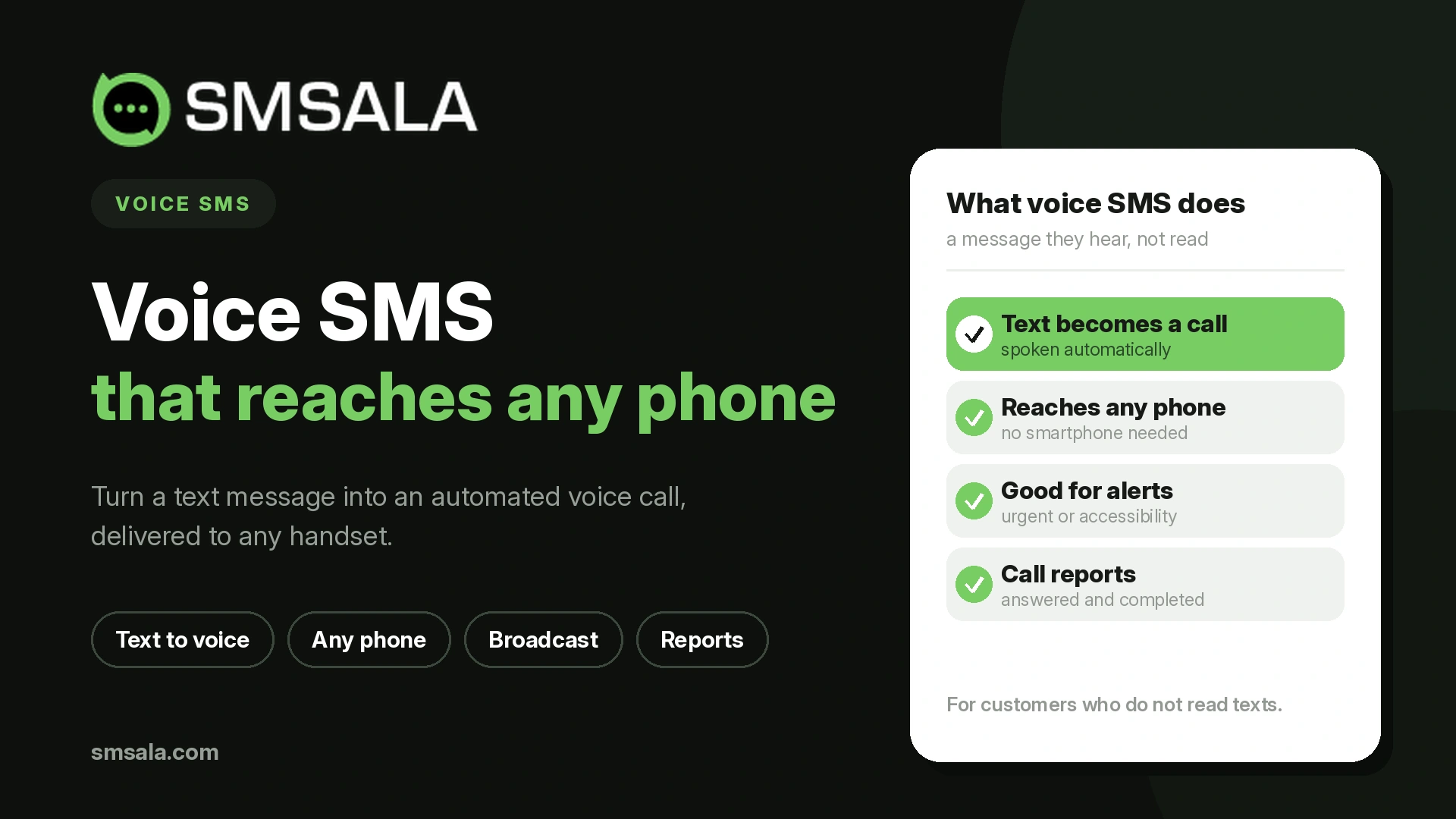
For a large part of the world, a text message is useless. The recipient cannot read it, will not read it, or does not read the language it is written in. A farmer in a rural district, an elderly customer who never took to texting, a worker more comfortable in a regional spoken language than a written one: text simply does not reach these people. Voice SMS does, by calling them and playing a recorded message in a human voice. That, more than any list of benefits, is what voice SMS is actually for.
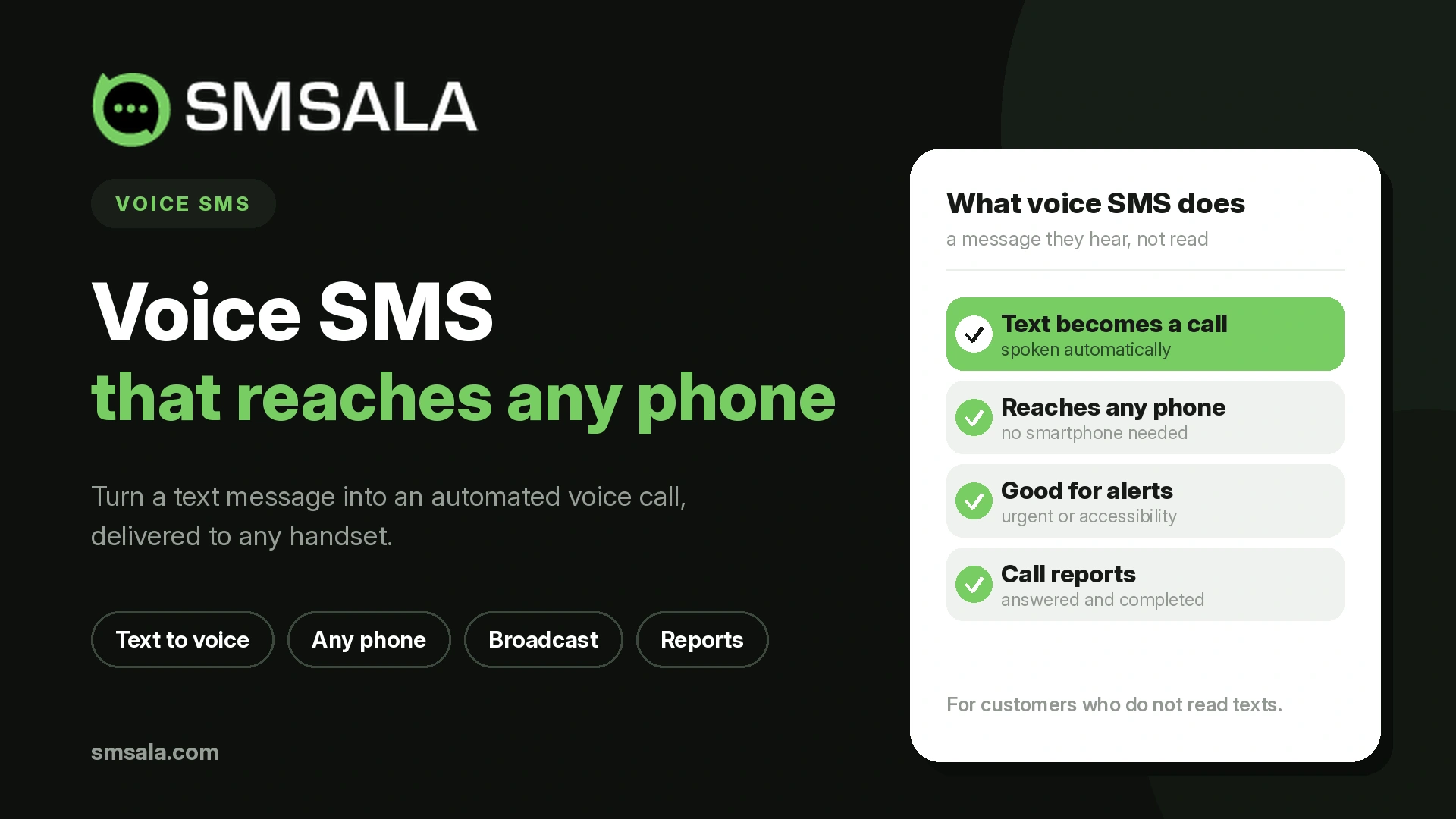
Voice SMS is also one of the most misunderstood messaging tools, because it gets confused with two other things: ordinary text SMS, which it is not, and interactive voice systems, which it only partly overlaps with. This guide sorts that out first, then makes the real case for voice SMS (the audiences it reaches that text cannot), explains the press-key response mechanism the benefit-listicles ignore, and covers the compliance reality that, honestly, matters more for voice than for almost any other channel.
What voice SMS actually is
Voice SMS is a bulk, pre-recorded voice message delivered to a list of recipients as automated phone calls. You record an audio message (or generate one from text), the system dials the recipients, and when a call is answered, it plays the recording. It is sometimes called voice broadcast or outbound dialing (OBD), and the "SMS" in the name is a bit misleading, because there is no text involved at all. It is a spoken message, broadcast at scale.
Two distinctions clear up most of the confusion.
It is not text SMS. Text SMS delivers written words to a screen; voice SMS delivers spoken audio to the ear. They reach different people and suit different messages, which is the whole point.
It is not the same as an interactive voice call API. That is a programmable system for building live, interactive, two-way calls (menus, real-time responses, agent connections). Voice SMS is simpler: a pre-recorded message broadcast to many people, with at most a basic press-key response. Think of voice SMS as the voice equivalent of a bulk broadcast, and the voice call API as the voice equivalent of a full conversational application. Both are voice; they are not the same tool.
Who voice SMS reaches that text cannot
Here is the real argument for voice SMS, and the one the promotional content states weakly. Its value is not that it is voice instead of text for its own sake. Its value is that it reaches specific audiences text leaves out.
Non-readers and low-literacy audiences. In many markets, a significant portion of the population cannot comfortably read a text message. For them, a written SMS is a closed door and a spoken message is an open one. Voice SMS is often the only scalable way to reach these people at all.
Regional-language speakers. A spoken message in someone's own language lands naturally, and voice sidesteps the complications of displaying and encoding non-Latin scripts in text. For audiences who speak a regional language more comfortably than they read any written one, a recorded voice message in that language communicates where a text would not.
Elderly and less tech-comfortable users. Plenty of people, particularly older ones, never became comfortable with texting but answer a phone call without a second thought. Voice reaches them on familiar ground.
Anyone for whom a human voice carries more weight. A recorded human voice conveys tone, warmth, and urgency that flat text cannot, which matters for certain messages and certain communities where a voice feels more personal and trustworthy than a text.
This is why voice SMS is especially prominent in markets like India and across emerging economies, where linguistic diversity, varying literacy, and large rural populations make voice the practical way to reach audiences that text-based bulk SMS marketing cannot. Voice SMS is not a better channel than text; it is the channel for the people text does not serve.
The press-key response layer
Voice SMS is usually described as one-directional, but it has a simple interactivity most guides omit: DTMF, the keypad tones. A voice SMS can invite the listener to press a key, and act on it.
This turns a broadcast into a basic two-way exchange. A recorded message can say "press 1 to confirm your appointment, press 2 to reschedule," or "press 1 to receive a callback from our team," or "press 9 to stop receiving these calls." The system captures the keypress and routes it accordingly. It is not the rich interactivity of a full IVR or a live conversation, but it is enough to turn a one-way announcement into a simple survey, a lead-capture mechanism, an opt-out, or a confirmation. For reaching non-reading audiences with something that needs a response, this press-key layer is what makes voice SMS more than a spoken billboard, and it is worth building into campaigns where a reply matters.
Voice SMS, text SMS, or interactive voice: which to use
The three are complementary, and choosing well means matching the tool to the audience and the message.
Factor | Text SMS | Voice SMS | Interactive voice API |
Format | Written text | Pre-recorded audio broadcast | Live, programmable call |
Best audience | Text-literate, general | Non-readers, regional-language, elderly | Anyone needing real interaction |
Interactivity | Links, replies | Press-key (DTMF) only | Full, real-time |
Scale pattern | Mass, cheap | Mass broadcast | Per-call, richer |
Typical use | Alerts, marketing, OTP | Announcements to non-reading audiences | IVR, support, verification |
Text SMS is the default for text-literate audiences and for anything needing a link or a written record. The interactive voice API is for genuine real-time interaction. Voice SMS sits between them as the bulk-broadcast voice tool, and its sweet spot is clear: reaching a large audience that text cannot serve, with a spoken message that may need at most a simple keypress response. Choosing voice SMS for a text-literate audience that would happily read an SMS usually just means paying more for a more intrusive version of the same message.
Where voice SMS genuinely fits
The strongest uses of voice SMS follow directly from who it reaches. Mass announcements and alerts to audiences that cannot rely on text, such as community notifications, public information, and service updates in regions with low text literacy. Regional-language marketing and outreach where a spoken local-language message connects. Payment and appointment reminders for customer bases that respond better to a call, common in microfinance, rural banking, and healthcare serving less tech-comfortable populations. Simple polls and confirmations using the press-key response. And community, political, or organizational outreach where a personal recorded voice at scale is the goal. This is a clear case of mass communication where the audience, not the sender's preference, dictates the channel.
Equally important is where voice SMS does not fit. It is a poor choice for verification codes (a spoken code is awkward and text or a dedicated OTP delivery serves better), for detailed or complex information the listener would need to re-read, for anything requiring a written record, and, crucially, for text-literate modern audiences who would find an automated call more intrusive than a text they could glance at. Voice SMS used on the wrong audience is not a richer message, it is an unwelcome interruption.
The compliance reality nobody mentions
This is the section every competing article skips, and it is the one that can get a business into the most trouble. Automated voice calls are among the most heavily regulated forms of communication anywhere, precisely because unwanted automated calls are a public nuisance that regulators actively police.
Voice SMS is subject to strict rules on several fronts. Do-not-disturb and do-not-call registries must be respected, and calling people who have registered to avoid such calls is prohibited and penalized. Calling hours are restricted, so broadcasts outside permitted daytime windows are not allowed. Consent requirements apply, particularly for promotional voice broadcasts. And in markets like India, regulators such as the TRAI enforce especially strict rules on outbound dialing and promotional voice calls, with registration and scrubbing requirements. The practical consequence is that voice SMS cannot be treated as "just call everyone on the list." It requires consent, list scrubbing against do-not-call registries, sending within permitted hours, and often registration, and the penalties for getting it wrong are real. Because these rules vary by market and change, confirming the current requirements for your target regions before a campaign is not optional. Compliant voice SMS is powerful; non-compliant voice SMS is a liability.
Using voice SMS well
Within those constraints, a few practices make voice SMS effective. Keep the recording short and clear, because attention on an automated call is brief. Use a natural, well-recorded voice in the recipient's language, since audio quality and language fit determine whether the message lands. Include a press-key option where a response or an opt-out is useful. Time calls to reasonable daytime hours and the recipient's context. Handle unanswered calls and voicemail sensibly rather than calling repeatedly. And target deliberately, using voice SMS for the audiences it genuinely serves rather than as a blanket alternative to text. As automated A2P messaging delivered by voice, it rewards the same discipline as any channel: relevance, restraint, and respect for the recipient.
Voice SMS checklist
Use voice SMS to reach audiences text cannot: non-readers, regional-language speakers, elderly or less tech-comfortable users.
Do not use it for verification, complex information, or text-literate audiences who would prefer a text.
Keep recordings short, clear, and in the recipient's language, with a natural voice.
Add a press-key (DTMF) option where a response, confirmation, or opt-out is useful.
Respect do-not-call and do-not-disturb registries, and scrub your list.
Send only within permitted calling hours, and obtain consent for promotional broadcasts.
Confirm current regulations for your markets, especially strict OBD regimes.
Choose voice SMS by the audience, not by preference over text.
The bottom line
Voice SMS is a bulk pre-recorded voice broadcast, and it is neither text SMS nor an interactive voice application, though it is constantly confused with both. Its genuine value is reaching the audiences text leaves out: people who cannot or will not read a message, who speak a regional language, who never took to texting, or for whom a human voice simply carries more. Used for those audiences, with the press-key response where a reply matters and strict attention to the heavy regulation around automated calls, voice SMS reaches people no text campaign can. Used as a spoken version of a text blast to text-literate audiences, it is just a more intrusive, more regulated, more expensive way to say what a text would have said better. Match it to the audience, respect the rules, and it fills a real gap.
SMSala provides voice SMS alongside text and interactive voice, with the reach and compliance handling these broadcasts require, but the value comes from using voice SMS for the audiences it genuinely serves, not as a default alternative to text.
Frequently asked questions
What is voice SMS?
Voice SMS is a bulk, pre-recorded voice message delivered to a list of recipients as automated phone calls that play the recording when answered. Despite the name, it involves no text at all. It is also called voice broadcast or outbound dialing (OBD), and it is used to reach many people at once with a spoken message.
How is voice SMS different from text SMS and from a voice call API?
Text SMS delivers written words to a screen; voice SMS delivers a pre-recorded spoken message as a broadcast call. An interactive voice call API is a programmable system for live, real-time, two-way calls. Voice SMS sits between them as the bulk voice-broadcast tool, with at most a simple press-key response rather than full interactivity.
Who is voice SMS best for reaching?
Audiences that text cannot serve: people who cannot or do not read text, regional-language speakers more comfortable with spoken language, elderly or less tech-comfortable users who answer calls but not texts, and communities where a human voice carries more trust. This is why voice SMS is prominent in markets with high linguistic diversity and varying literacy.
Can people respond to a voice SMS?
Yes, in a limited way, through DTMF keypad tones. A recording can invite the listener to press a key, such as press 1 to confirm, press 2 to reschedule, or press 9 to opt out, and the system acts on the keypress. It is not a full conversation like an interactive voice system, but it is enough for confirmations, simple surveys, callbacks, and opt-outs.
Is voice SMS heavily regulated?
Yes, more than most channels. Automated voice calls are subject to strict do-not-call and do-not-disturb registries, restricted calling hours, and consent requirements, and markets like India enforce especially strict rules on outbound dialing through regulators such as the TRAI. Voice SMS requires consent, list scrubbing, permitted-hours sending, and often registration, so it cannot be treated as calling everyone on a list.