
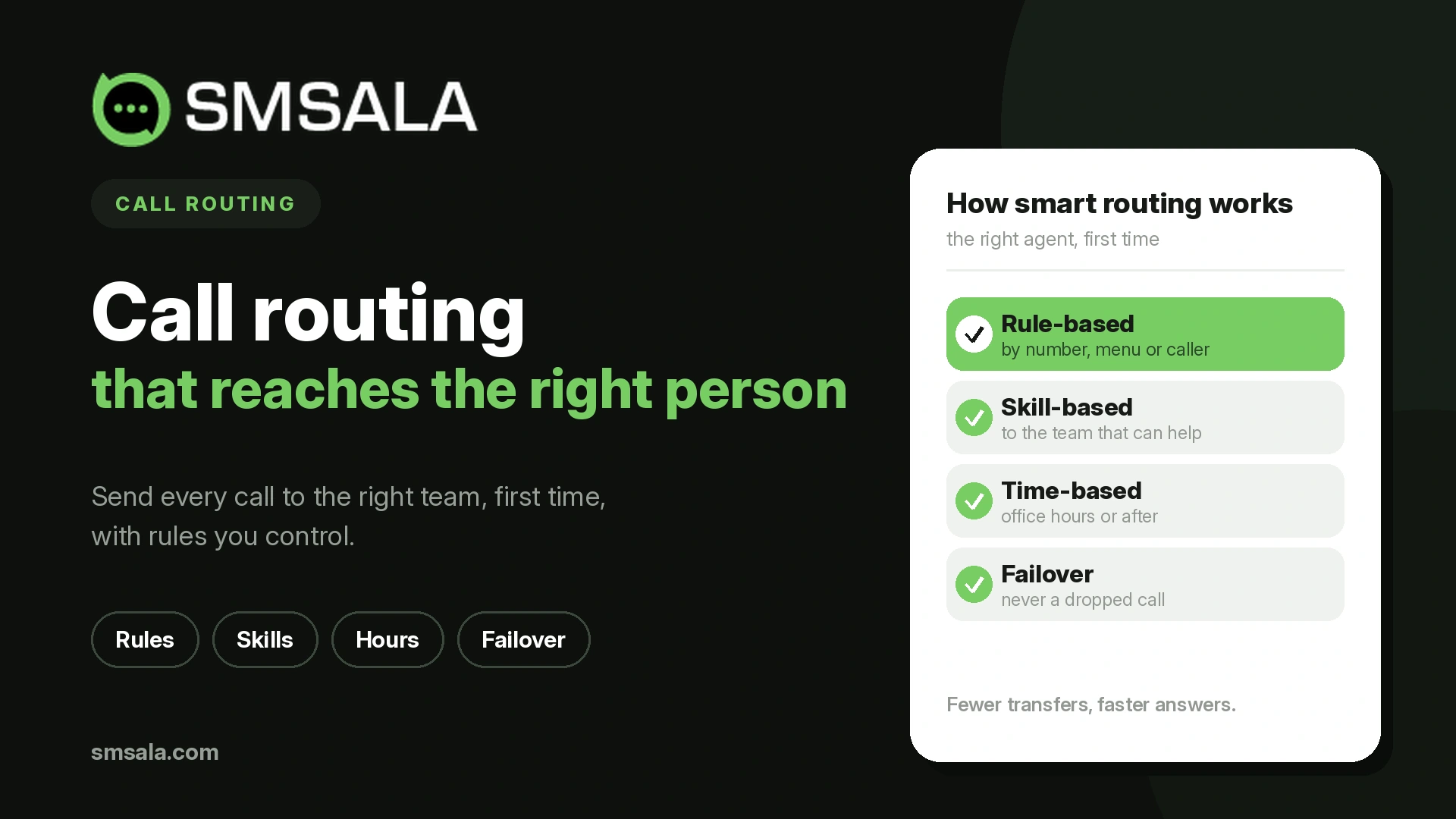
Call routing decides what happens in the seconds between a customer dialing your number and a person picking up. When it works, the caller reaches someone who can actually help on the first try. When it does not, they bounce between departments, wait on hold, or hit a voicemail that no one checks. The difference is rarely which "type" of routing a business picked. It is whether they designed the routing as a complete flow, including what happens when the ideal path is not available.
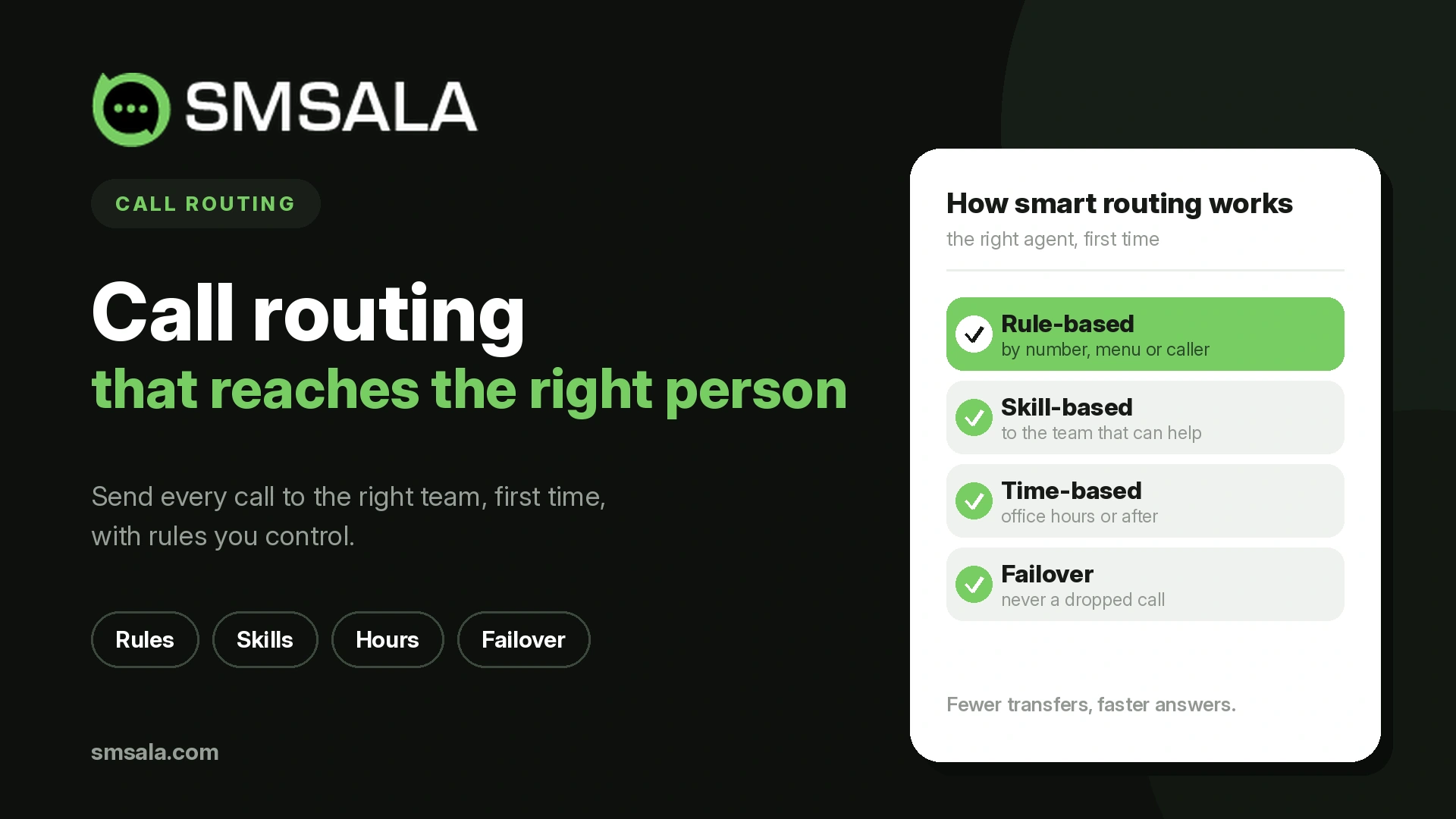
Knowing the routing types matters, but it is the easy part. The harder and more valuable skill is arranging them into a sequence that fits how your business works, and planning the fallbacks for when a call cannot be placed where it should go. This guide covers both.
What call routing actually is
Call routing is the set of rules that direct an incoming call to a destination, whether that is a specific agent, a team, a queue, a menu, or a voicemail box. In a contact center it is handled by automatic call distribution, the engine that holds calls in queues and assigns them to agents according to your rules.
The useful way to think about it is not as a single setting but as a decision flow. Each incoming call is asked a series of questions, and the answers determine where it lands. Get that sequence of questions right and routing feels effortless to the caller. Get it wrong and no individual routing type can save the experience.
The routing methods, as building blocks
These are the common routing strategies. Treat them as pieces you combine, not a single choice you make.
Method | What it decides | Best suited to |
Time-based | Whether it is business hours, and where calls go if not | Any business with fixed hours |
Menu-based (IVR) | Which option the caller selects | Multiple departments or intents |
Skills-based | Which agent has the right expertise or language | Specialized or multilingual teams |
Round-robin | Even distribution across available agents | Balancing load on similar agents |
Most-idle | The agent who has waited longest since a call | Keeping workload fair and response fast |
Priority | Which callers jump the queue | VIP tiers, urgent issues |
Data-directed | Routing based on who the caller is | Personalized service using caller records |
None of these is "the best." A small team might need only time-based routing and a simple menu, while a large support operation layers several together. The art is in the sequence.
Routing is a stack of decisions
A well-designed routing flow moves each call through layers, each one narrowing where it can go. Picture the journey rather than a single rule.
Is it business hours? The first gate. Outside hours, the call should go somewhere deliberate, not ring an empty desk.
Who is calling, and why? This is where an IVR menu or a lookup against your records identifies the caller's intent or account. Recognizing a known customer here lets everything downstream be smarter.
Which queue should hold the call? Based on the intent and the caller, the call joins the right team's queue, with priority applied if they qualify.
Which agent takes it? Within that queue, a distribution method such as most-idle or skills-based picks the specific person.
What if no one can take it? The overflow layer, which most designs treat as an afterthought and which deserves the most attention.
Naming these layers changes how you build. Instead of asking "what routing type should we use," you ask what each layer should decide, and the right methods fall into place. A call that is identified early, queued correctly, and matched to a capable agent rarely needs a transfer, which is the whole point.
Design the failure paths, not just the happy path
The moments that damage customer relationships are almost always the ones where routing had no plan. Every routing flow needs deliberate answers to the questions below, because if you do not decide, the system decides badly for you.
No agent is available. Offer a queue callback so the caller keeps their place without holding, route to an overflow team, or take a message you will actually return.
The call comes in after hours. State the hours, offer self-service or a callback for the next business day, and consider a text message follow-up so the caller is not left with nothing.
The queue is too long. Set a threshold beyond which calls divert rather than pile up, because a ten-minute hold does more damage than an honest "we will call you back."
The chosen agent does not answer. Move on quickly to the next eligible agent rather than letting the caller ring out.
A routing flow that handles these gracefully feels more reliable than one with a clever happy path and no safety net. Overflow is not the exception to plan for last. It is the part callers remember.
Routing is only as smart as its data
Sophisticated routing depends on information the system can act on, and this is where many setups quietly underperform. Skills-based routing needs agents accurately tagged with their skills and languages. Priority routing needs a definition of which customers matter most. Personalized routing needs the call connected to a customer record, so pulling caller data from your CRM at the identification layer is what turns a generic queue into recognized, relevant service. Before adding a fancy routing rule, check that the data it relies on actually exists and is current. A skills-based rule pointing at untagged agents is just random assignment with extra steps.
Choosing a strategy for your situation
Match the design to your reality rather than copying an enterprise blueprint.
A small team with one or two functions usually needs time-based routing, a short menu, and a solid voicemail-or-callback fallback. Adding layers it does not need only creates dead ends. A growing team with distinct departments benefits from an IVR to sort intent, skills-based queues, and most-idle distribution to keep load even. A high-volume operation with tiers of customers layers priority routing and data-directed personalization on top, and lives or dies by its overflow design. The through-line is that complexity should follow need. Every extra menu level and routing rule is another place a call can get lost.
Knowing whether your routing works
Routing is measurable, and the numbers reveal problems the happy path hides. Watch the average speed of answer to see whether callers wait too long, first-call resolution to see whether they reach someone who can actually help, and the transfer rate as a direct signal of misrouting, since a call transferred twice was routed wrong the first time. Abandonment rate exposes queues that are too long or menus that frustrate, and agent occupancy balance shows whether your distribution method is spreading work fairly. Reviewing these through proper analytics and reporting turns routing from a set-and-forget configuration into something you tune as your call patterns change.
Where routing fits your wider communication
Voice routing does not stand alone anymore. A caller who cannot reach an agent might prefer a text; a missed call can trigger an automated message; a routine question might be better answered before it becomes a call at all. Connecting your voice flow, delivered through a voice call API and supported by voice messaging for callbacks and notifications, to your messaging channels lets you meet the caller on whatever channel serves them best. This coordination across voice and text is part of a broader move toward automating business communication so that no contact simply falls through.
Frequently asked questions
What is the difference between call routing and IVR?
IVR is one layer within routing. The interactive menu that asks callers to press a number identifies their intent, and routing then uses that answer, along with other rules, to send the call to the right queue or agent. IVR gathers information; routing acts on it.
What is the best call routing method?
There is no single best method, because each solves a different problem. Most effective setups combine several: time-based routing to check hours, a menu or lookup to identify the caller, skills or priority rules to pick the queue, and a distribution method to pick the agent. The best design is the sequence that fits your business.
What happens to calls after business hours?
Whatever you decide, so decide deliberately. Good options include stating your hours, offering self-service, taking a callback request for the next business day, or sending a follow-up text. The failure is letting after-hours calls ring an empty office.
How do I stop callers from being transferred repeatedly?
Repeated transfers usually mean the call was routed wrong at the start. Identify intent early with a clear menu or caller lookup, route to the queue that can actually resolve the issue, and make sure agent skills are tagged accurately. Track your transfer rate as the warning sign.
Does call routing require a physical phone system?
No. Modern call routing runs on internet-based telephony and can be configured in software, which is what makes advanced rules, data-driven routing, and integration with your other channels practical without on-site hardware.
The takeaway
Good call routing is not a routing type you switch on. It is a flow you design: a sequence of decisions that identifies each caller, sends them to someone who can help, and, just as importantly, handles the moments when the ideal path is unavailable. Build it in layers, give as much thought to overflow and after-hours as to the happy path, feed it accurate data, and watch the metrics that expose misrouting. A business that gets this right sounds effortless to its callers, and reaching that point is easier with a communication partner such as SMSala that connects voice routing with the messaging channels around it, so every call finds a path rather than a dead end.