
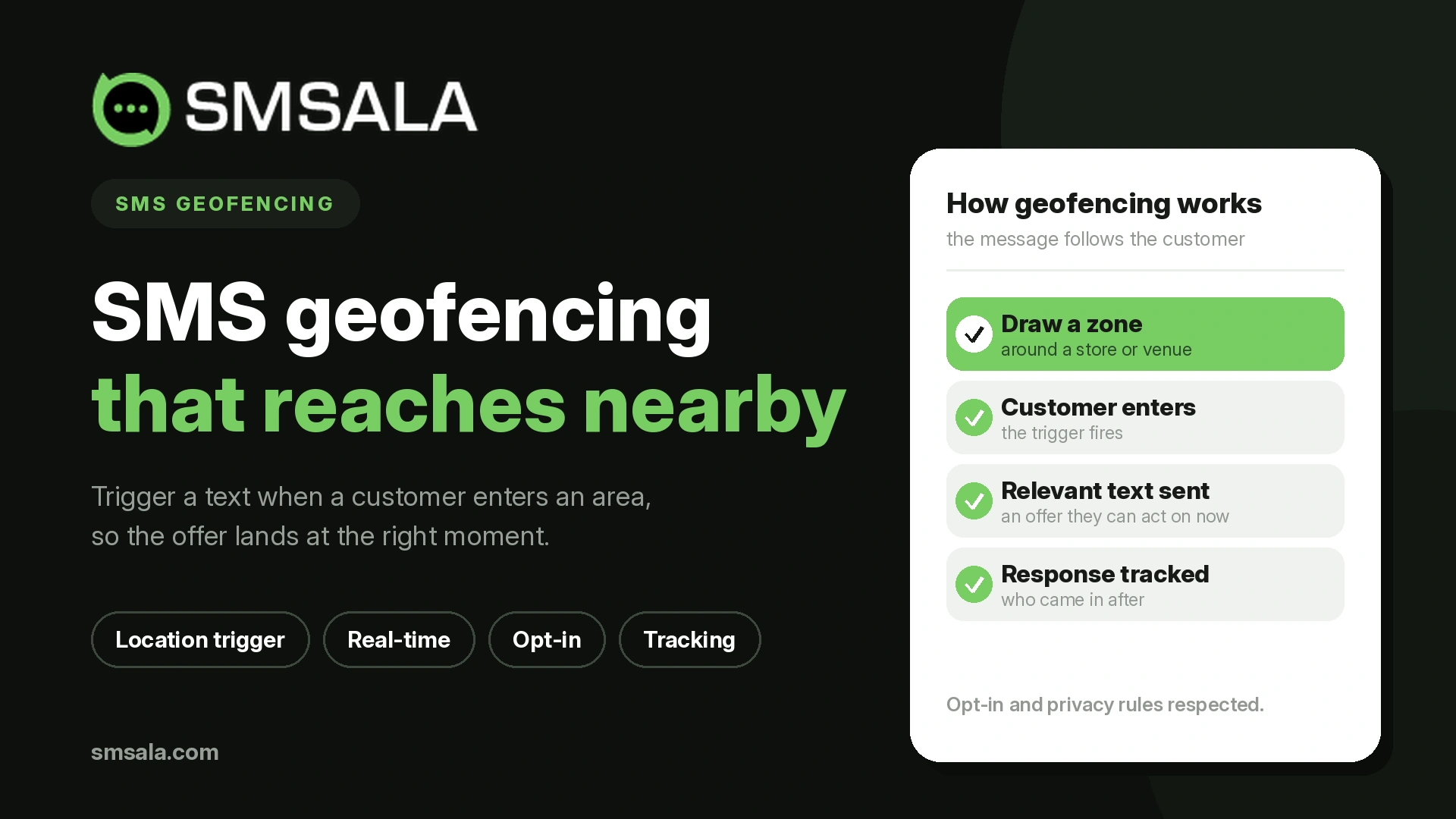
Most explanations of SMS geofencing describe the same appealing scene: a customer walks past your store, crosses an invisible boundary, and their phone buzzes with your offer, automatically. It sounds effortless. The problem is that for most businesses, that version is not possible, because it depends on something they do not have.
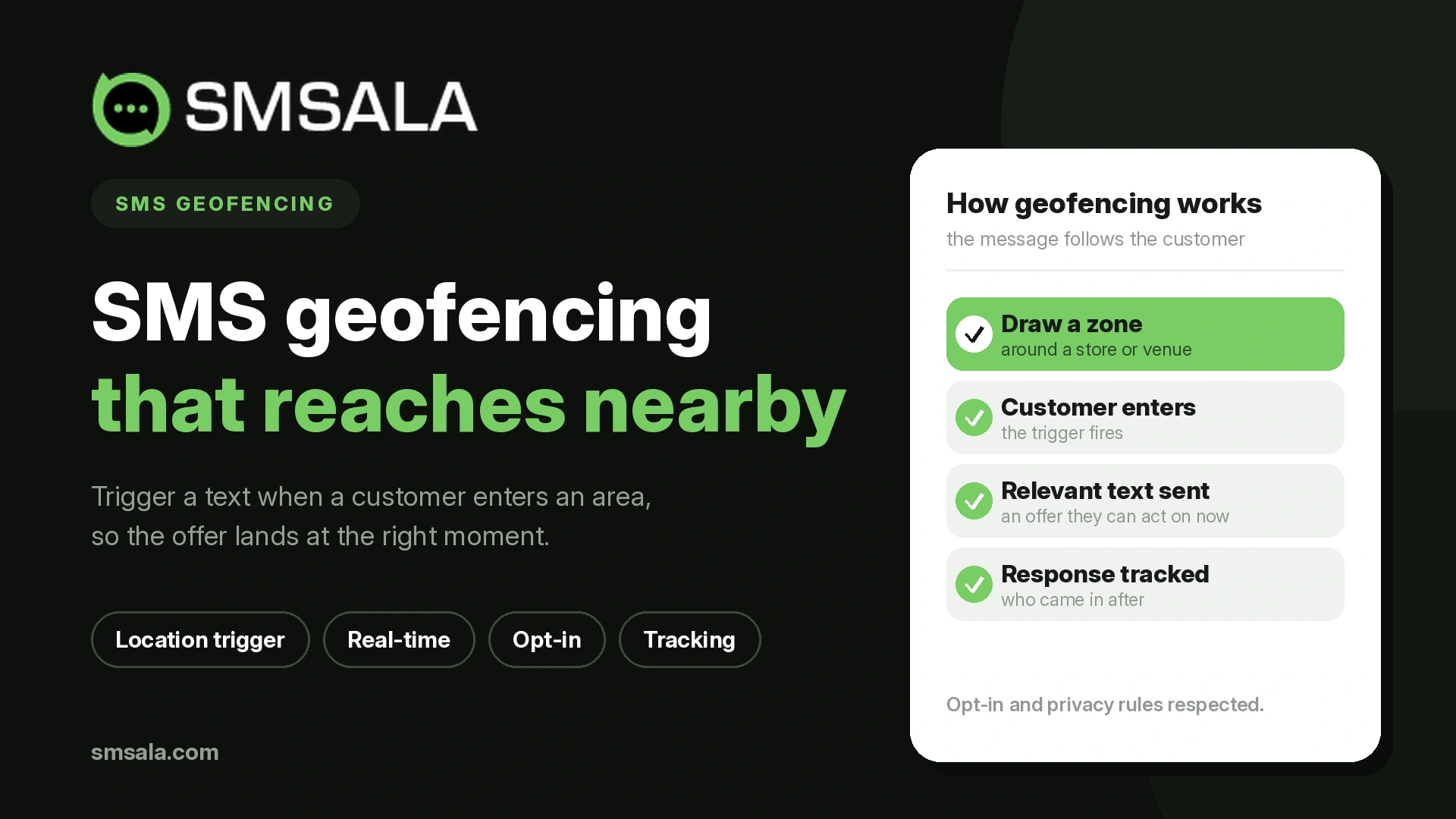
The confusion exists because three different things get sold under the single name "SMS geofencing," and they have wildly different requirements. One needs a mobile app on the customer's phone. One is really just location-based list segmentation. One is not even SMS. Before you budget for a location campaign or believe a vendor's pitch, you need to know which of the three you are actually being offered, and which one your business can realistically run. That is what this guide sorts out.
The fact that changes everything: SMS carries no location
Start here, because it dissolves the central myth. A text message contains no location information, and the mobile network does not hand a sender the GPS position of a subscriber. Your messaging platform knows a phone number. It does not know where that phone is.
This is why "send a text the instant someone walks in" is not something SMS does on its own. To detect that a specific phone has entered a specific area in real time, something on that phone has to report its position, and that something is almost always an app the customer has installed and granted location permission to. No app, no live trigger. Once you internalize that a message and a location are two separate things that someone has to connect, the rest of the topic becomes clear.
The three things called "SMS geofencing"
Here is the distinction no competing article draws cleanly. When a vendor says "SMS geofencing," they mean one of these.
Model | How it triggers | What it requires | Who can realistically run it |
Real-time triggered SMS | Phone crosses a boundary, app detects it, text fires | Your own app with background location permission, or beacons | Large retailers and brands with an installed app base |
Location-based segmentation | You send to subscribers grouped by stored location | SMS opt-in plus location data collected at signup | Almost any business with an SMS list |
Geofencing display ads | Ads shown to devices seen in an area | An ad-exchange campaign, not SMS at all | Anyone buying programmatic ads, but it is not messaging |
The impressive click-through and sales figures you see quoted in most geofencing articles usually come from that third row, geofenced display advertising, which is a separate channel with separate economics. Borrowing those numbers to sell SMS geofencing is where a lot of the unrealistic expectation comes from. Keep the three models separate and you will not overpay for one while expecting the results of another.
Real-time triggered SMS: powerful, but gated by an app
This is the version everyone pictures, and it does exist. When it works, the chain looks like this: your app runs on the customer's phone, they have granted it location access, the app notices the device entering a geofence you defined, and it signals your system to send a text.
The requirements are the catch. You need an app people have actually installed, and you need them to grant background or "always" location permission, which modern iOS and Android increasingly restrict and prompt users to deny. In practice only a minority of app users allow continuous location, so even a business with a popular app reaches a fraction of its audience this way. Beacons, small Bluetooth transmitters placed in a physical space, are an alternative trigger, but they still rely on a customer's app listening for them.
The honest conclusion: real-time triggered SMS is a strong tool for a national retailer or a brand whose customers already keep the app on their phone. For a business without an app, building one solely to enable geofenced texts almost never pays back. If that is you, the next model is the one that matters.
Location-based segmentation: what most businesses actually do
Strip away the marketing language and most "SMS geofencing" products are really doing location-based segmentation, and that is genuinely useful. Instead of tracking live movement, you collect location information when someone joins your list and use it to send relevant messages to the right group at the right time.
The practical flow:
Capture location at opt-in. When a subscriber signs up, collect a zip code, city, or preferred store as a custom field. This is the foundation, and it requires no tracking at all.
Segment your list by that data. Group subscribers by store, region, or catchment area.
Send with timing that fits the place. A lunch offer to subscribers near a specific branch, sent late morning, behaves a lot like a geofenced message without any of the live-location machinery.
Measure and refine. Track redemptions by segment so you learn which locations and timings actually respond.
This model is available to any business running SMS marketing, needs no app, and sidesteps the thorniest privacy problems because you are not tracking anyone's real-time position. It is less magical than a live trigger and, for most, considerably more practical. Pairing it with a well-built drip campaign lets you automate location-relevant sequences without manual work.
The consent problem is doubled, not single
Every competitor mentions consent. Few explain that location messaging requires two distinct permissions, and confusing them creates legal exposure.
The first is consent to message. Sending marketing texts requires prior opt-in regardless of location, and in the US that also means your traffic must run through proper 10DLC registration. A person walking past your store who never joined your list cannot be texted, geofence or not. There is no version of this where proximity substitutes for permission.
The second is consent to use location. If you track real-time position, you need separate, explicit permission for that, granted at the operating-system level and disclosed in your privacy policy. Regulations like GDPR treat precise location as sensitive personal data requiring a clear lawful basis, and CCPA requires disclosure and opt-out rights. Live tracking raises the privacy bar sharply, which is another reason segmentation, using data a subscriber knowingly gave you, is the lower-risk path.
Treating these as one requirement is a common and costly mistake. You can have a full SMS opt-in and still be non-compliant on location, or vice versa.
Accuracy, radius, and why small geofences misfire
If you do run live triggers, the technology has limits worth designing around.
GPS is accurate to a few meters under open sky and much worse among tall buildings or indoors, where it can drift by tens of meters. That has direct consequences. A geofence drawn tightly around a single small storefront will misfire, triggering for people across the street or failing to trigger for people inside. Sensible practice is to size the radius to the real accuracy available, use larger zones in dense urban areas, and add a dwell-time condition so a text fires only after someone stays in the zone for a minute or two rather than for everyone driving past at a red light.
Geofences come in three shapes: circular zones around a point, polygons for irregular areas like a mall footprint, and broad regional zones for a neighborhood or city. Match the shape to the goal. A drive-through promotion is a small circle; a "you are downtown, visit us" message is a regional zone.
Which model can you actually run?
Work through this quickly and you will know where to invest.
Do you have an app with a meaningful installed base? If yes, real-time triggered SMS is on the table for the subset who granted location. If no, skip it.
Do you collect any location data at signup, or can you start? If yes, location-based segmentation is your practical path and you can begin immediately.
Is your goal foot traffic to physical locations? Segmentation plus smart timing usually delivers most of the value without live tracking.
Are you chasing the eye-catching stats from ads? Then you may actually want geofenced advertising, a different budget line from SMS.
For the large majority of businesses, the answer is location-based segmentation done well, not a live-trigger system they cannot support. Knowing that up front saves the budget and the disappointment.
Making the message earn its place
Whichever model fires the text, the message still has to justify interrupting someone. Location adds relevance, but it does not excuse a weak offer.
Keep it short and specific, lead with the value, and give a reason to act now, since location-timed messages work best when they are immediately usable. A clear call to action pointing to well-made SMS landing pages turns a walk-past into a measurable visit, and trackable coupon codes tell you which locations and times actually convert. Respect frequency, because a customer who feels tracked and pestered will opt out, and connecting the campaign to your CRM keeps the targeting grounded in real customer history rather than proximity alone.
Underneath all of it sits plain deliverability. A perfectly timed location message is worthless if it does not arrive, so the same discipline that governs any campaign, clean routing and healthy deliverability, applies here too.
Frequently asked questions
Can I text someone just because they walked near my store?
No. You can only message people who have opted in to your SMS list. Location can decide which opted-in subscribers to message and when, but it never replaces consent. Texting a passerby with no prior relationship is not geofencing, it is a violation.
Does the mobile carrier tell me where a subscriber is?
No. Carriers know approximate location for their own network operation, but they do not expose it to businesses for marketing texts. Real-time location for geofencing comes from an app on the phone, not from the SMS channel.
Do I need my own app to do SMS geofencing?
For true real-time triggers, effectively yes, or a beacon setup that still relies on an app. For location-based segmentation, no. Most businesses run the segmentation model, which needs only an SMS list and location data collected at signup.
How accurate is geofencing?
GPS is accurate to a few meters in open conditions and less so among buildings or indoors. Draw geofences generously, prefer larger zones in dense areas, and use dwell-time rules to avoid triggering on people who are merely passing through.
Is SMS geofencing legal?
Yes, when done correctly. You need documented SMS opt-in, separate permission for any real-time location tracking, and compliance with privacy laws such as GDPR and CCPA. The segmentation model is generally lower-risk because it uses information subscribers knowingly provided.
The takeaway
SMS geofencing is real, but it is not the automatic proximity magic most articles imply. A text has no location, so something has to connect the two, and for most businesses that something is data a subscriber gave you at signup rather than live tracking through an app they have not installed. Decide which of the three models fits your situation, respect the two separate consents involved, and design for the real accuracy of the technology. Handled that way, location-aware messaging becomes a dependable way to reach the right customers near the right place, built on the same compliant foundations as the rest of your messaging program rather than on a promise the channel cannot keep. This is an area where a provider experienced in permission-based, well-routed campaigns, such as SMSala, helps you build something thatactually works instead of something that only sounds good.