
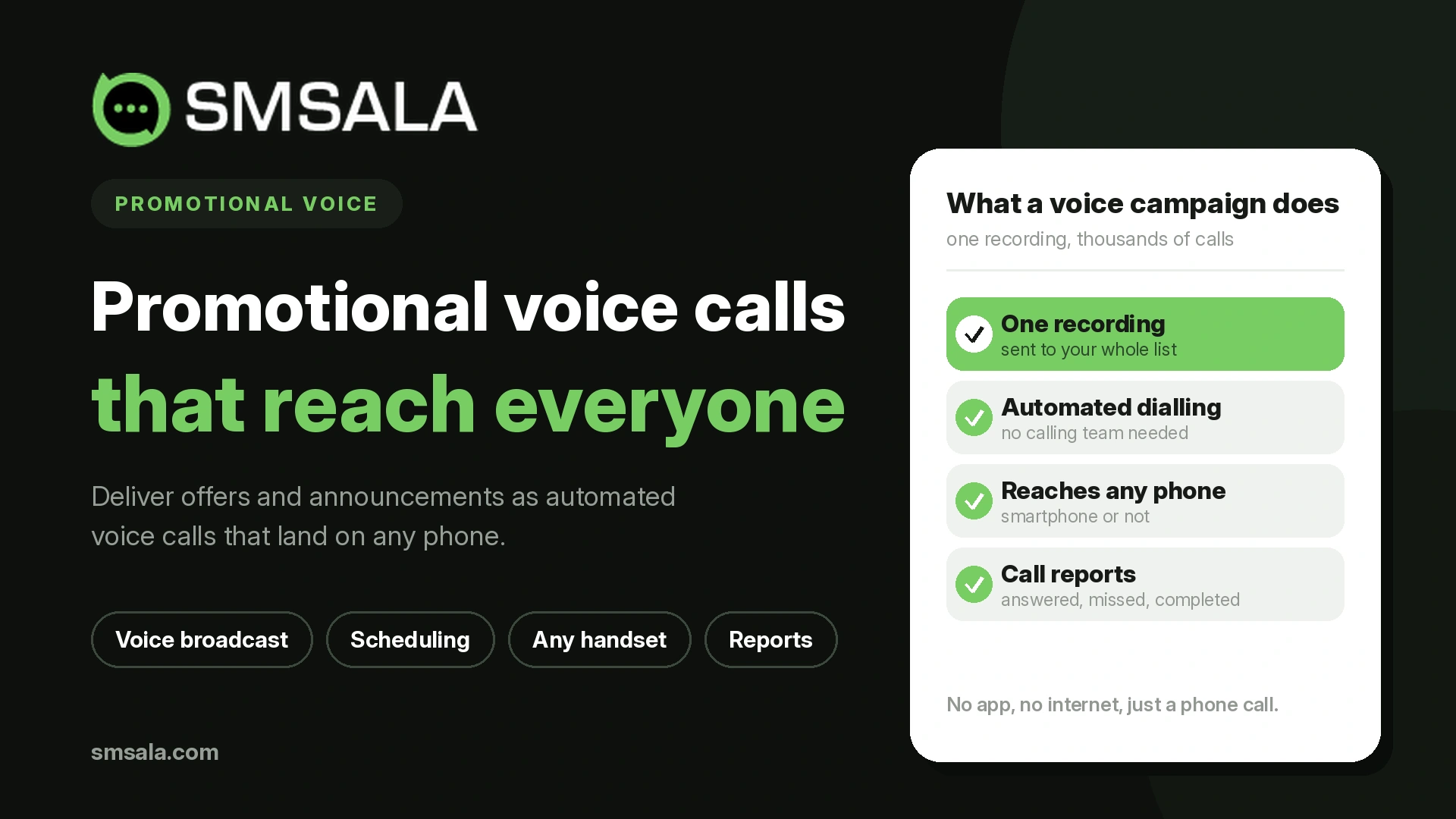
Promotional voice calls put a spoken message directly into the customer's ear, at scale, without a live agent on every line. For many businesses, they reach audiences that text and app-based channels sometimes miss, including people who prefer listening to reading or who use basic phones. Used well and within the rules, they are an efficient way to announce offers, drive responses, and add a human tone to outreach.
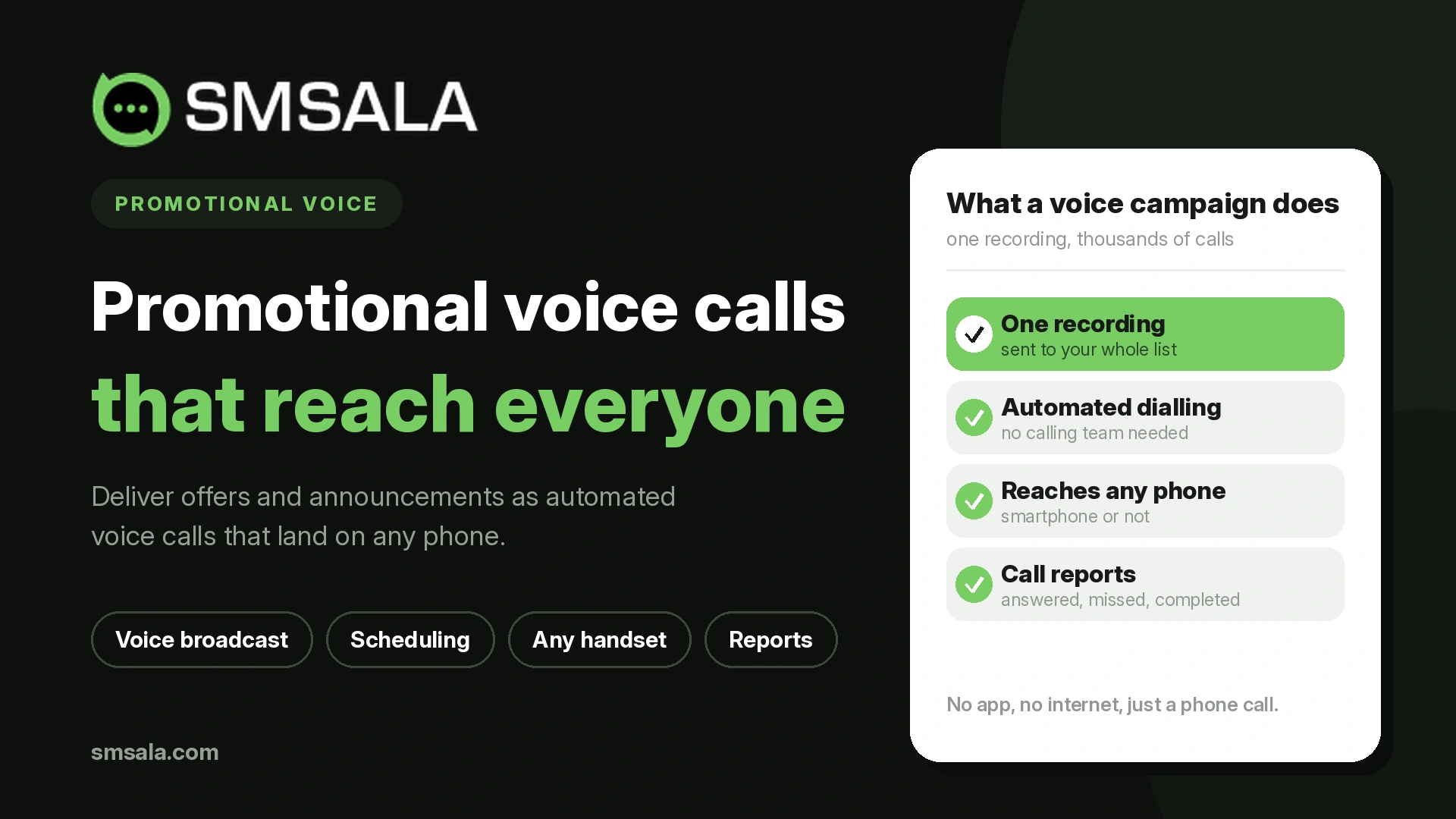
This guide explains what promotional voice calls are, how they work, where they fit against SMS and WhatsApp, what the rules require in different markets, and how to run campaigns that perform.
What are promotional voice calls?
A promotional voice call is an automated, pre-recorded or text-to-speech phone call used to promote a product, service, offer, or event to many recipients at once. Also known as bulk voice calls or voice broadcasting, and technically as outbound dialing (OBD), the campaign plays the same message to a targeted list, often with an option for the listener to press a key to respond, be connected to an agent, or opt out.
Unlike a call from a sales agent, a promotional voice call is delivered by a platform that dials thousands of numbers automatically and reports back on what happened to each one.
How promotional voice calls work
The workflow is straightforward and repeatable:
Build and segment the list. Group recipients by interest, location, language, or customer stage.
Create the message. Record a professional voice file or generate one with text-to-speech, keeping it short and clear.
Upload the campaign. Add the list and message to the platform, set the caller ID and schedule.
Place the calls automatically. The system dials at scale and, where enabled, captures keypad (DTMF) responses.
Monitor performance. Track answered calls, listen-through, responses, and opt-outs in real time.
Most of this runs through a dashboard for one-off campaigns or a voice call API for automated and triggered calls from your own systems.
Promotional vs transactional voice calls
The two look similar but are treated differently. Promotional calls carry marketing content such as offers and announcements, and they are subject to consent and Do Not Disturb rules. Transactional or service calls deliver information tied to an existing relationship, such as reminders, confirmations, or verification codes, and they follow separate rules with wider delivery permissions. Choosing the correct type is not a formality: it decides who you can call and when.
Promotional voice calls vs SMS and WhatsApp
Each channel has a distinct strength, which is why many businesses use them together rather than choosing one.
Factor | Promotional voice call | SMS | |
Format | Spoken audio message | Plain text | Text, media, interactive |
Reach | Any phone, including basic handsets | Any phone | Smartphones with the app |
Personal feel | High, a human voice | Moderate | Moderate to high |
Best for | Announcements, reminders, low-literacy or non-smartphone audiences | Universal, time-sensitive messages | Rich, conversational engagement |
Requirement | Consent and do-not-call compliance | Consent and local registration | Opt-in and template approval |
Voice is particularly effective where a spoken message lands better than text, and it pairs naturally with bulk SMS for follow-up.
Why businesses use promotional voice calls
Voice calls reach the whole audience, including customers on feature phones and those who find audio easier than reading, which matters in linguistically diverse markets. A recorded human voice adds warmth and urgency that text struggles to match, and messages can be delivered in the recipient's local language for far better comprehension. Because the platform automates the dialing, a small team can run campaigns that would be impossible to place by hand, and every call is measured.
Key use cases by industry
Retail and e-commerce: sale announcements, festival offers, and reactivation of lapsed customers.
Banking and financial services: payment and EMI reminders, and awareness campaigns.
Real estate: new project launches, site-visit invitations, and follow-ups.
Education and EdTech: admissions drives, fee reminders, and event alerts.
Healthcare: appointment and vaccination reminders, and health awareness drives.
Travel and hospitality: offers, booking reminders, and seasonal promotions.
Political and public outreach: mass awareness messages and voter or citizen communication.
Are promotional voice calls legal? It depends on the market
Promotional voice calls are permitted in most countries, but every market regulates them and the rules differ, so compliance has to be checked wherever you call. The common threads everywhere are consent and honoring do-not-call preferences. A few examples show the range:
United States: telemarketing calls that use a prerecorded or artificial voice generally require the recipient's prior express written consent, and callers must honor the National Do Not Call Registry, with strict penalties under FCC and TCPA rules.
India: promotional calls may go only to numbers not registered on the National Customer Preference Register (the Do Not Disturb list), within permitted daytime hours, through designated numbering series, and commercial voice is being brought under a DLT-based framework similar to the one used for SMS.
European Union: marketing calls require a lawful basis, usually consent, under the GDPR and ePrivacy rules, along with honoring opt-out registers.
Wherever you operate, the safe standard is permission-first calling: contact people who expect to hear from you, keep records of consent, respect local calling-hours and do-not-call rules, and honor opt-outs immediately. In markets such as India where messaging is registered on a ledger, familiarity with the DLT registration framework is increasingly useful for voice campaigns too.
Features to look for in a voice call service
A capable platform should offer text-to-speech and custom voice recordings, support for multiple languages, campaign scheduling, and caller ID configuration. For interaction, look for DTMF keypad capture and the ability to route interested listeners into an IVR or outbound calling flow or connect them to an agent. On the operational side, an API and webhooks for automation, do-not-call filtering built in, retry logic for unanswered calls, and real-time analytics are what separate a serious service from a basic broadcaster. The same voice messaging infrastructure often powers both promotional and service use cases.
What promotional voice calls cost
Pricing is usually based on connected or answered calls rather than every attempt, and rates vary by call duration, volume, and destination. Higher volumes bring lower per-call rates through negotiated tiers. As with any messaging channel, the cheapest option can cost more in practice if delivery is unreliable. Rather than relying on a single advertised figure, ask a provider for a current quote based on your expected volume and average call length, and confirm how unanswered and failed calls are billed.
How to run an effective campaign
Keep the message short, ideally under about thirty seconds, and lead with the most important point in the first few seconds before the listener loses interest. Use a natural, clearly recorded voice, and match the language to the audience segment. Give one clear action, whether that is pressing a key, expecting a follow-up SMS, or visiting a store. Schedule calls for reasonable daytime hours, and always include an easy way to opt out. Test a small batch first, review the results, then scale.
Common mistakes to avoid
The frequent errors are calling numbers on do-not-call registers, ignoring permitted-hours rules, recording messages that are too long or unclear, using a robotic or low-quality voice, over-calling until recipients complain, and failing to track results. Each of these is avoidable, and avoiding them protects both campaign performance and your standing with the operators.
Measuring performance
Judge campaigns on real signals: the answer or connection rate, how far listeners get through the message, DTMF response rate for any prompt you include, opt-out rate, and downstream conversions such as calls back, visits, or purchases. Comparing these across campaigns shows what messaging, timing, and segmentation work best.
Where voice fits with your other channels
Promotional voice calls are strongest as part of a multichannel plan rather than a standalone tactic. A common pattern is a voice call to grab attention followed by an SMS with the details and a link, or voice as a reminder within an automated SMS sequence. The same automated voice technology also supports transactional needs such as voice OTP for verification, so a single voice capability can serve both marketing and security use cases.
Frequently asked questions
What is the difference between a promotional and a transactional voice call?
Promotional calls carry marketing content and are subject to consent and do-not-call rules. Transactional or service calls deliver information tied to an existing relationship, such as reminders or verification, and have wider delivery permissions.
Are promotional voice calls legal?
Yes in most countries, but the rules vary by market. Broadly, you need the recipient's consent, you must honor do-not-call registers, and you should respect permitted calling hours. Some markets add specific requirements, such as prior express written consent in the United States or ledger-based registration in India.
Can I send voice calls in different languages?
Yes. Text-to-speech and custom recordings support multiple languages, which significantly improves comprehension and response in multilingual markets.
How are promotional voice calls priced?
Typically per connected or answered call, varying by duration, volume, and destination, with volume discounts. Confirm how failed and unanswered calls are billed.
How do I measure whether a campaign worked?
Track answer rate, listen-through, keypad responses, opt-outs, and conversions, rather than just the number of calls placed.
Conclusion
Promotional voice calls remain a practical, high-reach channel worldwide, especially for audiences that respond better to a spoken message. The businesses that get results treat them as a compliant, well-measured part of a wider strategy: call people who have opted in, respect do-not-call and timing rules, keep the message short and in the right language, and measure what happens. Do that, and a single well-placed call can open a conversation that other channels cannot start.