
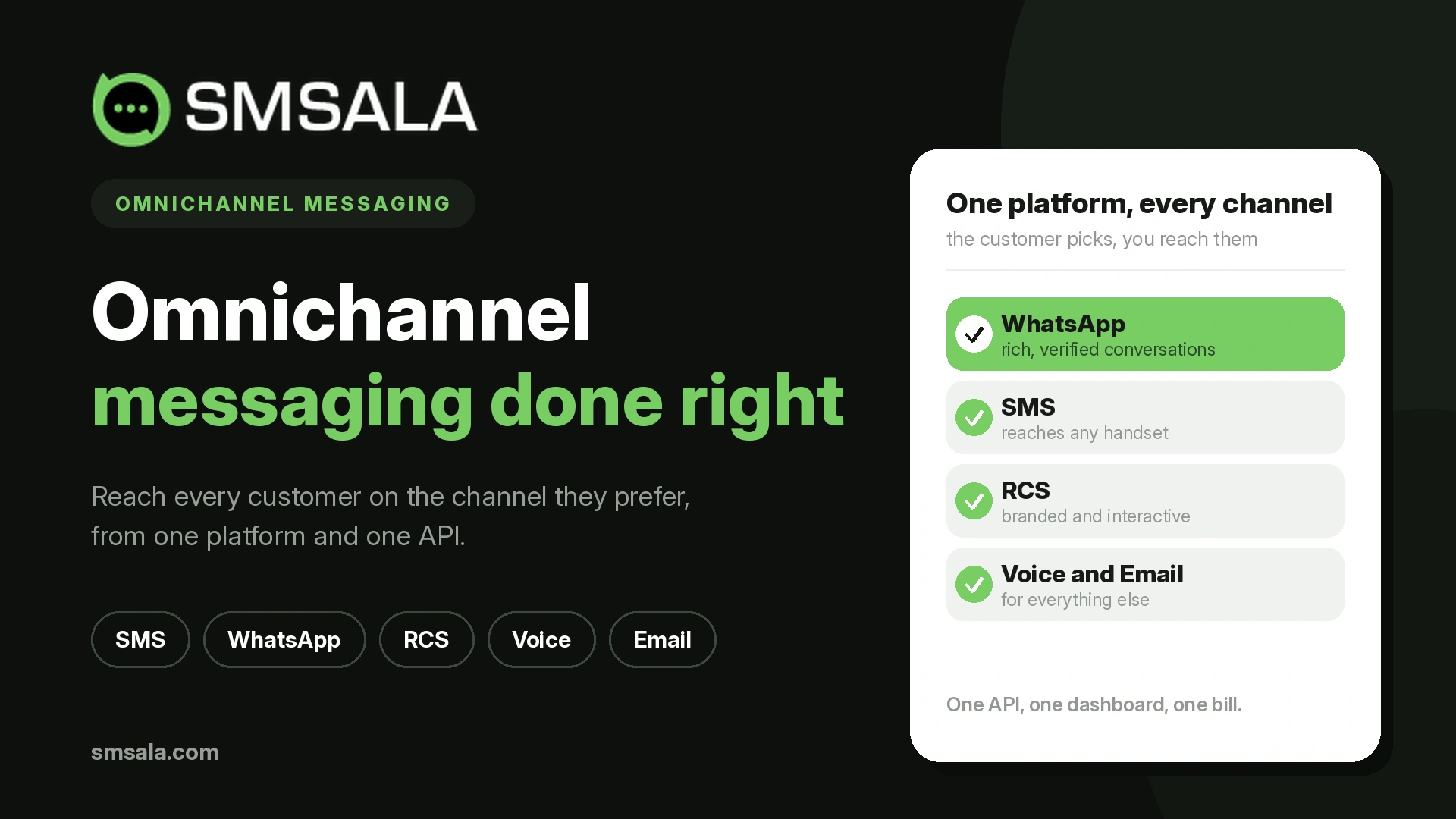
Adding channels is easy. Any business can put itself on SMS, WhatsApp, email, and a web chat widget in an afternoon. The hard part, and the part that separates real omnichannel messaging from a longer list of logos on a website, is making those channels behave as a single conversation instead of four disconnected ones.
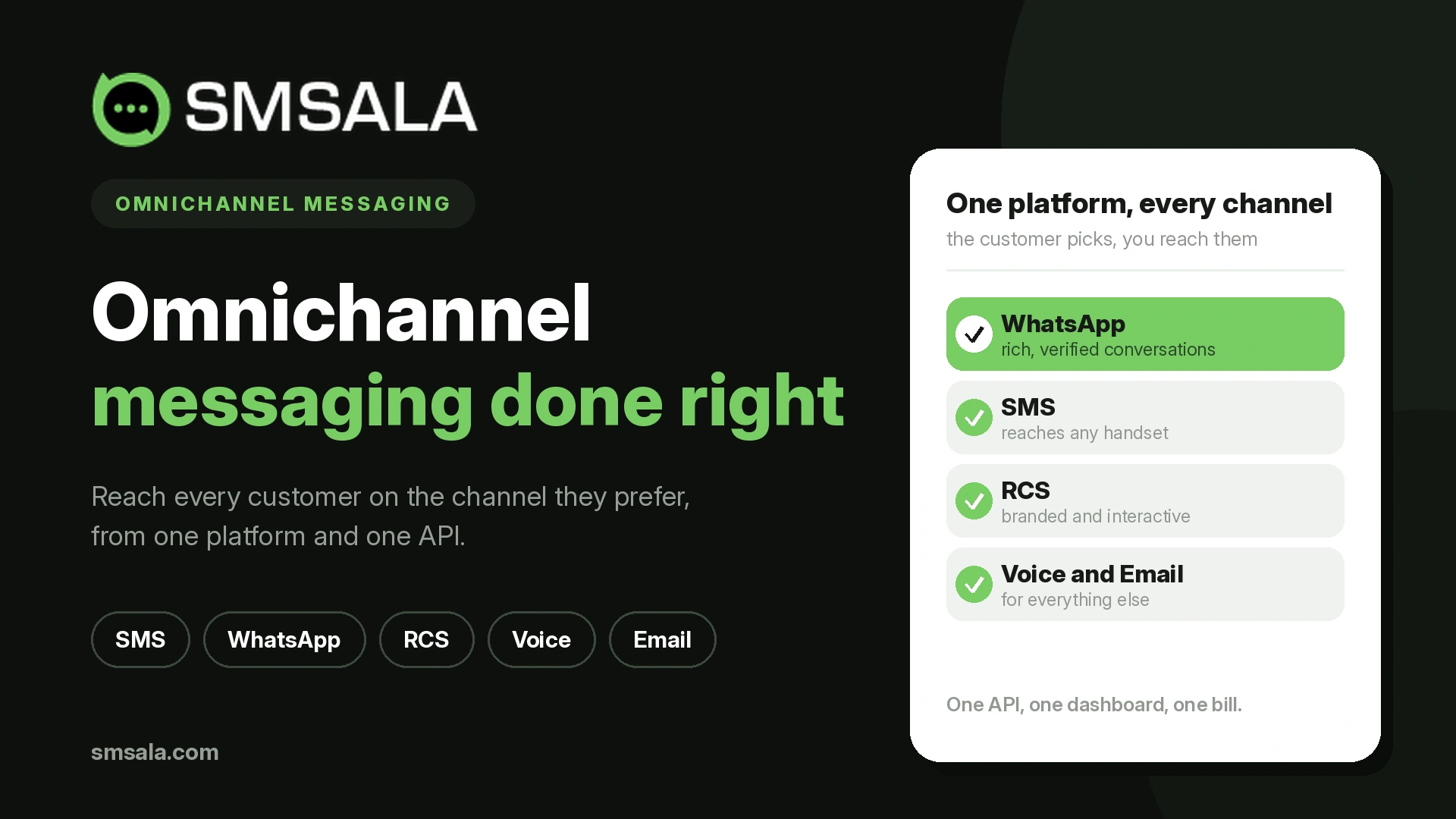
Most guides on this topic describe omnichannel as "be everywhere your customers are." That advice is not wrong, but it stops exactly where the difficulty begins. Being everywhere is multichannel. Being everywhere while remembering who the customer is, what they asked yesterday, and where the conversation left off, regardless of which channel they use next, is omnichannel. This article is about the mechanics that make that possible, because the concept is simple and the execution is where businesses get stuck.
The litmus test: omnichannel or just multichannel?
Skip the abstract definitions. Here is a test you can apply to your own setup in one question: if a customer starts a conversation on WhatsApp and continues it over SMS an hour later, does the second channel know about the first?
If the answer is yes, the customer is recognized, the history carries over, and whoever or whatever responds has the full context, that is omnichannel. If the answer is no, if your SMS system has never heard of the WhatsApp thread, you have multichannel with better branding. The presence of many channels is not the deciding factor. The continuity of the conversation across them is.
Multichannel | Omnichannel | |
Channels available | Many | Many |
Customer data | Separate per channel | Unified in one profile |
Conversation history | Trapped in each channel | Follows the customer |
Experience | Restart on every channel | Continuous across all |
Almost every deployment that calls itself omnichannel is actually sitting in the left column. Recognizing that is the first step, because the fix is not more channels. It is unifying the data behind the ones you already have.
The first hard problem: knowing it is the same person
The reason continuity is difficult comes down to identity. A customer is not one identifier to your systems. On SMS and WhatsApp they are a phone number. On email they are an email address. On a social channel they are an account handle. On your website they might be a cookie or a login. The same human wears a different name on every channel, and nothing automatically connects them.
Unifying that into a single customer profile, a process usually called identity resolution, is the real engineering behind omnichannel, and it is what the marketing glosses over. Until a phone number, an email, and a chat handle are tied to one record, the conversation cannot follow the person, because your systems do not yet know it is the same person.
Getting this right depends on a few things:
A single source of truth. One profile per customer that every channel reads from and writes to, rather than each channel keeping its own version. This is where a well-integrated CRM or customer data platform becomes the backbone of the whole effort.
Reliable matching. A way to link identifiers as you learn them, for example capturing both phone and email at signup so later interactions can be attributed to the right profile.
Shared conversation history. Every message, inbound and outbound, logged against that one profile so context is available no matter where the next message arrives.
Get identity resolution right and continuity becomes possible. Get it wrong and no amount of channel coverage will produce a joined-up experience
The second hard problem: deciding which channel and when
Once you know who the customer is, you face the orchestration question: given a message to send, which channel should carry it, and what happens if that channel fails? "Intelligent routing" gets named in every article and explained in almost none. Here is the actual logic.
Channel selection usually weighs three factors. Customer preference comes first, since messaging someone where they have chosen to engage respects both their wishes and, often, their consent. Urgency and content come next, because a rich, non-urgent promotion suits a media-capable channel while a time-critical passcode needs the fastest, most universal one. Cost is the tiebreaker, as channels differ in price and the cheapest reliable option wins when the first two are equal.
The piece that makes orchestration genuinely useful is fallback, sending on a preferred channel and automatically trying another when delivery does not succeed. A common cascade for a critical message looks like this:
Attempt the rich, preferred channel first, for example, the WhatsApp Business API, which supports branded, interactive messages.
If it is not delivered within a set window, fall back to SMS for its near-universal reach.
If SMS also fails and the message is important enough, escalate to a voice call.
Fallback is what turns several channels into one resilient delivery system. It depends on honest delivery signals, which is why clean routing and accurate deliverability data underpin the whole cascade. A fallback triggered by a false "delivered" status never fires when it should, so the orchestration is only as good as the delivery information feeding it.
The channel realities that complicate "unified"
The word "seamless" hides an inconvenient truth: each channel has its own rules, and a real omnichannel design has to respect them rather than pretend they are interchangeable.
Channel | Reach and richness | Key operational constraint |
SMS | Universal, plain text | Reply capability and sending depend on number type and registration |
WhatsApp Business API | Wide, rich, interactive | Free-form replies only within a service window; templates required outside it |
RCS | Rich, branded, growing | Depends on device and carrier support |
Universal, long-form | Deliverability and spam filtering; slower cadence | |
Web and app chat | Rich, real-time | Only works while the customer is on your property |
The practical implication is that orchestration cannot treat channels as identical pipes. Sending a follow-up over WhatsApp outside its service window requires an approved template, not free text. Pushing to RCS messaging assumes the recipient's device supports it, with a fallback ready when it does not. A design that ignores these rules produces failed sends and compliance problems, not a seamless experience.
Consent does not travel between channels
This is the compliance trap that abstract guides skip. Permission is granted per channel, and consent on one does not automatically authorize another. A customer who opted in to SMS has not thereby agreed to WhatsApp marketing, and an email subscriber has not consented to texts.
Each channel also carries its own rulebook. SMS marketing depends on documented opt-in and, in some markets, sender registration. WhatsApp requires opt-in and adherence to its business policy. Email has its own consent and unsubscribe laws. An omnichannel program therefore needs consent tracked at the channel level within that unified profile, so the system knows not just who the customer is but which channels it is actually permitted to use for them. Getting this wrong does not just annoy people, it creates legal exposure that multiplies with every channel you add.
A realistic path, not a big-bang rollout
The failure pattern is trying to launch everything at once. A more reliable path builds the foundation first and adds reach deliberately.
Unify the profile before adding channels. Establish the single customer record and identity resolution first. Without it, every channel you add deepens the silo problem.
Start with the channels customers actually use. Two or three well-integrated channels beat six disconnected ones. Add based on real customer behavior, not on completeness for its own sake.
Connect through one integration point. Rather than wiring each channel separately, many businesses use a single SMS API and messaging platform that exposes multiple channels through one connection, which keeps orchestration and logging consistent.
Layer in automation and routing. Add a chatbot to handle common interactions across channels, with clean handoff to people, and build your fallback rules.
Measure continuity, then optimize. Use unified analytics and reporting to see whole-customer journeys rather than per-channel vanity metrics.
Each step delivers value on its own, and each makes the next one easier.
When you do not need omnichannel
Omnichannel is a means, not a merit badge. If your customers reach you happily on one or two channels and conversations rarely span more than one, a solid setup on those channels serves you better than an elaborate orchestration layer you do not need. The investment pays off when customers genuinely move between channels and expect continuity, or when fragmented conversations are costing you resolution time and satisfaction. Build it because the customer journey demands it, not because a checklist says you should be everywhere.
Frequently asked questions
What is the difference between omnichannel and multichannel messaging?
Multichannel means being present on many channels that operate independently. Omnichannel means those channels share a unified customer profile and conversation history, so the experience continues wherever the customer goes. The test is whether a conversation started on one channel is visible and continuable on another.
Do I need every messaging channel to be omnichannel?
No. Omnichannel is about integration, not quantity. Two or three channels that share customer data and context deliver a better experience than many channels operating in silos. Add channels based on where your customers actually are.
What is the hardest part of implementing omnichannel messaging?
Identity resolution, tying a customer's different identifiers across channels into one profile so the conversation can follow them. Adding channels is straightforward; unifying the data behind them is the real work.
How does channel fallback work?
The system attempts a preferred channel first and, if delivery fails within a set time, automatically tries another, often cascading from a rich channel to a more universal one and finally to voice for critical messages. It relies on accurate delivery signals to know when to escalate.
Does opting in on one channel cover the others?
No. Consent is channel-specific. An SMS opt-in does not authorize WhatsApp or email, and each channel has its own compliance rules. Track permission per channel within the unified customer profile.
The takeaway
Omnichannel messaging is not a wider net of channels. It is the discipline of making the channels you already use recognize the same customer and carry one continuous conversation between them. That rests on two things the marketing rarely names: a unified profile built through identity resolution, and orchestration that chooses channels intelligently and falls back gracefully when one fails. Solve those, respect each channel's own rules and consent, and you get the experience customers actually want, which is not to be reached everywhere, but to be remembered anywhere. A provider that delivers multiple reliable channels through one integrated platform, such as SMSala, is what makes that continuity practical to build rather than a permanent project.