
"Which is better, SMS or email?" is a question with no good answer, because it's the wrong question — a bit like asking whether a phone call is better than a letter. It depends entirely on what you're trying to say and how fast it needs to land. A phone call is better for "the meeting's moved to now"; a letter is better for a detailed contract. Neither is "better" in the abstract. SMS and email are the same: two channels with genuinely opposite strengths, each excellent at what the other is bad at.
So the useful question isn't which channel wins — it's which message goes on which channel, and why. And the answer comes down to two things most comparisons never spell out: the opposite physics of the two channels (one spacious and slow, one brief and immediate), and their opposite economics (one near-free but easy to ignore, one costly but almost certain to be read). Once you understand both, the choice for any given message becomes obvious, and the "use both" advice everyone gives finally comes with instructions for how. Here's the decisive version.
The two channels have opposite physics
Start with the fundamental difference, because everything else follows from it. Email and SMS are built on opposite trade-offs.
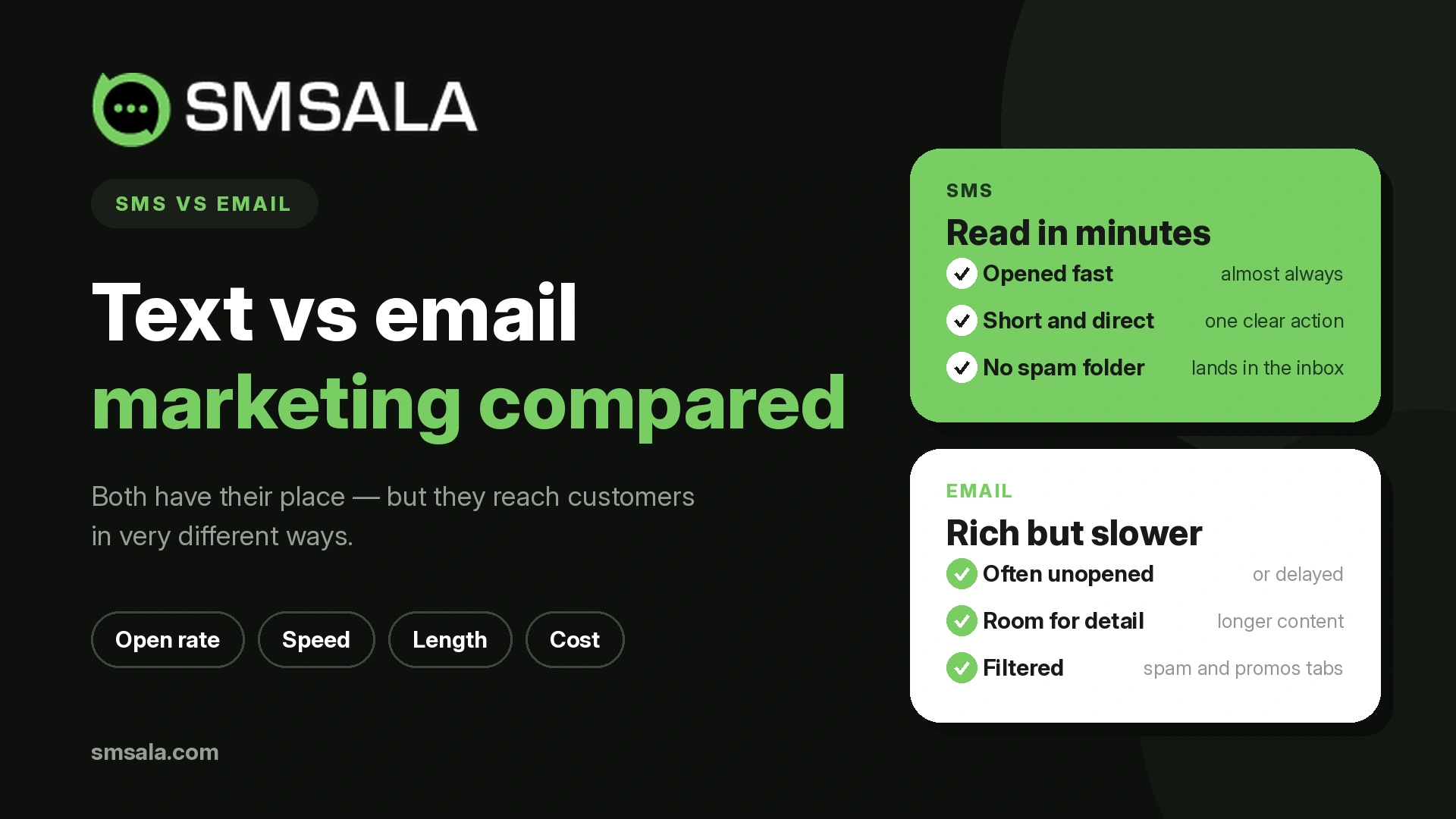
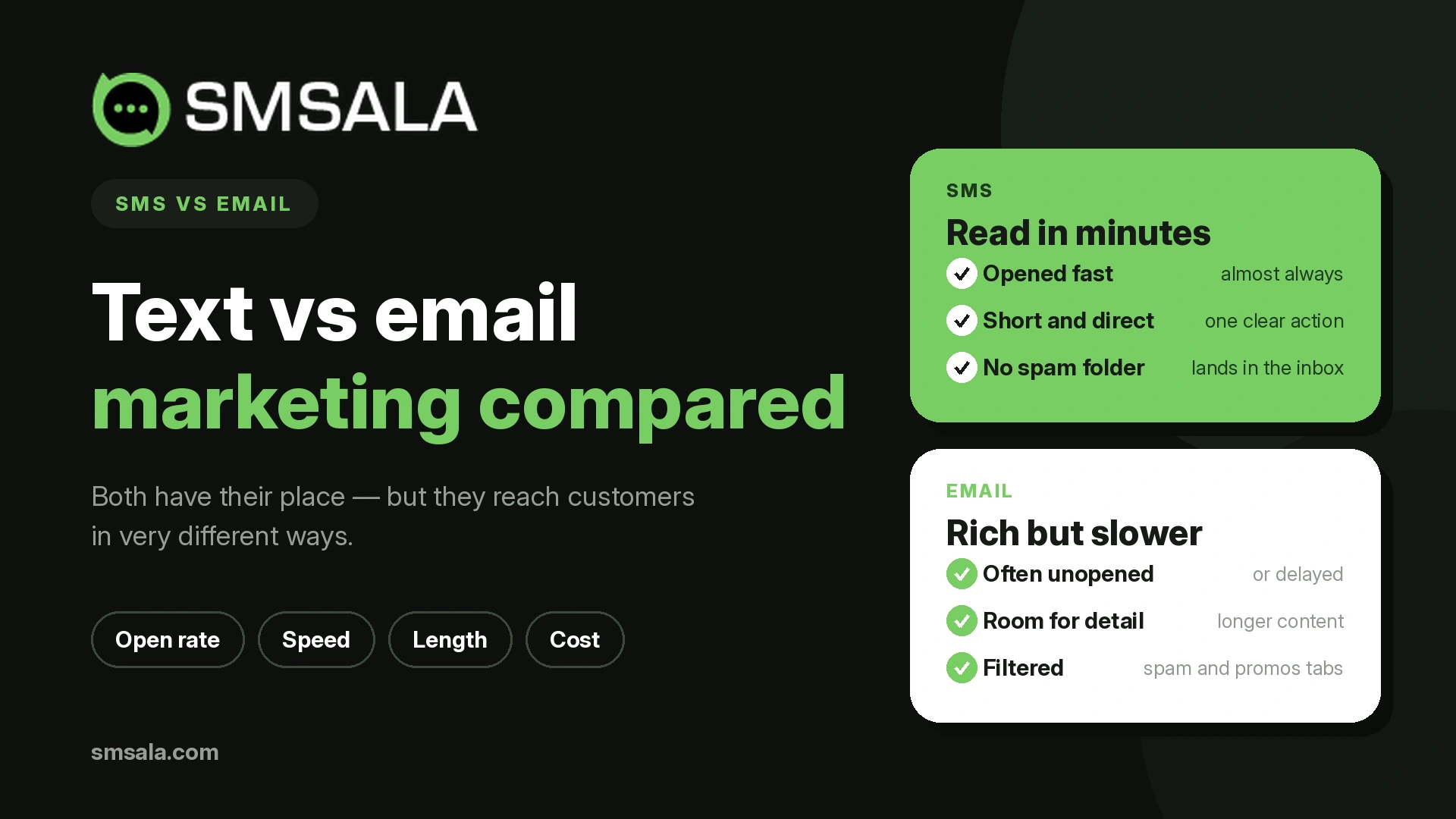
Email is spacious and slow. It can carry as much as you like — long copy, images, video, links, rich formatting, full brand design. But it arrives in an inbox people treat as a task list, often processed hours later if at all, competing with dozens of other emails and filtered through promotions tabs and spam folders. Room to say everything; no guarantee it's seen soon, or at all.
SMS is brief and immediate. It's tightly limited — a short text, no rich formatting. But it lands in the personal messaging space people check within minutes, triggers a notification they'll almost certainly see, and isn't filtered into a promotions folder. Almost no room; near-certain to be read, and read fast.
These aren't small differences of degree — they're opposite designs. Email trades immediacy for capacity; SMS trades capacity for immediacy. That single opposition is the key to the entire decision, because it means each channel is physically suited to different kinds of messages. Ask not "which is better" but "does this message need capacity or immediacy?" — and the channel picks itself.
What email is physically good at
Email's spaciousness makes it the right home for messages that need room, depth, or visual richness:
Detailed content — newsletters, product education, long-form storytelling, anything that needs explaining. Email's unlimited length lets you make the full case with examples, images, and context.
Visual, designed communication — rich layouts, galleries, video, branded templates. Email is a canvas; you can build a beautiful, elaborate message.
Brand-building — the space to convey identity, logo, voice, and design consistently, so the recipient recognises and absorbs the brand.
Non-urgent, reference material — receipts, records, guides, anything the recipient will keep and refer back to, where being read now doesn't matter.
Deep segmentation and content personalisation — email's capacity lets you tailor rich, varied content to different segments at length.
Email's weakness is the flip side: it's slow to be seen and easy to ignore. For anything time-sensitive, email's latency wastes the moment. So email wins wherever the value is in depth and richness and the timing doesn't matter — which is a large and important category, just not the urgent one.
What SMS is physically good at
SMS's immediacy makes it the right home for messages where being seen now is the whole point:
Time-sensitive messages — flash sales, limited offers, deadlines, anything that loses value if seen hours later. SMS's speed is the advantage.
Urgent alerts and reminders — appointment reminders, status updates, anything the recipient needs promptly.
High-priority, must-be-seen messages — the important things that can't afford to sit unread in an inbox.
Short, action-driving nudges — a quick prompt with a link, designed to trigger immediate action while intent is warm, which is why SMS drives strong response rates on the right messages.
Reaching people without reliable internet or email habits — SMS reaches any phone, read by people who rarely open marketing email.
SMS's weakness is the flip side: no room for depth, and a cost per message that email doesn't have. For anything long, visual, or non-urgent, SMS is the wrong tool — you can't fit it, and you'd be paying for immediacy the message doesn't need. So SMS wins wherever the value is in speed and certainty of being seen — the urgent, the brief, the important.
The economics nobody compares: the cost of certainty
Here's the dimension most SMS-vs-email comparisons skip entirely, and it sharpens the whole decision. The two channels have opposite economics, not just opposite physics.
Email is near-free at scale — sending to a hundred thousand people costs little more than sending to a thousand. But that cheapness comes paired with uncertainty: much of it goes unread, unseen, filtered away. You pay almost nothing and you get almost no guarantee.
SMS is costly per message — every recipient costs you real money, and it doesn't get cheaper the way email does. But that cost comes paired with certainty: SMS is read, within minutes, by nearly everyone you send to. You pay meaningfully and you get near-guarantee of attention.
So the real economic question for any message isn't "which channel is cheaper" (email always is, per message) — it's "is this message worth paying for certainty?" For a routine newsletter, no — email's cheap uncertainty is fine, because it doesn't matter if some people miss it. For a flash sale ending tonight, yes — the message is worthless if unseen in time, so SMS's costly certainty is exactly what you're paying for and it's worth it. This reframes the choice powerfully: email is for messages where you can afford to be ignored; SMS is for messages where you can't. The cost of SMS is the price of certainty, and you pay it for the messages that justify it. Understanding this stops marketers from either wasting SMS's expensive certainty on messages that don't need it, or losing important messages to email's cheap uncertainty.
The decisive rule: route by message, not by channel loyalty
Putting physics and economics together gives a decisive rule, no hedging:
Short + urgent + must-be-seen → SMS. The message is brief, its value depends on being read now, and you can't afford it to be missed. Pay for certainty.
Long + rich + non-urgent → email. The message needs room or visual depth, and timing doesn't matter, so cheap capacity beats costly immediacy.
Apply this test to any message — does it need capacity or immediacy, and can it afford to be ignored? — and the channel is clear. A flash sale: short, urgent, can't be missed → SMS. A monthly newsletter: long, non-urgent, survivable if missed → email. An order confirmation: short and wanted immediately → SMS. A detailed product launch: rich and explanatory → email (with, perhaps, a short SMS nudge pointing to it). The skill isn't loyalty to one channel; it's routing each message to the channel its nature demands. Marketers fail when they force everything through their preferred channel — cramming a newsletter into SMS (impossible and expensive) or sending a flash sale by email (seen too late). Route by message, and both channels do what they're good at.
How to use them together
"Use both" is the right conclusion — but it means divide the work, not duplicate it. The two channels used well form a division of labour where each carries the messages it suits:
Email carries the depth — newsletters, education, rich promotions, brand-building, records. SMS carries the urgency — time-sensitive offers, reminders, alerts, must-be-seen nudges. And they reinforce each other: email can host the rich content that a short SMS points people to; SMS can reach the people who didn't open an important email. The mistake to avoid is running them as two parallel channels that both blast every message — that doubles your cost and your customers' annoyance without doubling results. Instead, assign each message to one channel by the routing rule, and reserve using both for the rare message important enough to justify it. Done this way, the channels complement rather than compete, and the customer experiences a coherent programme rather than two overlapping ones. This coordinated use is what any mature SMS marketing programme aims for alongside its email.
Which has better ROI?
A decisive answer, since it's the underlying concern: neither has universally better ROI — they have better ROI on different messages. SMS delivers exceptional ROI on urgent, high-intent, time-sensitive messages, because its costly certainty converts when timing matters. Email delivers strong ROI on nurture, education, and rich content at scale, because its cheap capacity lets you communicate depth to many people for little. The highest total ROI comes from using each where it's strong — routing urgent, conversion-focused messages to SMS (where they justify the cost) and depth-and-nurture to email (where cheap reach compounds). A business that measures honestly usually finds SMS wins on immediate conversion per campaign while email wins on cost-efficiency at scale, and that using both by the routing rule beats over-investing in either. The conversions SMS drives on the right messages are what justify its per-message cost; email's low cost is what justifies its lower per-message conversion on the right messages.
Mistakes marketers make choosing between them
Asking "which is better" — treating it as a loyalty choice rather than routing each message to its right channel.
Forcing everything through one channel — cramming depth into SMS or sending urgent messages by slow email.
Wasting SMS's certainty — paying for SMS on routine messages that email's cheap reach would handle fine.
Losing important messages to email — sending must-be-seen, time-sensitive messages by email and having them missed.
Running both as parallel blast channels — duplicating every message on both, doubling cost and annoyance.
Judging ROI channel-wide — comparing overall SMS vs email ROI instead of recognising each wins on different message types.
If you're deciding between text message and email marketing, the move that beats picking one is routing each message to the channel its nature demands — urgency and certainty to SMS, depth and reach to email. SMSala's bulk SMS marketing platform gives you the immediate, high-certainty channel for the messages that can't afford to be missed, working alongside your email to reach customers with the right message on the right channel.
FAQ
Which is better, SMS or email marketing?
Neither is universally better — they have opposite strengths and suit different messages. Email is spacious and cheap but slow and easily ignored, so it's best for detailed, rich, non-urgent content. SMS is brief and costly but immediate and almost certainly read, so it's best for short, urgent, must-be-seen messages. The right question is which message goes on which channel, not which channel wins.
When should I use SMS instead of email?
Use SMS when a message is short, time-sensitive, and can't afford to be missed — flash sales, urgent reminders, appointment alerts, high-priority nudges. SMS's near-certain, within-minutes readership is worth its higher per-message cost for these. Use email instead when the message is long, visual, or non-urgent, where email's cheap capacity beats SMS's costly immediacy.
Is SMS or email cheaper for marketing?
Email is cheaper per message and gets cheaper at scale, but much of it goes unread. SMS costs meaningfully more per message but is read by nearly everyone within minutes. So the real question isn't which is cheaper but whether a given message is worth paying for certainty — email for messages that can afford to be ignored, SMS for messages that can't.
Should I use both SMS and email marketing?
Yes, but as a division of labour, not duplication. Let email carry depth — newsletters, education, rich promotions — and SMS carry urgency — time-sensitive offers, reminders, alerts. They reinforce each other: email hosts rich content SMS points to, and SMS reaches people who didn't open an important email. Avoid blasting every message on both, which doubles cost and annoyance.
Which has better ROI, SMS or email?
Neither universally — they deliver better ROI on different messages. SMS produces strong ROI on urgent, high-intent, time-sensitive messages where its certainty converts. Email produces strong ROI on nurture and rich content at scale where its low cost compounds. The best total return comes from routing each message to the channel it suits rather than over-investing in one.
What's the main difference between SMS and email marketing?
Their opposite trade-offs. Email offers unlimited space but slow, uncertain readership; SMS offers almost no space but immediate, near-certain readership. Email trades immediacy for capacity, SMS trades capacity for immediacy. This is why they suit different messages — depth and richness go to email, speed and certainty go to SMS.