
"Start a bulk SMS business — low investment, high returns, work from anywhere." You've seen the pitch. What it conveniently skips is that there are two completely different businesses hiding under that one phrase, with wildly different costs, risks, technical demands, and ceilings — and choosing the wrong one either wastes serious money or quietly caps how far you can grow. One path lets you start this week with a few thousand and someone else's infrastructure. The other requires real capital, telecom relationships, and technical depth, but gives you independence and far higher margins. They are not the same business, and the single most important decision you'll make is which one you're actually starting.
Most guides gloss over this. They mention "reseller or direct," declare reseller easier, and move on — leaving you to discover the real trade-offs the expensive way. This guide treats the choice as what it is: the foundational decision that shapes everything else. It lays out honestly what each path involves, gives you a framework to decide which fits your capital, skills, and ambition, and maps the realistic route many take — starting as a reseller and going direct as they scale. Plus the honest expectations the "high returns" pitch omits, because this is a genuine business, not a passive income scheme.
What an SMS business actually is
Briefly: an SMS business sells bulk messaging capacity to other businesses — the companies that want to send marketing, alerts, OTPs, and notifications to their customers but don't want to build the infrastructure themselves. You provide the platform and the message delivery; they pay you per message or per package. The demand is real and durable — messaging has been a core business tool for years, not a passing fad — which is why it's an attractive sector to enter.
The messages divide into promotional (marketing) and transactional (OTPs, alerts, confirmations), and understanding both matters because your customers will send both and they're treated differently by carriers and regulators. But the what is the easy part. The decision that determines whether your SMS business succeeds — and how big it can get — is how you deliver that capacity, which brings us to the two paths.
The two paths: reseller vs direct
There are two fundamentally different ways to run an SMS business, and they're different businesses wearing the same name.
The reseller path. You buy messaging capacity wholesale from an established provider and resell it to your own customers under your own brand (white-label), at your own prices. You don't own or operate any infrastructure — the provider handles the platform, the carrier connections, and the delivery, while you handle sales, pricing, and customer relationships. Low cost, fast to start, minimal technical requirement.
The direct path (SMPP). You build your own messaging infrastructure — hosting an SMPP server and establishing your own direct connections and commercial agreements with telecom carriers — and sell capacity to businesses without any intermediary. You own the whole operation. High cost, technically complex, slow to establish, but fully independent with much higher margins because you're not paying a wholesaler's markup.
The core distinction: the reseller builds on someone else's infrastructure; the direct operator builds their own. Everything that differs between the two paths — cost, risk, margin, control, technical demand, time to launch — flows from that one difference. And the right choice depends entirely on what you're bringing to the table, which is why the honest picture of each matters before you decide.
What going direct (SMPP) actually involves
The direct path gets waved off as "for established players only," which is true but unhelpfully vague. Here's what it genuinely requires, because underestimating it is expensive.
Going direct means becoming, in effect, a small telecom operation. You need to establish direct commercial relationships with carriers — negotiating agreements and interconnects, which requires credibility, volume commitments, and often deposits or guarantees carriers demand before dealing with you. You need to build and operate SMPP infrastructure — an SMPP gateway is the telecom-native protocol that connects you to carrier networks, and running it means real technical infrastructure, uptime responsibility, and the expertise to manage it. You need significant capital — far more than reselling, to cover infrastructure, carrier commitments, and the runway before volume justifies the outlay. And you need telecom and routing expertise — understanding routes, delivery quality, managing multiple carrier connections, and handling the operational complexity of message delivery at scale.
The payoff for all this is real: much higher margins (no wholesaler taking a cut), full control over routing and quality, independence from any provider, and the ability to become a wholesaler yourself, selling to resellers. But the barrier is genuinely high — this is a capital-intensive, technically demanding, slow-to-establish business suited to those with the resources, expertise, and volume to justify it. Most people starting an SMS business are not ready for this on day one, and that's fine — it's often where you grow to, not where you start.
What reselling actually involves
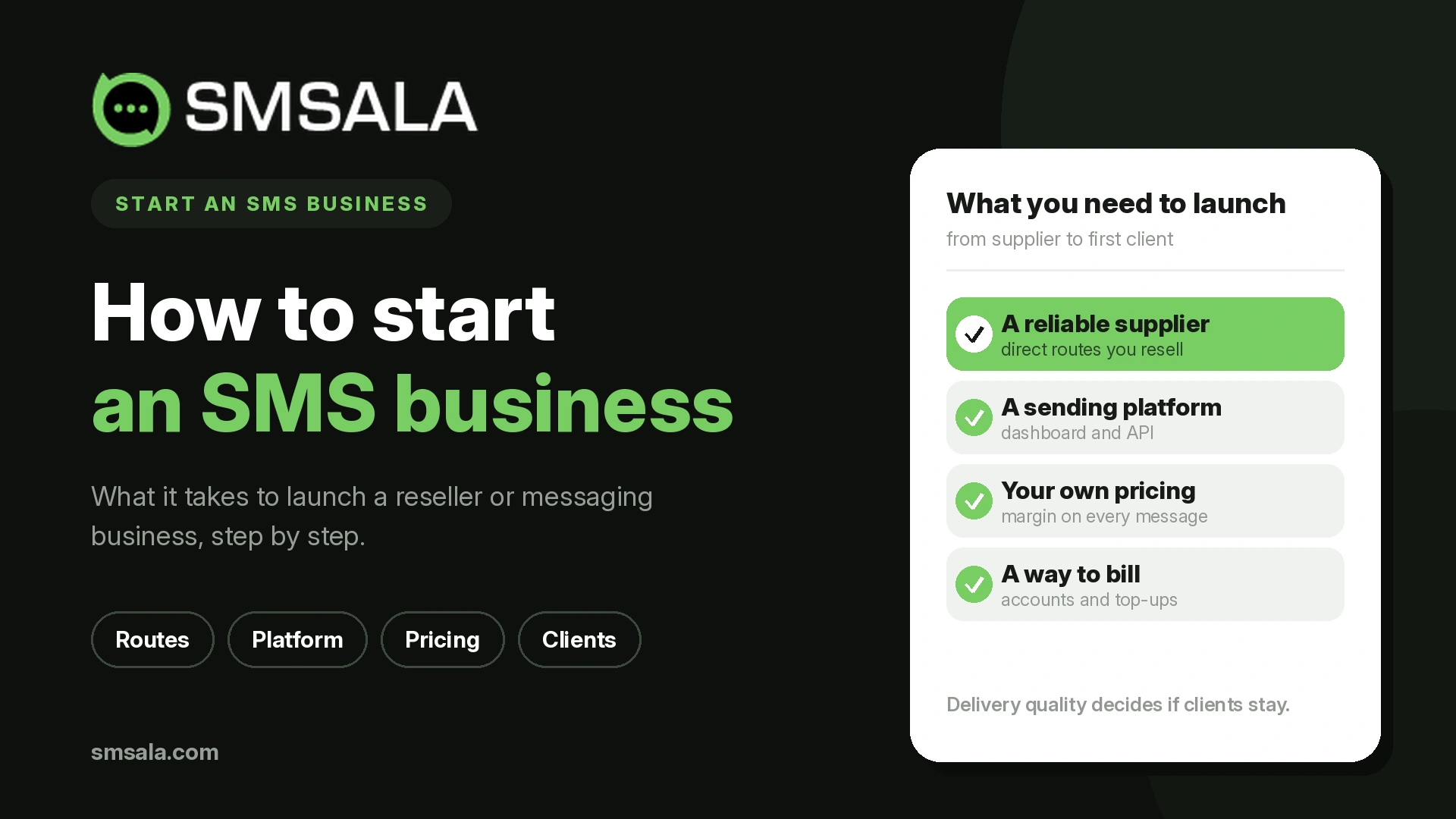
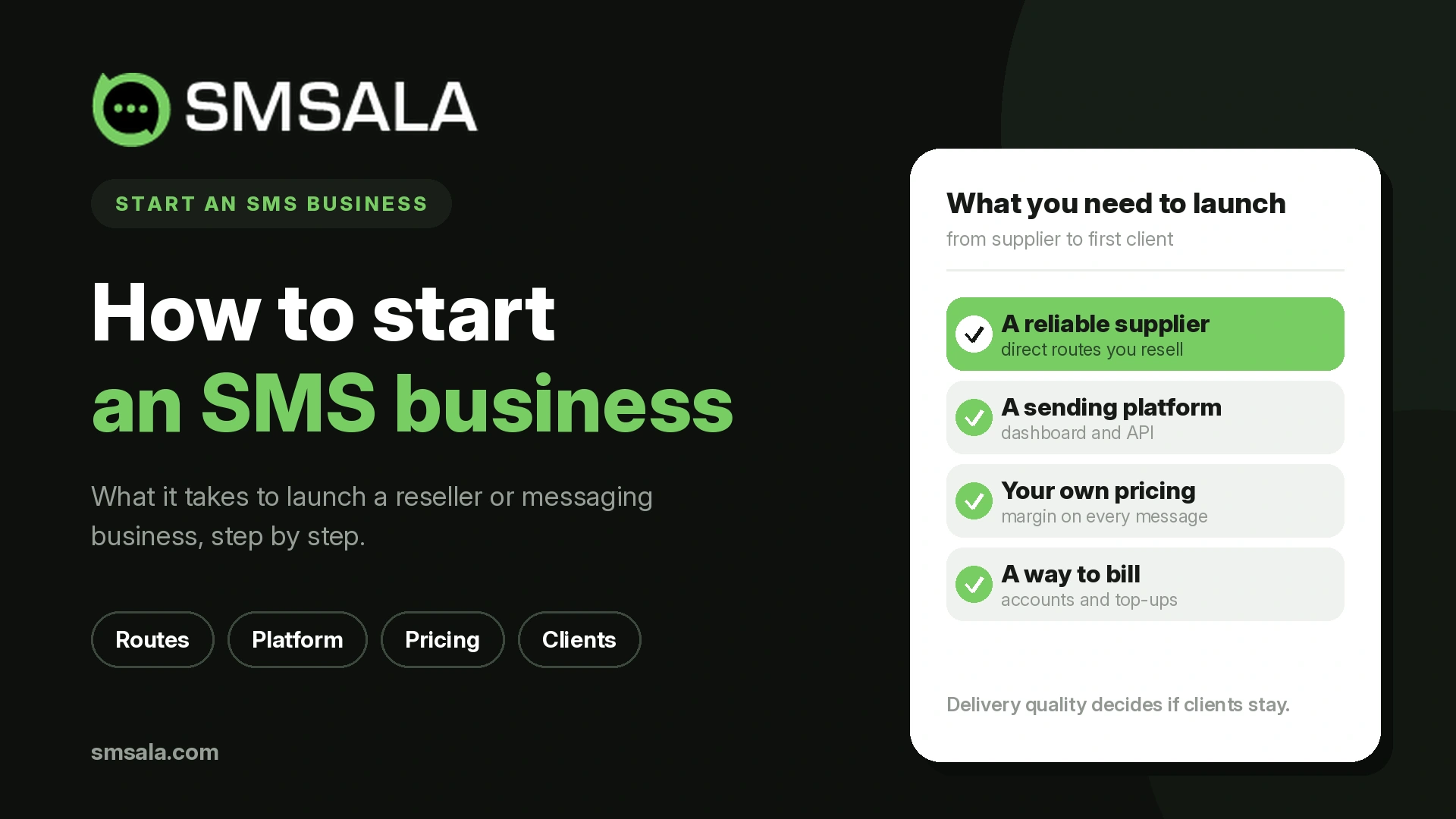
The reseller path is the accessible entry point, and its mechanics deserve their own full treatment — which they've had. In short: you choose a wholesale provider, buy credits at volume rates, brand their platform as your own, set your prices, and sell to customers, keeping the margin between wholesale and retail. Startup cost is minimal (essentially your first credit purchase and a website), setup is fast, and there's no infrastructure to build or maintain.
The crucial thing to understand about reselling — and the reason it's not as effortless as the pitch suggests — is that you inherit your provider's delivery quality entirely, because you're reselling their infrastructure under your name. Their reliability becomes your reputation, and their failures become your lost customers. That, plus the real margin mechanics and the honest "who it's for," is covered fully in our guide to becoming a bulk SMS reseller, which is worth reading before you commit to this path. For the purposes of this decision, the key point is that reselling is low-cost, fast, and accessible — but dependent, thin-margined, and reliant on choosing an excellent provider.
Which path is right for you?
Here's the decision framework the "reseller is easier" hand-waving never gives you. Choose your path by honestly assessing four things:
Capital. Do you have a few thousand, or real investment capital? A few thousand → reseller. Substantial capital → direct becomes possible.
Technical capability. Can you build and run SMPP infrastructure and manage carrier routing, or do you have no telecom/technical background? No technical depth → reseller. Strong technical/telecom capability → direct is viable.
Risk tolerance and timeline. Do you want to start fast with low risk, or can you absorb a longer, riskier build for a bigger payoff? Fast and low-risk → reseller. Willing to invest and wait → direct.
Ambition and scale. Do you want an additional income stream or side business, or to build a large, independent messaging operation? Side business → reseller. Large independent operation → direct (eventually).
The honest guidance: almost everyone starting an SMS business should start as a reseller. Unless you already have significant capital, telecom expertise, and the volume to justify carrier relationships, reselling is the sensible entry — it lets you enter the market, learn the business, and build a customer base with minimal risk. The direct path is where you go once you've proven demand and outgrown the reseller model, not where a newcomer begins. Choosing direct prematurely burns capital on infrastructure before you have customers to fill it; choosing reseller when you genuinely have the resources for direct caps your margins unnecessarily. Match the path to your honest reality, and for most that reality points to reseller first.
The realistic growth path: reseller now, direct later
The two paths aren't permanent either/or — they're often stages. The realistic trajectory for a successful SMS business is to start as a reseller and graduate to direct as you scale.
Here's why this sequence makes sense. As a reseller, you build a customer base and learn the business with low risk. As your volume grows, two things happen: your margins get squeezed (you're paying the wholesaler's markup on ever-larger volume), and you accumulate the customer base and revenue that would justify your own infrastructure. At that point, going direct — building your own SMPP connections and carrier relationships — starts to pay off, because you now have the volume to negotiate carrier deals and the revenue to fund infrastructure, and you eliminate the wholesaler's cut on all your traffic. So the natural path is: prove the business as a reseller, then invest in going direct once your scale justifies it. This staged approach lets you enter cheaply, de-risk by validating demand first, and invest in the capital-intensive direct model only when you have the evidence and revenue to support it. Understanding this trajectory keeps you from either over-investing too early or staying a thin-margin reseller longer than you need to.
Honest expectations: is this a real business?
The "high returns, low investment" pitch sets false expectations, so here's the honest version of what to expect.
It's volume-driven. Your earnings depend directly on how many paying, sending customers you have. More clients sending more messages, more income — which means it's a sales business, and revenue starts modest and grows with your customer base.
Margins are thin, especially early and especially as a reseller. The per-message margin is small; you make money on volume, and the reseller path means sharing profit with your wholesaler. This isn't a high-margin business, particularly at the start.
Support is your differentiator. In a competitive market where many offer similar services, how well you support customers determines who stays. Poor support loses clients fast; strong support and reliability are how you compete without racing to the bottom on price.
It's active, not passive. Income tracks directly to customers acquired and retained — this is a business you work, not a set-and-forget income stream.
None of this means it's a bad business — it's a legitimately viable one with low entry cost and durable demand. But it rewards effort, sales skill, and reliability, not passive hope. Enter it as a real business and it can genuinely become a solid income stream, especially as you scale and eventually go direct.
How to start
Mapped to the path you've chosen (reseller for most):
Survey the market. Research providers offering reseller packages, and understand the competitive landscape — what's offered, at what prices, with what quality. A look at the top bulk SMS providers helps you see the field.
Compare on delivery and rates — not just price. Compare wholesale rates and delivery quality, because as a reseller you inherit your provider's reliability. The cheapest wholesale rate bought with poor delivery is the most expensive mistake you can make.
Prioritise support quality. Choose a provider known for strong support, since you'll rely on them when your customers have issues — their support is effectively your support.
Choose a white-label reseller package. So you operate under your own brand with the provider invisible behind you — essential for building your own identity. Assessing this properly is part of learning how to choose the best SMS panel for your business.
Build a professional website. Your storefront and credibility — where customers find you, understand your offering, and sign up.
Launch and market. Announce your arrival and start selling (below).
For the direct path, the steps differ substantially — carrier negotiations, SMPP infrastructure setup, routing configuration — reflecting the greater complexity, and are a project on a different scale.
Finding your first customers
An SMS business is only a business when it has customers, so customer acquisition is the real work. Target the sectors that send heavily and consistently — banks, hotels, restaurants, educational institutions, airlines, e-commerce, and any business running regular SMS marketing or transactional messaging. These are the high-volume clients worth most to you. Reach them through a professional web presence and SEO, direct outreach, local business networks, and referrals. Compete on reliability and service rather than lowest price, since the cheapest provider wins the least loyal customers. And remember one steady high-volume client is worth many small occasional ones — focus your effort on acquiring and keeping the businesses that send in volume.
Mistakes people make starting an SMS business
Choosing the wrong path — going direct prematurely and burning capital, or staying reseller past the point where direct would pay off.
Choosing a wholesale provider on price alone — inheriting poor delivery that becomes your reputation.
Expecting passive income — treating it as set-and-forget when it's an active sales-and-service business.
Neglecting support — losing customers in a competitive market by under-serving them.
Racing to the bottom on price — winning only price-sensitive, disloyal customers on unsustainable margins.
No clear customer focus — chasing any customer instead of targeting the high-volume sectors worth most.
FAQ
How do I start an SMS business?
Most people start as a reseller: choose an established wholesale provider, buy messaging capacity at volume rates, brand their platform as your own (white-label), set your prices, and sell to businesses. This requires little capital, no infrastructure, and can start quickly. The alternative — going direct by building your own carrier connections and SMPP infrastructure — needs significant capital and technical expertise.
What are the two ways to start a bulk SMS business?
The reseller path (buying capacity wholesale and reselling it under your brand on someone else's infrastructure — low cost, fast, dependent) and the direct path (building your own SMPP server and carrier relationships — high cost, complex, independent, higher margins). The core difference is whether you build on someone else's infrastructure or your own, and that shapes everything about the business.
Which is better, reseller or direct SMS business?
For almost everyone starting out, reseller is better — it's low-risk, low-cost, and fast, letting you enter the market and build customers without major investment. The direct path suits those who already have significant capital, telecom expertise, and volume. Many successful operators start as resellers and graduate to direct as they scale and their volume justifies owning infrastructure.
How much money do I need to start an SMS business?
As a reseller, very little — essentially the cost of your first wholesale credit purchase and a professional website, often just a few thousand. The direct path requires far more: capital for SMPP infrastructure, carrier commitments and deposits, and runway before volume justifies the outlay. The low entry cost of reselling is why most newcomers start there.
Is an SMS business profitable?
It can be, but it's volume-driven with thin margins, especially early and as a reseller. Earnings depend directly on how many paying, high-volume customers you acquire and keep, making it an active sales-and-service business rather than passive income. Margins improve with scale and if you eventually go direct, eliminating the wholesaler's cut. Strong support and reliability are how you compete and grow.
Can I start as a reseller and become a direct provider later?
Yes, and it's the common growth path. Start as a reseller to build a customer base and learn the business at low risk, then invest in going direct once your volume justifies your own carrier relationships and infrastructure. This staged approach lets you validate demand cheaply before committing the capital that the direct model requires.