
An SMS gateway is the system that connects a business application to the mobile networks that deliver text messages. It sits between the software sending a message, whether a website, a CRM, or a custom app, and the carriers that terminate that message on a phone, translating between the two so they can communicate. Without a gateway, an application has no way to reach the telecom networks that actually carry SMS. Every automated text a business sends, from a passcode to a promotion, passes through one.
The gateway is easy to overlook because it is invisible to the end customer, yet it decides more about messaging performance than almost any other component. The protocols it speaks, the routes it uses, the way it reports delivery, and how it handles failure all shape whether messages arrive quickly and reliably or slowly and inconsistently. Understanding what a gateway is and how it works is the foundation for choosing one that will not quietly cost a business money and reach.
What an SMS gateway actually does
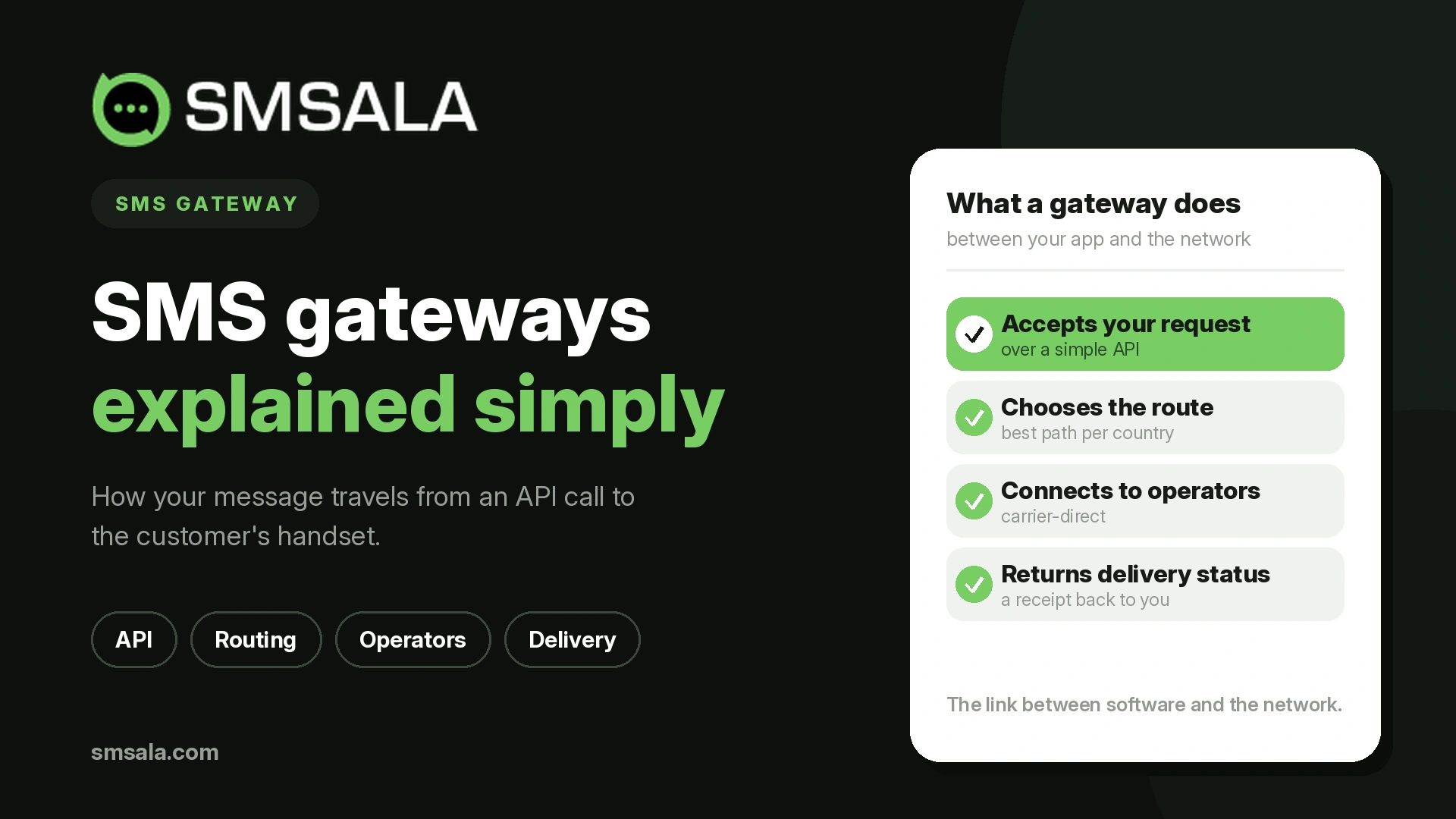
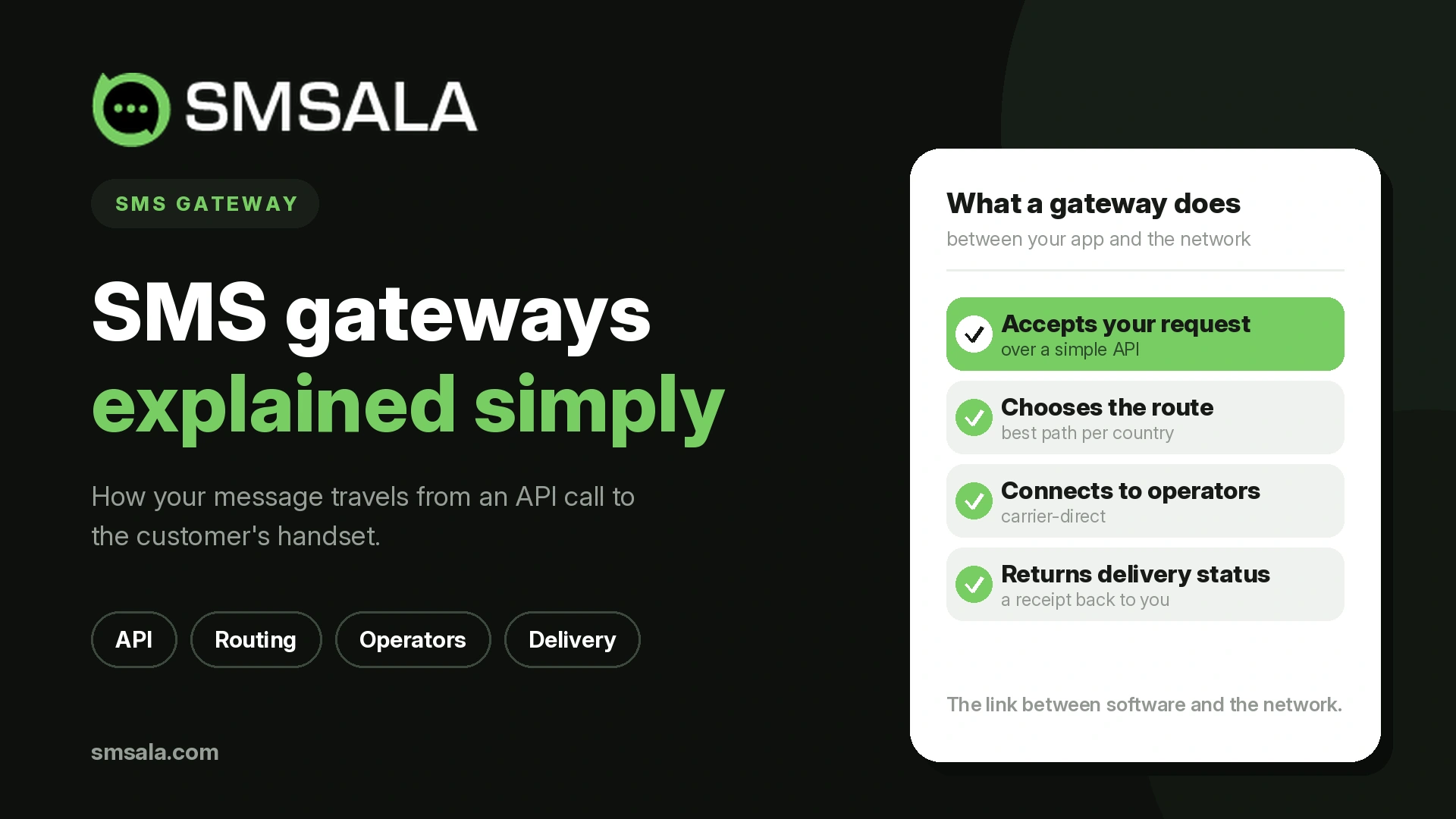
At its core, an SMS gateway is a translator and a router. Business applications speak the language of the internet, using web protocols and APIs. Mobile networks speak the specialized language of telecom signaling. The gateway converts a message from one into the other, hands it to the right network, and passes back the result.
That translation role carries several responsibilities. The gateway accepts messages from applications, formats them correctly, including handling character encoding and splitting long messages into segments, selects a route to the destination carrier, submits the message, and returns a delivery receipt confirming what happened. For inbound traffic, it does the reverse, receiving replies and messages sent to a business number and passing them back to the application. In effect, it is the single door through which all of a business's SMS traffic enters and leaves the mobile networks.
How an SMS gateway works
The journey of a message shows why the gateway matters so much. When an application sends a text, it passes the message to the gateway over a connection method such as an API or a direct telecom protocol. The gateway prepares the message, choosing the encoding and breaking it into segments if needed, then routes it to an aggregator or directly to a mobile operator. The operator delivers it to the recipient's handset and returns a status back up the chain, which the gateway records as a delivery receipt.
Two points in this flow decide results. The route the gateway chooses determines reliability, because a message sent over a legitimate direct carrier route behaves very differently from one sent over a cheap grey route that can be blocked without warning. And the filtering it passes through matters, because carriers run SMS firewalls that inspect incoming traffic and silently drop anything that looks like spam or fraud. A capable gateway routes over clean paths and returns honest delivery reports, so a business can see what actually reached a handset rather than what was merely accepted.
The protocols behind a gateway
How an application connects to a gateway is a real decision, because the connection method shapes throughput, flexibility, and how much engineering the integration takes. There are a few standard options.
Connection method | What it is | Best suited to |
REST API / HTTP | Modern web-based connection using simple requests | Most businesses; fast to build, flexible, developer-friendly |
SMPP | The telecom industry's dedicated messaging protocol, a persistent binary connection | Very high, sustained volumes needing carrier-grade throughput |
SMTP / email-to-SMS | Sends SMS by sending an email to the gateway | Simple, low-volume needs and legacy systems |
Web interface | A dashboard to compose and upload messages by hand | Non-technical users sending campaigns manually |
For most modern integrations, a REST API is the natural choice because it is flexible and quick to build on. When volumes are very high and constant, an SMPP gateway provides the persistent, high-throughput connection carriers themselves use. For lighter or simpler needs, an HTTP API or even email-to-SMS can be enough. The right protocol depends on volume, technical resources, and whether messages must fire automatically from another system.
Outbound and inbound: one-way and two-way
A gateway handles traffic in both directions, and the distinction matters for what a business can do.
Outbound messaging is the familiar case: the application sends, the customer receives. This covers most alerts, passcodes, and campaigns. Inbound messaging lets customers send messages to a business, whether a keyword to opt in, a reply to a survey, or a question to support. Supporting inbound turns SMS from a broadcast tool into a conversation, which is the basis of two-way messaging. The number type involved shapes this: alphanumeric sender IDs can send but not receive replies, while long numbers and short codes support genuine two-way flows. Choosing the right number and the right Sender ID for each market is part of setting up a gateway correctly.
Types of SMS gateway
Not all gateways are the same kind of thing. They range from physical hardware to fully hosted cloud services, and the choice affects cost, control, and scale.
Gateway type | How it works | Trade-off |
Cloud / API gateway | Hosted by a provider, reached over the internet | Fast to start, scalable, no maintenance; the default for most businesses |
On-premise gateway software | Installed and run on the business's own servers | Full control and data residency; requires expertise and upkeep |
SIM-based / modem gateway | Hardware with SIM cards sending over the cellular network | Cheap at tiny scale; slow, unreliable, and unsuited to business volume |
Direct SMPP to carrier | A direct binary connection into operators | Maximum throughput and control; complex and only worthwhile at scale |
Early SMS gateways were physical devices with SIM cards and radios wired into the mobile network, and small SIM-based gateways still exist. For any serious business volume, though, they are a false economy, because they cannot scale, deliver unreliably, and lack proper reporting. The modern default is a cloud gateway reached through an API, which offloads infrastructure and routing to a provider while giving the business clean integration and reporting. On-premise software remains relevant where strict data-residency or control requirements apply, but it shifts the burden of uptime and routing onto the business.
Why the gateway decides deliverability
The most important and least appreciated fact about SMS gateways is that the gateway, more than the message, determines whether traffic arrives. A message is only as good as the path it travels.
A gateway on direct carrier routes delivers reliably and reports accurately. A gateway leaning on grey routes to cut cost delivers unpredictably and returns receipts that cannot be trusted, and its routes can be shut off at any time. Beyond routing, a strong gateway supports the tools that protect delivery: an HLR lookup to clean invalid numbers before sending, real-time monitoring of the delivery rate so problems surface early, and support for the sender registration that regulated markets require. Because business SMS is A2P messaging, which carriers filter and regulate, the gateway is also where compliance with those rules is enforced or neglected.
How to choose an SMS gateway
Selecting a gateway is mostly about looking past the per-message price to the things that decide whether messages arrive and keep arriving. Weigh these criteria.
Route quality and coverage. Direct carrier routes to the countries you actually send to, not grey routes. This is the single most important factor and the hardest to see from a price list.
Reliability and uptime. Published uptime and stable throughput, because an automated flow breaks when the gateway does. Ask about redundancy and failover.
Connection options. The protocols and APIs you need, whether a simple REST API for a small integration or SMPP for high volume, with clear documentation.
Delivery reporting. Real-time, granular receipts tied to carrier responses, so you can tell delivered from merely accepted.
Security. Encrypted connections, secure credential handling, and protection against abuse of the endpoints that trigger messages.
Compliance support. Help with sender registration and the rules in each market you send to.
Support. Reachable, knowledgeable help, because a routing or registration problem during a launch is an emergency.
A practical test cuts through sales language: ask a prospective provider how it routes to your top destination countries and to show a sample delivery report. A provider running clean, direct routes answers plainly, and one relying on grey routes gets vague. Businesses sending into specific regions should also confirm genuine local strength, the way a dedicated SMS gateway in the UAE matters far more than a long list of nominally supported countries.
Security and reliability
Because a gateway is the single door for all of a business's messaging, its security and resilience are not optional. On the security side, connections should be encrypted, credentials protected, and the message-triggering endpoints defended against abuse, since exposed endpoints can be exploited to pump out fraudulent traffic at the business's expense. On the reliability side, the qualities that matter are redundancy across routes and carriers, automatic failover when a path degrades, and throughput that holds up during peak sends rather than collapsing when a campaign goes out. A gateway that is fast on a quiet Tuesday but buckles during a Black Friday send has failed at the one moment it mattered.
Who needs an SMS gateway
Any business that sends automated or high-volume text messages needs a gateway, whether it realizes it or not, because it is the mechanism that makes programmatic SMS possible. Developers integrating messaging into an app connect through a gateway's API. Enterprises sending passcodes and alerts rely on it for reliability. Marketers running bulk SMS campaigns depend on its routes and reporting. And businesses sending secure OTP delivery trust it with their most time-critical traffic. Increasingly, the same gateways extend beyond SMS to carry richer channels such as WhatsApp Business and RCS, becoming a single point of integration for business messaging as a whole.
Frequently asked questions
What is an SMS gateway in simple terms?
It is the system that lets a computer or application send and receive text messages by connecting to mobile networks. It translates between the web protocols applications use and the telecom protocols carriers use, acting as the bridge between the two.
What is the difference between an SMS gateway and an SMS API?
The gateway is the underlying system that connects to carrier networks and routes messages. An API is one way an application connects to that gateway. In everyday use the terms overlap, because most businesses reach a cloud gateway through its API.
Which protocol should I use to connect: API or SMPP?
Use a REST API for most integrations, since it is flexible and quick to build on. Choose SMPP when you send very high, sustained volumes that need carrier-grade throughput. Many providers offer both so you can match the connection to your needs.
Do I need my own SMS gateway or a hosted one?
Most businesses use a hosted cloud gateway, which handles infrastructure, routing, and scaling. Running your own on-premise gateway makes sense only when strict data-residency or control requirements justify the cost and expertise of maintaining it.
Why are my messages not being delivered even through a gateway?
Usually the route or filtering. Grey routes get blocked, unregistered senders are filtered in regulated markets, and invalid numbers waste sends. A gateway on direct routes with honest delivery reporting is how you find and fix the cause.
Can an SMS gateway receive messages too?
Yes. Gateways handle inbound as well as outbound traffic, letting customers reply or send keywords to a business number. Two-way support depends on using a long number or short code rather than an alphanumeric sender ID, which can only send.
An SMS gateway is the quiet infrastructure that makes business messaging possible, and its quality sets the ceiling on everything built on top of it. The routes it uses, the protocols it speaks, the honesty of its reporting, and its resilience under load decide whether messages arrive reliably or fail invisibly. Choosing well means looking past the headline rate to route quality, uptime, and support.
For businesses that want a gateway with direct routes, clean reporting, and the connection options and compliance support their markets require, that foundation is where an experienced messaging partner earns its place, so every message an application sends reaches the person it was meant for.