
SMS turned thirty and barely changed. The first text was sent in 1992, the 160-character limit still holds, and the basic mechanics of sending one are almost identical to what they were two decades ago. Yet businesses keep choosing it over channels that are newer, richer, and better-funded. That's the interesting question — not "why is SMS good," which every article answers the same way, but why a technology this old still earns a place in the stack next to email, push, WhatsApp, and paid social.
The answer is that SMS is exceptional at a specific set of jobs and mediocre or wrong for others, and businesses that get value from it are the ones who know which is which. So here are the seven reasons businesses actually reach for SMS — each with the real mechanism underneath it and, more usefully, the limit that tells you when the reason stops applying. A benefit you understand the edges of is worth more than one you've only heard praised.
1. It's near-instant — but only worth paying for when speed matters
The pitch is that SMS reaches customers in seconds, with no landing page to design, no creative to produce, no campaign to build. Write a line, send it, and it's on phones. That's true, and it's genuinely valuable when a business needs to react in real time — a flash sale, a same-day schedule change, a stock alert, a service outage.
The mechanism is that SMS is read fast, not just delivered fast. Most texts are opened within a few minutes of arriving, which is why the channel suits anything with a short window of relevance. A "storm delay, your delivery is now tomorrow" text reaches someone while the information still matters. The same message by email might be seen after the moment has passed.
The limit: speed only has value when timing is part of the message. A brand-awareness message that would have worked equally well arriving three hours later gains nothing from SMS's speed — you're paying a per-message premium for an immediacy the content doesn't need. The honest test is whether the message loses anything by being delayed. If not, a cheaper channel fits better. Speed is a reason to use SMS only when the message is actually time-sensitive.
2. It reaches customers 24/7 — which cuts both ways
Businesses like that SMS delivers around the clock, across time zones, without the recipient needing to be online or have an app open. For a company with customers in multiple countries, a text lands the same way at any hour, on any phone, on any network.
This is a real structural advantage, especially against app-based channels that need data and an installed app. SMS runs on the cellular network itself, so it reaches a customer with a basic phone and no internet just as reliably as a flagship smartphone — which matters enormously in markets where connectivity is uneven.
The limit, and it's one the source material glosses over entirely: 24/7 capability is not permission to send 24/7. A promotional text at 11pm doesn't feel convenient — it feels like an intrusion, because it lands in the same thread the recipient reserves for family and close friends. In most markets, sending outside roughly 9am–9pm local time is also a compliance breach, not just a courtesy issue. The round-the-clock reach is genuinely useful for time-critical transactional messages — an OTP, a fraud alert, a delivery update the customer is waiting on. For marketing, "always available" should be read as "available during the hours a customer would tolerate," which is a much narrower window. This is one of the clearest lines between business SMS and personal SMS: what's fine to text a friend at midnight is not fine to text a customer.
3. It's fully measurable — if your provider reports honestly
A common assumption is that a broadcast to tens of thousands of people is a black box — you send and hope. It isn't. A proper provider reports delivery rates, open behaviour, click-through on links, and conversions, so an SMS campaign is as measurable as any digital channel, arguably more so because the delivery signal is cleaner than email's.
The mechanism is the delivery report (DLR) the carrier returns for each message, plus link tracking on any URL you include. Together they tell you what arrived, what was clicked, and what converted — enough to run A/B tests and optimise real numbers rather than guessing.
The limit is a sharp one: your measurement is only as truthful as your provider's routing. A gateway using grey routes will report messages as "delivered" that the carrier actually dropped, so your dashboard shows 100% delivery on a campaign that reached 80% of the list. You're then optimising against fabricated data, which is worse than no data because it's confidently wrong. Measurability is a real advantage only when the delivery reports are genuine carrier receipts — which is why how you measure SMS delivery matters as much as the fact that you can. Before trusting any SMS metric, confirm the delivery data is real.
4. It captures leads with almost no friction
One of SMS's quietly powerful uses is inbound lead capture. "Text OFFER to 12345 for 20% off" turns a poster, a radio spot, a package insert, or a shop window into a lead-generation mechanism. Anyone who texts the keyword has raised their hand, identified themselves, and joined your list in a single five-second action — and unlike a web form, it works without a smartphone, an app, or a data connection.
The mechanism is that texting a keyword is the lowest-friction opt-in that exists. There's no page to load, no fields to type, no account to create. The action and the consent happen together, and the customer is qualified as a lead the instant they send it. That's why keyword campaigns often out-convert web forms for the same offer — you've removed every step between intent and action. Setting up the right opt-in keywords is what turns any offline touchpoint into a subscriber funnel.
The limit: a lead captured this way expects the value you promised, delivered immediately, and nothing more than they signed up for. Someone who texted for one discount and then receives daily promotions will opt out fast and may report spam. The friction that made acquisition easy also makes the relationship shallow until you earn more — so the welcome message should deliver the promised incentive on the spot, and the follow-up should stay within what the customer expected when they raised their hand.
5. It's cost-effective — measured per outcome, not per message
SMS costs a few cents per message, far less than most digital advertising, and every message reaches a phone directly rather than competing for space in a feed or an inbox. For a business weighing channels, the low unit cost combined with high read rates makes the per-contact economics attractive.
The mechanism behind the value isn't just the low price — it's the combination of low cost and high engagement. A cheap channel nobody reads is expensive per outcome; SMS is cheap per message and read by nearly everyone, so cost-per-outcome stays low when the targeting is right.
The limit is that last clause. "Cheap" is only true measured per outcome, and per-outcome cost depends entirely on relevance. Blast 50,000 poorly targeted promotional texts and the low unit price becomes an expensive way to generate opt-outs and annoy people into leaving. The right comparison is never cost-per-message; it's cost-per-conversion, and a well-segmented send of 5,000 usually beats a blast of 50,000 on that metric while costing a tenth as much. The channel is cheap the way any tool is cheap — only when used well. This is also why the SMS-versus-email cost comparison isn't as simple as "email is cheaper per send": email's lower unit cost is offset by its far lower read rate, so the channels win on different messages.
6. It's personal and targetable — when you have the data to do it
SMS lets you segment your list and send tailored messages to each group, which lifts response well above what a one-size blast achieves. Split by purchase history, location, engagement, or lifecycle stage, and each message can carry something relevant to the people receiving it.
The mechanism is that relevance drives response, and segmentation is how you manufacture relevance at scale. A message about running shoes sent only to people who buy athletic gear outperforms the same message sent to everyone, because most of "everyone" has no reason to care. Personalisation goes a layer deeper — acting on individual behaviour, like an item viewed or a reorder cycle due — and reads as genuine attention rather than a blast.
The limit: personalisation and targeting are only as good as the customer data feeding them, and inserting a first name is not personalisation. "Hi Sarah" fools no one; "the jacket you viewed is back in your size" is the real thing, and it requires data you've actually collected and organised. Businesses that treat SMS as personal without investing in the underlying data end up sending generic blasts with a name token bolted on — which recipients see straight through. The targeting is a genuine reason to use SMS, but only if you've done the unglamorous work of gathering and segmenting the data that makes it possible.
7. It goes two ways — the reason most businesses underuse
The six reasons above mostly describe SMS as an outbound broadcast. Its most underused strength is that it's a conversation channel: customers can reply, and a business that lets them unlocks the part of SMS that builds relationships rather than just delivering announcements.
The mechanism is that replying is lower-friction than clicking a link, so two-way messaging tends to lift engagement while generating data you can act on — a customer confirming an appointment, answering a poll, asking a question, or flagging a problem. Each reply is both an interaction and a data point that sharpens future targeting.
The limit: two-way only works if replies reach a human who responds. A reply into a void teaches customers the "conversation" was never real, and they stop bothering. So this reason applies only to businesses willing to staff or automate the response side — but for those that do, it's the reason SMS becomes a customer-service and relationship channel rather than a megaphone.
Where SMS actually fits: a quick decision frame
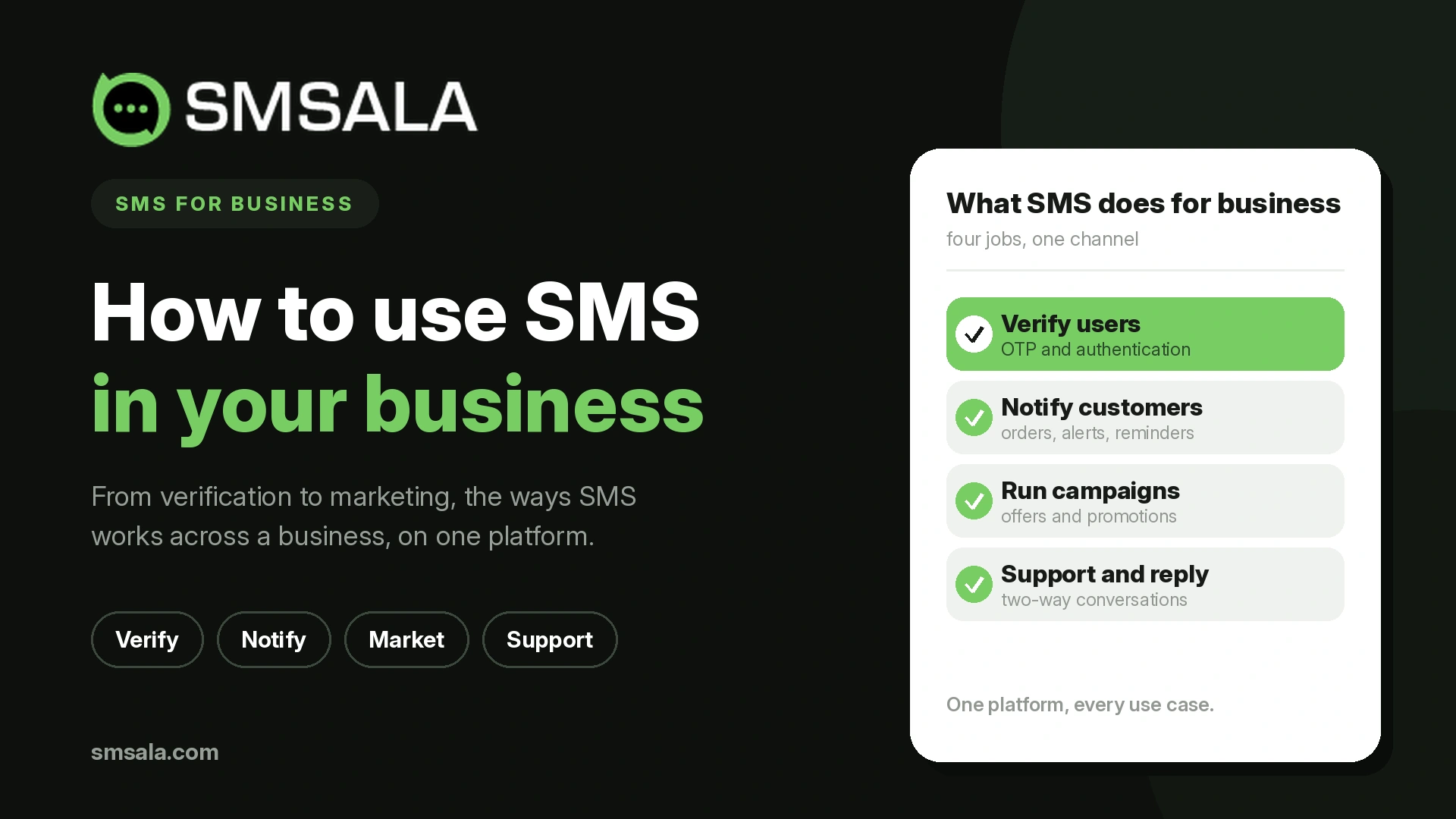
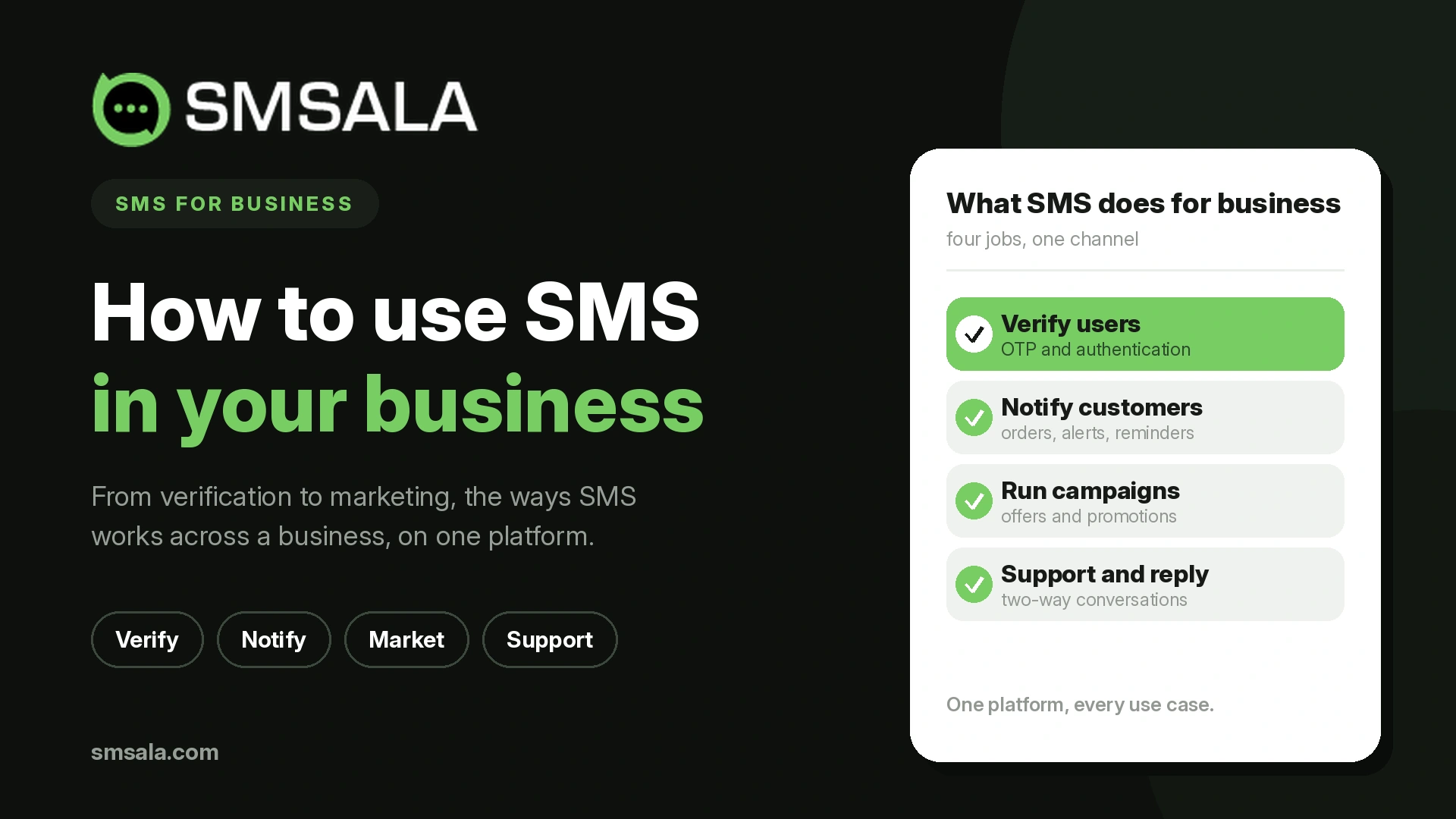
Pulling the limits together gives a clean rule for when SMS is the right business choice. Reach for it when the message is short, its timing matters, the recipient would want it, and you can measure whether it landed. That covers a huge, valuable set of jobs: transactional alerts, OTPs, delivery updates, appointment reminders, time-sensitive offers to an opted-in list, and inbound lead capture.
Reach for something else when the content is long or visual, timing is incidental, or you'd be sending to people who didn't ask. A monthly newsletter belongs in email. A detailed product showcase belongs on a page you link to. A message that gains nothing from arriving in the next two minutes probably doesn't need SMS at all.
The businesses that get the most from SMS aren't the ones who send the most — they're the ones who route each message to the channel its content actually needs, and reserve SMS for the jobs only SMS does well.
How to run it well once you've decided it fits
If SMS clears that decision frame for your use case, a few practices separate programmes that compound from ones that burn out:
Automate off triggers, not a calendar. Welcome messages, appointment reminders, post-purchase follow-ups, and reorder nudges fire off customer actions — which is both more relevant and less work than manual sends. This runs through an SMS API connected to your systems.
Integrate with your other channels rather than duplicating them. Use SMS to nudge email non-openers, confirm actions started elsewhere, or drive subscribers to a launch — each channel covering another's weakness.
Handle compliance as the foundation. Explicit consent, clear opt-out on every message, and adherence to TCPA, GDPR, and local rules aren't optional extras — A2P messaging is regulated in every market, and compliance is what keeps both your business and your deliverability safe.
Measure the outcomes, not the vanity metric. Track delivery, click-through, conversion, and opt-out rate — the KPIs that reflect real performance — rather than the near-universal open rate that tells you almost nothing.
The bottom line
Businesses still use SMS after thirty years because it does a handful of things better than anything newer: it reaches phones instantly and reliably, on any network, read within minutes, at low cost, fully measurable, and open to a reply. Every one of those strengths has an edge, though — speed only matters for timely messages, 24/7 reach isn't licence to send at midnight, measurability depends on honest routing, cheapness holds only per outcome, and personalisation needs real data. Understand where each reason stops applying and you'll use SMS for exactly the jobs it wins at, which is how the channel earns its place rather than wears out its welcome.
If you're weighing SMS for your business, the part that quietly determines whether all seven benefits show up in practice is delivery — honest routing and real reporting. SMSala runs on direct carrier routes with genuine delivery data, which is what makes the measurability, reach, and cost advantages real rather than theoretical.
FAQ
Why do businesses still use SMS when there are newer channels?
Because SMS does specific jobs better than anything newer: it reaches any phone on any network without internet, is read within minutes, costs little, and is fully measurable. For time-sensitive, transactional, or short messages to an opted-in audience, nothing outperforms it — even if it's poorly suited to long or visual content.
What is SMS best used for in business?
Short, time-sensitive messages the recipient wants and you can measure: OTPs, fraud alerts, delivery and appointment updates, order confirmations, time-limited offers to opted-in customers, and inbound lead capture via keywords. It's a poor fit for long-form content, visual showcases, or messages where timing doesn't matter.
Is SMS marketing actually cost-effective?
Yes, but measured per outcome, not per message. SMS costs a few cents to send and is read by nearly everyone, so cost-per-conversion stays low when targeting is good. A poorly segmented blast, though, makes the low unit price an expensive way to drive opt-outs — relevance is what makes it cheap.
Can you measure the results of an SMS campaign?
Yes — delivery rates, click-through, and conversions are all trackable, often more cleanly than email. The catch is that measurement depends on honest routing: gateways using grey routes report messages as delivered that were actually dropped, so confirm your delivery data comes from genuine carrier receipts before trusting it.
How often can a business send SMS without annoying customers?
Only as often as customers expect from their opt-in, typically a few times a month for marketing, and only during reasonable local hours (roughly 9am–9pm). SMS delivers 24/7, but that's a technical capability, not permission — off-hours promotional texts feel intrusive and often breach compliance rules.
What's the difference between using SMS for marketing versus transactional messages?
Transactional messages (OTPs, alerts, confirmations, delivery updates) are expected, time-critical, and can use SMS's 24/7 reach fully. Marketing messages require explicit opt-in, must stay within reasonable hours and expected frequency, and only justify SMS's cost when relevant and timely. The two follow different rules for timing, consent, and frequency.