
A law firm texting clients sits in a stricter box than almost any other business, and that's the part most guides skip entirely. The generic "SMS is cheap and gets read" pitch is true, but for a firm it's the least important thing to know. What matters is that legal marketing is regulated by the bar, client communications carry confidentiality obligations, and a text about a case can create a written record that lives in a discovery file. Get the compliance wrong and the cost isn't a low open rate — it's an ethics complaint.
So this covers both halves: where SMS genuinely helps a firm, and the guardrails that make it safe. Because for a law practice, "can we?" comes before "should we?" — and the answer changes depending on whether you're marketing to a prospect or communicating with a client you already represent.
The Two Kinds of Legal Texting (and Why the Line Matters)
Before any tactic, one distinction governs everything: are you marketing to someone you don't represent, or communicating with an existing client? The rules diverge sharply.
Marketing texts — reaching prospects, promoting a free consultation, following up on a web inquiry — are commercial messages. They're governed by consent and anti-spam law (TCPA in the US, and equivalents elsewhere), plus your jurisdiction's bar rules on attorney advertising. Prior express consent is mandatory, and many bars require advertising to be labeled and archived.
Client communications — appointment confirmations, case updates, document reminders for people you already represent — are transactional, tied to an existing relationship. Consent is easier to establish, but a different obligation kicks in: confidentiality. Anything about a matter is privileged, and a text is a written record.
Most compliance failures come from treating these as one thing. A firm that gets marketing consent right but texts case details carelessly has solved the wrong problem. Keep the two streams separate in your head and in your system.
Where SMS Earns Its Place in a Firm
With the distinction clear, here's where texting genuinely moves the needle — ranked by return, not by novelty.
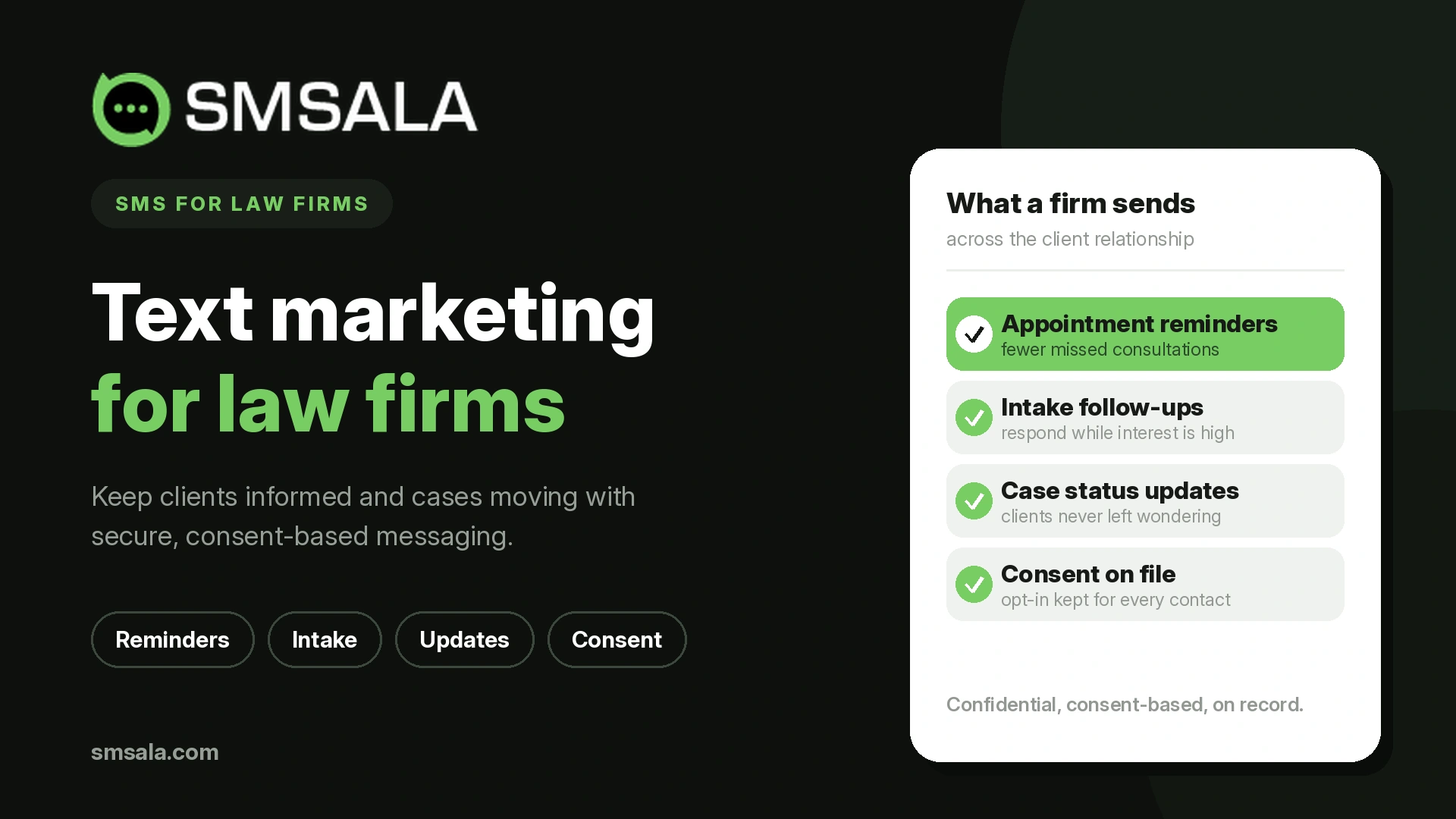
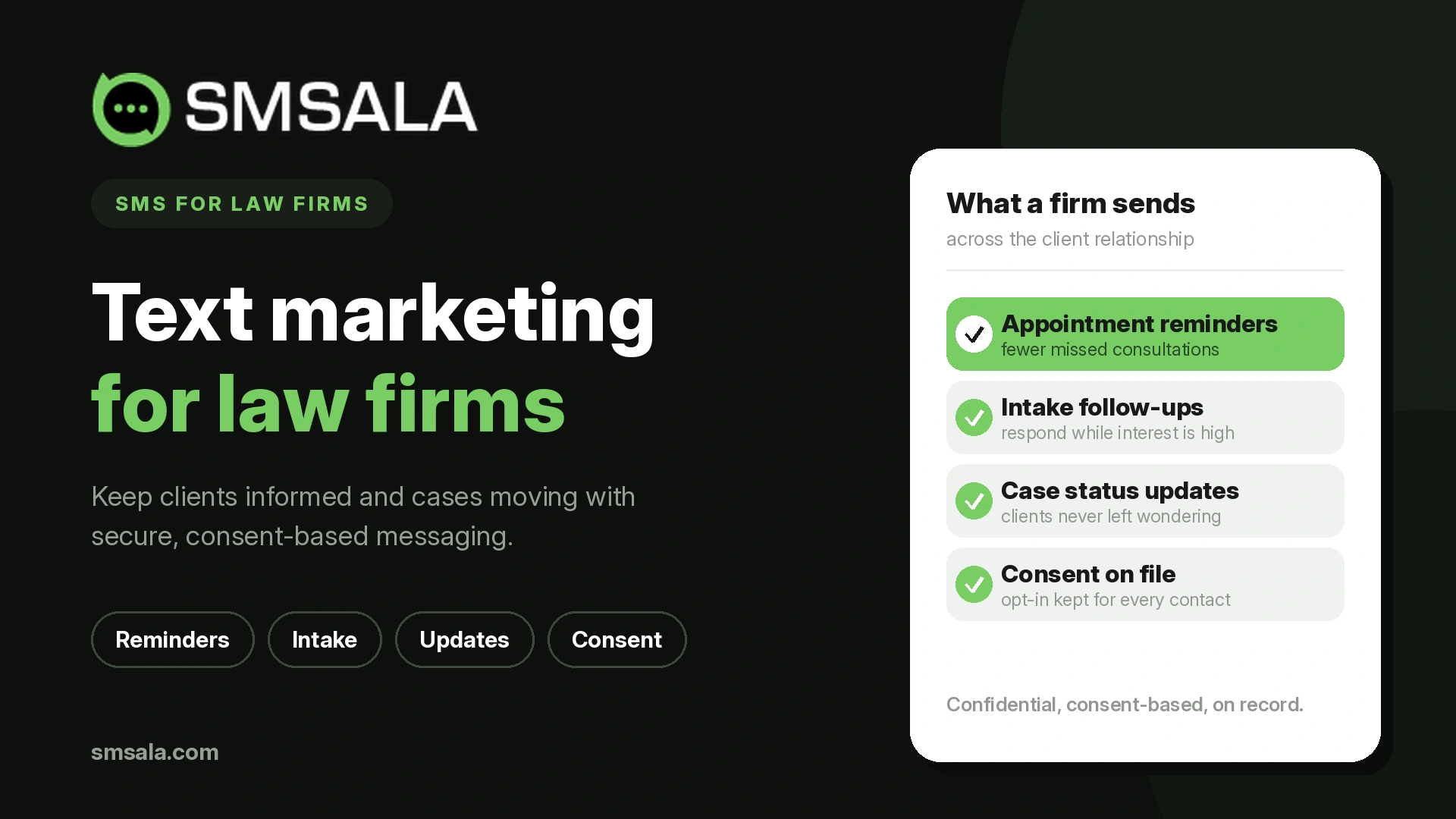
Appointment confirmations and reminders. The highest-value use for most firms, and the safest. Consultations and court-related meetings are expensive to miss; a no-show consultation is billable time lost, and a missed filing meeting can be far worse. A reminder the day before and the morning of sharply cuts no-shows, and it's low-risk because it need contain no case detail — just a time and a place.
Responding to new inquiries fast. In legal intake, speed wins the client. Someone who's just been in an accident or served with papers contacts several firms; the one that responds first often gets retained. A text acknowledging a web inquiry within minutes — "We received your message and will call within the hour" — holds the lead that email would lose. Enabling two-way messaging here lets intake staff answer basic questions and book the consult in the channel the prospect already opened.
Case status updates. Clients' single biggest complaint about lawyers is poor communication — being left in the dark. A brief "your hearing is confirmed for the 14th, details to follow by email" reaches the client immediately and reduces the anxious phone calls that eat your team's time. The discipline: keep the substance out of the text and in the secure channel.
Payment and document reminders. Retainer top-ups, invoice reminders, "we still need your signed form" — routine, useful, and effective precisely because they're seen fast. A payment reminder by SMS recovers slow receivables without the awkwardness of a collection call.
Internal team coordination. Court time changes, a partner needs a document pulled, a hearing moves up. Fast internal alerts keep a firm coordinated when email is too slow to catch someone already at the courthouse.
Why the Channel Fits Legal Work
Three properties make SMS suited to a firm specifically, beyond the generic cost argument.
Reach without dependencies. A text needs no app, no data plan, no internet — it reaches a client on any handset, anywhere, including the elderly client who doesn't use email and the one traveling without data. For a practice whose clients span every demographic, that universality matters.
Personalization at scale. A bulk SMS service with merge fields lets a firm send an appointment reminder addressed to each client by name, from one send. The client feels individually attended to; the paralegal sends a hundred in one action. Personal touch and efficiency stop being a trade-off.
Speed when speed is the product. Legal timelines are unforgiving. A filing deadline, a rescheduled hearing, a same-day document request — these need a channel measured in minutes, and SMS is the only one clients reliably see in time.
The Compliance Guardrails You Cannot Skip
This is the section other articles reduce to one closing sentence, and it's the one that protects the firm. Treat these as non-negotiable.
Requirement | What it means in practice |
Prior express consent | Get documented opt-in before any marketing text. A web-form checkbox or keyword opt-in, timestamped and stored. No pre-checked boxes. |
Opt-out in every marketing message | A clear "reply STOP to unsubscribe," honored instantly. |
Bar advertising rules | Many jurisdictions require attorney advertising to be identifiable as such and archived for a set period. Check your specific bar. |
Confidentiality | Never put privileged case detail in a text. Assume the message could be read by someone other than the client, or surface in discovery. |
Recordkeeping | Texts about a representation may be part of the client file and subject to retention rules. Archive them accordingly. |
No misleading claims | Bar rules restrict guarantees of outcome and comparative claims. A promotional text is still attorney advertising. |
Two of these deserve emphasis because they're specific to law and easy to get wrong.
Confidentiality is the one non-lawyers underestimate. A well-meaning "the settlement offer came in at $40k, call me" names a privileged figure in a channel that isn't secure and creates a record that isn't controlled. The rule of thumb: a text can tell a client that there's news and to check the secure channel — never what the news is. Notification, not substance.
Consent for a client is not consent to market. A client who gave you their number for case updates has not agreed to receive promotions about your other practice areas. Mixing transactional consent into a marketing list is a common and costly slip. Keep the lists — and the permissions — separate.
How to Roll It Out Without Creating Risk
A workable sequence for a firm starting from scratch:
Separate your two streams first. Decide what's transactional client communication and what's marketing, and build them as distinct lists with distinct consent. This one decision prevents most compliance problems downstream.
Capture consent cleanly. Add a texting checkbox to your intake and web forms, with clear language about what the client will receive. Store the timestamp and source.
Write templates that stay inside the lines. Draft standard messages for confirmations, reminders, and updates that carry no privileged detail. Approved templates stop a busy paralegal from improvising something risky at 5 p.m.
Set the confidentiality rule as policy. Every staff member who texts clients follows the same rule: notify in the text, put substance in the secure channel. Write it down.
Archive everything. Configure your system to retain client-related texts alongside the file, in line with your retention obligations.
Check your bar's specific advertising rules before the first marketing send. They vary by jurisdiction and change; don't assume.
Mistakes That Turn a Good Idea Into a Complaint
Putting case substance in a text. The single biggest risk. Privileged detail in an insecure, uncontrolled channel is a confidentiality and discovery problem waiting to happen.
Marketing to your client list. Transactional consent isn't marketing consent. Promoting services to clients who only opted in for case updates violates both consent rules and, often, bar advertising rules.
Treating promotional texts as exempt from advertising rules. A "free consultation" text is attorney advertising. It's subject to your bar's labeling, recordkeeping, and no-misleading-claims requirements like any other ad.
No documented consent. "We had their number from the intake form" is not consent to text-market them. Undocumented consent is, in a complaint, the same as none.
One person freelancing the wording. Without approved templates, an individual will eventually send something that names a figure, promises an outcome, or skips the opt-out. Templates are the cheapest risk control you have.
Bringing It Together
Text message marketing works for law firms, but the version that works is disciplined. The wins are real — fewer no-shows, faster intake, better-informed clients, quicker collections — and they come almost entirely from routine, low-substance messages sent to people who consented. The risks are equally real and almost entirely avoidable: keep marketing and client communication separate, keep privileged detail out of texts, get consent in writing, and follow your bar's advertising rules.
A platform like SMSala provides the pieces a firm needs underneath this — consent management, personalized bulk sending, delivery reporting, and archiving. The infrastructure is straightforward. The judgment about what to send, and what to keep out of a text, is where a firm protects itself.
Want to add texting to your practice without the compliance headaches? See how a bulk SMS provider handles consent capture, personalized client reminders, and message archiving built for regulated fields.