
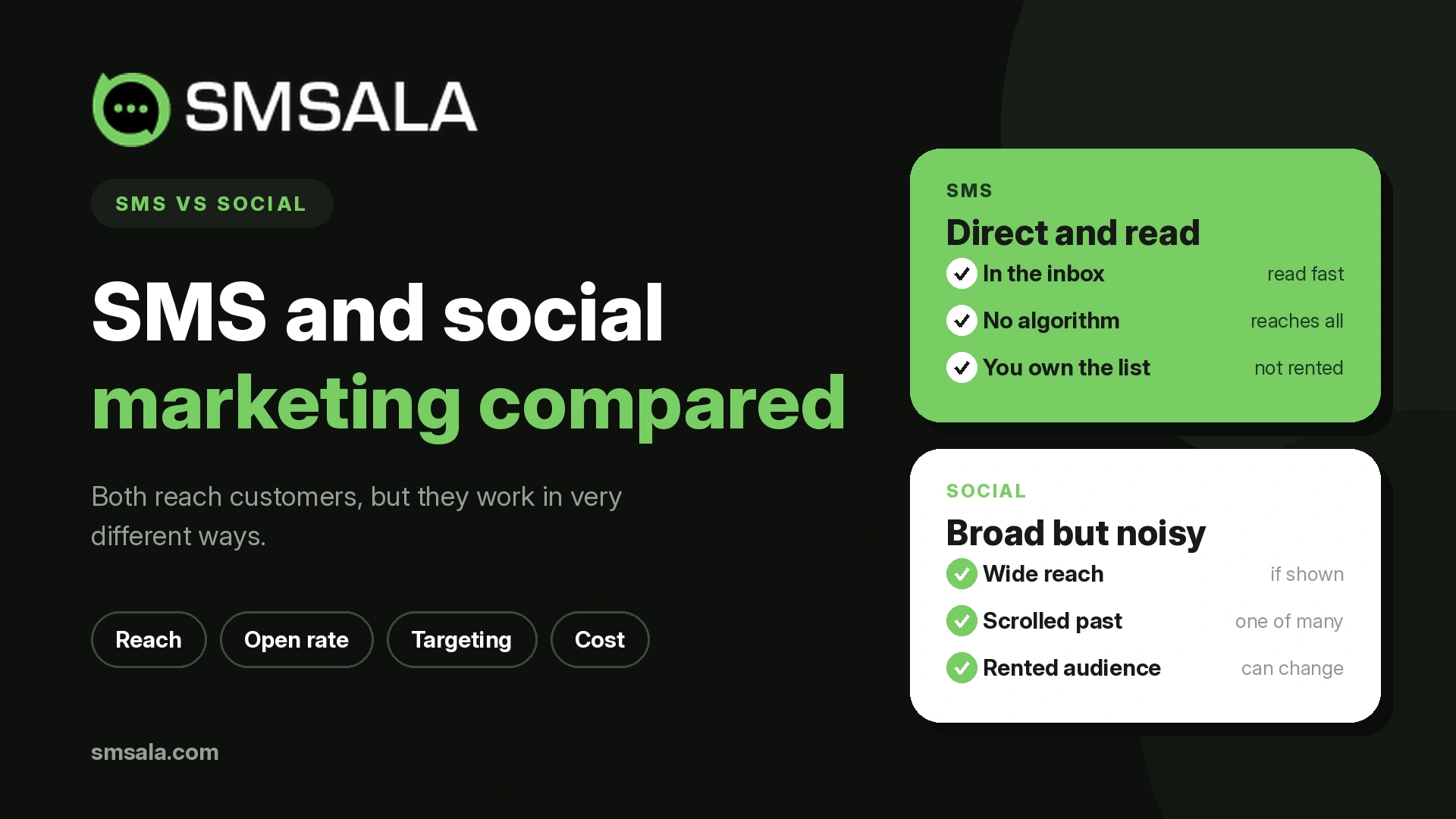
Ask which channel is "better," SMS or social media, and you've already framed the question in a way that leads to a bad answer. It's like asking whether a phone number is better than a billboard. They do different work at different points in how a customer finds, chooses, and stays with a brand. The marketer who understands that spends their budget well. The one still looking for a single winner tends to over-invest in whichever channel they read about last.
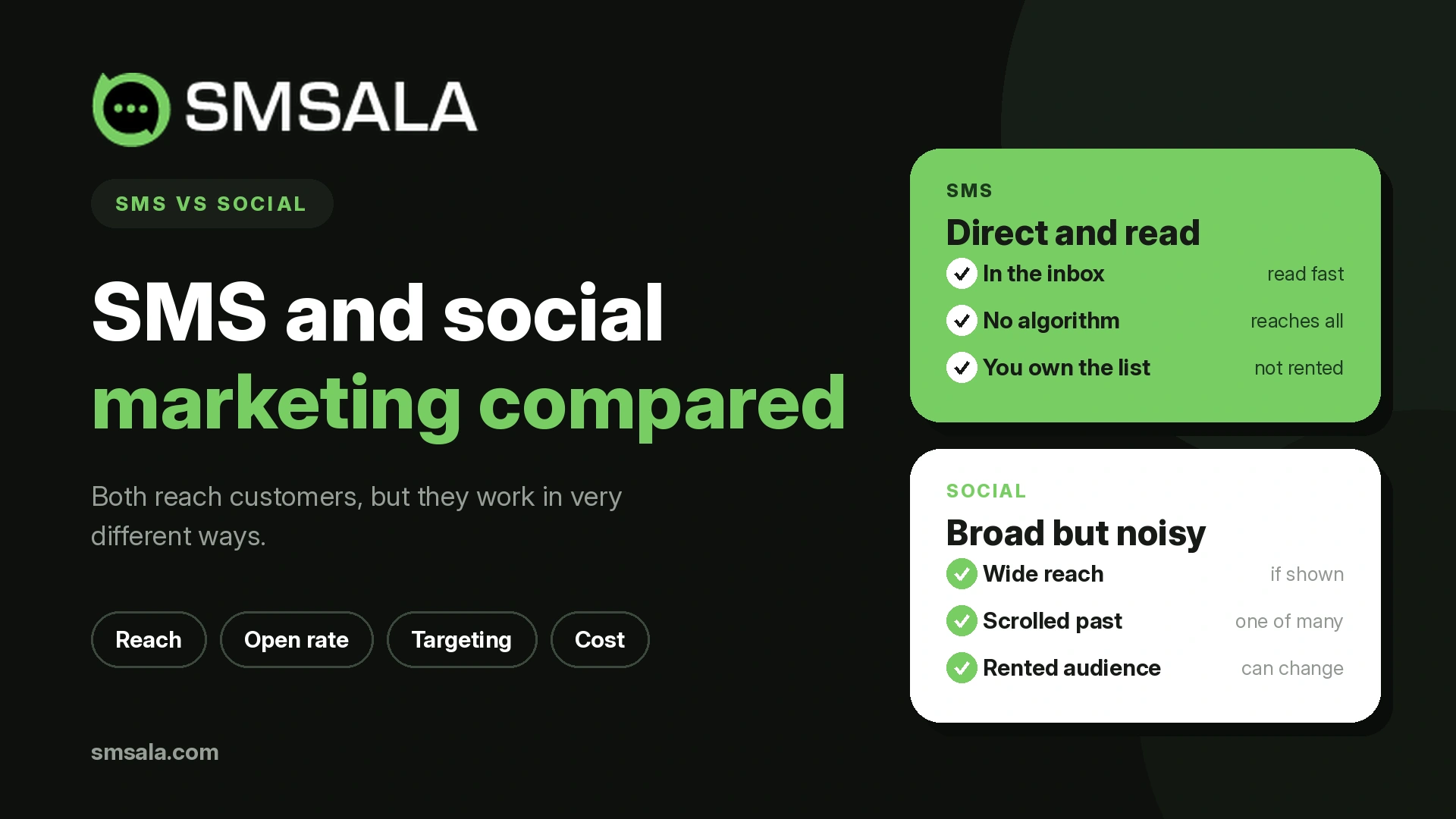
This comparison is built to help you decide — honestly. That means naming where social media beats SMS as clearly as where SMS beats social, then giving you a way to allocate based on your actual goals rather than a rigged scorecard.
The core difference, in one idea
Strip both channels to their essence and the distinction is about how the connection is made.
Social media is a discovery and attention channel. It reaches people who don't yet know you, builds familiarity over time, and lets your content compete for a share of a feed. Its power is reach and brand-building among strangers.
SMS is a permission and delivery channel. It reaches people who have given you their number — customers, subscribers, people already in your orbit — and delivers a message directly, with near-certainty that it arrives. Its power is directness and reliability with people who already know you.
That single distinction explains almost every difference that follows. Social casts wide to find people; SMS reaches deep to people you've already found. Confuse the two and you'll ask SMS to do discovery (it can't cheaply) or ask social to guarantee delivery (it won't).
Comparing the dimensions that matter
A fair comparison looks at each channel across the axes marketers actually care about — and admits that they trade places depending on the axis.
Reach to new audiences. Social wins, clearly. Platforms are built to put your content in front of people who've never heard of you, through algorithms, shares, and paid targeting. SMS can't do this — you can only text people who've opted in. If the goal is finding new customers, social is the channel.
Directness and delivery. SMS wins, clearly. A text lands in the same place as messages from friends and family and is opened quickly. Social content sits in a feed the user has to open and scroll, competing with everything else, and organic reach of any single post reaches only a fraction of your followers. When it must arrive and be seen, SMS is unmatched — the mechanics of which are covered in the fundamentals of what makes SMS effective as a marketing channel.
Targeting precision. Roughly even, but different in kind. Social platforms offer sophisticated demographic, interest, and behavioral targeting to reach lookalikes and segments. SMS targeting is based on your own data — who bought what, who's in which segment — which is less about finding people and more about relevant messaging to known ones.
Engagement quality. Depends what you mean. Social generates broad, shallow engagement (likes, views, comments) and supports rich media, video, and community. SMS generates narrow, high-intent engagement — a text with a link or a reply prompt drives action at a rate feeds rarely match. One is a megaphone; the other is a tap on the shoulder.
Cost structure. Different models. Social's organic side is "free" but demands constant content and increasingly requires paid spend for reach. SMS has a clear per-message cost but high response per message sent. Neither is universally cheaper; it depends on whether you're paying for reach or for delivery.
Funnel stage. This is the clarifying one. Social dominates the top of the funnel — awareness, discovery, consideration. SMS dominates the bottom and post-purchase — conversion, reminders, retention, abandoned-cart recovery, loyalty. They're not competing for the same stage.
Measurement. Both are measurable but track different things. Social measures reach, impressions, and engagement rate. SMS measures delivery and response directly, which is why understanding KPIs for promotional SMS matters — the metrics that prove SMS value aren't the ones social platforms report.
What SMS is genuinely best at
Where SMS earns its budget:
Time-sensitive action. Flash sales, restocks, appointment reminders, event alerts — anything where the window is short and the message must land now.
Conversion and retention. Reaching customers who've already engaged and nudging them toward purchase or back into the fold. This is SMS's home turf, and it's why SMS marketing conversions consistently outperform channels that depend on the customer choosing to check in.
Reliability regardless of platform. No app, no login, no algorithm deciding whether your message is shown. If the customer has a phone, the message arrives.
Personalized directness. A short, relevant, individually addressed message to someone who opted in — a level of directness social's public feed can't offer.
What social media is genuinely best at
Where social clearly beats SMS, and where the original comparison went quiet:
Discovery and reach to strangers. SMS cannot introduce you to people who don't know you. Social does exactly that, at scale, which makes it irreplaceable for growth.
Brand building and storytelling. Rich media, video, and ongoing narrative build a brand identity over time in a way a 160-character text simply can't.
Community and social proof. Comments, shares, reviews, and user content create trust signals and word-of-mouth that SMS has no mechanism for.
Low-commitment audience growth. Following a brand costs a user almost nothing. Handing over a phone number is a higher bar, which is exactly why SMS lists are smaller but more valuable.
Naming these honestly is the point. A comparison that pretends social has no advantages isn't a comparison — it's a pitch, and it leads to bad decisions.
The either/or mistake
The framing that sinks most marketing plans is treating this as a choice of one channel. It rarely is.
The two channels map onto different stages of the same customer journey. Social finds and warms a stranger; SMS converts and retains them once they've opted in. Choosing "only social" means great top-of-funnel and a leaky bottom. Choosing "only SMS" means excellent conversion of an audience you have no efficient way to grow. Each alone is half a funnel.
The businesses that get the most from both use social to acquire and SMS to convert and keep — which turns the "versus" into a sequence.
How to decide
If you genuinely must prioritize — limited budget, small team — decide by goal, not by which channel sounds better.
Lead with social media if:
Your priority is awareness and finding new customers.
You have little or no customer contact list yet.
Your product benefits from visual storytelling or community.
You're building a brand from a standing start.
Lead with SMS if:
You already have a customer or subscriber base with consent to text.
Your priority is conversion, retention, or time-sensitive action.
You need guaranteed, immediate delivery.
Your margins reward high-response, low-waste messaging.
A practical sequence for most businesses: use social to grow an audience and capture opt-ins, then use SMS to convert and retain that audience. If you have no list, social comes first by necessity. If you have a list you're underusing, SMS is likely your fastest return.
How they work together
The handoff is where the real value sits. A social campaign runs a promotion and drives interested users to opt into SMS updates — a keyword, a link, a signup. Now those warm prospects sit on a channel where you can reach them directly, without paying for reach each time or hoping an algorithm surfaces your post.
From there, SMS carries the relationship: order confirmations, exclusive offers, reminders, restock alerts. Social keeps filling the top of the funnel with new prospects; SMS keeps converting and retaining the ones who've raised their hand. Structuring SMS marketing campaigns around audiences that social helped you build is where the two channels stop competing and start compounding.
Where this leaves you
SMS and social media aren't rivals fighting over the same job — they're two stages of one journey. Social is your engine for reach and discovery; SMS is your engine for delivery, conversion, and retention. The right question was never "which is better," but "which does the job I need right now, and how do I connect them." Answer that, and the budget allocation answers itself.
For businesses ready to turn social-built audiences into a direct, high-response channel, SMSala provides the SMS infrastructure — from opt-in management to campaign delivery — that completes the funnel social media starts.
FAQ
Is SMS or social media marketing better?
Neither is universally better; they do different jobs. Social media excels at reaching and building awareness among new audiences, while SMS excels at directly reaching and converting people who've already opted in. Most businesses benefit from using both at different funnel stages.
Which has higher engagement, SMS or social media?
They generate different kinds of engagement. SMS drives narrow, high-intent action from a smaller audience, while social generates broader, shallower engagement across a wider reach. The right measure depends on whether your goal is reach or conversion.
Can SMS reach new customers like social media can?
No. SMS only reaches people who have opted in and shared their number, so it can't introduce you to strangers. That's social media's strength — which is why the two channels complement rather than replace each other.
Should a small business with a limited budget choose one?
If you have no contact list yet, lead with social to build an audience and capture opt-ins. If you already have a subscriber base with consent to text, SMS usually delivers the faster return through conversion and retention.
How do SMS and social media work together?
Social media builds awareness and drives people to opt into your SMS list, then SMS reaches those warm prospects directly to convert and retain them — turning broad social reach into a direct, high-response relationship.