
afternoon, the team celebrates, and the campaign gets marked a success. What nobody checks is how many of those buyers were already planning to shop that week and simply used the code because it landed in their pocket. The store didn't create demand. It discounted demand it already had.
This is the quiet trap in coupon marketing, and SMS makes it easier to fall into because sending is so fast and the open behaviour is so strong. A coupon feels like a guaranteed win. Sometimes it is. Often it is a margin transfer dressed up as a marketing result.
The good news is that SMS is also the channel where coupons can be done exceptionally well, because the code you send does something no other creative element does: it identifies exactly who redeemed. Used deliberately, that turns a discount into one of the few marketing activities you can measure down to the individual sale. This guide is about running SMS coupons so they lift revenue rather than quietly draining it the decisions that matter, the mechanics most guides skip, and the numbers that tell you the truth.
The coupon code is doing two jobs at once
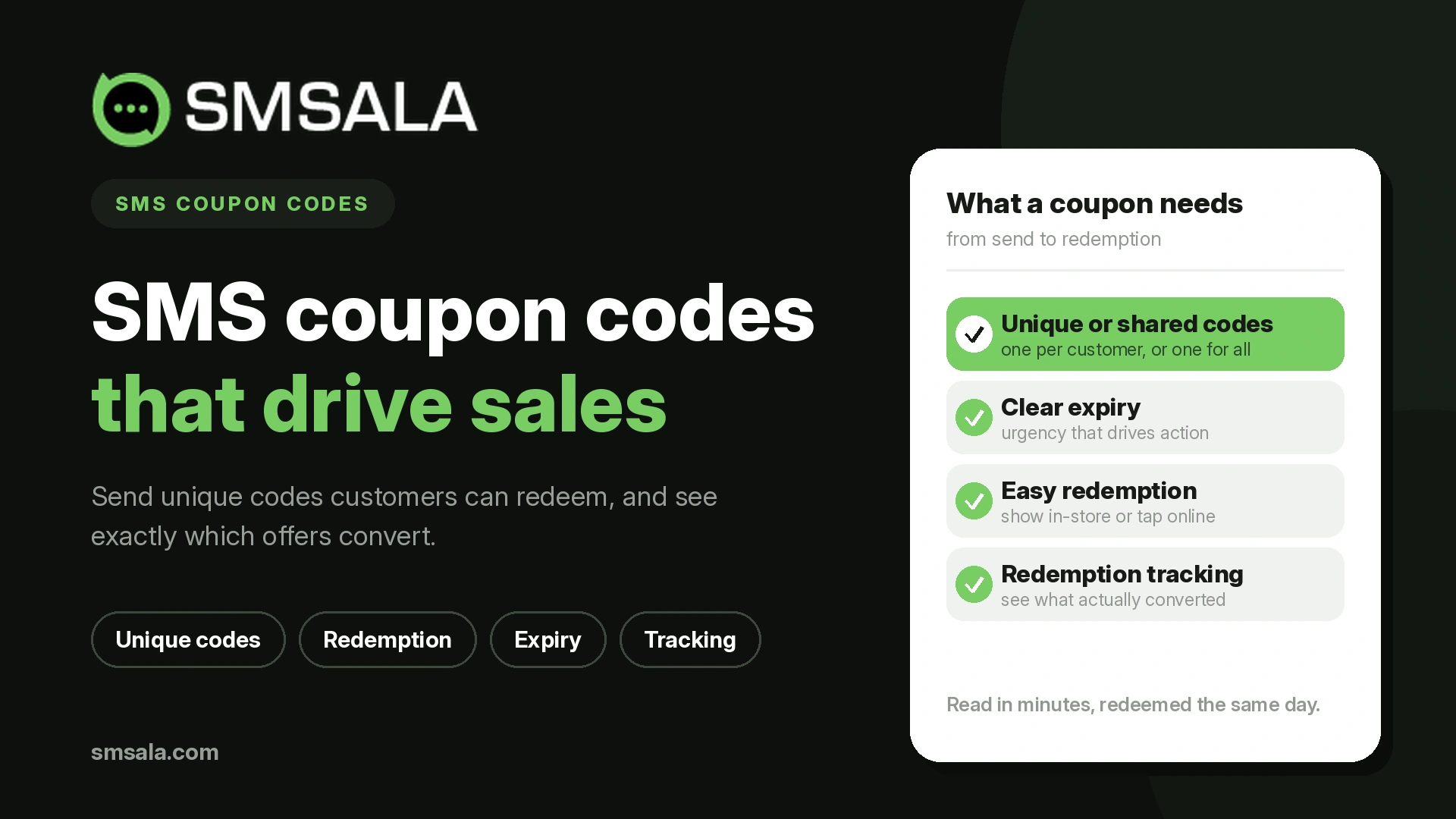
Before any of the tactics, understand what you are actually sending. An SMS coupon code is both an incentive and a measurement instrument. The discount is the part the customer cares about. The code is the part you should care about, because it is the thread that connects a message you sent to a purchase that happened.
Most businesses design the incentive carefully and treat the code as an afterthought a generic word like SAVE20 bolted on at the end. That decision, made casually, is what makes half the campaigns in this space unmeasurable and vulnerable to abuse. Get the code right and everything downstream, from attribution to fraud control, becomes easier. That is why the first real decision is not what to offer, but how to structure the code itself.
Unique codes vs. one shared code: the decision that shapes everything
There are two ways to run an SMS coupon, and the choice affects your measurement, your exposure to fraud, and your workload.
A shared code is a single code sent to everyone SAVE20, one string, thousands of recipients. It is simple to set up and easy for customers to remember. It is also impossible to attribute to individuals and trivial to leak. The moment one recipient posts SAVE20 to a deal-sharing site, your "SMS subscribers only" offer belongs to the entire internet.
A unique code is a distinct string generated for each recipient SAVE20-4827, SAVE20-9931, and so on. Each code works once and maps back to one person. This costs more effort to generate and manage, but it closes the leak and gives you precise attribution: you know not just that the campaign converted, but which segments, which customers, and which message variants drove it.
Shared code | Unique code | |
Setup effort | Minimal | Requires generation + tracking |
Attribution | Aggregate only | Per-recipient |
Leak resistance | None one post exposes it | High a leaked code works once |
Best for | Broad, low-risk awareness offers | High-value offers, testing, loyalty |
Fraud control | Weak | Strong (one-time enforcement) |
The practical rule most experienced teams follow: use unique codes whenever the discount is large enough to be worth abusing, whenever you need to measure results properly, and whenever the offer is meant to be exclusive to your list. Reserve shared codes for genuinely public, low-margin-risk promotions where simplicity matters more than control. If you only ever run one type, unique codes are the safer default the extra setup buys you both measurement and protection.
How redemption actually works
A coupon is only as good as the moment it gets redeemed, and that moment looks very different online versus in a physical store. Guides rarely explain the plumbing, which is exactly where campaigns break.
Online, redemption is straightforward: the customer taps a link, lands on a page, and the code is either pre-applied through the URL or entered at checkout. Pre-applying it removes friction and lifts conversion, which is why coupon links that drop the customer onto dedicated SMS landing pages with the discount already loaded tend to outperform ones that ask the shopper to copy, switch apps, and paste. For online stores, a coupon is usually one piece of a broader ecommerce SMS marketing program spanning carts, launches, and post-purchase follow-ups.
Some campaigns let customers claim a coupon by replying to the message before they receive their code, which two-way messaging makes possible and which doubles as a light confirmation of intent.
In-store, redemption depends on your point-of-sale system. The code might be read aloud to a cashier, scanned as a QR code or barcode, or validated against a database at the till. Each method has a failure point: cashiers mistype spoken codes, older POS systems can't scan a phone screen reliably, and validation that requires a live lookup fails when the store's connection drops. Deciding the redemption method before the send and testing it on the actual hardware staff will use prevents the frustrating scenario where a customer receives a coupon the store literally cannot accept.
Redemption method | Where it fits | Watch out for |
Link with pre-applied code | Online checkout | Broken or untested links |
Manual code entry | Online or in-store | Typos, confusing characters |
QR / barcode scan | In-store POS | Screen glare, older scanners |
Database validation | In-store, high-value | Connectivity, POS integration |
Mobile wallet pass | Both | Setup complexity |
For location-driven offers a coupon that fires when a subscriber is near a store pairing the campaign with geofencing makes the in-store redemption path far more natural, because the message arrives when the customer is already positioned to act on it.
The discount that doesn't wreck your margins
Here is the part almost no coupon guide will tell you: the biggest risk in coupon marketing is not a technical failure. It is training your customers to stop paying full price.
Every discount teaches a behaviour. Send coupons predictably every Friday, every month-end and your best customers learn to wait. They stop buying at full price because they know a code is coming, and your average order margin erodes even as your redemption numbers look healthy. The campaign appears to work while the business quietly gets worse.
Avoiding this is a matter of discipline rather than cleverness. A few principles hold up in practice:
Discount to acquire or reactivate, not to reward people already buying. A coupon aimed at a lapsed customer who needs a reason to return earns its margin hit. The same coupon sent to an actively engaged buyer just hands back money you already had.
Make the discount irregular and event-driven so it can't be predicted and gamed. Tie it to a genuine reason a seasonal clearance, a launch, a genuinely limited window rather than a recurring slot on the calendar. Where the timing is tied to a specific event, scheduled sends let you line the coupon up with the moment it makes sense rather than whenever someone remembers to run it.
Do the margin math before sending, not after. A 30% discount on a product with a 40% margin leaves almost nothing, and if a meaningful share of redemptions would have bought anyway, the campaign can lose money while reporting a positive "redemption rate." Know your break-even redemption profile before you commit.
Prefer offers that protect average order value. Free shipping over a threshold, a discount on a second item, or a spend-based tier ("save 15 when you spend 75") lifts basket size instead of simply shaving the price of what someone was already buying.
None of this means coupons are dangerous. It means a coupon is a financial instrument, and sending one without the margin math is the single most expensive mistake in this channel.
Matching the offer to the job
Different coupon types do different jobs, and reaching for the same 20%-off reflex every time leaves value on the table. Choose the mechanism that fits the outcome you actually want.
Offer type | Best job | Main risk |
Percentage off | Broad appeal, clearance | Margin erosion on high-priced items |
Fixed amount off | Predictable cost, mid-range carts | Feels small on low-priced items |
Free shipping | Recover abandoned carts | Cost on heavy or distant orders |
Spend threshold | Lift average order value | Excludes small buyers |
Buy-one / second-item | Move inventory, raise basket | Perceived as gimmicky if overused |
Early or exclusive access | Reward loyalty without discounting | Only works with a genuinely valued product |
That last row deserves emphasis, because it is the option teams forget: exclusivity can substitute for a discount entirely. Early access to a launch, a members-only window, or a limited allocation gives subscribers a reason to act without touching your margin at all. When your product is desirable enough, the best "coupon" is not a price cut it's a head start.
Writing the message so the code gets used
An SMS coupon has seconds to land. The craft is making the offer, the urgency, and the code all legible at a glance.
Lead with the offer, not a greeting. Put the value in the first few words while the message is still on the lock screen. Identify yourself clearly a recognisable sender ID turns an anonymous number into a message people trust enough to open. State one action and one code. And give the offer a real deadline: "today only" or "ends Sunday" converts better than an open-ended discount, because urgency is what moves a coupon from "saved for later" (and forgotten) to "used now."
Two details separate clean coupon copy from sloppy copy. First, make the code unmistakable set it apart from the surrounding text and avoid characters that are easy to confuse, like the letter O next to a zero, which cause redemption failures at manual entry. Second, always include the terms that matter in compressed form: the expiry and any minimum spend. Hiding an expiry to seem more generous just produces frustrated customers at checkout and complaints you didn't need.
A coupon message that works usually reads something like: sender name, the offer, the code, the deadline, the link, and the opt-out nothing else competing for the reader's few seconds of attention.
Stopping leakage and fraud
Discounts attract the wrong kind of attention. A share of every public coupon code ends up on deal-aggregation sites within hours, redeemed by people who were never on your list and never will be. Others get abused internally, applied to transactions they were never meant for.
Unique, one-time codes are the strongest defence, because a leaked code that has already been used is worthless to the next person who finds it. Beyond that, three habits help: set genuine expiries so codes don't circulate indefinitely, tie high-value offers to a minimum spend so abuse at least comes with a purchase, and monitor redemption patterns for anomalies a single code hit hundreds of times, or a spike from one location, is a signal something has leaked. For offers valuable enough to be worth defending, validating each code against a database at redemption closes the loop entirely.
Measuring what actually happened
Redemption rate is the honest headline metric for coupon campaigns the share of delivered coupons that were actually used. Unlike the open rates that dominate most SMS guides, redemption is a real, countable event: a code either got redeemed or it didn't. Consolidating those redemptions through proper campaign analytics gives you a clean read on which segments and offers performed.
But redemption rate alone can still mislead, which brings us to the one concept that separates sophisticated coupon marketers from the rest: incrementality. The question that matters is not "how many people redeemed?" but "how many sales happened that would not have happened without the coupon?" A campaign with a 15% redemption rate where most redeemers would have bought anyway is worse than a 5% campaign that pulled in genuinely new or lapsed customers.
You cannot measure incrementality perfectly, but you can approximate it. Hold out a control group a random slice of the target segment that receives no coupon and compare their purchase rate to the group that did. The difference is roughly the lift the coupon actually created. It is the single most valuable habit in coupon marketing and almost nobody does it, which is precisely why the businesses that do consistently out-earn the ones chasing redemption numbers.
Alongside those two, track margin-adjusted return rather than gross revenue, and keep an eye on the opt-out rate coupons that arrive too often, even generous ones, still burn down the list that makes future campaigns possible.
How SMS coupon campaigns quietly fail
The failures in this channel are rarely dramatic. They look like success until you examine them.
The campaign that "worked" but only discounted existing demand. The generous offer that leaked to a coupon site and blew the margin. The in-store code the POS couldn't actually validate. The predictable Friday discount that trained loyal customers to wait. The unmeasurable shared code that made it impossible to learn anything for next time. Every one of these produces activity messages sent, codes redeemed, a chart that ticks up while eroding the economics underneath. The antidote is the same in each case: decide the code structure deliberately, do the margin math first, and measure lift rather than volume.
A pre-launch checklist
Before an SMS coupon campaign goes out, confirm:
The code structure (unique or shared) matches the offer's value and risk.
The margin math has been done, including a realistic view of how many redeemers would have bought anyway.
The redemption method is tested on the actual checkout or POS it will run through.
Expiry and any minimum spend are stated clearly in the message.
The code is visually distinct and free of easily confused characters.
Consent is in place and an opt-out is included.
A holdout control group is set aside so you can measure real lift.
Attribution and redemption tracking are configured before the send.
The bottom line
SMS coupon codes reward marketers who treat them as financial decisions, not just creative ones. The mechanics that make the difference unique codes over shared ones, a tested redemption path, margin math before the send, and a holdout group to prove the lift was real are exactly the parts most guides skip and most campaigns ignore. Get them right and coupons become one of the sharpest tools in SMS marketing. Get them wrong and you are simply paying customers to do what they were going to do anyway.
Whether you run these through automated drip campaigns that reward the right moments in a customer's journey or as one-off promotional bursts, and whether SMS carries the whole campaign or works alongside WhatsApp Business API for richer offers, the discipline is what matters. SMSala provides the delivery, sender registration, and reporting to run coupon campaigns cleanly but the profit comes from the decisions above, not the platform.
Frequently asked questions
Should I use one code for everyone or a unique code per person?
Use unique codes whenever the discount is large, the offer is meant to be exclusive, or you want to measure results properly. Shared codes suit only broad, low-risk public promotions where simplicity outweighs control. As a default, unique codes are safer because they resist leaking and give you real attribution.
How do I know if a coupon campaign actually made money?
Do the margin math before sending, then measure lift, not just redemptions. Hold back a control group that gets no coupon and compare their purchase rate to the group that did. The difference is the sales the coupon genuinely created which is the only version of "success" that survives scrutiny.
Why did customers receive a code the store couldn't accept?
Almost always an untested redemption path. The code was generated and sent, but the checkout or point-of-sale system wasn't set up or tested to validate it. Confirm the exact redemption method on the real hardware before any send that includes in-store redemption.
How often can I send coupons without hurting the business?
Less often than most marketers think. Predictable, frequent discounts train customers to wait for them, eroding full-price sales. Keep coupons irregular and tied to genuine reasons reactivation, a launch, a real seasonal event rather than a recurring slot on the calendar.
Can shared coupon codes be stopped from leaking online?
Not reliably. Any code sent to a large group can be posted publicly within hours. The only robust defence is a unique, one-time code per recipient, so that a leaked code is already spent by the time anyone else tries it.