
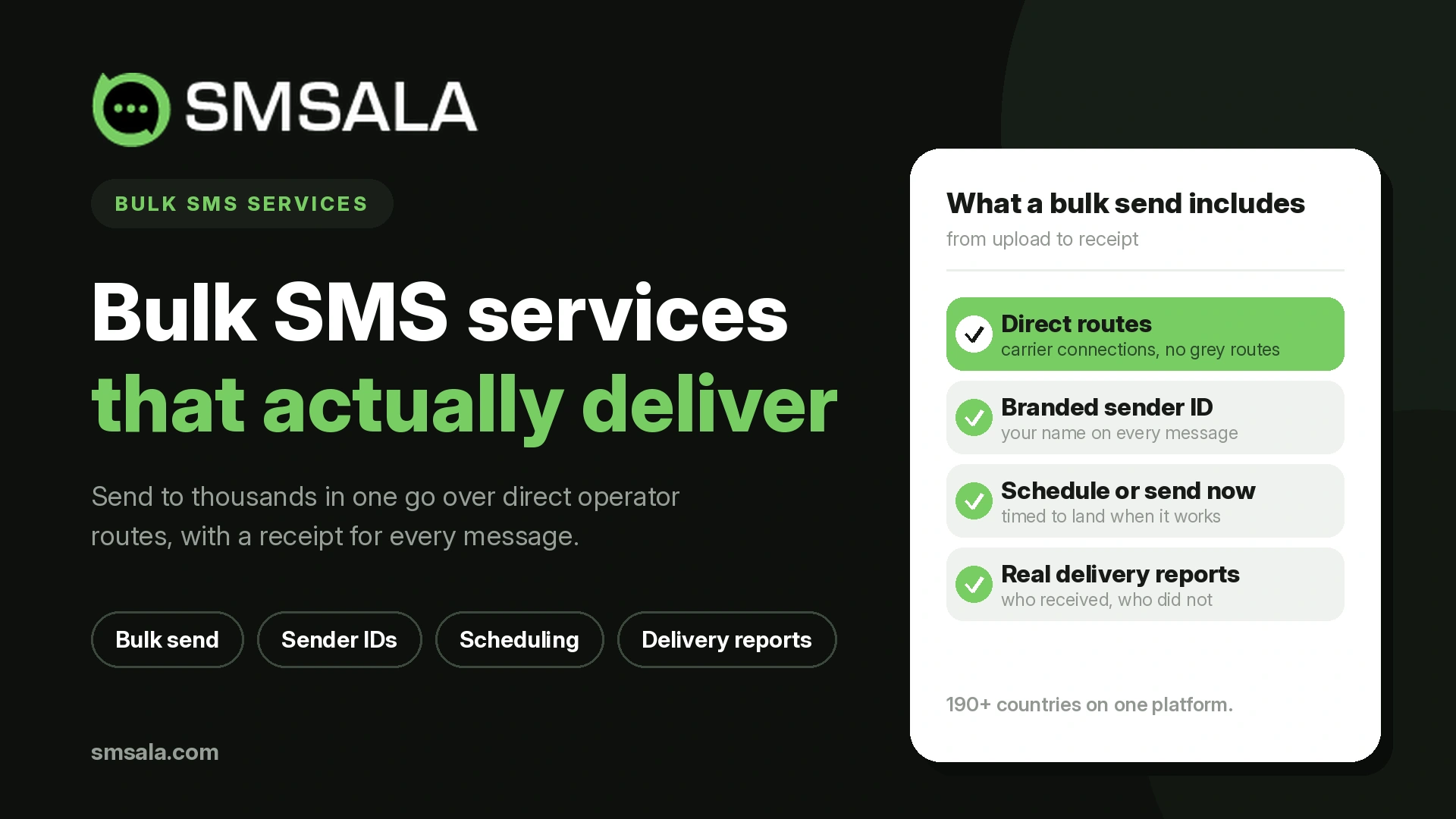
A bulk SMS service lets one business send text messages to thousands of phone numbers at once, through software rather than a phone. That single sentence hides a lot of machinery. The gap between a message you send and a message that arrives on the right handset, at the right time, at a price that makes sense, is where good providers separate themselves from cheap ones. Most articles on this topic stop at "it sends a lot of texts." This one covers what actually happens underneath, what you are really paying for, how to evaluate a provider, and where bulk SMS earns its cost across different industries.
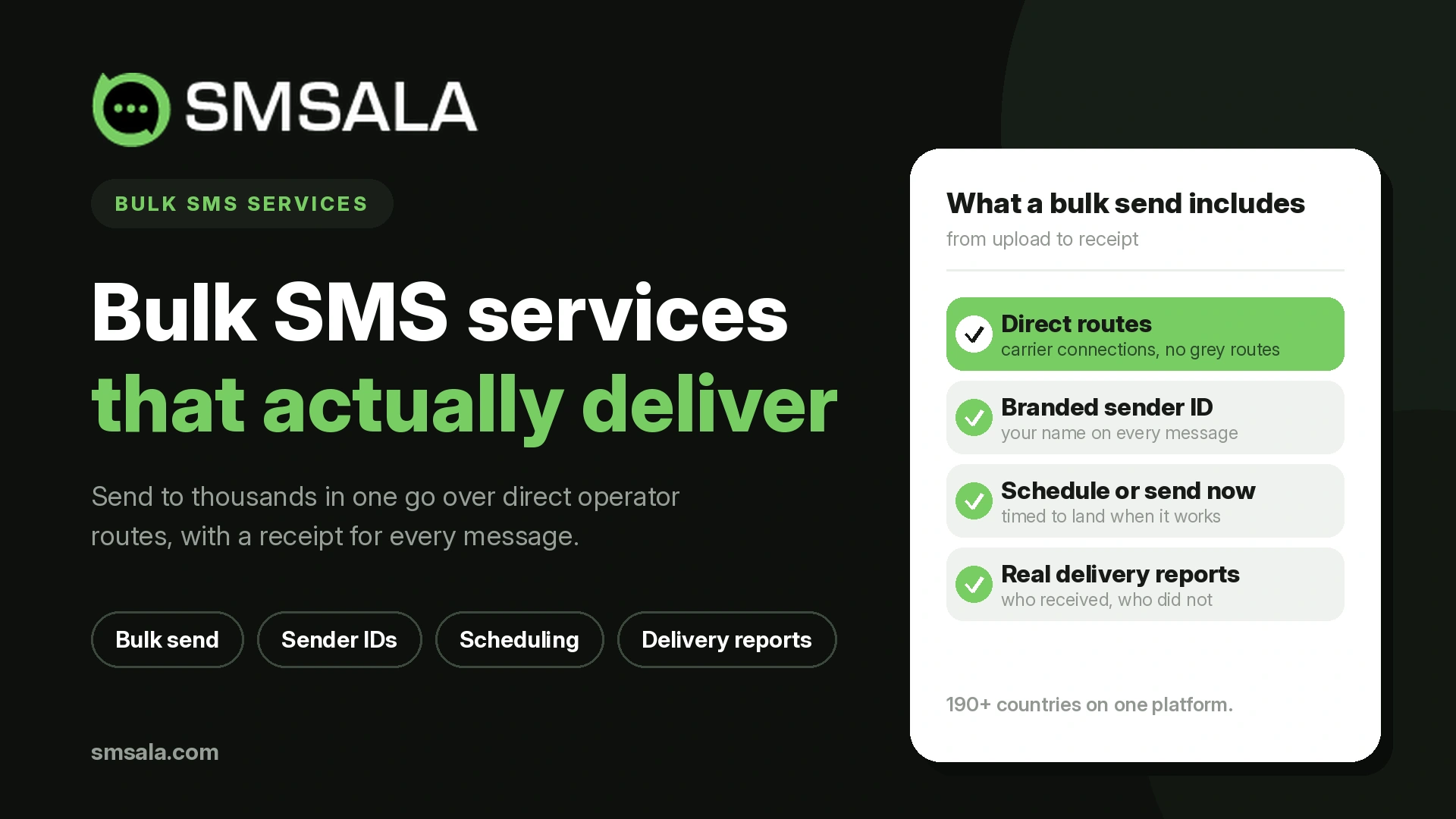
It is written for the person doing the buying and the running: an operations lead, a marketer, a developer, or a business owner who needs the messages to land and the invoice to make sense.
What a bulk SMS service actually is
Bulk SMS is a form of application-to-person (A2P) messaging, which means software initiates the message instead of a human typing it phone-to-phone. You upload or connect a list of numbers, compose a message, and the service dispatches it across mobile networks to reach every recipient at once. The same infrastructure carries three broadly different kinds of traffic:
Promotional messages such as offers, launches, and event invitations, aimed at driving a response.
Transactional messages such as order confirmations, one-time passcodes, delivery updates, and appointment reminders, which the recipient is expecting.
Service and alert messages such as payment reminders, outage notices, and emergency or weather alerts, where speed and reach matter more than persuasion.
These categories are treated differently by regulators and by mobile carriers, which is why a serious provider asks what you intend to send before switching you on. It also explains why bulk SMS is not the same product as consumer texting. A2P traffic is registered, filtered, priced, and routed under rules that ordinary personal messaging never touches.
What happens between "send" and "delivered"
Understanding the delivery path is the single most useful thing a buyer can learn, because almost every problem with bulk SMS traces back to one link in this chain.
When you press send, the message travels through a gateway operated by your provider, which converts it into a format mobile networks understand. From there it moves to an aggregator or carrier connection, then across a route to the recipient's mobile operator, and finally to the handset. At the end of the trip, the operator returns a delivery receipt confirming whether the message actually arrived.
Two things about this chain decide your results.
First, the quality of the route. Legitimate traffic travels over direct carrier agreements. Cheaper traffic often travels over grey routes, which disguise international messages as local to dodge fees. Grey routes look like a bargain until they get blocked, at which point delivery becomes unpredictable and the delivery receipts stop being trustworthy. If one provider's price is far below everyone else's, route quality is usually the reason.
Second, the filtering. Every mobile operator runs SMS firewalls that inspect incoming A2P traffic for spam patterns, forbidden content, and unregistered senders. A message that trips a filter is silently dropped, and a weak provider will still bill you for it while reporting it as "sent." This is why the difference between "sent" and "delivered" matters so much, and why accurate delivery reports only exist on quality routes. Before a large campaign, an HLR lookup can check which numbers on your list are live, ported, or switched off, so you stop paying to message dead numbers.
The practical takeaway: when you evaluate a bulk SMS service, you are really evaluating its routes, its carrier relationships, and the honesty of its reporting. The dashboard is just the part you see.
The three ways businesses send bulk SMS
There is no single "right" way to send. The correct choice depends on who is sending, how often, and whether messages need to fire automatically.
The web panel
A browser-based dashboard where you upload contacts, write a message, and send or schedule it. No technical skill required. This suits marketing teams, small businesses, and anyone running periodic campaigns by hand. A good SMS panel also handles contact groups, templates, scheduling, and reporting in one place.
The API
When messages need to be triggered automatically by another system, such as an order confirmation the moment a customer checks out or a passcode the instant someone logs in, you integrate through an API. A bulk SMS REST API is the modern, developer-friendly option and covers most needs. For very high sustained volumes, an SMPP gateway provides a persistent, high-throughput connection built for carrier-grade sending, while a lightweight HTTP API suits simpler request-based integrations. The API route is what turns bulk SMS from a manual task into an automated part of your product or operations.
The reseller model
If you plan to sell messaging to your own clients, a bulk SMS reseller arrangement lets you buy volume wholesale and manage sub-accounts under your own brand. This is a business model rather than a sending method, but it belongs on the list because many agencies and IT firms reach bulk SMS this way.
Most established businesses end up using more than one: a panel for the marketing team and an API for the automated, transactional traffic.
What separates a reliable provider from a cheap one
Price is the easiest thing to compare and the worst thing to compare on. A message that does not arrive costs more than one that does, no matter how low the per-message rate. Use these criteria to judge a bulk SMS service, roughly in order of importance.
Criterion | What to look for | Why it matters |
Route quality | Direct carrier routes to your target countries, not grey routes | Determines whether messages actually arrive and whether receipts are accurate |
Delivery reporting | Real-time, granular delivery rates tied to carrier receipts | You cannot fix what you cannot measure honestly |
Compliance support | Help with sender registration, DLT, and consent rules in your markets | Unregistered traffic gets filtered or blocked in regulated countries |
Coverage | Genuine reach and local routes in the countries you send to | A provider strong in one region may be weak in another |
API and uptime | Documented API, stable throughput, published uptime | Automated flows break when the connection does |
Support | Reachable human help, especially during campaigns | A blocked sender ID at 9 a.m. on launch day is an emergency |
Transparent pricing | Clear per-country rates, no hidden credit expiry | The cheapest headline rate often hides the highest true cost |
A quick test that cuts through sales talk: ask a prospective provider how they route to your top three destination countries, and ask to see a sample delivery report. A provider running clean, direct routes will answer plainly. One relying on grey routes will get vague. If you sell in the United States, the same rigor applies to choosing a supplier that supports proper A2P registration, because unregistered US traffic is heavily filtered.
What bulk SMS costs, and what drives the price
Bulk SMS is priced per message, but the number on the invoice is shaped by several factors that buyers often miss. Rather than quote rates that change constantly by country and volume, here is what actually moves the price.
Destination country. This is the biggest variable. Terminating a message in one country can cost many times what it costs in another, based on local carrier fees. A quote that looks cheap may be priced for a low-cost destination and rise sharply for the countries you actually send to. Rates can vary several-fold between markets, so a figure quoted for one country tells you very little about another.
Message length and encoding. A single SMS segment holds 160 characters in the standard GSM-7 alphabet. Add an emoji, a curly quote, or a non-Latin script and the message switches to Unicode encoding, which cuts the segment limit to 70 characters. A message you thought was one text can quietly become two or three, multiplying the cost across a large send.
Volume commitments. Per-message rates usually fall as monthly volume rises. Committed or prepaid volume is cheaper per unit than occasional pay-as-you-go sending.
Route type. Direct, reliable routes cost more than grey routes. This is a feature, not a markup, because the price difference buys delivery you can count on.
Number type and registration. Alphanumeric sender IDs, short codes, and dedicated numbers carry different setup and rental costs, and some markets add registration fees.
Hidden erosion. Watch for credits that expire, charges for undelivered messages, and per-account fees. These are where a low advertised rate turns into a high effective one.
The honest way to compare quotes is to price a realistic month: your actual message volume, to your actual destination countries, in your actual encoding. A rate card in isolation tells you very little.
Sending across borders
International bulk SMS is where the rules stop being uniform. A campaign that is compliant and deliverable in one country can be illegal or simply undeliverable in the next, because every market sets its own sender-registration, content, and consent rules.
A few patterns worth planning for. Some countries require pre-registered sender IDs and will block anything unregistered. Some restrict promotional content to certain hours or categories. Some, like India, require full template and consent registration before a single message goes out. And cost varies enormously, which is why businesses expanding into new markets often discover that reach and price differ far more than they expected.
The operational lesson is to treat each destination country as its own small project with its own rules and its own route, and to choose a provider with real coverage and local registration support in the markets you care about. A provider that is excellent at home but relies on grey routes abroad will quietly fail you the moment you cross a border.
Consent, DND, and staying compliant
Reach is worthless if it is illegal. Bulk SMS sits under consent and telemarketing rules that vary by country but share a common spine: send marketing messages only to people who agreed to receive them, identify yourself, and make opting out easy.
Two mechanisms deserve special attention.
Consent and registration. In regulated markets you must document how each recipient opted in and, increasingly, register your sender identity and message templates. India's DLT registration is the strictest example, requiring businesses to register their entity, headers, and content templates on a central platform before sending. The United States requires A2P registration for standard numbers. Choosing and registering the right Sender ID per country is part of the same job.
DND and preference registries. Many countries maintain Do Not Disturb or do-not-call registries. Numbers on these lists cannot legally receive promotional messages, though transactional and service messages are usually still permitted. Sending promotional content to registered DND numbers risks penalties and carrier blocks, which is why a capable provider scrubs your list against these registries automatically rather than leaving it to you.
The safe operating standard, wherever you send, is a clear opt-in, a documented consent record, an unmistakable opt-out on promotional messages, and respect for local quiet hours. Getting this right is not only legal protection. Clean, permission-based lists deliver better and cost less to run.
Getting more from each send
Sending once, by hand, to your whole list is the least effective way to use bulk SMS. Three capabilities turn it from a blunt broadcast into something that compounds.
Scheduling. Queuing messages to go out at the right local time, rather than whenever you happen to hit send, lifts response and keeps you inside legal sending windows. A batch that fires at 10 a.m. on your server can land at 3 a.m. across an international list, so time-zone-aware scheduling is not a nicety.
Automation. Triggering messages from events, such as a payment due date, a completed purchase, or a new signup, means the right message sends itself at the right moment. A well-built automated drip campaign runs continuously with no one touching it, which is where bulk SMS becomes efficient rather than labor-intensive.
Measurement. Delivery rate tells you whether messages arrived. Click-through and conversion tell you whether they worked. Opt-out rate warns you when you are sending too much. Reading these together, rather than assuming a sales bump came from your last blast, is how programs improve instead of guess. Two-way and reply handling adds another dimension, letting recipients confirm, opt out, or respond, which suits reminders and service messages especially well.
Where bulk SMS delivers the most value
Bulk SMS earns its cost wherever a message is short, the timing is decisive, and a missed message is expensive. That describes a surprising range of industries. The table below maps common sectors to the use cases where SMS consistently pays off.
Industry | High-value use cases |
Banking and finance | Transaction alerts, fraud warnings, payment and EMI reminders, secure OTP for banking |
E-commerce and retail | Order and shipping updates, abandoned-cart nudges, flash sales, restock alerts |
Education | Admission and fee updates, exam and result notifications, attendance alerts to parents, class reminders |
Travel and hospitality | Booking confirmations, check-in details, flight and gate changes, itinerary updates |
Airlines and transport | Schedule changes, delay and boarding alerts, disruption notices |
Real estate | New-listing alerts, viewing reminders, follow-ups with prospective buyers |
Healthcare and clinics | Appointment reminders, prescription and follow-up notices, results-ready alerts |
Government and public safety | Traffic and weather alerts, public notices, emergency broadcasts |
Recruitment and HR | Interview scheduling, application status, shift and onboarding updates |
Events and campaigns | Invitations, reminders, last-minute changes, turnout and voting drives |
Two threads run through all of these. The first is that transactional and service messages, the reminders and confirmations and alerts, often deliver more value than promotions, because they are genuinely useful and always opened. The second is that the same platform serves marketing and operations at once, which is why so many organizations that adopt bulk SMS for one purpose expand it to several. Across all of them, SMS alerts and reminders extend well beyond marketing into the daily operations that keep customers informed.
Bulk SMS alongside your other channels
Bulk SMS is rarely the only channel a business uses, and it works best as part of a set rather than in isolation. It handles the short, urgent, universally received messages. Email carries detail and longer content. Richer conversations, media, and catalogs increasingly move to the WhatsApp Business API, while RCS is bringing branded, interactive messaging into the native inbox on both Android and, now, iPhone. The strongest setups treat these as complementary, using SMS for reach and immediacy and reserving richer channels for conversations that need them. Coordinated well, this is simply mass communication done across the channels each message suits best, and it pairs naturally with bulk SMS marketing campaigns and the wider discipline of SMS marketing.
Mistakes buyers make most often
A few errors show up again and again, and each is avoidable.
Choosing on headline price alone, then discovering the cheap rate rode grey routes that get blocked. Buying a huge, unverified contact list, which lowers delivery reputation and wastes spend on dead numbers. Skipping registration in regulated markets and watching traffic get filtered. Sending everything to everyone instead of segmenting, which drives opt-outs. Ignoring time zones and quiet hours. And treating "sent" as if it meant "delivered," rather than checking real receipts. Getting the unglamorous parts right, meaning routes, registration, list quality, and honest measurement, prevents nearly all of these.
A short checklist before you commit
Work through these before signing with any bulk SMS service.
Confirm the provider uses direct carrier routes to your top destination countries.
Ask to see a real, granular delivery report, not a summary dashboard.
Verify support for sender registration and compliance in every market you send to.
Price a realistic month at your true volume, destinations, and encoding.
Check the API documentation and published uptime if you plan to automate.
Confirm how DND and preference-list scrubbing is handled.
Read the fine print on credit expiry and charges for undelivered messages.
Test with a small live send before committing to volume.
A provider that answers these clearly is one you can build on. One that gets vague is telling you something.
Frequently asked questions
What is the difference between bulk SMS and SMS marketing?
Bulk SMS is the capability to send many messages at once through a gateway. SMS marketing is one use of that capability, focused on promotions to an opted-in audience. The same bulk SMS service also carries transactional and alert traffic that is not marketing at all.
Do I need consent to send bulk SMS?
For promotional messages, yes, in essentially every regulated market, along with an opt-out on each message. Transactional and service messages the customer set in motion, such as an order confirmation or a passcode, face lighter rules, but recording consent and honoring opt-outs everywhere is the safe standard.
Why do some messages show as "sent" but never arrive?
"Sent" only means your provider accepted and forwarded the message. Whether it arrives depends on the route, the recipient's carrier, whether the number is active, and whether a firewall filtered it. Accurate delivery receipts, which exist only on quality routes, are how you tell the two apart.
Can I send bulk SMS internationally from one account?
Yes, but each destination country has its own routing, cost, and registration rules. What matters is whether your provider has genuine coverage and direct routes to the specific countries you send to, not just a long list of supported destinations.
How much does bulk SMS cost?
It depends mostly on the destination country, then on message length and encoding, volume, and route quality. Because rates vary so widely by market, the only reliable comparison is a quote priced for your real volume and destinations rather than a headline per-message figure.
Should I use a web panel or an API?
Use a panel for campaigns you send by hand and an API when messages need to fire automatically from another system. Many businesses use both, a panel for marketing and an API for transactional traffic.
Conclusion
The businesses that get the most from bulk SMS are not the ones that found the lowest rate. They are the ones that chose a provider with clean routes, honest reporting, and real compliance support, then used scheduling, automation, and measurement to make each send count. Sort out delivery and compliance first, and the rest becomes tuning.
If you are comparing providers and want the routing, registration, and delivery layer handled properly for the countries you actually send to, that groundwork is exactly where an experienced messaging partner earns its place, leaving your team free to focus on the message itself.