
Bulk SMS remains one of the most dependable ways to reach customers in India. It lands on every handset, needs no app or internet connection, and is read within minutes. But sending it well is no longer as simple as uploading a list and pressing send. Between DLT compliance, message categories, and route quality, the difference between a campaign that lands and one that gets blocked comes down to doing the fundamentals right.
This guide covers what bulk SMS marketing is, the message types you can send in India, how DLT compliance works, how to run a campaign step by step, what it costs, and how to choose a provider. It is written for marketing and product teams sending promotional and transactional SMS at scale.
What is bulk SMS marketing?
Bulk SMS marketing is the practice of sending text messages to many recipients at once for a business purpose, from a dashboard or through an API. It covers promotional campaigns such as offers and announcements, as well as transactional and service messages such as order updates and reminders. The messages are sent as application-to-person (A2P) traffic, which is regulated in India and must be sent through registered, compliant channels.
Why bulk SMS still works in India
India has more than a billion mobile connections, and SMS reaches all of them, smartphones and basic phones alike, without depending on data or an installed app. That universality is why it stays relevant even as WhatsApp, RCS, and app notifications grow.
A few qualities keep it effective. Text messages are read quickly, which suits time-sensitive offers and alerts. SMS supports regional languages, so a message in Hindi, Tamil, or Bengali can reach audiences that generic English misses. And it is direct: the message arrives in the inbox rather than competing for attention in a crowded feed. For many Indian businesses, bulk SMS complements digital ads and email rather than replacing them, covering the audience those channels do not reliably reach.
Types of SMS you can send in India
India separates commercial SMS into categories, and choosing the right one determines routing, consent, and whether Do Not Disturb (DND) applies. The table below summarises the main types.
Type | Purpose | Consent | DND |
Promotional | Offers, discounts, and marketing to prospects | Not required, but preferences apply | Subject to DND and preference scrubbing |
Service (Implicit) | Customer-triggered updates such as order and delivery status | Implicit, from the customer's action | Exempt |
Service (Explicit) | Service or informational messages to existing customers | Explicit consent required | Applies unless consent is recorded |
Transactional | OTPs and alerts by regulated entities such as banks | Implicit | Exempt |
Getting the category wrong is a common mistake. A promotional message sent to a DND-registered number will not be delivered, so audience and category have to match.
DLT compliance: the non-negotiable first step
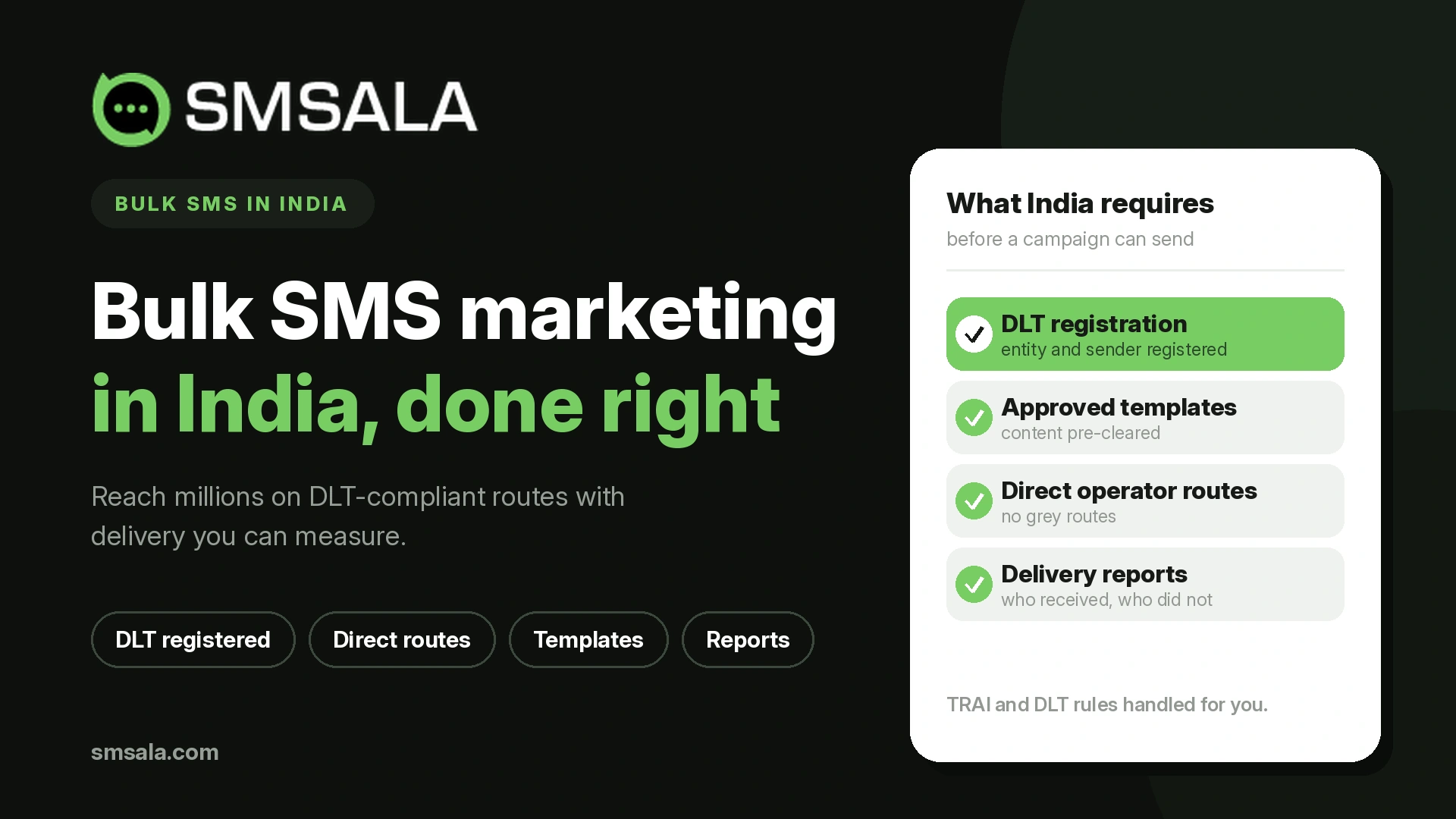
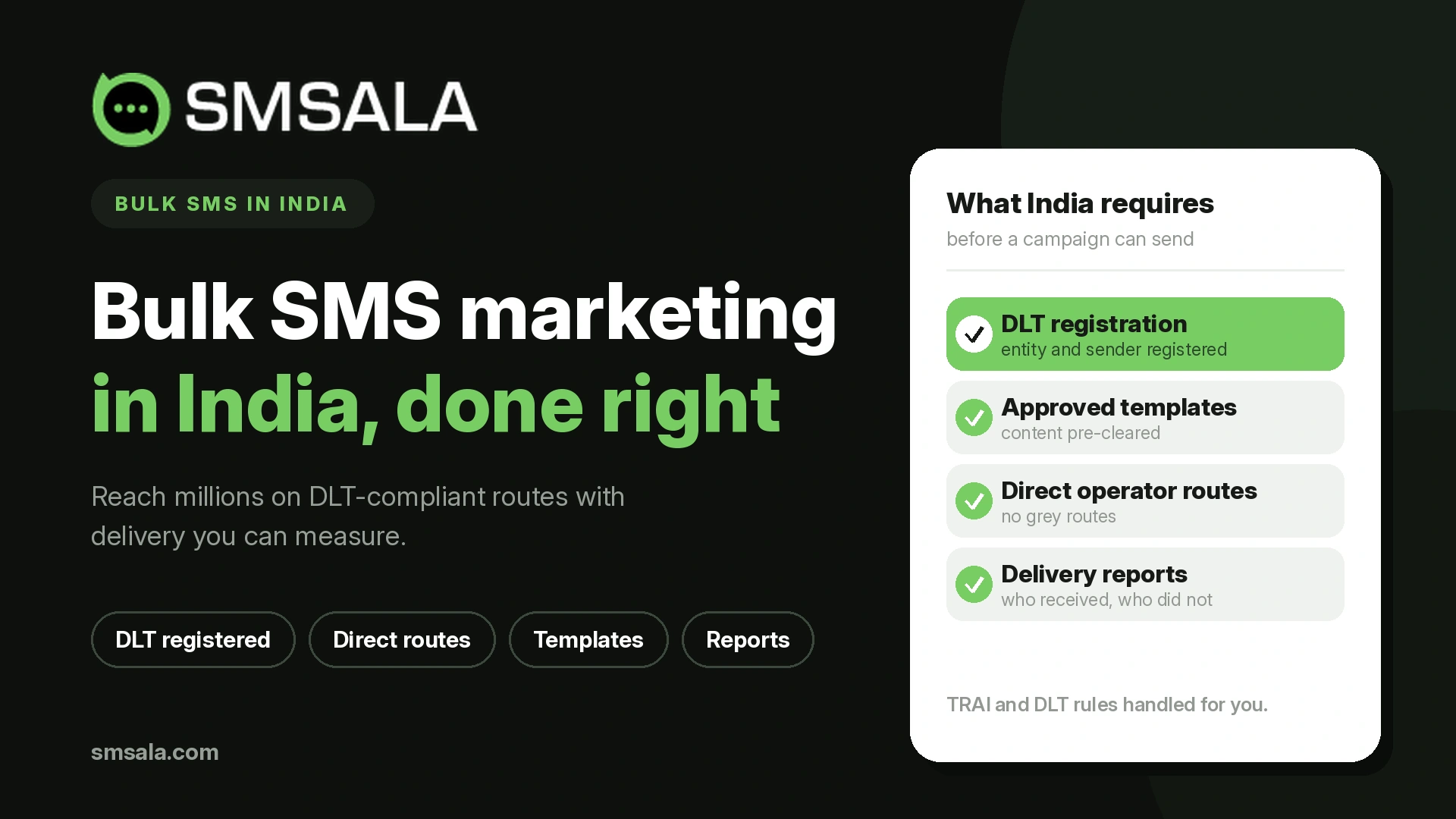
Before any bulk SMS goes out in India, your business must be registered on a Distributed Ledger Technology (DLT) platform under TRAI's Telecom Commercial Communications Customer Preference Regulations. This means registering your entity, your sender IDs (headers), and every message template. Since December 2024, operators also enforce end-to-end telemarketer-chain traceability, blocking messages whose declared path does not match the actual one.
The practical implication for marketers is that you cannot improvise message copy. Every message must match a registered template, and any change to the fixed text needs an updated template or it can be scrubbed before delivery. Completing DLT registration correctly, and keeping templates current, is the foundation everything else sits on.
How to run a bulk SMS marketing campaign
A well-run campaign follows a clear sequence:
Define the goal and audience. Decide what the campaign should achieve and who should receive it, then segment your list accordingly.
Confirm consent and compliance. Ensure you have the right to message each recipient, and that your DLT entity, header, and templates are registered.
Register the template. Draft the exact message, with variable placeholders for the parts that change, and register it before sending.
Segment and personalise. Tailor the message to each segment, using personalisation fields where they add value.
Craft the message. Keep it short, lead with the point, and include one clear call to action.
Time the send. Schedule around local hours and, for promotions, respect permitted sending windows.
Send via panel or API. Use a dashboard for one-off campaigns and an API for automated or triggered messages.
Measure and learn. Track delivery and response, and refine the next campaign based on what the data shows.
For teams new to the mechanics, a practical walkthrough of how to send bulk SMS covers the sending process in more detail.
Writing effective SMS for Indian audiences
Good SMS copy is short and specific. Lead with the offer or information, keep the sender identity clear, and give the reader one obvious next step, whether that is a reply, a call, or a link. A consistent, registered sender ID builds recognition and trust over time.
Regional language matters. Campaigns in the recipient's preferred language consistently outperform generic English in many segments, and that requires Unicode support. Keep in mind that Unicode messages hold fewer characters per segment than plain English, which affects both length and cost, so check segment counts before sending.
Industry use cases
Bulk SMS marketing works across sectors, each with its own pattern:
E-commerce and retail: offers, cart reminders, order confirmations, and delivery updates. Combined with other channels, it is a core part of SMS marketing for e-commerce.
Banking and finance: transaction alerts, payment reminders, and OTPs, mostly on transactional and service routes.
Healthcare: appointment reminders, test-result notifications, and health campaigns.
Education: admissions updates, fee reminders, and results notifications.
Real estate and services: new listings, event invites, and follow-ups.
What bulk SMS costs in India
Bulk SMS in India is priced per message, and the rate depends on the category, your monthly volume, and route quality. Per-message rates are low, often in the range of a few paise to around twenty paise or more depending on those factors, and higher volumes bring negotiated discounts. Two things are worth remembering: the cheapest quote is often the most expensive in practice, because low prices usually signal grey routes that fail and force resends, and DLT registration plus operator considerations add to the total.
Rather than fixing on a single figure, which shifts with the market, ask any provider for a current written quote for your specific category and volume, and confirm the routes are direct.
How to choose a bulk SMS provider in India
The provider you choose handles most of the factors above on your behalf. Look for reliable delivery across all Indian operators over direct routes, active DLT and compliance support, a solid API for automated sending, real-time delivery reporting, and transparent pricing. A short live test across networks reveals more than any feature list. For a fuller framework specific to the Indian market, this guide on choosing the best SMS panel in India walks through the criteria in detail.
Common mistakes to avoid
The frequent errors are predictable: messaging without proper consent, sending promotional content on the wrong route, letting templates drift out of sync with the copy you actually send, over-messaging until recipients opt out, choosing a provider on price alone, and ignoring delivery reports. Each is avoidable with a little discipline, and avoiding them is far cheaper than recovering a damaged sender reputation.
Measuring results
Judge campaigns on real signals, not sends. Track your delivery rate through real-time receipts, click-through on tracked links, and downstream conversions or responses. Strong bulk SMS analytics and reporting let you compare campaigns, spot a failing route quickly, and understand which messages actually move the needle.
For businesses that want compliant delivery, direct routing, and reporting in one place, SMSALA's bulk SMS service for India is built around the DLT framework and Indian operator coverage, with an API and delivery tracking suited to campaigns at scale.
Frequently asked questions
Is DLT registration required for bulk SMS marketing in India?
Yes. Every business sending commercial SMS must register its entity, sender IDs, and message templates on a DLT platform. Unregistered or template-mismatched messages are blocked.
What is the difference between promotional and transactional SMS?
Promotional messages are marketing content sent to prospects and are subject to DND rules. Transactional and service messages, such as OTPs and order updates, use routes exempt from DND when categorised correctly.
Can I send bulk SMS in regional languages?
Yes, using Unicode encoding. Note that Unicode messages hold fewer characters per segment than English, which affects length and cost.
How much does bulk SMS cost in India?
Rates are low and vary by category, volume, and route quality, and DLT and operator factors apply on top. Ask providers for a current written quote for your specific needs rather than relying on a single advertised figure.
How do I measure whether a campaign worked?
Track delivery rate through receipts, click-through on tracked links, and conversions or responses, rather than counting messages sent.
Conclusion
Bulk SMS marketing still delivers in India because it reaches everyone, fast, in the language they prefer. The winners are the businesses that treat it as a compliant, well-measured channel: register correctly on DLT, match message type to audience, write short and clear, send over direct routes, and judge results by delivery and conversion rather than volume. Get the fundamentals right, and SMS remains one of the most cost-effective ways to reach Indian customers at scale.