
A recruiter finds a strong candidate, exactly the profile the team's been after. The plan is to email an interview invitation. The email goes out that afternoon, sits unopened in a busy inbox overnight, gets a reply two days later — and by then the candidate has accepted an offer somewhere else, from a company that moved faster. Nobody did anything wrong. The candidate was just lost to the gap between "we want to talk to you" and the candidate actually hearing it in time to act. In hiring, that gap is where good people slip away, and it's the gap SMS is built to close.
The way most articles frame SMS for recruitment — higher open rates, candidates prefer texting — is true but misses the point. The reason SMS matters in hiring isn't that texts get read more; it's that hiring is a process where you lose candidates at every slow, silent stage, and speed is what keeps them. A text that reaches a candidate in minutes, at each step of the funnel, compresses the response time that email lets stretch into days — and that compression is the difference between hiring the person and watching them go elsewhere. But there's a boundary that matters just as much: some parts of hiring belong on SMS and some absolutely don't, and getting that wrong damages your employer brand. This covers both — how SMS reduces candidate drop-off, and where it has no business being.
Recruitment's real problem: drop-off across a slow funnel
To see why SMS helps, look at hiring as a funnel with leaks at every stage. A candidate applies, then has to be screened, scheduled, interviewed, evaluated, and offered — and at every transition between stages, candidates drop out. Some drop because a competitor moved faster; some because a slow, silent process made them lose interest or assume they were rejected; some because a message never reached them in time; some because the friction of coordinating (scheduling emails back and forth) wore them down.
The common thread in most of that drop-off is time and silence. The longer a candidate waits between stages with no contact, and the slower each interaction, the more of them leak out of the funnel — and crucially, the best candidates leak fastest, because they have other options and get hired elsewhere while a slow process dithers. This is the recruitment equivalent of speed-to-lead in sales: the employer who responds and moves candidates through fastest disproportionately wins them, not necessarily because the job is better, but because they were there first and kept the candidate engaged. So the real problem to solve isn't "reach candidates" — it's move them through the funnel fast enough, and keep them warm enough between stages, that they don't leak out. That reframes what SMS is for.
Why SMS fixes it: compressing response time at each stage
SMS reduces funnel drop-off by compressing the response time at every stage where email lets it stretch. A text reaches the candidate in minutes, on the device they always check, and — because replying to a text is effortless — comes back fast too. Each interaction that would take days by email takes minutes by text, so a candidate moves from application to interview to offer in a fraction of the time, giving them far less window to cool off, disengage, or accept elsewhere.
Consider the compounding effect across the funnel. If each of five stages is a day or two faster by SMS, the whole process compresses from weeks to days — and in a market where good candidates are gone in days, that compression is decisive. It's the same mechanism that makes SMS drive strong response rates in any context, applied to the specific problem of a leaky hiring funnel: faster contact and faster replies at each stage mean fewer candidates lost between stages. The recruiter who texts an interview invite gets a yes within the hour while the emailing competitor is still waiting for their message to be opened — and that speed advantage, repeated at every stage, is why SMS meaningfully improves hiring outcomes. It's not that texts are magic; it's that hiring is a race, and SMS runs it faster.
Where SMS fits in the hiring funnel
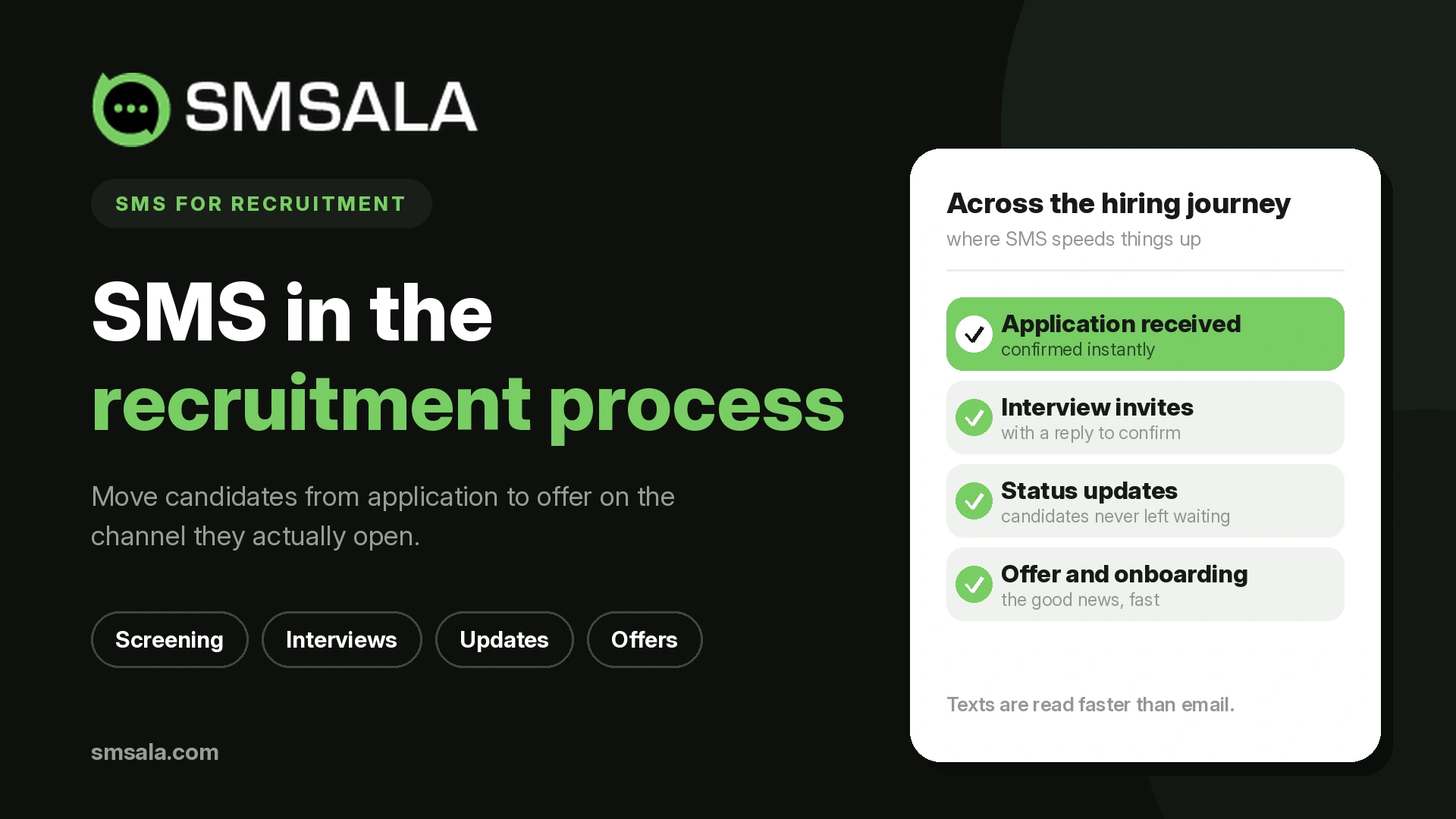
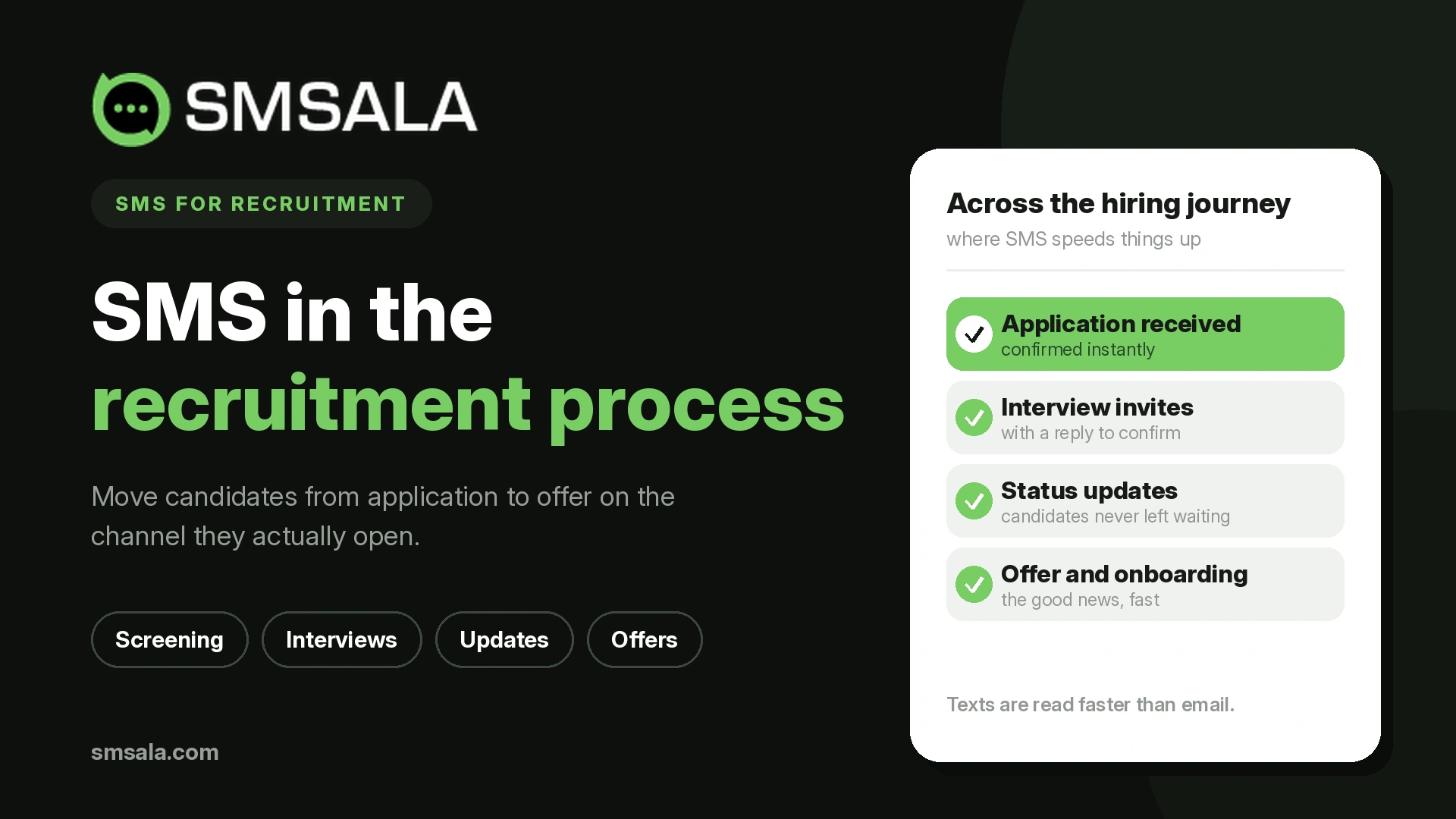
SMS earns its place at the logistical and coordination stages — the points where speed and low friction move a candidate forward. Mapped to the funnel:
Application acknowledgement. An instant text confirming an application was received tells the candidate they're not shouting into a void — a small thing that reduces the early anxiety and silence that make candidates disengage. An automated autoresponder acknowledgement is ideal here, provided the follow-up it implies actually happens.
Initial screening. Quick screening questions or a prompt to complete the next step, answered by text far faster than by email, moving candidates into the process quickly.
Interview scheduling. The biggest friction-remover. Coordinating interview times by email is a slow back-and-forth; by text it's a rapid exchange, and it's where SMS saves the most time and prevents the most drop-off. Two-way texting turns scheduling from a multi-day chore into a few quick messages.
Interview reminders. A reminder the day before and the morning of an interview measurably reduces no-shows — a candidate who forgets or double-books is a wasted slot and a lost prospect, and a timely text prevents it.
Status updates. Keeping candidates informed between stages ("you've progressed to the next round," "we're reviewing and will be in touch by Friday") keeps them warm and engaged, preventing the silence-driven drop-off where candidates assume rejection and move on.
Onboarding logistics. Once hired, the practical coordination of starting — documents, first-day details, reminders — where fast, clear communication smooths the transition.
Notice these are all coordination and information — moving the candidate through, reducing friction, keeping them warm. That's precisely what SMS is good at, and precisely where it reduces drop-off. But there's an equally important set of stages where SMS is the wrong tool.
Where SMS does not belong in hiring
Here's the boundary that protects your candidate experience and employer brand, and that the enthusiastic "text your candidates!" advice ignores. Some moments in hiring are substantive or sensitive, and handling them by text — especially cold, one-directional text — damages the relationship and your reputation.
Job offers. An offer is one of the most significant moments in a person's professional life, and delivering it as a bare text feels impersonal and cheapens it. Offers deserve a call or a proper conversation — the warmth, the chance to answer questions, the human moment. SMS can support the offer stage (a text to schedule the offer call, a follow-up confirming details in writing), but the offer itself shouldn't be a cold text.
Rejections. Rejecting a candidate by impersonal text — particularly one who invested in interviews — is a fast way to damage your employer brand, because rejected candidates talk, review, and remember. Rejections deserve a considerate email at minimum, and a call for candidates who reached late stages. A curt "you were unsuccessful" text reads as callous and costs you goodwill and future applicants.
Substantive evaluation or sensitive discussion. Anything requiring nuance, judgment, or two-way depth — discussing a candidate's fit, negotiating, handling a concern — needs a richer channel than 160 characters. SMS is for coordination, not conversation of substance.
The principle: use SMS for the logistics of hiring, not the humanity of it. The coordination stages (scheduling, reminders, updates, acknowledgements) benefit from speed and suit text; the significant human moments (offers, rejections, real discussion) need a warmer, richer channel and are harmed by a cold text. A recruiter who respects this line gets SMS's speed benefits without the candidate-experience damage; one who texts everything, including offers and rejections, gains speed and loses the relationship. Knowing that recruitment SMS is professional coordination — quite distinct from how business SMS differs from personal SMS — keeps the tone right: courteous, clear, and human even in a text.
How this reduces ghosting and improves candidate experience
Candidate ghosting — where candidates go silent and vanish from the process — is a major recruitment frustration, and it runs both ways: candidates ghost employers, but employers also effectively ghost candidates with long silences. SMS reduces both. By keeping candidates informed and engaged at each stage rather than leaving them in silence, it removes the disengagement that leads candidates to drift away, and by making it effortless for candidates to respond, it reduces the friction that causes them to go quiet. A candidate who gets a prompt acknowledgement, quick scheduling, timely reminders, and honest status updates feels respected and stays engaged; one left in silence for weeks assumes rejection and moves on.
The candidate-experience gain is real and worth naming, because candidate experience is employer brand now — candidates share how they were treated, and a responsive, communicative process (which SMS enables) builds a reputation that attracts future applicants. The caveat, per the boundary above, is that the experience gain only holds if SMS is used warmly and appropriately; used for cold rejections or impersonal offers, it damages the very experience it could improve. Speed and respect together improve candidate experience; speed without respect harms it.
The consent and professionalism rules
Candidates aren't a marketing list, and recruitment SMS carries its own etiquette. Get consent to text candidates — typically candidates provide a mobile number and consent to contact when they apply, but be clear that you'll use SMS and let them opt for another channel if they prefer. Keep every message professional, courteous, and clearly identified as from your organisation and about their application — a candidate should never be confused about who's texting or why. Respect reasonable hours (a recruitment text at 11pm is intrusive), keep messages relevant to their process, and never over-message. And remember the tone: even a quick scheduling text should read as warm and respectful, because it's shaping the candidate's impression of your organisation. Treating candidates with the professionalism the moment deserves — using text for its speed while keeping it human — is what makes recruitment SMS an asset rather than an irritant.
Two-way: letting candidates respond
Recruitment SMS works best as a genuine two-way channel, because most of its value (scheduling, screening responses, questions) depends on the candidate replying. Enabling two-way messaging lets candidates confirm interview times, answer screening questions, ask logistics questions, and stay in dialogue — turning SMS from a one-way notification tool into an actual coordination channel. This is what makes the scheduling and screening speed possible: a candidate who can just text back "Tuesday works" moves the process forward in seconds. It also signals responsiveness — a candidate who can reach a real recruiter by text feels supported, improving their experience. Just ensure replies are actually monitored and answered, because inviting responses and then leaving them unanswered recreates the silence you were trying to eliminate.
Mistakes that damage candidate experience
Texting offers and rejections — handling the significant, sensitive moments by cold text, damaging the relationship and employer brand.
Leaving candidates in silence between stages — the drop-off SMS should prevent, undone by not using it to keep candidates informed.
Cold or robotic tone — treating candidates like a marketing list rather than people, so even scheduling texts feel impersonal.
Inviting replies then ignoring them — recreating the ghosting-by-employer that drives candidates away.
Over-messaging or bad timing — texting too often or at unreasonable hours, irritating candidates.
No consent or unclear identity — texting candidates who didn't expect it, or from an unidentified sender, creating confusion and distrust.
FAQ
How does SMS help in the recruitment process?
It reduces candidate drop-off by compressing response time at each stage of hiring. Recruitment loses candidates at every slow, silent step — especially the best ones, who get hired elsewhere fast — and SMS's speed keeps them engaged and moving through the funnel. It's most valuable for acknowledgements, screening, interview scheduling, reminders, and status updates, where fast, low-friction contact prevents candidates from leaking out of the process.
At which stages of hiring should I use SMS?
The logistical and coordination stages: acknowledging applications, quick screening prompts, interview scheduling (its biggest time-saver), interview reminders to cut no-shows, status updates to keep candidates warm, and onboarding logistics. These benefit from speed and low friction, which is exactly what SMS provides — moving candidates through the funnel faster than email allows.
Where should I NOT use SMS in recruitment?
For the significant or sensitive moments: job offers (which deserve a call, not a cold text), rejections (which need a considerate email or call, since a curt text damages your employer brand), and any substantive evaluation or nuanced discussion. Use SMS for the logistics of hiring, not the humanity of it — coordination suits text, but the important human moments need a warmer, richer channel.
Does SMS reduce candidate ghosting?
Yes, in both directions. By keeping candidates informed and engaged at each stage rather than leaving them in silence, SMS removes the disengagement that makes candidates drift away, and by making replying effortless, it reduces the friction that causes them to go quiet. A candidate who gets prompt acknowledgements, quick scheduling, and honest updates stays engaged; one left in silence assumes rejection and leaves.
Do I need consent to text job candidates?
Yes. Candidates typically provide a mobile number and consent to contact when they apply, but be clear you'll use SMS and let them choose another channel if they prefer. Keep every message professional, clearly identified as from your organisation about their application, sent at reasonable hours, and relevant — candidates aren't a marketing list and should never be confused about who's texting or why.
Why is SMS better than email for recruitment?
Because hiring is a race where good candidates are gone in days, and SMS compresses the response time that email lets stretch. A text reaches a candidate in minutes and gets a reply fast, so each stage — scheduling, screening, updates — takes minutes instead of days. Across the whole funnel, that speed keeps candidates engaged and prevents the drop-off that loses them to faster-moving competitors.