
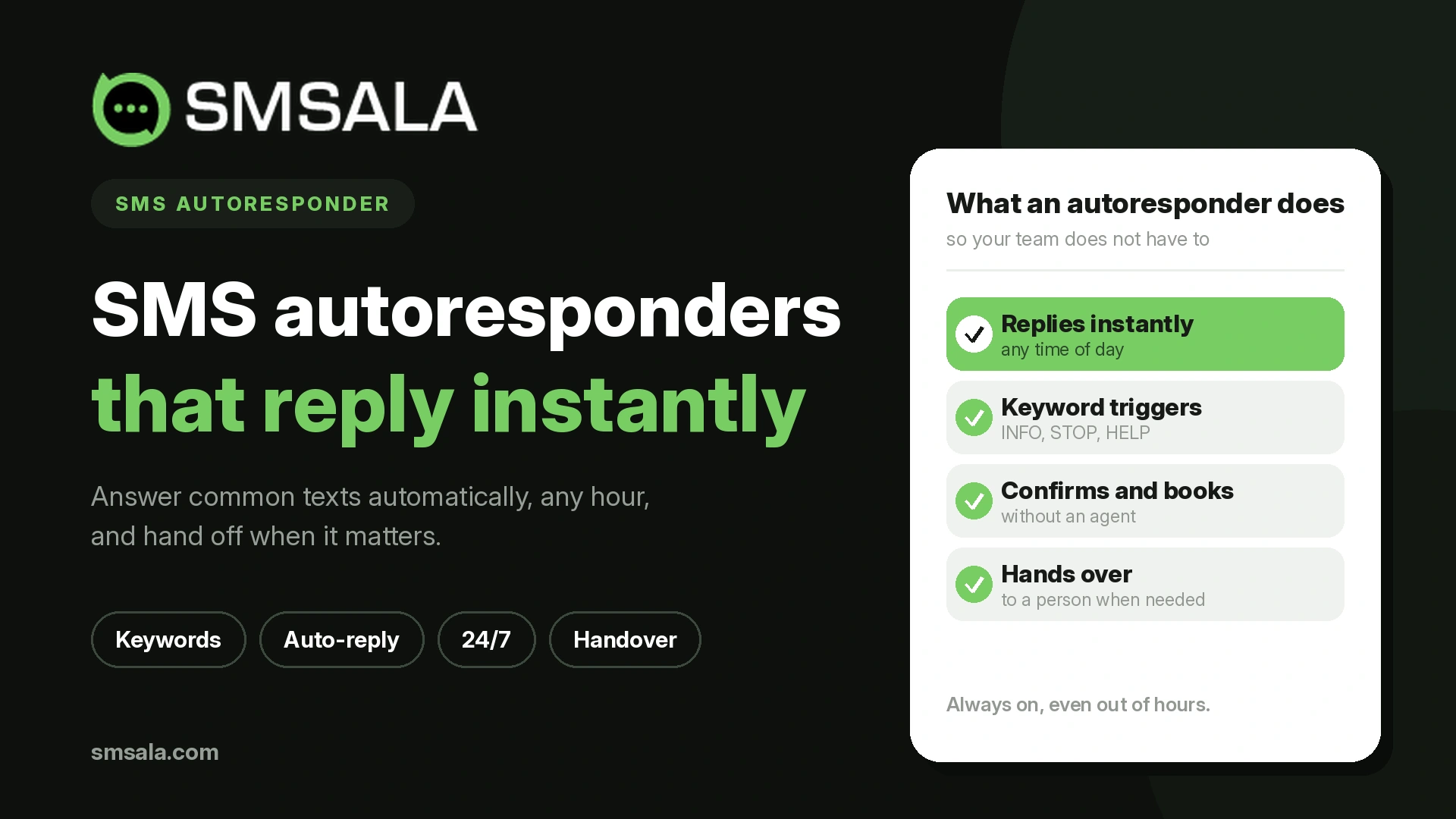
A customer texts a business a simple question — "are you open Sunday?" — and hears nothing. Ten minutes pass, then an hour. By the time someone at the business gets to it, the customer has already texted a competitor, got an instant answer, and made their plan. The business didn't lose that customer because of price, product, or service. It lost them to silence — the gap between the question and any response at all. That gap is what an SMS autoresponder exists to close.
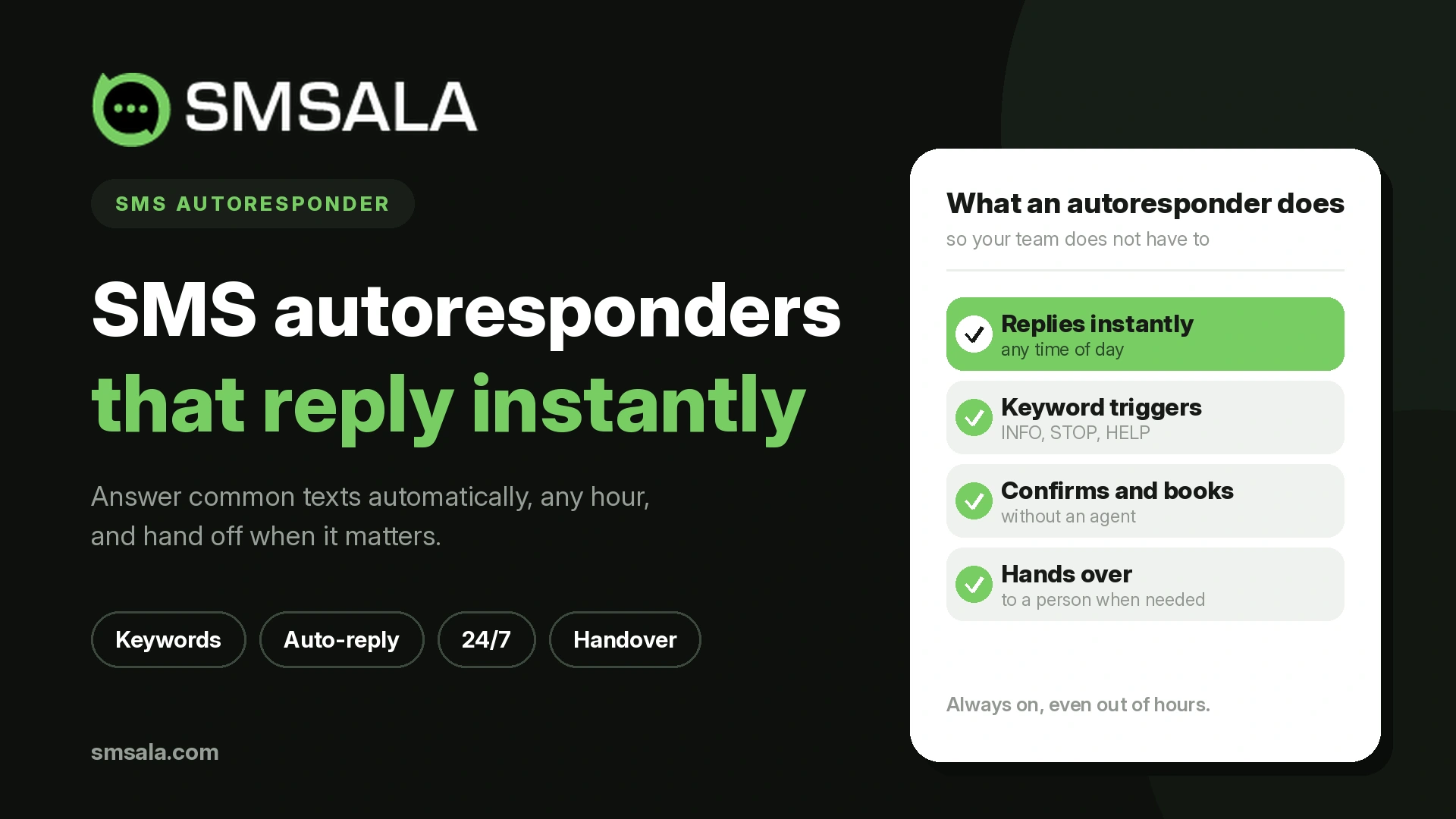
Most explanations treat the autoresponder as an "away message for texts" — a nice-to-have for when you're out of the office. That undersells it. An SMS autoresponder is the mechanism that lets a business acknowledge every inbound message instantly and always, turning silence into a response that keeps the customer engaged instead of gone. But there's a catch the cheerful guides never mention: an autoresponder makes a promise on your behalf — "we'll get back to you shortly" — and if you don't keep that promise, it does more harm than sending nothing at all. This guide covers what an autoresponder genuinely does, how to use it, and the honest realities — the promise you have to keep, and where a simple autoresponder ends and real conversational automation begins.
What an SMS autoresponder actually is
An SMS autoresponder is an automatic reply sent the moment a specific trigger occurs — someone texts a keyword, signs up, sends an inbound message, or has a call go unanswered — with no human typing or hitting send. The system detects the trigger and fires a pre-written response instantly.
The reframe worth making: this isn't primarily about you being away. It's about the customer never waiting. Even a fully-staffed business can't answer every inbound text in the seconds it takes for a customer's attention to move on — but an autoresponder can, every time, day or night. So its real value is instant acknowledgement at scale: every person who contacts you gets an immediate, relevant response confirming they've been heard, which holds their attention and buys you the time to follow up properly. It's the difference between a business that only broadcasts (sends messages out) and one that can respond the instant it's contacted. That responsiveness, made possible by automating the reply, is what turns SMS from a one-way megaphone into a channel that reacts to customers in real time — the foundation of genuine two-way messaging.
How an SMS autoresponder works
An autoresponder fires on a trigger, and understanding the common triggers helps you see what it can do:
Keyword trigger — a customer texts a specific word ("INFO," "JOIN," "HOURS") to your number, and the matching auto-reply sends. This is the backbone of keyword-driven campaigns, where setting up the right opt-in keywords lets customers request exactly the information or action they want.
Sign-up / opt-in trigger — someone joins your list and instantly receives a welcome message.
Inbound-message trigger — any customer texting your number receives an acknowledgement that their message arrived and what happens next.
Missed-call trigger — when a call goes unanswered, an automatic text follows so the caller isn't left feeling ignored.
The response can be a single canned message (the simplest form) or the entry point to a more elaborate flow (keyword menus, follow-up sequences). At its most basic, an autoresponder is one trigger → one reply; at its most advanced, it's the front door to full conversational automation. Most businesses start simple and build up, which is the sensible path.
What SMS autoresponders are actually for
The genuinely valuable uses, each solving the acknowledgement-gap problem:
Instant welcome for new sign-ups. The moment someone opts in, a warm welcome confirms they're in and sets the tone — sent at 3am or on a holiday without anyone present. Example: "Welcome to ! You're on the list — here's your promised 15% off: . Thanks for joining."
Order and booking confirmations. A customer who buys or books at any hour gets instant confirmation for their records and peace of mind. Example: "Your order [#1234] is confirmed. We'll text you when it ships. Thanks for shopping with ."
Appointment confirmations. For clinics, salons, and service businesses, an instant confirmation of date and time reassures the customer and reduces uncertainty. Example: "Your appointment with Dr. is confirmed for May 12 at 10am. Reply R to reschedule."
Inbound-query acknowledgement. When a customer texts a question you can't answer instantly, an autoresponder confirms it's been received and sets expectations. Example: "Thanks for reaching ! We've got your message and a team member will reply within . For urgent help, call ."
Missed-call recovery. A text after an unanswered call keeps the caller from feeling ignored and gives them a next step. Example: "Sorry we missed your call! We'll call back shortly, or reply here and we'll help by text."
Keyword-requested information. Customers text a keyword to instantly pull hours, directions, pricing, or an offer — self-service that answers common questions without staff. This is a core part of using SMS to improve customer service, because it resolves routine queries the instant they're asked.
The thread through all of these: the customer gets an immediate, relevant response instead of silence — which is exactly what keeps them engaged.
The warning nobody gives: an autoresponder is a promise you have to keep
Here's the honest point the sample-message lists skip entirely, and it's the most important thing to understand before you deploy one: an autoresponder sets an expectation, and a broken expectation is worse than no expectation at all.
Look at the most common autoresponder: "Thanks for your message! A team member will get back to you shortly." That message makes a promise — someone will follow up, shortly. If a real person then follows up promptly, the autoresponder has done its job beautifully: it acknowledged the customer and delivered on the acknowledgement. But if no one follows up — or "shortly" turns into two days — the autoresponder has actively damaged trust, because it promised responsiveness the business didn't deliver. The customer would have been less annoyed by silence than by a friendly automated lie. A dead-end autoresponder, one that promises a human who never arrives, is worse than none.
This changes how you should deploy autoresponders. Every auto-reply that promises a follow-up must be backed by a real process that delivers it — a routing to actual staff, a genuine response time you can meet, a system that ensures the promised human actually appears. Only promise what you'll keep: if you can't reliably follow up "within an hour," don't say an hour. If you can only reliably respond next business day, say that — an honest expectation met beats an ambitious one broken. The autoresponder is the first half of a commitment; the business has to supply the second half. Treating it as a complete solution — "the autoresponder handles it" — when it only acknowledges and doesn't resolve is how autoresponders backfire.
Simple autoresponder vs conversational automation vs chatbot
Understanding the ladder of automation helps you know what you're actually buying and where its limits are — a distinction the source blurs completely.
Simple autoresponder — one trigger, one canned reply. "Text HOURS, get our hours." Excellent for acknowledgement and fixed information; it can't handle anything unexpected or hold a conversation.
Keyword-driven flows — multiple keywords, each with its own response, and simple branching ("Reply 1 for sales, 2 for support"). This handles a menu of common needs and routes customers, still using pre-set responses but offering more than a single reply.
Chatbot / conversational automation — an actual SMS chatbot that understands varied inputs, answers a range of questions, and holds a back-and-forth, increasingly powered by AI. This can resolve queries, not just acknowledge them — a genuine step up from an autoresponder, and a bigger undertaking.
The decisive distinction: an autoresponder acknowledges; a chatbot converses and resolves. An autoresponder says "we heard you, here's what happens next"; a chatbot actually handles the customer's need. Knowing which you have matters because it tells you what still requires a human. Many businesses only need the autoresponder rung — instant acknowledgement plus reliable human follow-up — and that's genuinely enough. Others with high query volume climb to chatbots. The mistake is expecting an autoresponder to do a chatbot's job (resolve issues) when it only does an autoresponder's (acknowledge them). Increasingly, AI-driven SMS automation blurs these rungs, but the principle holds: match the rung to what you actually need, and know its limits.
When an SMS autoresponder isn't enough
Honestly, the situations where an autoresponder alone falls short:
Complex or unique queries — an autoresponder can acknowledge but not resolve anything non-standard; these need a human or a capable chatbot.
Emotional or sensitive situations — a canned reply to a complaint or distressed customer can feel dismissive; these need a person.
When you can't back the promise — if you lack the staff to deliver the follow-up an autoresponder promises, the autoresponder exposes the gap rather than filling it.
As a substitute for actual service — an autoresponder improves responsiveness, not the quality of the eventual help; it's the front door, not the whole house.
Recognising these keeps you from over-relying on automation where a human is what the situation actually needs.
How to write autoresponders that work
A few principles: keep it short and clear; confirm what happened and what happens next ("we got your message, someone will reply by "); only promise what you'll keep; include an escape hatch for urgency ("for urgent help, call "); sound human, not robotic; and identify your brand so the recipient knows it's you. The best autoresponders acknowledge, set an honest expectation, and give the customer a next step — nothing more.
Setting it up
Getting autoresponders running comes down to choosing a provider that supports inbound messaging and keyword triggers (you need a number that can receive, not just send), configuring your triggers and responses, and — crucially — wiring the follow-up: routing acknowledged messages to real staff or a system that delivers the promised response. Test the full loop, not just the auto-reply: send an inbound message and confirm both the instant acknowledgement and the human follow-up actually happen. An autoresponder that fires perfectly but leads nowhere is the failure mode to avoid.
Mistakes that make autoresponders backfire
Promising follow-up you don't deliver — the cardinal sin; a dead-end auto-reply that breaks its own promise, worse than silence.
Over-promising response times — saying "within an hour" when you mean "next day," setting an expectation you'll miss.
Treating it as a complete solution — expecting acknowledgement to substitute for resolution.
Robotic, cold wording — a reply that feels like a machine brushing the customer off.
No escape hatch — leaving urgent customers stuck in an automated loop with no way to reach a human.
Never testing the full loop — checking the auto-reply fires but not that the promised follow-up actually happens.
If you're setting up an SMS autoresponder, the thing that makes it work isn't the auto-reply itself — it's backing every promise it makes with a real response, so instant acknowledgement leads to actual help. SMSala's inbound and outbound SMS supports the keyword triggers and two-way handling that let you acknowledge every customer instantly and route them to the follow-up that keeps the promise — the whole loop, not just the automatic half.
FAQ
What is an SMS autoresponder?
An SMS autoresponder is an automatic text reply sent the instant a trigger occurs — someone texts a keyword, signs up, sends a message, or has a call go unanswered — with no human typing or sending it. Its core value is acknowledging every inbound contact instantly, turning silence into a response that keeps customers engaged while you follow up.
Why does a business need an SMS autoresponder?
Because silence loses customers. When someone contacts a business and hears nothing, they often move to a competitor who responds faster. An autoresponder acknowledges every message instantly, day or night, holding the customer's attention and buying time for a proper follow-up. Even fully-staffed businesses can't reply in the seconds it takes attention to move on — an autoresponder can.
What's the difference between an SMS autoresponder and a chatbot?
An autoresponder acknowledges — it sends a pre-set reply confirming a message was received and what happens next. A chatbot converses and resolves — it understands varied questions and handles the customer's need in a back-and-forth. The autoresponder is the front door; the chatbot handles the whole interaction. Many businesses only need an autoresponder plus reliable human follow-up.
What should an SMS autoresponder say?
Keep it short: confirm what happened, set an honest expectation of what's next, and give an escape hatch for urgency. For example: "Thanks for reaching ! We've got your message and will reply by . For urgent help, call ." Only promise a follow-up time you can actually keep, and sound human rather than robotic.
Can an autoresponder hurt my business?
Yes, if it makes a promise you don't keep. An auto-reply saying "we'll get back to you shortly" that leads to no follow-up damages trust more than sending nothing, because it's a friendly automated broken promise. Every autoresponder that promises a human response must be backed by a real process that delivers it — otherwise it exposes the gap rather than filling it.
What triggers an SMS autoresponder?
Common triggers include a customer texting a specific keyword, signing up or opting in, sending any inbound message to your number, or having a call go unanswered (a missed-call auto-reply). The system detects the trigger and instantly sends the matching pre-written response, with no human involvement in the reply itself.