
Mobile marketing is the practice of reaching people through the device they keep within arm's reach almost every waking hour: the smartphone. It spans everything from a text message and a push notification to a mobile ad, an in-app message, a location-based offer, and a scannable QR code. What unites these is not a single technology but a context. The audience is on a personal, always-on device, often mid-task, with a short attention window and high intent when the moment is right.
That context is why mobile marketing is now the center of most marketing rather than a channel within it. More web traffic, more search, more social, and more commerce happen on phones than on desktops in most markets, which means a strategy that is not built for mobile first is built for a shrinking audience. The businesses that win are not the ones that shout loudest on mobile but the ones that understand which channel fits which moment, respect the permission the device demands, and measure what each channel returns.
What mobile marketing is
Mobile marketing is any marketing activity designed for and delivered to mobile devices, primarily smartphones and tablets. It includes messaging channels such as SMS and app-based chat, app experiences such as push and in-app messages, mobile web and search, mobile advertising across apps and social platforms, and location-aware tactics that respond to where a person is. The defining feature is not the format but the delivery to a personal device that travels with the user.
It helps to separate two broad intents inside mobile marketing, because they call for different channels and different measures of success. Performance-oriented mobile marketing aims to drive a measurable action now, such as a click, an install, or a purchase, and leans on ads, search, and direct messaging. Engagement-oriented mobile marketing aims to build an ongoing relationship, such as retention, loyalty, and repeat use, and leans on owned channels like messaging, push, and in-app experiences. Most mature programs run both, but confusing the two, and judging an engagement channel by a performance metric or vice versa, is a common source of wasted budget.
Why mobile sits at the center of the economy
The reason mobile marketing matters is structural. The smartphone has become the primary computer for most of the world, and for a large share of people in mobile-first regions it is the only one. Shopping, banking, searching, socializing, and messaging have consolidated onto a single device that is almost always on and almost always within reach. Time spent on phones dwarfs time spent on other screens, and commerce has followed that attention.
This concentration has two consequences for marketers. First, the phone is where the audience already is, so reaching them no longer requires pulling them to a desktop or a store. Second, because the device is so personal, the tolerance for irrelevance is low. A person will read a text within minutes but will also block, mute, or uninstall the moment a brand abuses that access. The mobile economy rewards relevance and punishes intrusion more sharply than any channel before it.
The channels of mobile marketing
Mobile marketing is not one tactic but a portfolio of channels, each with its own reach, cost, and best use. The map below shows how they differ and where each earns its place.
Channel | What it is | Best for | Type |
SMS and messaging | Texts and chat via SMS, WhatsApp, RCS | Direct, high-reach, time-sensitive messages | Owned |
Push notifications | Alerts from an installed app | Re-engaging existing app users | Owned |
In-app messaging | Messages shown while using an app | Guiding and converting active users | Owned |
Mobile web and search | Mobile-optimized sites and search results | Capturing intent and being found | Owned and paid |
Mobile and social ads | Paid placements in apps and feeds | Acquisition and awareness at scale | Paid |
Location and proximity | Geofencing, beacons, location offers | Driving nearby foot traffic | Owned and paid |
QR codes and mobile wallet | Scannable codes, wallet passes and coupons | Bridging physical and digital, loyalty | Owned |
Mobile email | Email designed for phone screens | Detailed content and lifecycle nurture | Owned |
Reading the table by the "type" column reveals the deeper structure. Owned channels reach an audience you already have a relationship with, cost little per message, and are the foundation of retention. Paid channels buy reach you do not yet have and are the engine of acquisition. The strongest programs use paid channels to acquire and owned channels to keep, rather than paying repeatedly to reach the same people.
Messaging: the direct line inside mobile marketing
Among all mobile channels, messaging holds a specific and often underrated position, because it reaches people directly without depending on an app install, an ad auction, or a platform algorithm. A message arrives in a personal inbox and is read, usually within minutes.
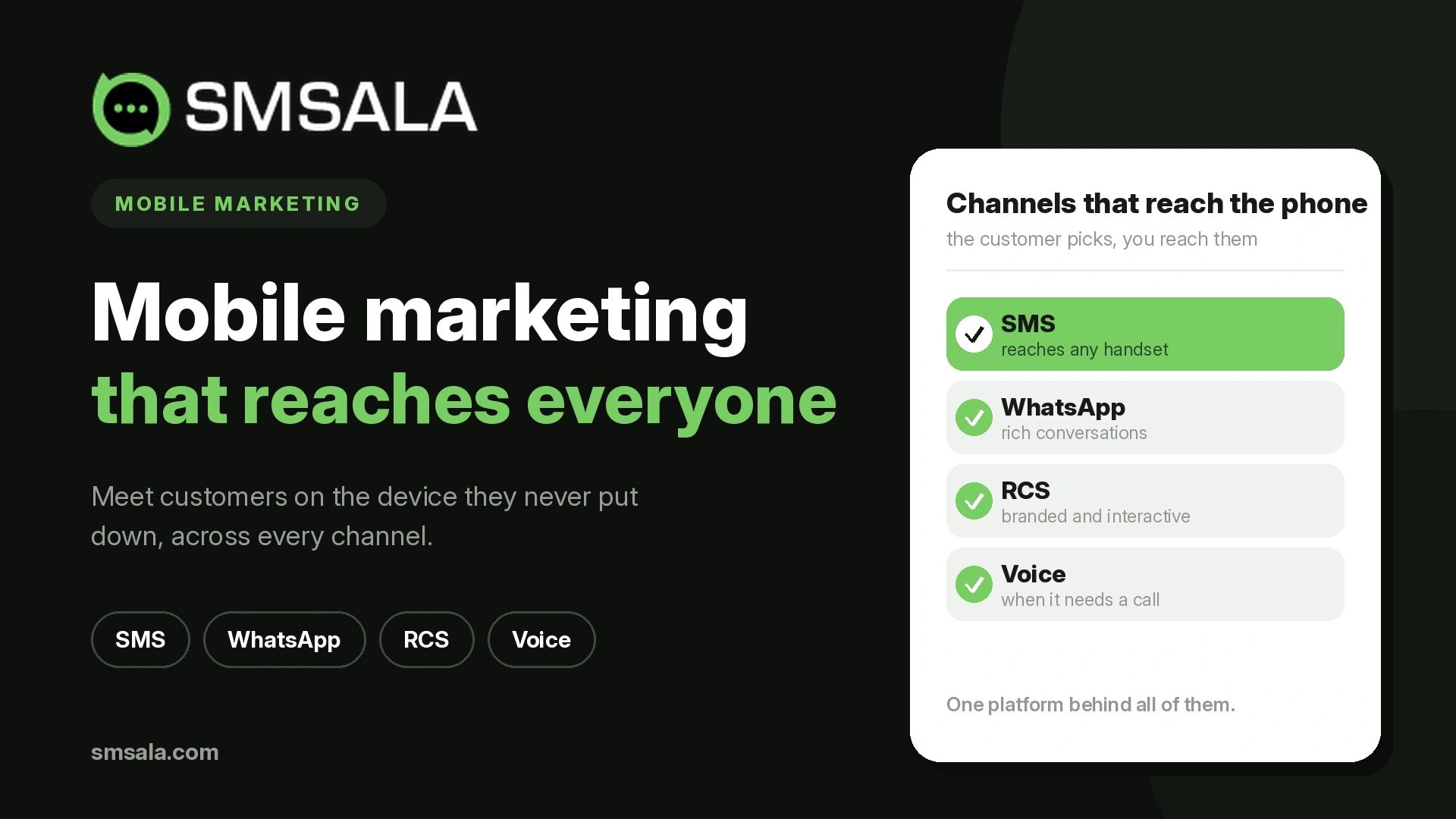
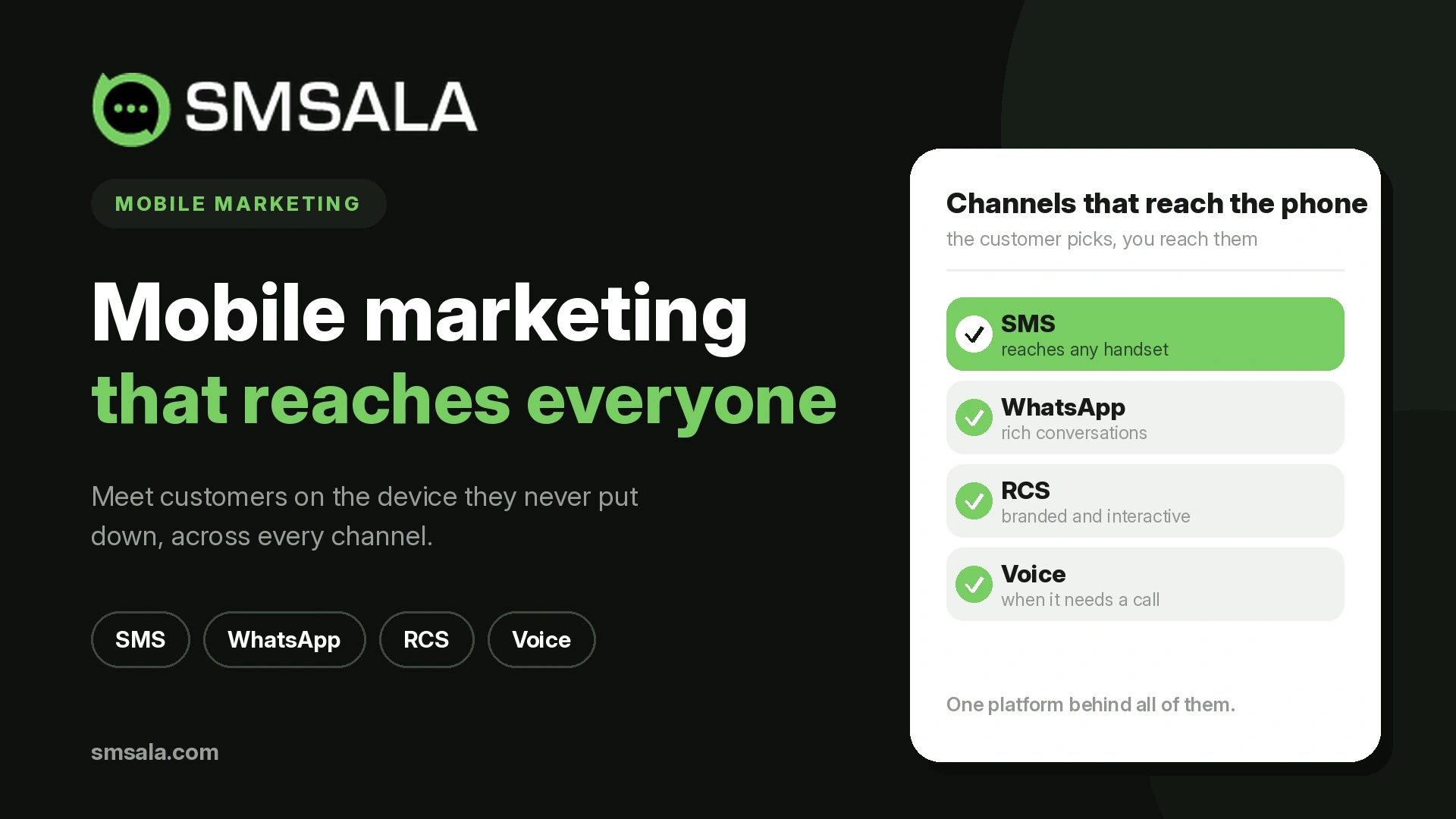
Messaging spans several channels that complement each other. SMS marketing offers near-universal reach on any phone with no app required, which makes it the dependable backbone for time-sensitive and transactional messages. WhatsApp Business adds rich, two-way conversations for audiences who live in the app. RCS brings branded, interactive messaging into the native inbox on Android and iPhone. Together they let a brand match the message to the channel, using broad reach for a passcode or an alert and richer formats for a guided conversation.
Messaging is also where owned mobile marketing becomes measurable and automated. Behavioral triggers turn it into a relationship engine, so a cart reminder or a replenishment nudge sends itself at the right moment, and a chatbot or two-way messaging lets customers respond without switching channels. For businesses coordinating several channels, this is the core of an omnichannel messaging approach, with messaging as the direct thread running through it.
Building a mobile marketing strategy
A collection of channels is not a strategy. A strategy is the decision about which channels serve which goals for which audience, and how they work together. A workable framework has five parts.
Set one clear objective per effort. Acquisition, activation, conversion, retention, and reactivation are different goals that suit different channels. Naming the goal first prevents the common mistake of judging every channel by the same metric.
Understand the mobile audience. Know how your customers actually use their phones, which channels they prefer, when they are reachable, and what they have consented to receive. Mobile behavior is specific, and assumptions drawn from desktop or email rarely transfer.
Match channels to moments. Use paid mobile and social ads to reach new audiences, search and mobile web to capture intent, and owned channels like messaging, push, and in-app to engage and retain. The art is fitting the channel to the moment rather than forcing every message through a favorite tool.
Personalize and automate. The value of mobile comes from relevance, and relevance at scale requires behavioral data and automation. Triggered messages based on what a customer actually did outperform broadcasts to everyone, and automation makes that practical across a large audience.
Coordinate across channels. A customer does not experience your push, email, and SMS as separate programs. Coordinating them, so the same person is not hit three times with the same offer, and capping frequency across channels, is what separates a system from a set of silos.
The output of this framework is a channel mix tied to goals, not a list of tactics run in parallel.
The cost and ROI of mobile marketing
One of mobile marketing's strengths is that it can be highly cost-effective, but only when measured properly. Channels differ enormously in cost structure, and the cheapest per-message channel is not always the cheapest per result.
Owned channels such as messaging, push, and in-app cost little to send and are therefore where the strongest returns usually sit, because you are reaching an audience you already have. Paid channels such as mobile and social ads cost more because you are buying reach, and their return depends on conversion, not impressions. The practical way to compare is not per-message price but cost per outcome: what you pay to acquire a customer, drive a sale, or retain a subscriber.
A simple discipline keeps mobile marketing profitable. Model the return before spending, using the chain of reach, engagement, conversion, and value rather than a vague expectation. Favor owned channels for repeat engagement, since paying repeatedly to re-reach existing customers through ads is the most common way mobile budgets leak. And measure each channel against its own job, so an engagement channel is judged on retention and a performance channel on cost per acquisition. Low-cost, high-reach tactics such as bulk SMS marketing and mobile coupons tied to trackable mobile landing pages often deliver the clearest return precisely because both the cost and the outcome are easy to measure.
Measuring what mobile marketing returns
Mobile marketing lives or dies on measurement, and the metrics that matter depend on the goal. For acquisition, cost per install and cost per acquisition tell you what new customers cost. For engagement, open, click, and conversion rates show whether messages earn action. For retention, repeat purchase rate and churn reveal whether the relationship is holding. And across everything, lifetime value against acquisition cost is the number that tells you whether the whole program is sustainable.
Attribution is the hard part on mobile, because a customer journey now crosses an ad, a search, a website, a message, and an app, often on the same device within minutes. Trackable links, campaign parameters, and unified customer profiles that stitch these touchpoints together are what let you credit the right channel rather than crediting the last click by default. Without that, mobile marketing measurement collapses into guesswork dressed up as data.
Privacy and the shift to first-party data
The biggest change reshaping mobile marketing is not a new channel but a tightening of privacy, and ignoring it is a strategic risk. Platform and regulatory shifts have steadily reduced the tracking that once powered mobile advertising. App-tracking transparency controls on mobile operating systems now require explicit permission to track users across apps, the third-party cookie has been deprecated or restricted across browsers, and privacy laws such as GDPR and similar regimes require genuine consent for marketing communication.
The consequence is a shift from borrowed, third-party data toward first-party data, meaning the information customers share directly and the consent they give explicitly. This is exactly where owned channels gain value, because a permission-based messaging list or an engaged app audience is first-party data by nature, resilient to the loss of third-party tracking. The brands adapting best are treating consent as an asset rather than a hurdle, building direct relationships that do not depend on tracking people across the web. Mobile marketing is moving from surveillance toward permission, and the programs built on genuine opt-in are the ones positioned to last.
Common mistakes in mobile marketing
A few errors recur across mobile programs regardless of industry. Treating mobile as a smaller version of desktop rather than its own context. Judging every channel by the same metric instead of by its job. Overusing paid reach to re-message customers who could be reached for free through owned channels. Sending without genuine consent and eroding trust on the most personal device a person owns. Ignoring frequency across channels so a customer feels bombarded. And skipping measurement, so spend continues on channels no one has proven return on. Each is avoidable, and each quietly caps what a mobile program can achieve.
Frequently asked questions
What is mobile marketing in simple terms?
It is marketing designed for and delivered to mobile devices, mainly smartphones. It spans messaging, app push and in-app messages, mobile web and search, mobile ads, and location-based tactics, all reaching people on the personal device they carry everywhere.
What are the main channels of mobile marketing?
The core channels are SMS and messaging, push notifications, in-app messaging, mobile web and search, mobile and social advertising, location and proximity marketing, QR codes and mobile wallet, and mobile-optimized email. Each suits a different goal and moment.
Is mobile marketing cost-effective?
It can be, especially owned channels like messaging and push that cost little to reach an existing audience. The key is measuring cost per outcome rather than per message, and using paid channels to acquire while relying on owned channels to retain.
How is mobile marketing different from digital marketing?
Mobile marketing is the subset of digital marketing built specifically for mobile devices and the personal, always-on context they create. Because most digital activity now happens on phones, mobile has moved from a channel within digital marketing to its center.
How do privacy changes affect mobile marketing?
App-tracking permissions, cookie restrictions, and consent laws have reduced third-party tracking, pushing marketers toward first-party data and consented, owned channels. Permission-based messaging and engaged app audiences are more resilient because they do not depend on tracking users across the web.
Which mobile channel has the highest reach?
SMS has the broadest reach because it works on any phone without an app or data connection, which is why it remains the backbone for time-sensitive and universal messages, complemented by richer channels for audiences that use them.
Conclusion
Mobile marketing has become the main way brands reach people, not because of any single technology but because the phone is where attention, commerce, and daily life now concentrate. Success comes from matching each channel to the moment it serves, favoring owned and consented channels for lasting relationships, measuring cost per outcome rather than vanity metrics, and treating the permission a personal device demands as the foundation rather than an obstacle.
For businesses that want the direct, owned layer of their mobile marketing set up well, from promotional SMS and rich messaging to coordinated SMS campaigns across their audience, that groundwork is where an experienced messaging partner earns its place, giving mobile marketing a dependable channel that reaches people directly and keeps working as privacy tightens.